5 Best Link Building Services for Personal Injury Lawyers for 2026, Vetted and Compared
A practical look at link building services for personal injury lawyers in 2026, with vendor details, limits and a buying checklist for law firm SEO.
- Editor's choice
 FATJOE
Legal-friendly blogger outreach
Starts atSee websiteVisit fatjoe.comFull review - Great alternativeLinkBuilder.io
Managed link building for law firms
Starts atSee websiteVisit linkbuilder.ioFull review - Also consider
 Pitchbox
Running your own outreach
Starts atSee websiteVisit pitchbox.comFull review
Direct answer
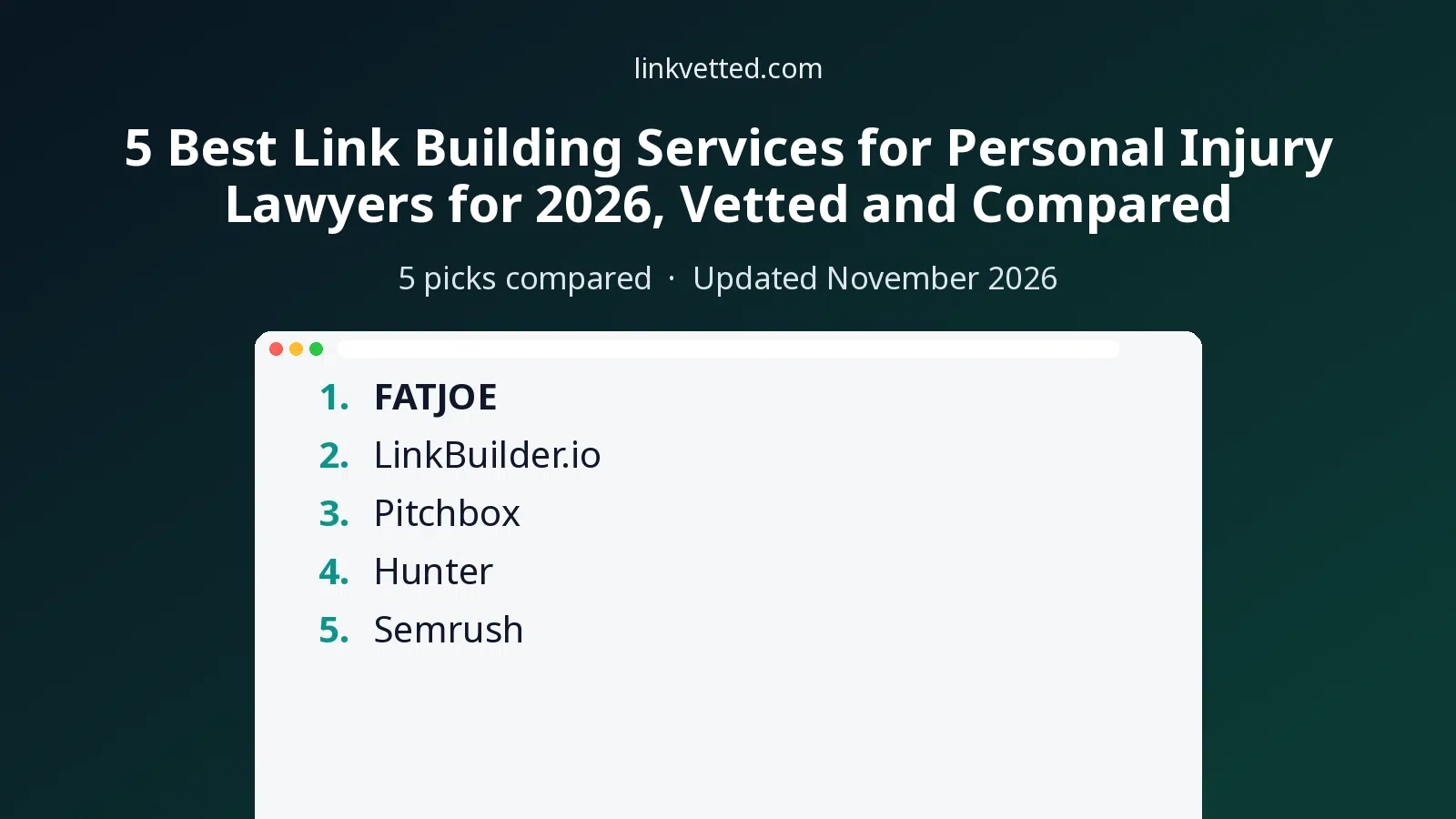
My top pick is FATJOE, because it is built around blogger outreach and link placements that suit legal niches and it publishes its own editorial standards. For teams that want a managed, done-for-you service, I suggest LinkBuilder.io. For agencies that prefer to run outreach themselves with a database and email tools, Pitchbox is the third name I would look at. Each fits a different way of working.
TL;DR:
- Personal injury keywords are competitive, so links from real legal, news and local publications matter more than volume.
- Managed services save time but give you less control over which sites you appear on.
- Outreach platforms cost less per link but require your own writer, prospecting and follow-up.
- Always ask for a sample of live placements and check whether the sites accept paid legal content openly.
- Local citations and bar association mentions should sit alongside any link building campaign.
Last checked November 2026. Plan prices are not quoted in this guide because they change often; see each vendor's own pricing page for current figures before you buy.
Quick comparison
| Tool | Best for | Starts at | Free plan? | |
|---|---|---|---|---|
| FATJOE | Legal-friendly blogger outreach | See website | Not stated | Visit |
| LinkBuilder.io | Managed link building for law firms | See website | Not stated | Visit |
| Pitchbox | Running your own outreach | See website | Not stated | Visit |
 Hunter | Finding legal editor emails | See website | Free plan | Visit |
 Semrush | SEO data with link tools | See website | Free plan | Visit |
The best link building services for personal injury lawyers compared
I put this list together from vendor documentation and public sources such as each company's own site and help pages. I did not run hands-on tests of these tools, and I am not quoting client results. The aim is to help you compare fit, workflow and limits before you talk to a sales team.
FATJOE is a link building service that arranges placements through blogger and publisher outreach. It is aimed at businesses and agencies that want editorial links rather than directory listings. For a personal injury firm, that matters because legal editors and niche publishers are more likely to link to a genuinely useful article than to a thin service page.
In practice, you would give the team topic ideas around injury claims, safety, or local legal questions, and they would approach publishers. This fits firms that can supply a writer or approve content briefs. The workflow is closer to digital PR than to buying a fixed list of links, which is usually a better fit for legal topics.
The limit is transparency. You may not see the full list of target sites before you commit, so ask for examples of live placements in legal or news categories. Skip it if you need a guaranteed fixed number of links on named domains.
- Outreach-based placements
- Publicly described editorial process
- Suits niche and legal topics
- Site list not fully public up front
- Placement timelines vary by niche
LinkBuilder.io
Best for: Managed link building for law firms
LinkBuilder.io is a managed link building agency. It handles prospecting, outreach and placement, and it is often used by SEO agencies and in-house teams that do not have the time to run campaigns themselves. For a personal injury firm with a busy case load, that removes most of the admin.
The service usually pairs content with outreach, so you are not just buying links to existing pages. That helps when you want links to practice-area pages or to a legal guide. You still need to approve topics and review the sites that are proposed, so build in time for that.
The main drawback is control. Because the agency runs the campaign, you see fewer of the day-to-day decisions. Ask how they screen sites for legal relevance and whether you can reject placements. Skip it if you want to manage every outreach email yourself.
- Done-for-you outreach
- Content and placement handled together
- Reports on live links
- Less control over individual sites
- Managed pricing can be higher than DIY
Pitchbox is an outreach platform rather than a link building service. It gives you a place to build prospect lists, send outreach emails and track replies. Agencies and larger marketing teams use it to run link campaigns in-house, including for legal clients.
For personal injury work, you would use it to contact legal bloggers, local news desks and industry publications with story ideas or expert commentary. The platform does not write the content or guarantee placements, so you need a writer and someone to manage replies. It suits teams that already have those people.
The limit is that it is a tool, not a service. If you want links without hiring staff, this is not the right fit. It also takes time to learn the interface and to build a clean prospect list.
- Prospect database and email tools
- Campaign tracking
- Works for agency teams
- Requires your own writers and lists
- Learning curve for new users
Hunter is an email finding tool. You enter a company domain and it suggests likely email addresses, which you can then verify. It is a small piece of the link building puzzle, but a useful one when you are trying to reach an editor at a legal publication or a local news site.
For a personal injury firm, Hunter fits a DIY approach where you build a short list of target publications, find the right contact and send a pitch yourself. It works best alongside a CRM or spreadsheet and a clear pitch template. It does not send emails or track campaigns.
The limit is scope. Hunter will not find placements or manage follow-ups, and some domains return few or no results. Skip it if you want a managed service or a full outreach platform.
- Email finding and verification
- Simple interface
- Useful for small outreach lists
- No outreach or placement management
- Data quality varies by domain
Semrush is a broad SEO platform with backlink analysis, keyword research and competitor tracking. It is not a link building service, but it is often where a legal firm starts when it wants to understand which sites link to competitors and where gaps exist.
For personal injury work, you can use it to see which local news sites and legal directories link to rival firms, then plan outreach around those targets. The data helps you prioritise rather than guess. It also gives you reporting material for partners who want to see progress.
The limit is that it does not do outreach for you. It is a data and research tool, and the link features sit inside a larger subscription. Skip it if you only want placements and have no interest in SEO data.
- Backlink and competitor data
- Keyword research in the same platform
- Useful for reporting
- Link building is one part of a larger tool
- Full feature set needs a paid plan
How I chose
I compared these services by reading vendor documentation, help pages and public descriptions of how each one works. I looked at whether the workflow fits a legal niche, how much control the buyer keeps, and what each service openly says about its process. I did not run hands-on tests, and I am not claiming client results or ranking outcomes. Where a vendor does not publish details, I say so rather than guess.
The second part of the method was fit. A solo practitioner with no marketing staff needs something different from a multi-office firm with an in-house team. I also weighed limits: tools that need your own writers, services that keep site lists private, and platforms that do one job well but not the whole campaign. That is why the list mixes managed services, outreach software and data tools rather than ranking them on a single scale.
What to check before you buy
- Ask for live examples of placements on legal, news or local sites, and check that the pages are indexed and the links are followed.
- Confirm whether the vendor writes the content or expects you to supply it, and who approves the final copy.
- Ask how sites are screened for spam, paid-link disclosure and relevance to personal injury topics.
- Check whether you can reject proposed sites and whether there is a replacement policy for links that are removed.
- Confirm reporting: which links went live, when, and on which pages, so you can review progress with partners.
- Make sure the campaign fits your state bar advertising rules and any disclaimers your firm uses.
FAQ
Are paid link building services safe for law firms?
Paid placements are common, but the risk depends on how they are done. Links that are clearly labelled as sponsored or that sit on low-quality sites can cause problems. Ask vendors how they disclose paid content and whether they follow search engine guidelines. Keep the focus on editorial relevance and real publications rather than volume.
How long does link building take for a personal injury firm?
Outreach campaigns usually run over months rather than weeks, because publishers take time to reply and publish. A managed service may give you a schedule, but no vendor can promise a specific timeline for individual placements. Plan for a steady programme rather than a one-off purchase, and review progress quarterly.
Should I use a managed service or run outreach myself?
A managed service suits firms with no marketing staff or limited time. Running outreach yourself costs less per link but needs a writer, a prospect list and someone to follow up. If you have an in-house marketer, a platform like Pitchbox plus an email tool may be enough. If not, a managed agency is usually the simpler route.
Do local citations count as link building?
Citations are mentions of your firm's name, address and phone number on directories and local sites. They help with local consistency and can support local search visibility, but they are not the same as editorial links from news or legal publications. Use them as a baseline and build outreach on top.
Can link building guarantee higher rankings for a personal injury firm?
No. Links are one factor among many, and search engines do not promise rankings for any tactic. Personal injury keywords are competitive, so links work best alongside useful content, a fast site and a clear local presence. Treat any guarantee of rankings as a warning sign.
Sources
- https://fatjoe.com
- https://linkbuilder.io
- https://pitchbox.com
- https://hunter.io
- https://semrush.com