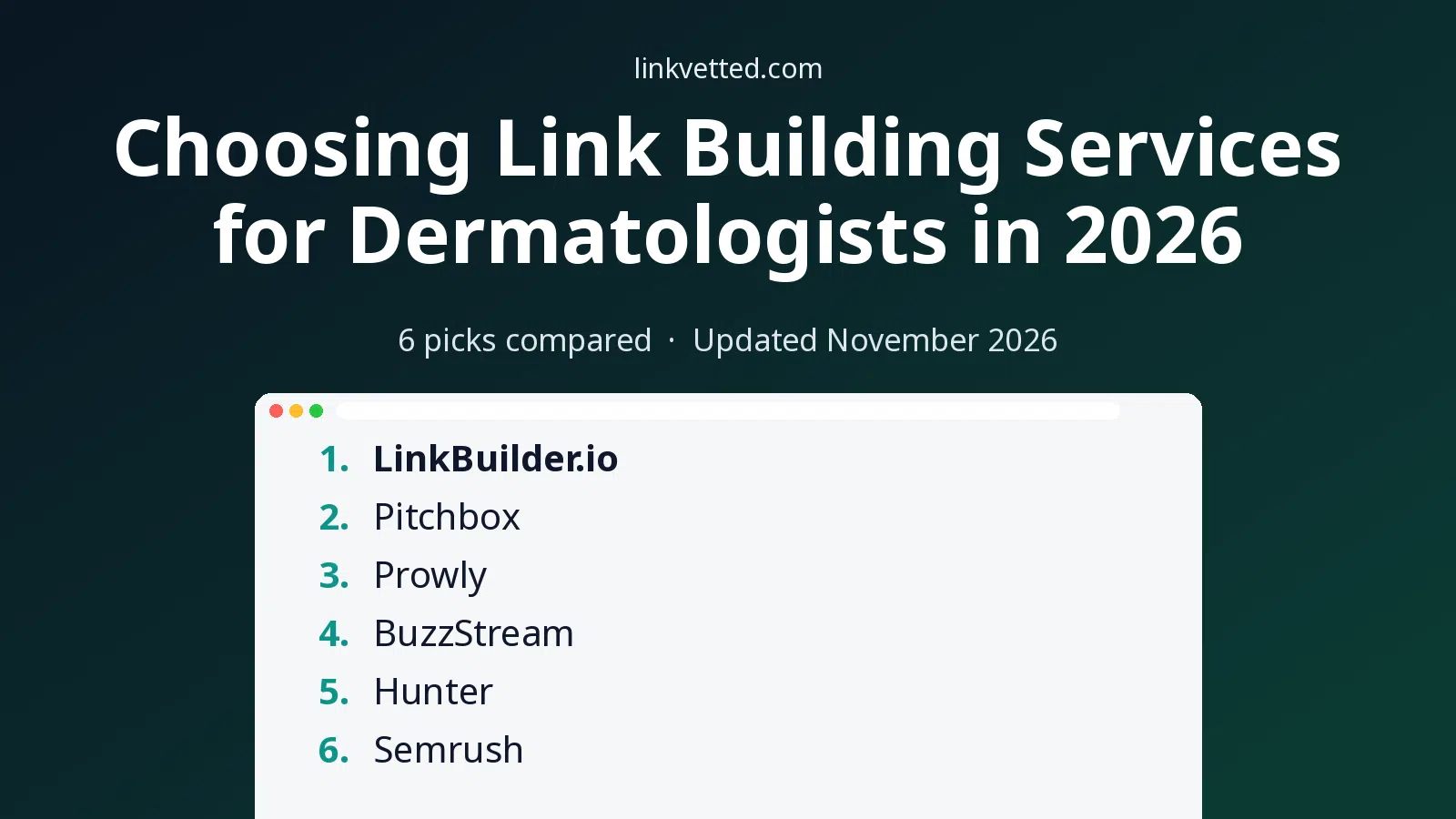
Choosing Link Building Services for Dermatologists in 2026: 6 Options Compared
A practical comparison of link building services for dermatology practices, based on vendor documentation and public sources, with fit, limits and checks.
- Editor's choiceLinkBuilder.io
Done-for-you editorial link placements
Starts atSee websiteVisit linkbuilder.ioFull review - Great alternative
 Pitchbox
Managing outreach campaigns in-house
Starts atSee websiteVisit pitchbox.comFull review - Also consider
 Prowly
Digital PR for skin health stories
Starts atSee websiteVisit prowly.comFull review
Direct answer
My top pick is LinkBuilder.io for dermatology practices that want an agency-style outreach service with editorial placements. For teams that prefer to run outreach themselves with a database and email tools, Pitchbox is a strong alternative, and for digital PR built around newsworthy angles, Prowly fits better. Each one covers a different part of the link building workflow, so the right choice depends on whether you want done-for-you links, a tool to manage outreach, or PR support.
TL;DR:
- Dermatology practices need links from health, medical and local sources more than generic high-authority sites, because relevance matters to both readers and search engines.
- A managed service suits clinics without an in-house SEO person, while outreach software suits practices with a marketer who can run campaigns.
- Digital PR helps when you have a dermatologist willing to comment on skin health topics that journalists already cover.
- Local citations and directory listings are not the same as editorial links, and you should ask any vendor how they separate the two.
- Medical content review and accuracy are worth asking about, since health pages are held to a higher standard than general business pages.
Last checked November 2026. Plan prices are not quoted in this guide because they change often; see each vendor's own pricing page for current figures before you buy.
Quick comparison
| Tool | Best for | Starts at | Free plan? | |
|---|---|---|---|---|
| LinkBuilder.io | Done-for-you editorial link placements | See website | Not stated | Visit |
| Pitchbox | Managing outreach campaigns in-house | See website | Not stated | Visit |
| Prowly | Digital PR for skin health stories | See website | Free trial | Visit |
 BuzzStream | Small teams running blogger outreach | See website | Free trial | Visit |
 Hunter | Finding contact emails for outreach | See website | Free plan | Visit |
 Semrush | Link research and competitor analysis | See website | Not stated | Visit |
The best link building services for dermatologists compared
I put this comparison together from vendor documentation and public sources such as product pages and help centers. I did not run hands-on tests of these tools, and I am not reporting client results. The aim is to help a dermatology practice match a service to its workflow, budget style and appetite for managing outreach itself.
LinkBuilder.io
Best for: Done-for-you editorial link placements
LinkBuilder.io is a link building service that runs outreach and places editorial links on your behalf. It fits dermatology practices that do not have someone to manage prospecting and follow-up, or agencies that want to outsource the outreach layer. Because it is a managed service, you brief the team on the topics and site types you want, and they handle the rest.
For a dermatology site, the useful part is the briefing. You can ask for placements on health, wellness and local publications rather than generic business blogs. The workflow usually starts with a topic and target list, then moves to outreach and reporting. That structure helps a clinic keep links relevant to skin health and local patients instead of chasing any high-authority domain.
The limit is control. If you want to approve every site before outreach, a managed service can feel slow. Practices with a strict compliance process may prefer to run outreach in-house. Skip it if you need to vet each placement personally.
- Managed outreach and placement
- editorial link focus
- works with agencies and in-house teams
- Less control over individual placements
- medical relevance depends on the brief you give
Pitchbox is outreach software that combines prospecting, email sequences and campaign tracking. It suits dermatology practices with a marketer or agency partner who can run campaigns week to week. Instead of buying links, you use it to find writers and site owners, pitch them, and track replies.
For dermatologists, the value is in targeting. You can build lists of health writers, local journalists and skincare bloggers, then send pitches about topics your dermatologists can speak to. The tool keeps follow-ups organized, which matters because most outreach replies come after more than one message. It also gives you a record of who you contacted and what was placed.
The drawback is effort. Pitchbox does not write your pitches or guarantee placements. If nobody on your team can run outreach consistently, the subscription will sit unused. Skip it if you want a fully managed service.
- Prospect database and outreach workflow
- campaign tracking
- team collaboration features
- Needs an operator to run campaigns
- learning curve for new users
Prowly is a PR platform with a media database, press release distribution and campaign reporting. It fits dermatology practices that have a dermatologist willing to comment on skin health news, seasonal skin concerns or treatment trends. The links come as a byproduct of coverage rather than as a direct placement purchase.
For link building, Prowly helps you find journalists who cover health and lifestyle topics and pitch them a story. A dermatologist commenting on sunscreen habits or acne misinformation can earn coverage on news sites, and those articles often link back. The workflow is closer to traditional PR than to outreach software, so you need a story angle before you start.
The limit is that coverage is not guaranteed and link metrics are not the focus. If you want a predictable number of links each month, this is not the right tool. It suits practices that can produce expert commentary regularly.
- Media database and press release tools
- campaign reporting
- contact management
- Not built around link metrics
- needs newsworthy angles
BuzzStream is outreach and relationship management software for small teams. It fits a dermatology practice or solo marketer who wants to track contacts, pitches and follow-ups without a large platform. It is often used for blogger and local media outreach.
For dermatology link building, BuzzStream works well when you already know the sites you want. You can add health writers, local publications and skincare bloggers, then manage the conversation in one place. The pipeline view helps you see which pitches are waiting on a reply and which have turned into placements.
The trade-off is that you bring your own list. BuzzStream is not a large prospecting database, so research time is on you. Skip it if you want a vendor to find prospects and run the campaign for you.
- Contact and outreach management
- simple pipeline tracking
- good for small lists
- Smaller prospect database
- manual list building
Hunter is an email finding and verification tool. It fits dermatology practices that already have a list of target sites and need contact addresses for the editors or writers. It is a supporting tool rather than a full link building service.
In a dermatology campaign, Hunter helps you find the right contact at a health publication or local news site. You can search by domain, verify addresses before sending, and reduce bounce rates. It pairs well with outreach software such as Pitchbox or BuzzStream, where the actual pitching happens.
The limit is scope. Hunter does not find prospects, write pitches or place links. If you expect a link building service, look elsewhere. It is best treated as one step in a workflow you already run.
- Email finding and verification
- simple interface
- useful alongside outreach tools
- No outreach management
- not a link building service on its own
Semrush is an SEO platform with backlink analysis, competitor research and content tools. It fits dermatology practices that want to understand which sites link to competing clinics and plan outreach around that data. It is a research tool, not a placement service.
For link building, the backlink reports show you which health directories, local publications and medical sites link to other dermatology practices. You can use that list to plan outreach or brief a managed service. The competitor view is useful when you are deciding which site types are worth pursuing.
The limit is that Semrush does not run outreach for you. The data is only useful if someone acts on it. Skip it if you want a vendor to handle everything from prospecting to placement.
- Backlink data and competitor research
- broad SEO toolkit
- useful for planning
- Not a managed link building service
- data needs interpretation
How I chose
I selected these tools by reading vendor documentation, product pages and public help resources, then matching each one to the workflow a dermatology practice actually runs. I looked at whether the tool handles prospecting, outreach, placement or research, because those are different jobs and practices often need only one or two of them. I also checked whether each product is currently operating and has a clear official homepage.
I did not run hands-on tests, and I am not claiming client results or statistics. The comparison is based on what vendors publish and what is publicly visible about each product. Where a tool is a supporting utility rather than a full service, I say so. The goal is to help you shortlist options that fit your team, not to rank them by a score I cannot verify.
What to check before you buy
- Ask whether placements are editorial links on real publications or directory listings, and get examples of the site types they target.
- Confirm how the vendor handles medical and health content, including whether they avoid sites with misleading health claims.
- Check whether you can approve target sites before outreach, which matters for clinics with compliance review.
- Ask for reporting that shows the live URL, the page topic and the date of placement, not just a count.
- Confirm whether the service covers local publications and health directories relevant to your city or region.
- Read the contract for minimum terms and renewal rules, since managed services often run on monthly retainers.
FAQ
Are link building services worth it for a dermatology practice?
They can be, if the links come from relevant health and local sources and the service fits your workflow. A managed service saves time for clinics without an in-house marketer, while software suits practices that can run outreach themselves. The value depends on relevance and consistency more than on volume.
Can I build links myself instead of hiring a service?
Yes. Outreach software such as Pitchbox or BuzzStream, plus an email finder like Hunter, lets a small team run campaigns. It takes consistent effort and someone who can write pitches. Many practices start in-house and move to a managed service when time runs short.
How do I judge link relevance for a dermatology site?
Look at the site topic, the page the link sits on and the audience. Health publications, local news and skincare sites that cite dermatologists are more relevant than general business blogs. Ask the vendor for example placements and check whether the page topic relates to skin health.
Is digital PR better than paid link placements?
Neither is automatically better. Digital PR can earn coverage from news sites when you have a dermatologist who can comment, but results vary. Paid placements are more predictable but need relevance checks. Some practices use both, with PR for brand coverage and placements for steady links.
What should I avoid when buying link building for a clinic?
Avoid vendors who promise exact rankings, sell links by volume without showing sites, or place links on pages unrelated to health. Also avoid contracts that hide the target list. Ask for transparency on sites, reporting and renewal terms before you commit.
Sources
- https://linkbuilder.io
- https://pitchbox.com
- https://prowly.com
- https://www.buzzstream.com
- https://hunter.io
- https://www.semrush.com
Related guides
- Best EHR Software for Dermatologists (2026): 5 Picks Checked on Vendor Pages
- Choosing Live Chat Software for Healthcare Providers in 2026: 5 Options Compared
- Choosing Language Lab Software for University Programs in 2026: 6 Options Compared
- Choosing Management Software for Healthcare in 2026: 5 Options Compared