Choosing Link Building Services for Cybersecurity Companies in 2026: 6 Options Compared
A practical comparison of link building services for cybersecurity companies, based on vendor documentation and public sources, with fit and limits for each.
- Editor's choice
 Authority Builders
Hand-picked domains you approve
Starts atSee websiteVisit authority.buildersFull review - Great alternativePoint Visible
Editorial placements in tech media
Starts atSee websiteVisit pointvisible.comFull review - Also consider
 uSERP
Managed outreach on retainer
Starts atSee websiteVisit userp.ioFull review
Direct answer
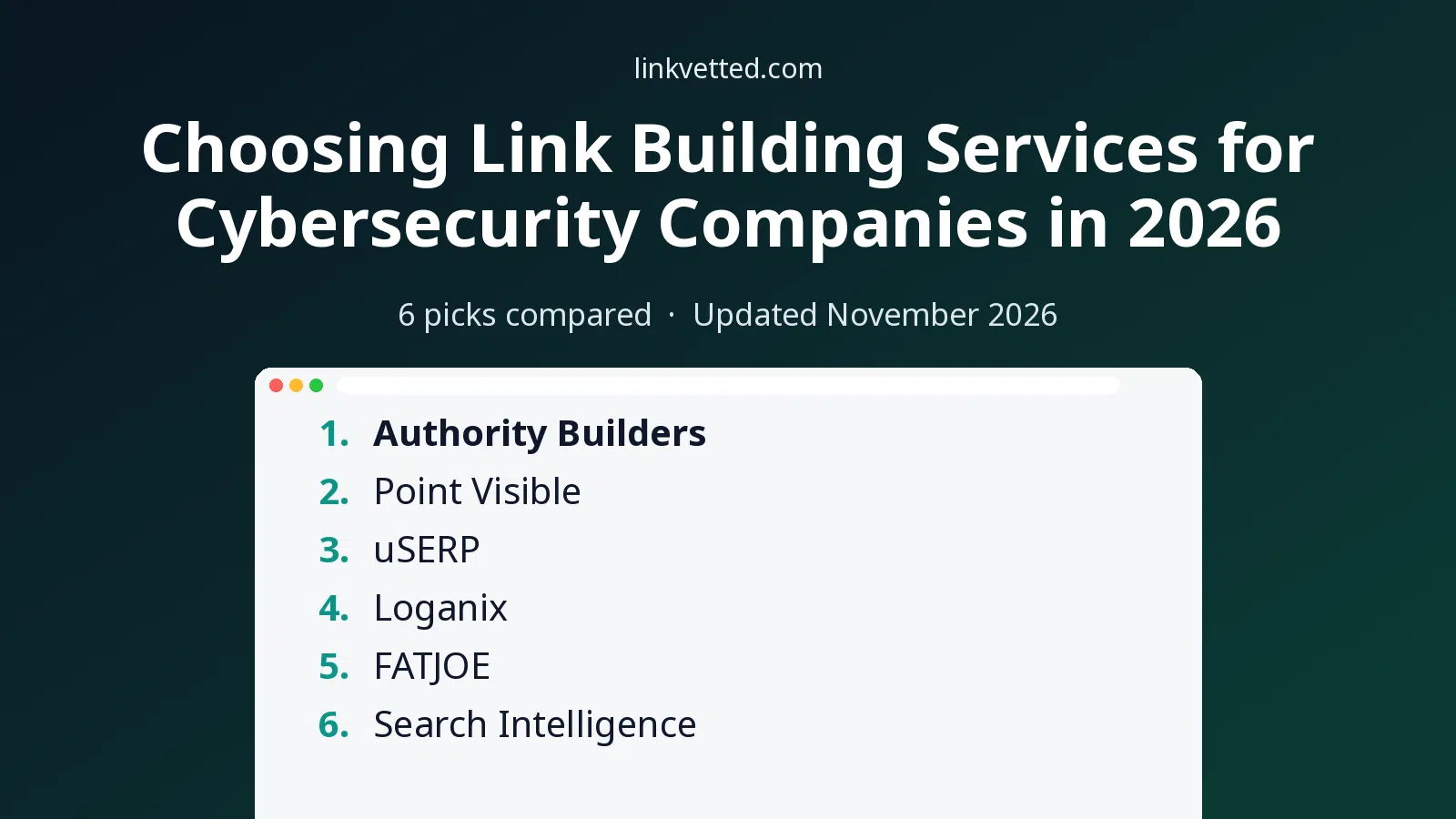
My first pick is Authority Builders, because it lets you pick specific sites and vet them yourself, which suits security vendors who cannot risk a bad neighborhood link. For editorial placements in tech and business media, Point Visible is the stronger fit. If you want a managed retainer with outreach handled for you, choose uSERP. Each one covers a different part of the job, so the right choice depends on how much control you want.
TL;DR:
- Security buyers check who links to you, so relevance matters more here than raw link volume.
- Placement-on-demand services give you the final say on every domain before you pay.
- Editorial outreach services fit companies that have no in-house link building capacity.
- Digital PR works well for research, reports and threat data that journalists can cite.
- Check every vendor for link sourcing policy, niche restrictions and reporting detail.
Last checked November 2026. Plan prices are not quoted in this guide because they change often; see each vendor's own pricing page for current figures before you buy.
Quick comparison
| Tool | Best for | Starts at | Free plan? | |
|---|---|---|---|---|
| Authority Builders | Hand-picked domains you approve | See website | Not stated | Visit |
| Point Visible | Editorial placements in tech media | See website | Not stated | Visit |
| uSERP | Managed outreach on retainer | See website | Not stated | Visit |
 Loganix | Productized link packages | See website | Not stated | Visit |
 FATJOE | Contextual links with manual review | See website | Not stated | Visit |
| Search Intelligence | Data-led digital PR campaigns | See website | Not stated | Visit |
The best link building services for cybersecurity companies compared
I compared these services from vendor documentation and public sources, not from hands-on tests. I looked at how each one sources links, what control the buyer gets, and where the fit breaks down for security vendors. The notes below reflect what each vendor publishes about its own process.
Authority Builders is a marketplace where you browse a catalog of sites and buy placements on the ones you select. For a cybersecurity company this is useful because you can reject any domain that looks off-topic or low quality before spending anything. It suits teams with someone who can read a site and judge whether it belongs next to your brand.
The workflow is straightforward. You filter the inventory, review each site, and place an order for the ones you want. Because you approve every domain, you can keep links inside technology, business and security-adjacent publications rather than accepting whatever a vendor sends. That control is the main reason I put it first for this niche.
The limit is that the judgment call is yours. If nobody on your team can assess a site's editorial quality, this model shifts risk onto you. Skip it if you want a fully managed service with no review step.
- You choose individual sites from a listed inventory
- domain metrics shown before purchase
- supports niche filtering
- Vetting responsibility sits with you
- inventory changes over time
Point Visible
Best for: Editorial placements in tech media
Point Visible is an agency that runs outreach campaigns and secures editorial placements on sites it pitches. For cybersecurity firms, the appeal is that links land inside articles written by publishers, which reads better to anyone auditing your backlink profile than a footer or sidebar link.
You brief the campaign, the team pitches publishers, and you get placements plus reporting. The vendor handles prospecting and negotiation, which saves time if your marketing team is small. The trade-off is that you see results as they land rather than choosing each domain up front.
This fits companies that want editorial links but lack the staff to run outreach. Skip it if you need to approve every single domain before publication, or if your budget only covers one-off purchases.
- Outreach handled by the vendor
- editorial placements rather than link networks
- campaign reporting included
- Placement timelines depend on publisher response
- less granular control than a marketplace
uSERP is a link building agency that works mainly with software and technology companies. Cybersecurity sits close to that world, so the vendor's existing publisher relationships often overlap with the publications your buyers read. You get a managed process rather than a self-serve catalog.
The team handles prospecting, outreach and placement, and reports back on what went live. That suits a security company with a content operation but no dedicated link building person. You set the brief and the niche boundaries, and the agency works inside them.
The main drawback is control. You are trusting the agency's judgment on which domains fit, and retainer pricing is higher than buying individual placements. Skip it if you want to hand-pick every site or if your budget is strictly per-link.
- Full-service outreach and placement
- works with SaaS and tech brands
- reporting on placements and links
- Retainer model costs more than one-off buys
- you delegate domain selection
Loganix sells link building as defined products, including editorial-style placements and other link types. For a cybersecurity company that knows what it wants and just needs it executed, the productized approach removes a lot of back-and-forth.
You pick a product, place an order, and the vendor delivers according to its published specification. That is efficient when your needs are simple. The documentation describes what each product includes, so you can compare it against your own standards before ordering.
The limitation is flexibility. Standardized packages do not adapt much to a niche brief, and you have less say over individual domains than with a marketplace. Skip it if you need a bespoke campaign built around original security research.
- Clearly defined link products
- multiple placement types
- ordering process is simple
- Packages are standardized
- less room for custom campaign design
FATJOE is a link marketplace that focuses on contextual placements and reviews sites before adding them. For security vendors, the review step matters because it filters out the obvious junk that plagues open marketplaces.
You order placements through the platform and the team handles publishing. The catalog is smaller than some competitors, which cuts both ways: less choice, but also less noise to sift through. The vendor publishes its review criteria, so you can check whether its standard matches yours.
The limit is inventory depth. If you need many links in a narrow security niche, availability may constrain you. Skip it if you want a large self-serve catalog or a fully managed retainer.
- Placements reviewed before publishing
- contextual link options
- simple ordering
- Inventory is smaller than large marketplaces
- availability varies by niche
Search Intelligence
Best for: Data-led digital PR campaigns
Search Intelligence is a digital PR agency that builds campaigns around data, surveys and stories, then pitches them to journalists. Cybersecurity companies sit on interesting data, from threat trends to breach statistics, which gives this approach real material to work with.
The team helps shape an angle, produces the assets and runs press outreach. Links come as a byproduct of coverage rather than from direct placement buying, which tends to produce links that look natural in an audit. That is a meaningful advantage in a sector where buyers scrutinize sources.
One limit: digital PR depends on having something worth pitching. Without original data or a strong story, results are harder to predict. Skip it if you cannot commit to producing research or if you need links on a fixed schedule.
- Campaigns built around data and stories
- press-focused outreach
- fits research-heavy brands
- Needs a newsworthy angle to work
- results depend on journalist interest
How I chose
I built this list from vendor documentation, published service descriptions and public sources, and I did not run hands-on tests of any service. My starting filter was simple: the vendor had to be a real, operating company with a clear description of how it sources and places links. I then compared how much control the buyer gets, whether placements are editorial or productized, and how well each model fits a security vendor's need for relevant, defensible links.
The second pass looked at limits. Every service here has a trade-off, whether that is inventory size, retainer cost or the need for a newsworthy angle. I noted those honestly rather than presenting any vendor as a universal answer. Because pricing changes and I do not publish figures, I point you to each vendor's site for current details. Treat this as a shortlist to research, not a ranking.
What to check before you buy
- Ask how the vendor sources domains and whether it publishes a review standard you can read.
- Confirm you can reject individual domains before payment, or at least before publication.
- Check whether placements are editorial articles or sitewide and footer links, and decide which you accept.
- Ask for sample placements in technology or security-adjacent publications, not just general niches.
- Confirm what reporting you receive, including live URLs and placement dates.
- Read the vendor's policy on link removal and replacements if a placement disappears.
FAQ
Are link building services worth it for cybersecurity companies?
They can be, if the links are relevant and the vendor is transparent about sourcing. Security buyers and procurement teams often look at who cites a vendor, so a small number of placements in respected technology and business publications can do more than a large volume of weak links. The value depends on the vendor's standards matching yours.
Can I buy links safely in a regulated sector like cybersecurity?
Buying placements is common, but the risk is in the sourcing. Editorial placements in publications that review their contributors are lower risk than links from open networks. Check each vendor's review process and keep your own approval step where possible. Avoid anything that promises fixed volumes of links from unnamed sites.
How many links should a security company build per month?
There is no universal number, and I would not trust a vendor that quotes one without looking at your site. A modest, steady pace of relevant placements usually reads more naturally than a burst. Decide based on your content output and your ability to review each domain, then set the vendor's scope around that.
Do digital PR campaigns work for cybersecurity brands?
They often do, because security companies hold data that journalists want, such as threat reports and breach trends. The work is in turning that data into a clear story. Campaigns take longer than direct placements and results vary, so treat digital PR as a complement to, not a replacement for, a steady link building process.
What should I avoid when hiring a link building vendor?
Avoid vendors that will not name the sites, promise exact link counts from undisclosed domains, or push sitewide and footer links as a package. Also avoid anyone who cannot explain how they review a domain. If a vendor's documentation is vague about sourcing, that is a reason to keep looking.
Sources
- https://authority.builders
- https://pointvisible.com
- https://userp.io
- https://loganix.com
- https://fatjoe.com
- https://search-intelligence.co.uk
Related guides
- Choosing Cybersecurity Automation Tools in 2026: 6 Options Compared
- Best Cybersecurity Awareness Training for Banks (2026): 5 Picks Checked on Vendor Pages
- 5 Best Cybersecurity Awareness Training Platforms for 2026, Vetted and Compared
- Top 5 Cybersecurity Behavior Change Platforms for 2026 (Prices and Free Plans)