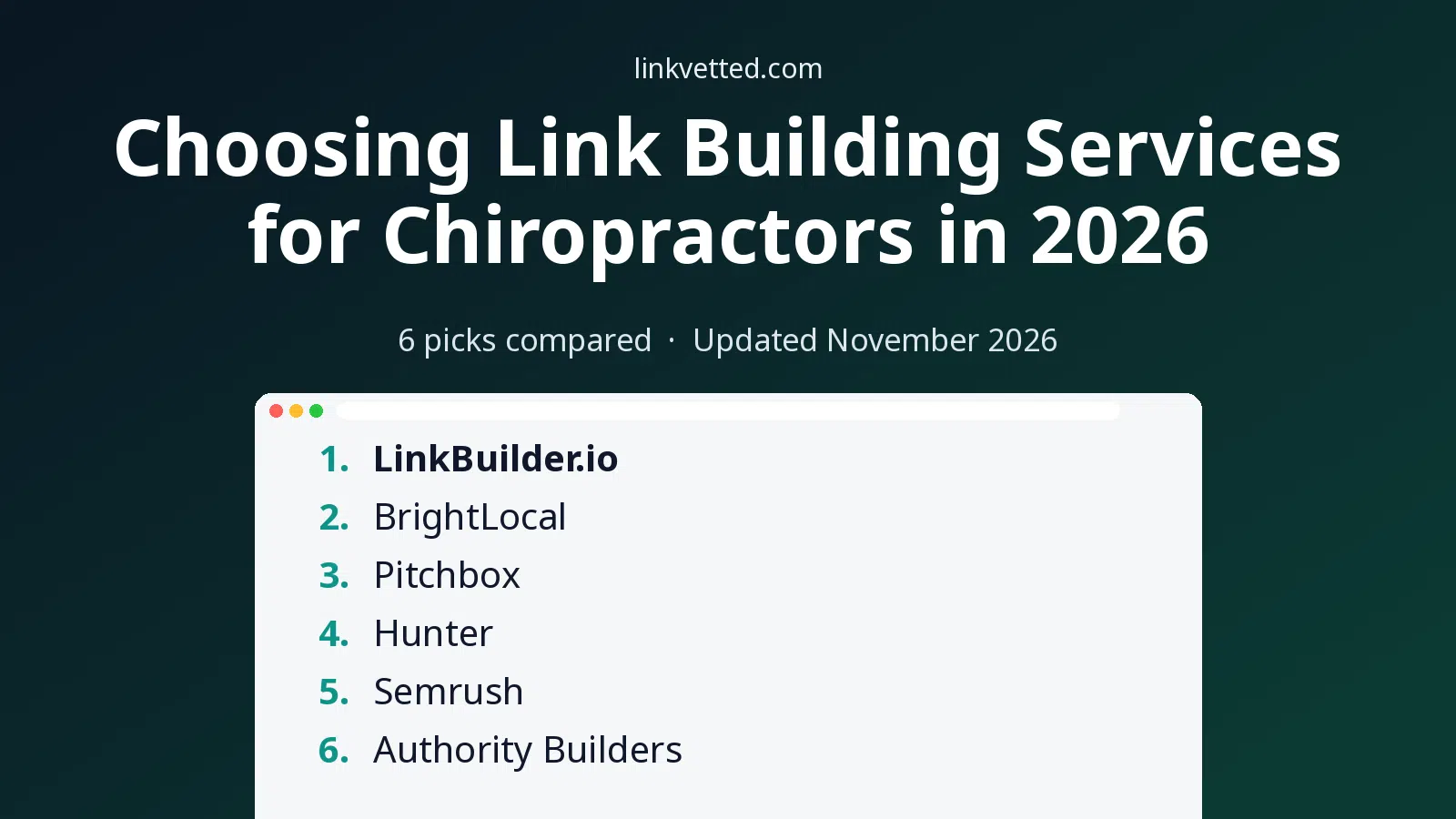
Choosing Link Building Services for Chiropractors in 2026: 6 Options Compared
A practical guide to the best link building services for chiropractors in 2026, compared from vendor documentation and public sources.
- Editor's choiceLinkBuilder.io
Managed outreach with relevant placements
Starts atSee websiteVisit linkbuilder.ioFull review - Great alternative
 BrightLocal
Local citations and listing consistency
Starts atSee websiteVisit brightlocal.comFull review - Also consider
 Pitchbox
Running your own outreach campaigns
Starts atSee websiteVisit pitchbox.comFull review
Direct answer
My top pick is LinkBuilder.io for chiropractors who want outreach handled by a specialist team, because its documented process focuses on relevant, editorially placed links. For local citations and directory-style links, BrightLocal is the practical second choice, and for running your own outreach, Pitchbox gives you the control. Each fits a different budget and level of involvement.
TL;DR:
- Chiropractic practices usually need local relevance more than raw link volume, so niche and geographic fit matter most.
- Done-for-you outreach services save time but give you less control over which sites link to you.
- Local citation and directory tools help with consistent business listings, which support local search visibility.
- Outreach software is only worth it if you or someone on your team can run campaigns consistently.
- Ask every vendor how they source prospects and whether they disclose the sites they place links on.
Last checked November 2026. Plan prices are not quoted in this guide because they change often; see each vendor's own pricing page for current figures before you buy.
Quick comparison
| Tool | Best for | Starts at | Free plan? | |
|---|---|---|---|---|
| LinkBuilder.io | Managed outreach with relevant placements | See website | Not stated | Visit |
| BrightLocal | Local citations and listing consistency | See website | Free trial | Visit |
| Pitchbox | Running your own outreach campaigns | See website | Not stated | Visit |
 Hunter | Finding contact emails for outreach | See website | Free plan | Visit |
 Semrush | Link research and competitor analysis | See website | Not stated | Visit |
 Authority Builders | Buying vetted guest post placements | See website | Not stated | Visit |
The best link building services for chiropractors compared
I put this list together from vendor documentation and public sources, not from hands-on testing. I looked at what each service says it does, how it fits a small healthcare practice, and where the limits are. Treat it as a starting point for your own checks before you commit.
LinkBuilder.io
Best for: Managed outreach with relevant placements
LinkBuilder.io is a link building agency that runs outreach campaigns for clients. From what the company publishes, the work centers on finding relevant sites, pitching editors, and securing placements rather than selling links from a fixed inventory. That model suits a chiropractic practice that wants links but does not have someone on staff to run email outreach week after week.
For a clinic, the useful part is the relevance angle. A practice in a mid-size city benefits more from links on local health, wellness, and community sites than from generic directories. A managed service can take that targeting off your plate, but you should still ask which sites are in scope and how placements are disclosed.
The limit is control. If you want to approve every prospect before a pitch goes out, a managed agency may feel opaque. Skip it if you prefer to run outreach yourself or have a very tight budget.
- Outreach handled by a team
- focus on relevant, editorially placed links
- clear process described on the site
- Less control over individual placements
- managed service cost
BrightLocal is a local marketing platform known for citation building and listing management. For a chiropractor, the main value is making sure your name, address, and phone number match across directories and local sites. Those listings are not the same as editorial links, but consistency helps local search and gives people a reliable way to find you.
The platform also includes tools for auditing existing listings and tracking local visibility. If your practice has moved, changed phone numbers, or opened a second location, citation cleanup is often the first practical step before any outreach campaign.
Do not expect BrightLocal to earn you links on health blogs or news sites. It handles the directory layer. If you need editorial placements, pair it with an outreach service or run your own campaigns.
- Strong local citation tools
- listing audit features
- built for local businesses
- Not an editorial link building service
- citation links carry limited weight alone
Pitchbox is outreach software for finding prospects, managing contact lists, and sending personalized pitches. It is a tool, not a service, so the results depend on who runs it. A chiropractor with a marketing assistant or a small agency partner can use it to keep outreach organized instead of scattered across spreadsheets.
For link building, the workflow usually goes: build a list of relevant local and health sites, find contact emails, send a pitch, and track replies. Pitchbox supports that sequence. The relevance still comes from how you build the list, so a chiropractor should focus on local community sites, wellness publications, and professional associations.
The main drawback is that it requires consistent effort. If nobody on your team can send and follow up on pitches, the software will sit unused. Skip it if you want a done-for-you service.
- Prospect management and outreach workflow
- campaign tracking
- built for link building teams
- Needs a person to run it
- no guaranteed placements
Hunter is an email finding tool. You give it a domain, and it returns publicly available email addresses associated with that site, along with verification. For a chiropractor running outreach, it solves one narrow problem: getting a usable contact for an editor or site owner.
It fits into a link building workflow as a supporting tool, not a full service. You still need to choose prospects, write pitches, and follow up. Hunter does not place links and does not manage campaigns.
The limitation is coverage. Some sites do not expose contact emails, and results can be incomplete. Use it alongside a CRM or outreach tool, and always verify addresses before sending.
- Email finding and verification
- simple interface
- useful for building prospect lists
- No outreach or placement features
- results depend on public data
Semrush is an SEO platform with backlink analysis among its features. For a chiropractor, the useful part is seeing which sites link to competing practices and which local publications cover health topics. That research can inform your own outreach targets.
It is not a link building service. You still need to pitch sites or hire someone to do it. The platform helps you decide where to aim, which is often the hardest part for a small practice.
The drawback is scope. Semrush covers much more than links, and the link data still needs a human to interpret it. Skip it if you only want placements and have no interest in research.
- Backlink analysis tools
- competitor link research
- broad SEO feature set
- Link building is one part of a larger platform
- data needs interpretation
Authority Builders is a marketplace-style service for guest post placements. The company presents a curated list of sites and handles placement. For a chiropractor, that can mean links from health, wellness, and lifestyle publications without running outreach yourself.
The key check is relevance. A guest post on a general business blog may do little for a clinic. Ask for sites in health, local news, or professional association categories, and review each one before agreeing. Paid placements should be disclosed and should sit on sites with real audiences.
The limit is that you are buying placements, not earning editorial coverage through PR. If your goal is local press mentions, a PR approach may fit better. Skip it if you want only unpaid, editorially earned links.
- Curated site inventory
- guest post placement model
- transparent site details
- Paid placements only
- you must vet each site for relevance
How I chose
I compared these services using vendor documentation and public sources. I did not run hands-on tests, and I am not claiming client results or statistics. My focus was on fit for a chiropractic practice: whether the service handles local relevance, whether it requires your time, and what it openly says about its process. I also looked at the limits each vendor describes, because those often decide whether a tool is worth it for a small clinic.
The second factor was workflow. A practice with no marketing staff needs a managed service or a simple citation tool. A practice with an assistant who can send emails needs outreach software and an email finder. I grouped the picks by that reality rather than by feature count. Prices change, so I left entry pricing as "See website" and recommend you confirm current terms directly with each vendor.
What to check before you buy
- Ask whether the service targets local and health-relevant sites, not just any site with a link slot.
- Confirm how placements are disclosed and whether the vendor shares the full list of sites before publishing.
- Check whether the service handles outreach and follow-up, or whether you must run campaigns yourself.
- Ask how they handle healthcare content and whether they follow advertising and disclosure rules.
- Review the contract for minimum terms, cancellation, and what happens if a placement is removed.
- Request sample placements and check whether the sites have real audiences and recent activity.
FAQ
Are paid link building services safe for a chiropractic practice?
Paid services are common, but the risk depends on how links are obtained. Placements on relevant sites with real audiences and clear disclosure are lower risk than links from low-quality directories or networks. Ask vendors how they source sites, and avoid anyone selling links in bulk from a fixed inventory. Your own due diligence matters more than the vendor's marketing.
Do chiropractors need links from health sites specifically?
Health and wellness sites are useful because they are topically relevant, but local relevance matters too. A link from a local news site or community organization can help with local visibility. A mix of local and health-related links is usually more practical than chasing one category. Avoid generic directories that accept any business.
Can I build links myself instead of hiring a service?
Yes. You can run outreach with an email finder and a spreadsheet, or use outreach software. The trade-off is time. A solo practice often finds that consistent outreach is hard to sustain, which is why managed services exist. Start with citation cleanup and a few local pitches before paying for a full campaign.
How long before link building shows results?
Link building is a slow input. New links need time to be crawled and to have any effect, and results vary by competition and site quality. I cannot promise timelines, and you should be skeptical of anyone who does. Treat links as one part of a broader local SEO effort that includes your website, listings, and content.
What should a chiropractor avoid when buying links?
Avoid anyone selling links by volume, promising rankings, or hiding the sites they use. Avoid private blog networks and link schemes. Avoid vendors who will not explain their prospect sourcing. If a deal sounds too cheap for the work involved, the placements are likely low quality. Ask questions and walk away if the answers are vague.
Sources
- https://linkbuilder.io
- https://www.brightlocal.com
- https://www.pitchbox.com
- https://hunter.io
- https://www.semrush.com
- https://authority.builders
Related guides
- Best Clinic Management Software for Chiropractors (2026): 5 Picks Checked on Vendor Pages
- Top 6 Clinic Scheduling Software for Chiropractors for 2026 (Prices and Free Plans)
- Top 6 EMR Software for Chiropractors for 2026 (Prices and Free Plans)
- Best Medical Scheduling Software for Chiropractors for 2026: Our 5 Vetted Picks