6 Journalist Database for Tech PR Worth Shortlisting in 2026
A practical guide to the best journalist databases for tech PR in 2026, compared from vendor documentation and public sources, with limits and buying checks.
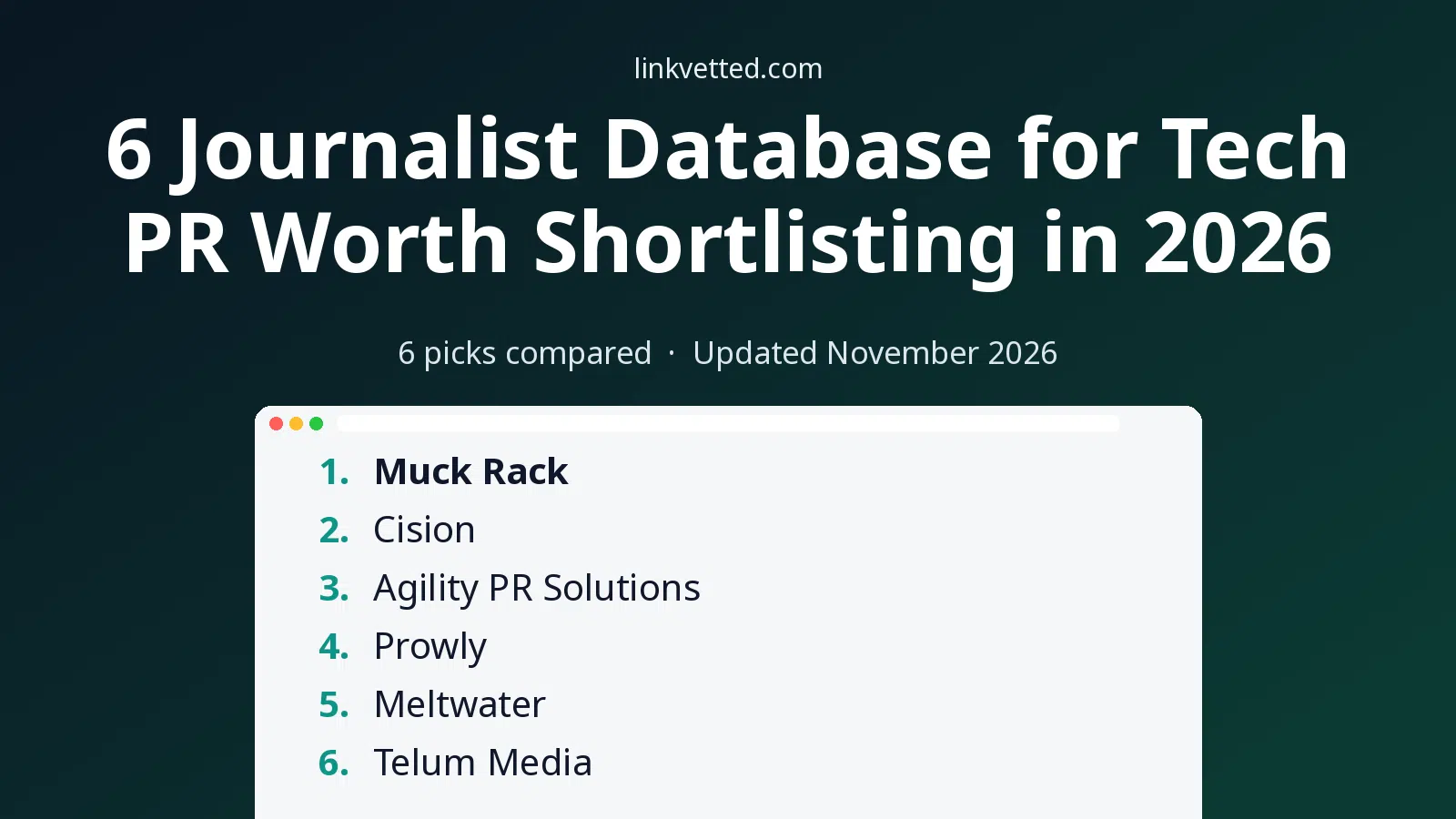
- Editor's choice
 Muck Rack
Database, monitoring and pitching in one tool
Starts atSee websiteVisit muckrack.comFull review - Great alternative
 Cision
Large-scale media databases and PR workflow
Starts atSee websiteVisit cision.comFull review - Also consider
 Agility PR Solutions
Media database with monitoring for mid-sized teams
Starts atSee websiteVisit agilitypr.comFull review
Direct answer
My first pick is Muck Rack, because it combines a large journalist and outlet database with monitoring and pitching tools that suit tech PR teams working across many beats. For teams that want a lower-cost media contact database, Cision's PR Newswire side and Agility PR Solutions are worth a look. If your priority is tracking tech coverage rather than building lists, Prowly and Meltwater cover that ground well.
TL;DR:
- A journalist database is only useful for tech PR if it lets you filter by beat, outlet type and recent coverage, not just by name.
- Muck Rack fits teams that want contact data, monitoring and pitching in one place, while Cision suits larger PR operations with wider media reach.
- Agility PR Solutions and Prowly are reasonable options for smaller tech PR teams that need media lists plus basic monitoring.
- Meltwater and Telum Media lean more toward media intelligence and relationship building than pure contact list building.
- Always confirm data coverage for your region and tech niches directly with the vendor before you commit.
Last checked November 2026. Plan prices are not quoted in this guide because they change often; see each vendor's own pricing page for current figures before you buy.
Quick comparison
| Tool | Best for | Starts at | Free plan? | |
|---|---|---|---|---|
| Muck Rack | Database, monitoring and pitching in one tool | See website | Not stated | Visit |
| Cision | Large-scale media databases and PR workflow | See website | Not stated | Visit |
| Agility PR Solutions | Media database with monitoring for mid-sized teams | See website | Not stated | Visit |
 Prowly | Small teams wanting lists plus a newsroom | See website | Free trial | Visit |
 Meltwater | Media monitoring with contact data attached | See website | Not stated | Visit |
| Telum Media | Journalist contacts with a strong Asia-Pacific focus | See website | Not stated | Visit |
The best journalist databases for tech PR compared
I put this comparison together from vendor documentation and public sources, including each vendor's own product pages and published descriptions of their coverage. I did not run hands-on tests of these platforms, so treat this as a starting point for your own evaluation rather than a lab result. The focus is on how each tool fits tech PR work specifically.
Muck Rack is a media database and PR platform built around journalist profiles, outlet data and coverage tracking. It is aimed at PR teams and agencies that want to find reporters, follow what they publish and manage outreach without stitching several tools together. For tech PR, that combination matters because reporters move between beats and outlets often.
In practice, you would search for journalists by beat, outlet and recent coverage, build a media list, and then track whether your pitch turned into coverage. The monitoring side helps you see which tech reporters are already writing about topics close to your client's space, which is useful when you are deciding who to approach first.
The main limit is cost and complexity. If you only need a simple contact list a few times a year, the full platform may be more than you need. Small teams should ask about lighter plans before committing.
- Large journalist and outlet database
- Media monitoring and alerts
- Pitching and coverage reporting tools
- Pricing is quote-based
- Full feature set may be more than small teams need
Cision is one of the long-established PR software companies, offering media databases, press release distribution and monitoring. It tends to suit larger PR departments and agencies that need wide media coverage and a formal workflow across teams. Tech PR teams at bigger companies often end up here because procurement and reporting requirements push them toward a full platform.
For tech PR specifically, the value is in filtering a large contact set down to the reporters and outlets that cover your sector, then tying outreach to coverage reports. The distribution side can also help when you are announcing product news and want a record of where it went.
The trade-off is that Cision is a big platform, and smaller teams may find the setup and cost hard to justify. If you mainly need a lean contact list, look at lighter options first.
- Broad media contact coverage
- Combines database with distribution and monitoring
- Established in large PR operations
- Can be complex to set up
- Pricing is quote-based
Agility PR Solutions
Best for: Media database with monitoring for mid-sized teams
Agility PR Solutions offers a media database alongside monitoring, measurement and reporting tools. It is positioned for PR agencies and in-house teams that want a middle ground between a bare contact list and a large enterprise platform. That makes it a reasonable candidate for tech PR teams that need lists plus proof of coverage.
The workflow is fairly standard: build a media list from the database, send pitches, then track mentions and report on results. For tech PR, the useful part is being able to narrow contacts by beat and outlet so you are not pitching general news desks about specialist product news.
Before you buy, ask specifically about coverage in your tech niches and regions, because database depth is not uniform across every market. Teams with very narrow beats should test the search results first.
- Media contact database with monitoring
- Coverage measurement and reporting
- Fits agencies and in-house teams
- Regional and niche coverage can vary
- Pricing is quote-based
Prowly combines a media database with a press release newsroom, contact management and pitching features. It is often chosen by smaller PR teams and agencies that want one place to keep contacts, publish news and send pitches without a large enterprise contract. A free trial makes it easier to check fit before committing.
For tech PR, the newsroom element can be handy when you are publishing product updates and want a link to send reporters. The contact side lets you group journalists by beat and keep notes on previous conversations, which helps when you are pitching the same tech reporters over time.
The limitation is scale. If you need very broad global coverage or deep regional data, Prowly may not match the largest databases. Check its coverage for your target markets before you rely on it.
- Media database combined with a press newsroom
- Contact management and pitching tools
- Easier starting point for small teams
- Database depth is narrower than the largest vendors
- Coverage varies by market
Meltwater is best known for media monitoring and social listening, with media contact data as part of a wider platform. It suits teams that want to know what is being said about their brand or market and then act on it. Tech PR teams often use it to track coverage of competitors and category topics.
For journalist research, the monitoring side can help you spot which reporters are covering your space right now, then use the contact data to reach out. That is a different starting point from a pure database, where you begin with filters and build a list.
If your main need is a clean, filterable contact database, Meltwater may feel like more platform than you need. It is a better fit when monitoring is a core requirement.
- Strong media monitoring and alerts
- Broad coverage across markets
- Reporting and analytics features
- List building is secondary to monitoring
- Pricing is quote-based
Telum Media
Best for: Journalist contacts with a strong Asia-Pacific focus
Telum Media is a media contacts and intelligence service with a strong presence in Asia-Pacific markets. It provides journalist contacts, media moves and industry updates, which helps PR teams keep lists current in fast-changing markets. Tech PR teams working across Asia often use it for that regional depth.
The practical value is in knowing who covers which beat and when reporters change roles, so your pitches reach the right person. For tech PR, that matters when you are working across several countries and need local contacts rather than a single global list.
The limit is geography. If most of your outreach is in North America or Europe, a vendor with deeper coverage there will likely serve you better. Confirm regional coverage before you buy.
- Journalist contact database with regional depth
- Media moves and industry updates
- Useful for Asia-Pacific outreach
- Thinner coverage outside its core regions
- Pricing is quote-based
How I chose
I selected these tools by reading vendor documentation and public sources, then judging how well each one fits tech PR work: finding reporters by beat, keeping contacts current, and tracking coverage. I did not run hands-on tests, so I have not scored ease of use or data accuracy from personal use. Where a vendor does not publish clear details, I have said so rather than guessing.
The second filter was fit and limits. A large enterprise platform is not automatically better for a small tech PR team, and a lean contact list is not enough if you also need monitoring and reporting. I weighed what each tool is clearly built for, and noted where coverage or pricing transparency is unclear. Your own shortlist should come from a trial or a vendor demo, not from this page alone.
What to check before you buy
- Ask for a live search demo using your own tech beats and target outlets, not a generic sample list.
- Confirm coverage for every region you pitch in, since database depth varies by country.
- Check how often contact records are updated and how media moves are handled.
- Ask whether monitoring and coverage reporting are included or sold separately.
- Confirm how many user seats you get and what happens when your team grows.
- Request the contract terms in writing, including cancellation and data export options.
FAQ
What is a journalist database?
A journalist database is a searchable directory of reporters, editors and outlets, usually with contact details, beat information and recent coverage. PR teams use it to build media lists and find the right person for a story. Some databases also include monitoring, pitching and reporting tools alongside the contact data.
Is a journalist database enough for tech PR?
No. A database gives you contacts, but tech PR also needs a clear story, relevant proof points and follow-up. You still have to research what each reporter covers and tailor your pitch. Many teams pair a database with monitoring so they can see which reporters are already writing about their category.
How do I check coverage for niche tech beats?
Ask the vendor for a demo search using terms from your niche, such as specific product categories or technologies. Look at how many relevant journalists and outlets come back, and whether the records look current. Do this for each region you pitch in, because coverage is rarely uniform.
Do these tools offer free plans?
Most of the platforms in this guide do not publish a free plan, and pricing is usually quote-based. Prowly lists a free trial, which lets you check fit before committing. For the others, ask the vendor directly about trials or demo access rather than assuming one exists.
Can I use a general database instead of a tech-focused one?
Yes, and many teams do. The key is whether the database lets you filter down to tech reporters and outlets with enough depth. A general database with strong beat filters can work well, while a smaller database with thin tech coverage will slow you down. Test the search results before you decide.
Sources
- https://muckrack.com
- https://www.cision.com
- https://www.agilitypr.com
- https://prowly.com
- https://www.meltwater.com
- https://www.telummedia.com
Related guides
- 5 Best Business Database Software for ERP for 2026, Vetted and Compared
- 6 Best Church Database Software for Volunteer Coordination for 2026, Vetted and Compared
- Best Columnar Database Performance Software for 2026: Our 5 Vetted Picks
- Best Companies for Database Software Maintenance in 2026: 8 Firms Compared