Best Journalist Database for Healthcare PR for 2026: Our 6 Vetted Picks
A practical guide to the best journalist databases for healthcare PR in 2026, compared from vendor documentation and public sources, with limits and fit.
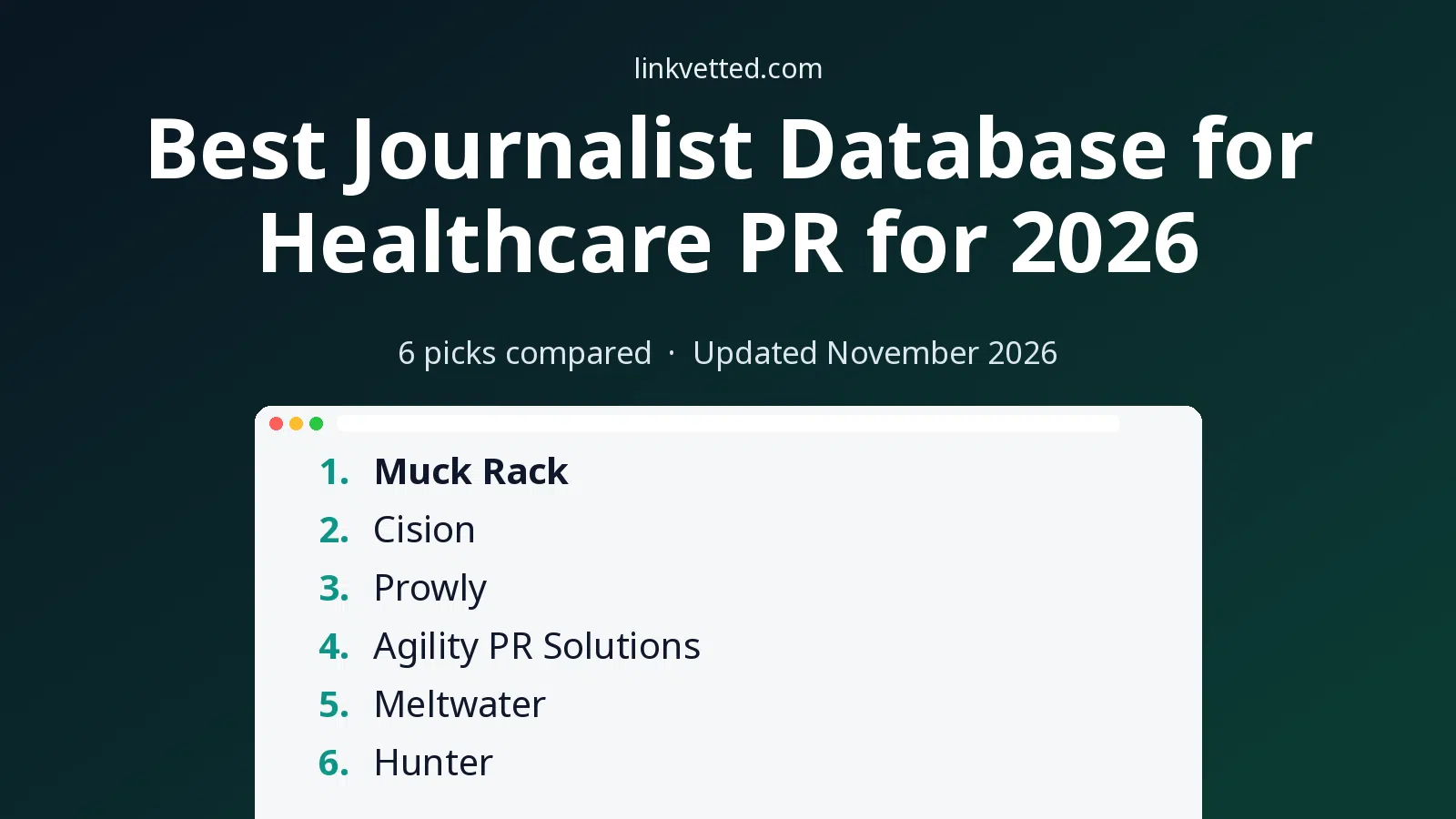
- Editor's choice
 Muck Rack
Verified journalist profiles with monitoring
Starts atSee websiteVisit muckrack.comFull review - Great alternative
 Cision
Broad media intelligence and distribution
Starts atSee websiteVisit cision.comFull review - Also consider
 Prowly
Small teams wanting database plus newsroom
Starts atSee websiteVisit prowly.comFull review
Direct answer
My first pick is Muck Rack, because its media database and monitoring are built around verified journalist profiles and it covers health and medical trade outlets as well as national press. For teams that want a broader all-in-one media intelligence suite, Cision is the other common choice, and for a lower-cost database with contact details, Prowly is worth a look. I compared them from vendor documentation and public sources, not hands-on tests.
TL;DR:
- Healthcare PR needs journalists who cover medicine, health policy, pharma and clinical topics, not just general news desks.
- A database is only useful if the contact records are current and you can filter by beat and outlet type.
- Verification and update practices matter more in health PR because beat reporters change jobs often.
- Monitoring and coverage reporting are separate jobs from contact discovery, so decide which you actually need.
- No database replaces reading the outlet and tailoring the pitch to the reporter's recent work.
Last checked November 2026. Plan prices are not quoted in this guide because they change often; see each vendor's own pricing page for current figures before you buy.
Quick comparison
| Tool | Best for | Starts at | Free plan? | |
|---|---|---|---|---|
| Muck Rack | Verified journalist profiles with monitoring | See website | Not stated | Visit |
| Cision | Broad media intelligence and distribution | See website | Not stated | Visit |
| Prowly | Small teams wanting database plus newsroom | See website | Free trial | Visit |
 Agility PR Solutions | Monitoring with contact research | See website | Not stated | Visit |
 Meltwater | Media and social monitoring at scale | See website | Not stated | Visit |
 Hunter | Finding and verifying email addresses | See website | Free plan | Visit |
The best journalist databases for healthcare PR compared
I put this comparison together from vendor documentation, public product pages and published help material. I did not run hands-on tests of each tool, and I have not measured response rates or coverage results. What follows is about fit: which tool suits which healthcare PR workflow, and where each one stops being useful.
Muck Rack is a media database and monitoring platform built around individual journalist profiles. Each profile links to recent work, which helps you check whether a reporter actually covers health, pharma or clinical topics before you pitch. It fits healthcare PR teams that want to research reporters and track coverage in the same place.
For healthcare pitches, the useful part is filtering by beat and outlet. You can build lists around medical trade press, health policy reporters or science desks, then review recent articles to see what angle each person takes. Monitoring alerts let you follow coverage of a condition, a drug category or a client name after a launch.
The limit is cost and commitment. Pricing is quoted, so you need a sales conversation before you know if it fits your budget. Small agencies that only need a few hundred contacts may find a lighter tool enough, and solo consultants should check whether a monthly subscription makes sense.
- Journalist profiles with recent articles
- beat and outlet filters
- media monitoring and alerts
- Quote-based pricing
- full suite may be more than a small team needs
Cision is one of the longest-running media intelligence providers, combining a contact database with distribution, monitoring and reporting. It suits healthcare PR teams that send releases regularly and want contacts, distribution and coverage measurement from one vendor rather than stitching tools together.
In a health context, the database covers national outlets, trade publications and regional press, which helps when a story has both a consumer and a professional audience. You can build lists by beat, then use distribution and monitoring to follow what gets picked up. That combined workflow is the main reason teams choose it.
The trade-off is complexity. The platform has many modules, and smaller teams may end up paying for features they do not use. Setup and training take time, so it fits organisations with a dedicated PR function more than a one-person operation.
- Large contact database
- press release distribution
- monitoring and analytics
- Suite can be complex
- pricing requires a quote
Prowly combines a media database with pitching tools, a hosted newsroom and monitoring. It is aimed at PR teams that want a single workspace without the scale of an enterprise suite. For healthcare PR, it works well when you have a defined list of medical and health reporters and want to manage outreach and coverage in one place.
The newsroom feature is useful for clinics, health tech companies and pharma-adjacent firms that publish updates and want a stable page for journalists. You can group contacts by beat, send pitches and track opens, then check monitoring for mentions. That covers the basics of a healthcare PR workflow without extra tools.
The database is smaller than the biggest providers, so niche medical trade press in some markets may be thin. Teams that need very broad coverage or deep regional lists should check coverage for their target outlets during a trial before committing.
- Contact database with pitch tools
- brand newsroom feature
- media monitoring
- Smaller database than the largest suites
- less depth in some regions
Agility PR Solutions offers a media database, monitoring and analytics, with a focus on helping teams find contacts and measure coverage. It suits healthcare PR teams that need to report on coverage volume and sentiment to stakeholders alongside their outreach work.
For health campaigns, the monitoring side is useful when you need to track a condition, treatment or policy topic across outlets. Contact records let you build lists for outreach, and coverage analysis helps show what was published. That combination fits teams that answer to communications leads or clients who want regular reporting.
The main drawback is that setup takes effort, and pricing is quoted rather than published. Smaller teams may find the platform more than they need if they only want contact lists, so it is worth being clear about requirements before a demo.
- Media database and monitoring combined
- coverage analysis
- journalist contact records
- Learning curve on setup
- pricing by quote
Meltwater is a media intelligence platform known for monitoring across news, social and broadcast. It includes a media contact database, but its centre of gravity is listening and reporting. That makes it a fit for healthcare organisations that need to track conversation around a condition, brand or policy issue as much as they need to pitch.
In practice, a healthcare PR team might use it to follow coverage and social discussion after an announcement, then use the contact database to find reporters for follow-up. Dashboards help when you report to a communications director or a client who wants a regular view of coverage.
The limitation is that contact research is not the main design goal, so the database experience may feel secondary to monitoring. Teams whose priority is building precise journalist lists should compare it against database-first tools before deciding.
- Broad monitoring across media and social
- media contact database
- reporting dashboards
- Monitoring-first design
- quote-based pricing
Hunter is an email finding and verification tool, not a journalist database. I include it because many healthcare PR teams already have reporter names from reading outlets and need a reliable way to find and check email addresses. It searches by domain and returns likely addresses with verification.
The workflow is simple: you identify a health reporter at an outlet, look up the outlet's domain, and check which addresses are valid before adding them to your list. Verification reduces bounces, which matters when you send a small number of carefully targeted pitches rather than bulk mail.
The clear limit is that Hunter gives you no beat information, no outlet filters and no journalist profiles. It only makes sense alongside a real database or a manually built list. Anyone expecting it to replace a media database will be disappointed.
- Email finding by domain
- verification to reduce bounces
- simple workflow
- Not a journalist database
- no beat or outlet filters
How I chose
I started from vendor documentation and public product pages, then checked what each tool actually does rather than what its marketing claims. For healthcare PR, the questions I cared about were whether a tool has journalist profiles with recent work, whether you can filter by beat and outlet type, and whether contact records are verified or updated. I also looked at monitoring, because health campaigns often need coverage reporting after launch.
I did not run hands-on tests, did not measure response rates and did not compare prices beyond noting that most of these vendors quote rather than publish them. Where a tool is not a journalist database, such as Hunter, I say so plainly. The aim is to help you shortlist two or three tools to demo, not to declare an overall winner for every team. Your own outlet coverage check during a trial matters more than any comparison table.
What to check before you buy
- Search the database for the specific medical and health trade outlets you pitch, not just national newspapers.
- Confirm how often journalist records are updated and whether the vendor shows recent articles on each profile.
- Check whether you can filter by beat terms such as health, medicine, pharma, clinical and policy.
- Ask whether email addresses are verified and what the vendor does about bounces and outdated contacts.
- Decide whether you need monitoring and coverage reporting, or only contact research, before you sit through a demo.
- Ask about contract length, seat limits and what happens to your lists if you leave.
FAQ
What is the best journalist database for healthcare PR?
There is no single best for every team. Muck Rack is a strong first pick for verified profiles and monitoring, Cision suits teams that also want distribution, and Prowly fits smaller teams that want a database with a newsroom. Check coverage of your target health outlets during a trial before deciding.
Can I use a general journalist database for health and medical stories?
Yes, but check the trade press. Healthcare stories often run in medical, pharma and health policy publications that general databases may cover thinly in some markets. Search for your specific target outlets during a demo, and keep a manual list of specialist reporters you find by reading.
Is Hunter a replacement for a journalist database?
No. Hunter finds and verifies email addresses by domain, but it has no journalist profiles, beat filters or outlet information. It works as a supplement when you already know which reporters you want to contact. You still need a database or a manually built list to identify them.
How do I keep healthcare media lists accurate?
Review lists before each campaign, check that reporters still cover the beat, and remove anyone who has moved. Use verification tools to catch bad addresses, and note in your list when each contact was last checked. Beat reporters move often, so a list built a year ago will have gaps.
Do I need monitoring as well as a database?
Only if you report on coverage. Monitoring helps you show what was published after a launch or announcement, and it can surface reporters covering your topic. If your work is purely outreach, a database with good contact records may be enough, and you can add monitoring later.
Sources
- https://muckrack.com
- https://www.cision.com
- https://prowly.com
- https://www.agilitypr.com
- https://www.meltwater.com
- https://hunter.io