Best AI Healthcare Companies in 2026: 9 Companies Compared
Looking for the best ai healthcare companies? We compare 9 healthcare AI companies on imaging, documentation, pathology, and patient care tools today.
- Editor's choice
 Tempus
Precision medicine and oncology
Starts atSee websiteVisit tempus.comFull review - Great alternative
 Aidoc
Radiology imaging triage
Starts atSee websiteVisit aidoc.comFull review - Also consider
 Viz.ai
Stroke and time-critical care
Starts atSee websiteVisit viz.aiFull review
TL;DR:
- Aidoc and Viz.ai lead on imaging triage and time-critical care coordination for hospitals and radiology teams.
- Abridge, Ambience Healthcare, and Suki lead on ambient documentation that turns visit conversations into clinical notes.
- Tempus and PathAI lead on precision medicine and pathology, where genomic and image data guide treatment decisions.
- Hippocratic AI and Nabla lead on patient-facing agents and documentation support for outreach and follow-up.
- Most healthcare AI is sold to health systems and providers, not directly to patients, so pricing and deployment are enterprise decisions.
Quick comparison
| Tool | Best for | Starts at | Free plan? | |
|---|---|---|---|---|
| Tempus | Precision medicine and oncology | See website | No | Visit |
| Aidoc | Radiology imaging triage | See website | No | Visit |
| Viz.ai | Stroke and time-critical care | See website | No | Visit |
 PathAI | Digital pathology | See website | No | Visit |
 Abridge | Ambient clinical documentation | See website | No | Visit |
 Ambience Healthcare | Comprehensive clinical AI platform | See website | No | Visit |
 Suki | Voice-driven clinical workflow | See website | No | Visit |
 Hippocratic AI | Patient-facing AI agents | See website | No | Visit |
 Nabla | Ambient documentation and support | See website | No | Visit |
The best AI healthcare companies
AI in healthcare now touches imaging, documentation, pathology, drug discovery, and patient outreach, but no single company covers all of it well. The firms below are leaders in specific clinical or operational jobs, and they are mostly sold to hospitals, clinics, and health systems rather than to individual patients. Use this list to understand which problem each company solves, and judge it on clinical validation, integration with electronic health records, and safety controls, not on marketing claims alone. This article is general information, not medical advice.
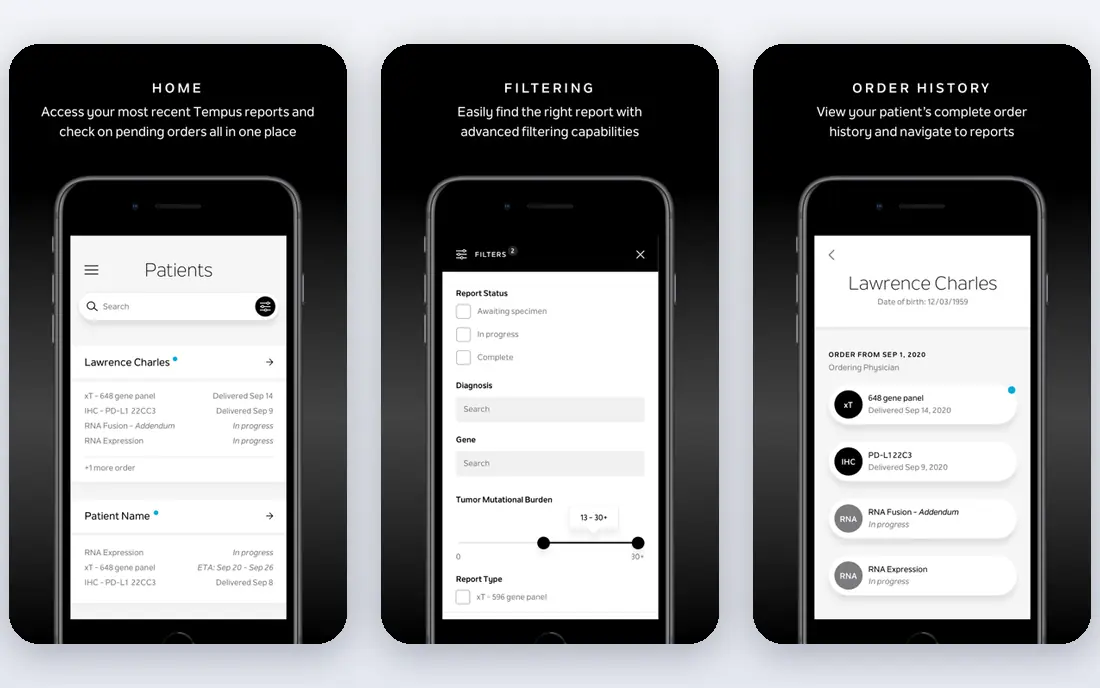
Tempus combines genomic sequencing, clinical data, and AI analysis to support precision medicine, especially in oncology. Its platform helps clinicians and researchers connect molecular findings with treatment options and clinical trials, using large datasets of patient records and test results. For cancer care teams, that combination of lab data and clinical context is more useful than a standalone AI tool, because treatment decisions depend on both.
The limits are access and scope. Tempus is primarily a provider and research platform, not a consumer app, and its pricing and deployment are enterprise decisions made by health systems and labs. Patients interact with Tempus mainly through their clinician or testing provider, so direct comparison with a patient-facing app does not apply. If precision oncology is the problem, Tempus is a leading name. If you want a personal health app, look at documentation or outreach tools instead, and talk to your clinician about testing options.
- Large genomic and clinical data platform
- Oncology focus
- Tools for treatment and trial matching
- Enterprise and provider-focused, not a patient app
- Data and privacy controls need careful review
- Pricing is custom
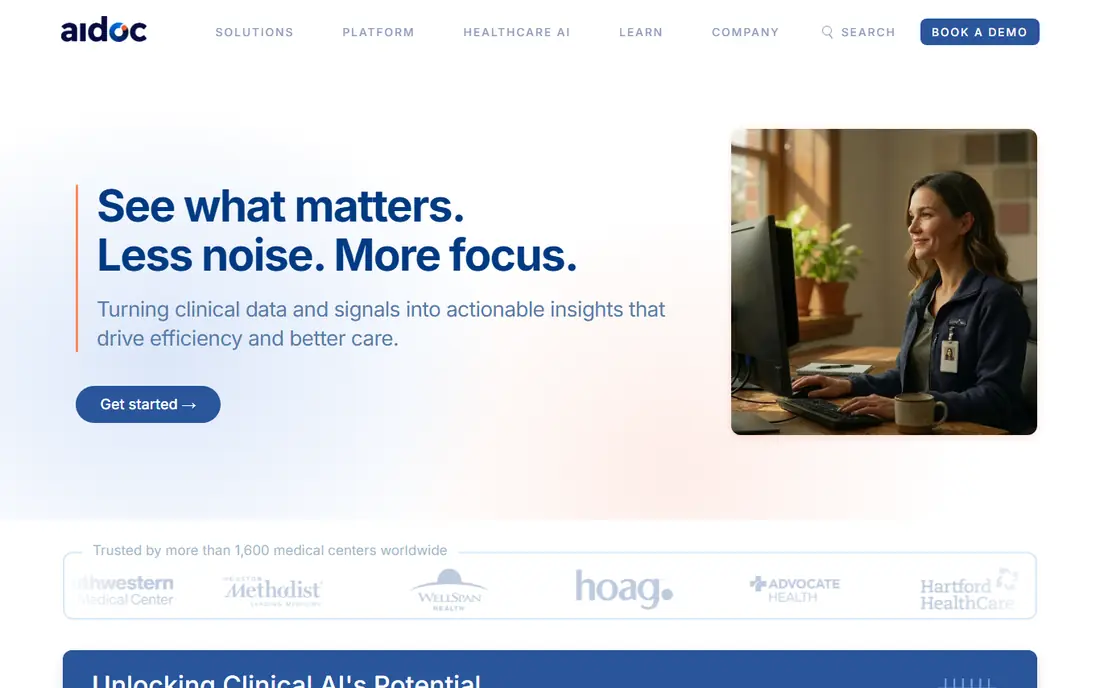
Aidoc provides AI tools that flag critical findings in medical imaging and help radiology teams prioritize urgent cases. Its platform covers a wide range of conditions across brain, chest, abdomen, and other areas, and it includes care coordination features that alert the right team when a finding needs fast action. For hospitals with high imaging volumes, that triage can shorten time to treatment for stroke, bleeding, and other urgent conditions.
The catch is deployment. Aidoc is an enterprise radiology platform, so it requires integration with imaging systems, workflow changes, and validation by clinical leaders. It does not replace a radiologist, and its value depends on how well a hospital acts on its alerts. Pricing is custom and deployment is health-system led. If imaging triage is your priority, Aidoc is a leading pick. If you want documentation help, Abridge or Ambience will be more relevant.
- Broad imaging triage coverage
- Many regulatory clearances
- Care coordination tools
- Hospital and radiology focused
- Implementation needs IT and workflow work
- Pricing is custom
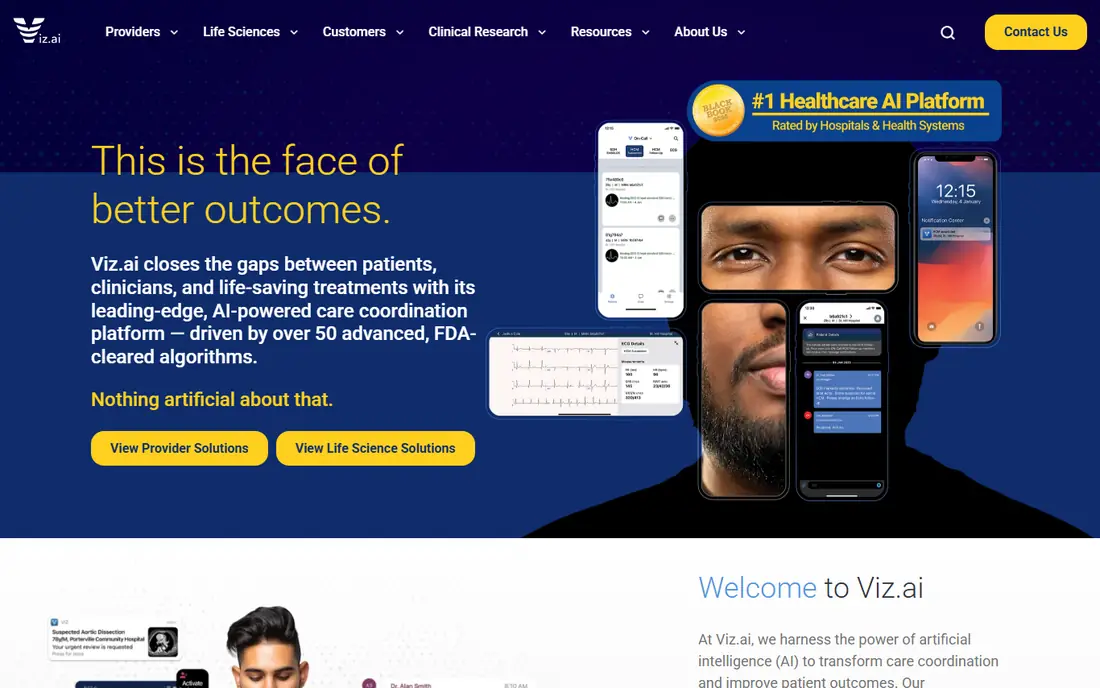
Viz.ai focuses on time-critical conditions, especially stroke, where minutes matter and care teams across hospitals need to coordinate quickly. Its platform analyzes imaging, alerts stroke teams, and shares case details across facilities, which helps smaller hospitals connect with larger stroke centers. That coordination focus sets Viz.ai apart from general imaging tools, because the bottleneck in stroke care is often communication, not just detection.
The trade-off is scope. Viz.ai is strongest in stroke, cardiology, and other time-critical pathways, rather than broad radiology triage across all conditions. It is also a hospital platform, not a patient tool, and deployment requires clinical and IT work. If stroke or time-critical care coordination is the goal, Viz.ai is a top pick. If you need broad imaging coverage, compare Aidoc alongside it.
- Strong stroke and time-critical focus
- Care team coordination
- Imaging and workflow integration
- Narrower specialty focus than Aidoc
- Hospital deployment required
- Pricing is custom
PathAI applies AI to digital pathology, helping pathologists analyze tissue slides, quantify biomarkers, and support diagnostic and research workflows. Its tools aim to improve consistency in tasks such as cancer grading and biomarker scoring, where human variation can affect results. For labs and biopharma teams, PathAI also supports clinical trial pathology and drug development work, which extends its value beyond routine diagnosis.
The limits are deployment and validation. Digital pathology requires slide scanners, data infrastructure, and regulatory clearance for specific uses, so adoption is a lab decision, not an individual purchase. PathAI tools support pathologists rather than replacing them, and clinical validation matters more than speed alone. If pathology is your focus, PathAI is a leading company. If you want a clinical documentation tool, look at Abridge, Ambience, or Suki.
- AI-assisted pathology image analysis
- Research and diagnostic support
- Large pathology datasets
- Lab and provider focused
- Regulatory and validation work is complex
- Pricing is custom
Abridge turns patient-clinician conversations into structured clinical notes, reducing the documentation burden that keeps many clinicians working after hours. Its platform listens during a visit, drafts a note, and links claims to evidence in the conversation, which helps clinicians review and edit rather than type from scratch. It supports multiple specialties and integrates with major electronic health record systems, which is why large health systems have adopted it.
The catch is that AI notes still need clinician review. Abridge is a drafting aid, not a substitute for clinical judgment, and accuracy depends on audio quality, specialty, and workflow. Deployment is enterprise-led, with pricing by health system, so individual clinicians usually access it through their employer. If documentation burden is your main problem, Abridge is our first pick in this category.
- Ambient note generation from visit conversations
- EHR integration
- Multi-specialty support
- Health-system deployment required
- Clinician review is still essential
- Pricing is custom
Ambience Healthcare offers a comprehensive clinical AI platform that covers ambient documentation plus coding support, referral letters, and other administrative work that follows a visit. That breadth appeals to health systems that want one platform for several documentation and workflow jobs, rather than separate tools for notes, coding, and paperwork. Its multi-specialty support helps large groups with varied clinics adopt a single system.
The trade-off is implementation scope. A broader platform can take longer to deploy and configure than a focused scribe tool, and value depends on which modules a health system actually uses. Pricing is custom and enterprise-led. If you want a single clinical AI platform for documentation and related workflows, Ambience is a strong pick. If you only need ambient notes, Abridge or Suki may be simpler to deploy.
- Broad platform covering documentation, coding, and referrals
- Multi-specialty support
- EHR integration
- Enterprise deployment required
- Breadth can mean longer implementation
- Pricing is custom
Suki provides a voice-driven AI assistant that helps clinicians document visits, complete tasks, and retrieve information without typing long notes. It is well suited to ambulatory and outpatient settings, where clinicians see many patients in a day and need fast, hands-free documentation. Per-provider deployment options make it more accessible to smaller practices than some enterprise-only platforms, though health-system deals remain common.
The limits are familiar for voice tools. Accuracy varies by specialty, accent, dictation style, and background noise, and clinicians must still review notes before signing them. EHR integration depth also varies by system. If voice documentation is your priority, especially in ambulatory care, Suki is a strong pick. If you want ambient listening without dictation, Abridge or Ambience may suit you better.
- Voice assistant for documentation and tasks
- Ambulatory focus
- Per-provider deployment options
- Accuracy depends on specialty and dictation style
- EHR integration varies
- Pricing is custom
Hippocratic AI builds patient-facing AI agents for tasks such as chronic care check-ins, post-discharge follow-up, appointment preparation, and benefits navigation. Its focus on non-diagnostic, high-volume outreach helps health systems stay in touch with patients between visits without adding the same load to nursing and call center teams. Safety controls, escalation to humans, and clinical oversight are central to its design, which matters for any patient-facing system.
The catch is scope and risk. Hippocratic AI agents are not diagnostic tools, and they must be deployed with clear escalation paths when a patient reports concerning symptoms. Pricing and deployment are enterprise-led, so patients encounter these agents through their health system rather than by downloading an app. If patient outreach and follow-up are your goals, Hippocratic AI is a leading pick. If you need diagnosis or treatment advice, talk to a clinician directly.
- Patient outreach and follow-up agents
- Focus on non-diagnostic tasks
- Health-system partnerships
- Patient-facing AI needs careful safety controls
- Not a diagnostic tool
- Enterprise deployment required
Nabla offers ambient AI documentation that drafts clinical notes from visit conversations, with support for multiple languages and a focus on clinician review and accuracy. It suits health systems and clinics that want documentation help with multilingual patients or international teams, and its design emphasizes that clinicians remain responsible for final notes. Nabla also works on related support tools that help clinicians prepare and follow up after visits.
The trade-off is scale in the US market. Nabla is a strong product, but its US health-system footprint is smaller than Abridge, so integration experience and references may be fewer in some regions. Pricing is custom and deployment is provider-led. If multilingual documentation or a focused ambient tool appeals to you, Nabla is worth comparing. If maximum US deployment experience matters most, Abridge is the safer first pick.
- Ambient documentation for clinicians
- Multilingual support
- Focus on accuracy and clinician review
- Smaller US footprint than Abridge
- Enterprise deployment required
- Pricing is custom
How we picked these
We compared company focus, clinical area, deployment model, EHR integration, and public validation signals for healthcare AI companies that are active in 2026. We favored firms with clear clinical or operational jobs, health-system deployments, and stated safety and oversight practices, and we covered imaging, pathology, documentation, and patient outreach rather than crowning one general winner. We did not claim hands-on testing, and we note that regulatory status varies by product and use case, so buyers should verify current clearances for their specific application.
How to choose a healthcare AI company
Start with the job, not the technology. Imaging teams should compare Aidoc and Viz.ai on triage coverage and workflow fit. Pathology labs should compare PathAI on validation and scanner integration. Documentation teams should compare Abridge, Ambience, Suki, and Nabla on note quality, specialty fit, and EHR integration. Patient outreach teams should compare Hippocratic AI on safety controls and escalation. In every case, run a pilot with real clinicians, measure time saved and note quality, and check data privacy, security, and bias controls before scaling.
Safety and oversight matter more than speed
Healthcare AI can make mistakes, and those mistakes can affect care, so human review, audit trails, and escalation paths are not optional extras. Ask vendors how models are validated, how errors are reported, whether data is used for training, and how the system handles edge cases and non-English speakers. Require a clinician-led evaluation, not just a vendor demo, and keep final clinical decisions with qualified humans. This article is general information, not medical advice, and patients should discuss care decisions with their own clinicians.
FAQ
What are the best AI healthcare companies?
Tempus leads on precision medicine, Aidoc and Viz.ai lead on imaging, PathAI leads on pathology, and Abridge, Ambience, Suki, and Nabla lead on documentation. Hippocratic AI leads on patient-facing outreach agents. The best company depends on whether your problem is imaging, documentation, pathology, or patient communication.
What are the best healthcare AI companies for hospitals?
Hospitals typically compare Aidoc and Viz.ai for imaging and time-critical care, Abridge and Ambience for documentation, and Tempus and PathAI for oncology and pathology. The right mix depends on specialty, EHR system, and workflow, so pilot with real clinical teams before a system-wide rollout.
Is AI in healthcare safe?
AI tools can help, but they require human oversight, validation, and clear escalation paths, especially for patient-facing or diagnostic uses. Safety depends on the specific product, its regulatory status, data controls, and how clinicians review its output. Patients should not rely on AI tools for diagnosis or treatment decisions without a clinician.
Can patients use these AI healthcare companies directly?
Most companies on this list sell to health systems, labs, and providers, not directly to patients. Patients usually encounter them through a hospital, clinic, or testing provider. If you want a personal health app, look for consumer tools with clear medical disclaimers, and discuss any health concerns with your clinician.
How much does healthcare AI cost?
Pricing is almost always custom and enterprise-based, depending on health-system size, specialty coverage, EHR integration, and support. Vendors rarely publish rates, so request a proposal based on your volume, sites, and modules. Factor in implementation, training, and ongoing validation, not just the software fee.
Which AI healthcare company is best for documentation?
Abridge is the strongest first pick for ambient documentation at scale, with Ambience offering a broader platform and Suki offering voice-driven workflows for ambulatory care. Nabla is a strong alternative, especially for multilingual teams. Pilot each finalist with your own clinicians and specialties before choosing.