Top 5 Healthcare Analytics Platforms for 2026 (Prices and Free Plans)
Best healthcare analytics platforms in 2026: 5 tools with starting prices, free plans and limits. Trade-offs are spelled out for each entry. Straight answers.
- Editor's choice
 Qlik Sense
Data integration plus associative analytics
Starts atSee websiteVisit qlik.comFull review - Great alternative
 Tableau
Self-service visual analysis of health data
Starts at$15 per user per monthVisit tableau.comFull review - Also consider
 Databricks
Large-scale data engineering and AI
Starts atSee websiteVisit databricks.comFull review
Direct answer
Qlik Sense is the first pick on this list for data integration plus associative analytics. Listed starting prices: Tableau from $15 per user per month. Tableau is better for self-service visual analysis of health data, and Databricks is better for large-scale data engineering and AI. The other 2 tools in the list cover narrower or pricier cases.
TL;DR:
- This list starts with Qlik Sense, which is built for data integration plus associative analytics.
- Epic Systems is the one to check for organizations already on Epic clinical software.
- Check the limits for Google Cloud Healthcare API before you commit: developer-oriented, not end-user BI.
- Just one of the 5 tools, Tableau, has a free plan.
- Tableau is the lowest-priced starter here at $15 per user per month.
Last checked November 2026. Prices and plan details were read from the vendors' own pages in November 2026; vendors change plans often, so confirm the current price on the vendor site before you buy.
Quick comparison
| Tool | Best for | Starts at | Free plan? | |
|---|---|---|---|---|
| Qlik Sense | Data integration plus associative analytics | See website | Not stated | Visit |
| Tableau | Self-service visual analysis of health data | $15 per user per month | Yes | Visit |
| Databricks | Large-scale data engineering and AI | See website | Not stated | Visit |
| Google Cloud Healthcare API | Managing FHIR, HL7v2 and DICOM data | See website | Not stated | Visit |
| Epic Systems | Organizations already on Epic clinical software | See website | Not stated | Visit |
The 5 tools in detail
If you are comparing healthcare analytics platforms, this page covers 5 tools in one place: what each is best for, what it costs to start, whether it has a free plan, and the main limit to know about.
Qlik Sense is aimed squarely at data integration plus associative analytics. Qlik, now with Talend, describes a data fabric and next-level insights delivered through end-to-end data integration, data quality and analytics options.
For everyday use, Healthcare-specific content and prebuilt clinical models are restricted compared to dedicated healthcare analytics vendors, so your team carries more design work. From a buyer's view, organizations with straightforward reporting needs may find the system broader than necessary. Qlik Sense shows no starting price here, so confirm the cost on the vendor site. Trial and free access: Not stated.
Trade-offs to know: Setup can need specialist skills.
- Wide analytics toolset
- Associative exploration style
- Healthcare templates are restricted
Tableau works best for self-service visual analysis of health data. Tableau does not supply clinical workflows or healthcare data models from day one, so governance, terminology and privacy handling must be designed by your team.
More specifically, organizations wanting a packaged healthcare analytics product should look at specialized vendors first. Price to start with Tableau: $15 per user per month. Tableau offers a free plan.
Drawbacks to consider: Not a clinical system itself.
- Simple sharing of dashboards
- Drag-and-drop visualization
- Needs healthcare data modeling work
Databricks makes the most sense for large-scale data engineering and AI. Databricks gives you a unified system for data, analytics and AI, with a data-centric approach that eases ETL, data warehousing, governance and AI work. On top of that, the product is infrastructure instead of a healthcare analytics product, so clinical logic, dashboards and compliance workflows must be built on top.
Drawbacks to consider: Needs engineering expertise.
Healthcare organizations use it to consolidate large volumes of clinical, claims and operational data before building models and reports. In practice, organizations without dedicated engineering staff should consider managed healthcare analytics vendors instead. Databricks does not show a starting price in this comparison, so check the vendor site for current pricing. As for free access: Not stated.
- Unified data
- Eases ETL and warehousing
- Not a clinical application
Google Cloud Healthcare API
Best for: Managing FHIR, HL7v2 and DICOM data
Google Cloud Healthcare API is aimed squarely at managing FHIR, HL7v2 and DICOM data. Google Cloud Healthcare API is a secure, compliant, completely managed service for managing healthcare data in FHIR, HL7v2 and DICOM formats, plus unstructured text in natural language.
It is an API and data service, not a dashboard or analytics application, so visualization and clinical reporting must come from other tools. Beyond that, teams without cloud development resources should weigh managed products that bundle analytics with data handling. No starting price is listed for Google Cloud Healthcare API here; confirm pricing on the vendor site. As for free access: Not stated.
Points against: Developer-oriented, not end-user BI.
- Completely managed cloud service
- Deals with unstructured text too
- Requires cloud engineering effort
Epic Systems
Best for: Organizations already on Epic clinical software
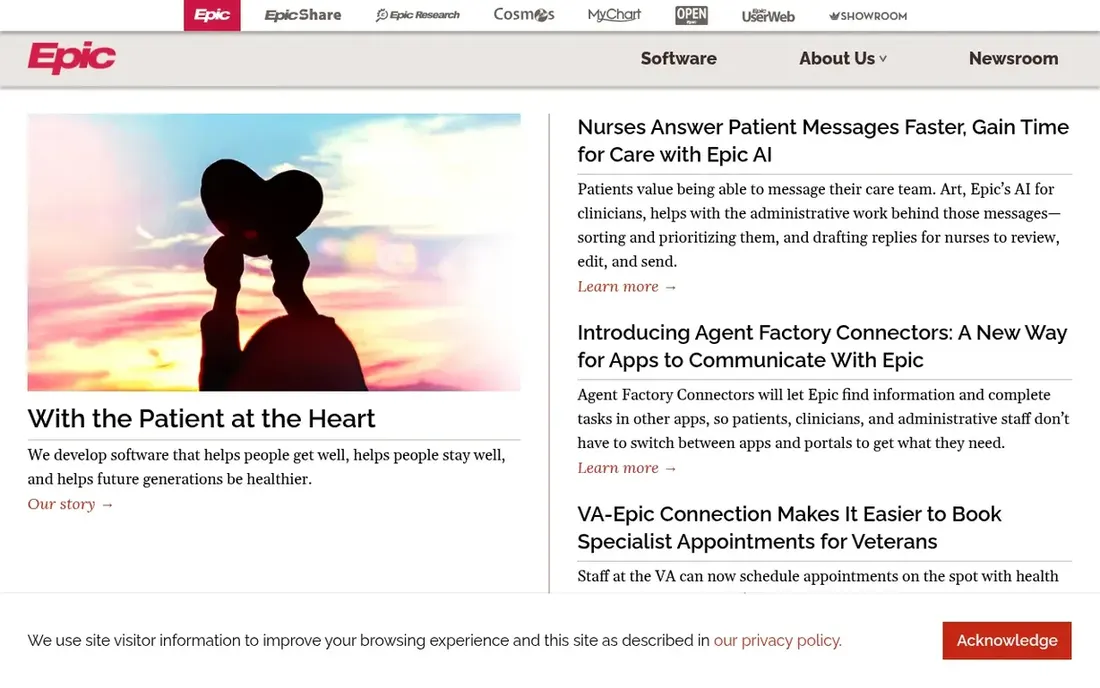
For organizations already on Epic clinical software, Epic Systems is a natural candidate. Epic Systems develops software geared toward helping people get well, stay well and support future generations.
Its analytics capabilities sit alongside its clinical records environment, so organizations already running Epic workflows can analyze patient and operational data without stitching together separate systems. For everyday use, because the product is built around Epic's own ecosystem, organizations running other clinical systems may find integration and fit harder to justify. Pricing for Epic Systems is not stated here, so ask the vendor for current figures. Free options: Not stated.
Honest limits: Best value inside Epic environments.
- Analytics tied to clinical records
- Long-standing healthcare focus
- Less suited to standalone BI needs
Selection criteria
We compared the tools on published pricing, free plan or trial availability, feature coverage for healthcare analytics platforms, and the limits each vendor documents. Plan names, prices and limits change often. Treat the figures here as a starting point and verify them with the vendor. Position on the page reflects fit for a typical buyer first, with price clarity and free access breaking ties. Treat it as a guide, not a ruling.
Before you commit
- Confirm the entry price on the vendor page. For Qlik Sense, Databricks, Google Cloud Healthcare API and Epic Systems that means a quote rather than a fixed price.
- Test the free plan from Tableau against your real workload before relying on it.
- Before choosing Qlik Sense, weigh its main limit: Healthcare templates are restricted.
- Ask Epic Systems how an export works before you move any records in; an easy exit lowers the risk.
- Ask Google Cloud Healthcare API whether prices are locked for the first term and what happens at renewal.
FAQ
Where do cloud data systems fit in healthcare analytics?
Services like Databricks and Google Cloud Healthcare API manage storage, integration and interoperability beneath reporting tools. They suit organizations with engineering resources that want to build a governed data foundation before layering analytics on top.
Which options for healthcare analytics platforms have a free plan?
Tableau is the only tool in this list with a free plan. Free plans usually cap users, projects or features, so check the limits on the vendor page. All 5 picks in this healthcare analytics platforms comparison list a starting price, free plan details and the main limits on their cards above.
Can I try these options before paying?
Often, yes. Tableau has a free plan. Use your own data and a real task during the test, and check what the free tier or trial limits before you rely on it. For the full picture, the cards above cover all 5 entries of this healthcare analytics platforms list, including price, free plan and limits.
What is the cheapest option for healthcare analytics platforms in this list?
On published monthly entry prices, Tableau is the lowest here at $15 per user per month. Entry price is only part of the cost, because seats, add-ons and billing terms can change the total. Prices, free plan details and limits for all 5 tools in this healthcare analytics platforms roundup sit on the individual cards above.
Do these tools publish their prices?
Not all of them. Qlik Sense, Databricks, Google Cloud Healthcare API and Epic Systems publish no starting price, so expect a quote request for those. The rest, Tableau included, show a starting price, though seats and billing terms still change the final cost.
Sources
- https://www.qlik.com
- https://www.tableau.com
- https://www.databricks.com
- https://cloud.google.com/healthcare-api
- https://www.epic.com