Best Family Office Accounting Software in 2026: 8 Tools Compared
Best family office accounting software compared for reporting, ledgers and entity management, with pricing and honest limits for 8 platforms for 2026 readers.
- Editor's choice
 Eton Solutions AtlasFive
Large operations-heavy offices
Starts atSee websiteVisit eton-solutions.comFull review - Great alternative
 Addepar
Complex portfolio analytics
Starts atSee websiteVisit addepar.comFull review - Also consider
 Masttro
Fixed-price reporting, alternatives
Starts atSee websiteVisit masttro.comFull review
TL;DR:
- Eton Solutions AtlasFive suits large, operations-heavy family offices that need a full ERP with accounting, tax and entity management.
- Addepar suits complex, alternatives-heavy portfolios that need deep analytics and reporting, though pricing is quote-based.
- FundCount and Asset Vantage suit mid-size offices that want accounting and investment data in one ledger.
- Aleta and Asora suit smaller offices that want consolidated reporting without asset-based pricing.
- Most family office platforms use custom pricing, so implementation time and data migration matter as much as the software fee.
Quick comparison
| Tool | Best for | Starts at | Free plan? | |
|---|---|---|---|---|
| Eton Solutions AtlasFive | Large operations-heavy offices | See website | No | Visit |
| Addepar | Complex portfolio analytics | See website | No | Visit |
| Masttro | Fixed-price reporting, alternatives | See website | No | Visit |
 FundCount | Accounting plus portfolio reporting | See website | No | Visit |
 Aleta | Smaller offices, flat pricing | $1,000 per month | No | Visit |
 Asora | Early-stage single family offices | $900 per month | No | Visit |
 Asset Vantage | Mid-market integrated ledger | See website | No | Visit |
 Archway by SEI | Accounting inside SEI ecosystem | See website | No | Visit |
The best family office accounting software
Family office accounting is not the same as small business bookkeeping. A family office must track many legal entities, bank and custodian accounts, private investments, partnerships, tax lots, bills and distributions, and then report all of it in a way family members and advisers can understand. The eight platforms below cover that work from different angles, from full ERP systems to reporting platforms that pair with an external ledger. Most use custom pricing, so starting prices below show published figures where vendors provide them, and See website where pricing is quote-based.
Eton Solutions AtlasFive is a cloud ERP built for family offices, combining general ledger accounting, partnership accounting, bill pay, tax workflows, entity management and reporting in one system. That breadth suits large single and multi-family offices that want one vendor for operations, rather than stitching together a ledger, a reporting tool and a document system.
Eton also offers an outsourced Administrative Family Office service, which appeals to offices that want staff support beside the software. The trade-offs are cost and time. Pricing is custom and enterprise-scale, with reported annual costs often well into six figures for large offices, and implementation can take six to nine months for complex structures. Smaller offices should compare Aleta, Asora or FundCount first.
- Integrated ERP for accounting, tax, entity and document management
- Broad bank and custodian connectivity
- Outsourced operations service available
- Custom enterprise pricing
- Implementation can take months for complex offices
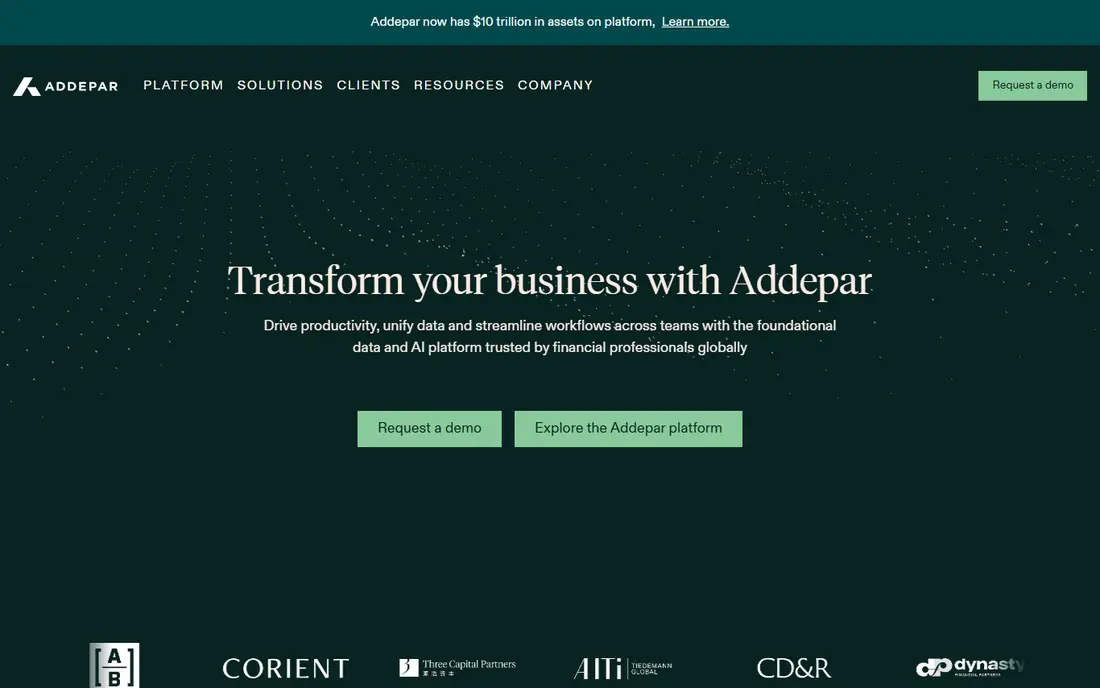
Addepar is the reporting and analytics standard for many large family offices, advisers and private banks. It reconciles data from hundreds of custodians, banks and administrators, covers public and private assets, and offers performance attribution, risk modeling, Monte Carlo simulations and benchmarking. Reporting can be tailored by family, entity, account and asset class, which matters when different family members need different views.
Addepar does not publish pricing, and contracts often scale with assets on the platform, with flat-fee options in some cases. Entry costs are commonly reported around $50,000 per year or higher, with implementation taking 60 to 90 days in standard cases and longer for complex books. Addepar is primarily a reporting and analysis platform rather than a general ledger, so most offices pair it with accounting tools. For complex, alternatives-heavy portfolios, that analytics depth is hard to match.
- Deep performance analytics and risk modeling
- Broad custodian and alternatives coverage
- Flexible reporting
- Pricing is quote-based and often asset-based
- Implementation needs dedicated internal effort
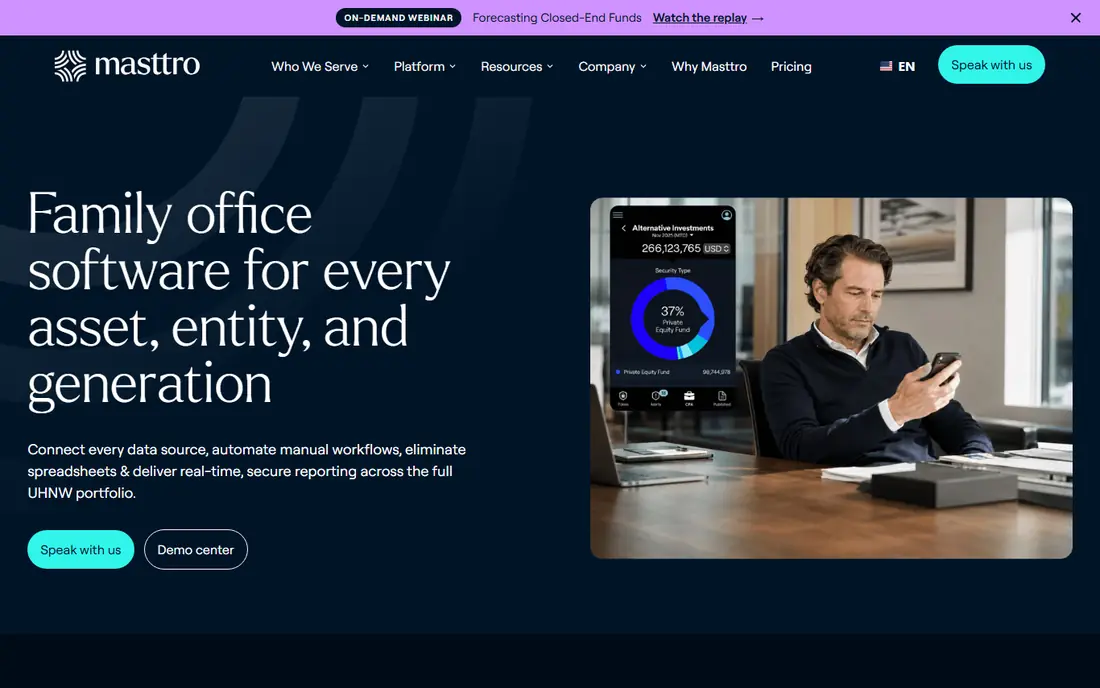
Masttro suits family offices that want strong consolidated reporting and alternatives handling without pricing that rises with market value. Its platform covers data from more than 750 custodian feeds across many countries, with an investment sub-ledger that can export to a general ledger. Document handling and alternatives workflows are strengths, which helps offices with private funds, direct investments and complex ownership structures.
Pricing is custom, but it is fixed-license rather than asset-based, which gives larger offices more predictable costs as assets grow. Reported annual costs often start around $50,000 or higher. Implementation typically takes 12 to 14 weeks, longer for complex setups. Offices that want a fixed-price alternative to Addepar, with strong alternatives support, should demo Masttro early in the process.
- Fixed license pricing, not asset-based
- Strong alternatives workflow
- Broad custodian feeds
- Custom pricing with no published entry price
- Implementation takes weeks to months
FundCount is built around the general ledger, which sets it apart from reporting-only platforms. It combines accounting, partnership accounting, portfolio reporting and investor reporting in one system, with connectors for banks, custodians, PDFs, FTP and APIs. That ledger-first design suits offices that need accounting-grade data, waterfall calculations and partnership allocations in the same system as performance reporting.
Published comparisons list a single family office entry price around $35,899 per year plus fees, though actual quotes vary by scope. The interface is accountant-grade and requires training, and implementation takes months for complex offices. For mid-size offices that want ledger and reporting together, without running two systems, FundCount is a strong candidate. Smaller offices may find Aleta or Asora simpler and cheaper.
- Integrated general ledger with portfolio reporting
- Strong partnership accounting
- Many data connectors
- Interface requires training
- Published entry pricing is high for small offices
Aleta suits smaller and faster-moving family offices that want consolidated wealth reporting without asset-based pricing. Pricing starts at $1,000 per month, with an investment ledger that feeds third-party general ledgers, custodian and bank integrations, and a principal-friendly interface that family members can actually use. Implementation is reported at four to eight weeks, which is faster than many enterprise platforms.
The trade-off is depth. Aleta does not match Addepar on deep statistical risk modeling or large institutional analytics, and its ecosystem is smaller. For offices that mainly need a clear consolidated view, clean reporting and predictable pricing, Aleta is a strong fit. For very large, alternatives-heavy estates with dedicated investment teams, Addepar or Masttro may still be needed.
- Flat pricing from $1,000 per month, not asset-based
- Consolidated reporting with principal-friendly views
- Faster implementation
- Less deep analytics than Addepar for very complex portfolios
- Newer vendor than larger rivals
Asora, formerly known under a different brand in some comparisons, targets early-stage single family offices that are moving off spreadsheets. It offers consolidated reporting, a book-cost accounting module and custodian connections, with tiered pricing from about $870 to $900 per month for smaller asset levels. Implementation can take days to a few months depending on data cleanliness.
The limit is scale. Reporting and analytics are more basic than Addepar, Masttro or Eton, and pricing rises with asset tiers, so a growing estate should model costs at future asset levels. For a new family office that needs clean books and reporting without an enterprise contract, Asora is a practical starting point, with a path to a larger platform later if complexity grows.
- Tiered pricing from about $900 per month
- Book-cost accounting module
- Suits offices from about $5 million to $100 million
- Reporting depth is more basic than larger platforms
- Pricing rises with asset tiers
Asset Vantage suits mid-market family offices that want an integrated general ledger with portfolio analytics, entity management and document handling in one system. It covers accounting, investment reporting and family governance workflows, with data feeds on a next-day basis in many cases. Published pricing in some markets lists single family office plans from about $30,000 per year, tiered by entity count, though US quotes vary.
The interface is built for accountants and office staff rather than family principals, so principal-facing reporting may need extra work. Implementation typically takes two to four months. For a mid-size office that wants ledger and reporting together, with a vendor that has served family offices for many years, Asset Vantage is a solid candidate beside FundCount.
- Integrated general ledger with analytics
- Entity and document management
- Published tiered pricing in some markets
- Interface is accountant-grade
- Pricing varies by entity count and region
Archway, part of SEI, offers accounting and reporting for single and multi-family offices, with support for partnership accounting, multi-entity structures and consolidated reporting. Offices already using SEI for custody, investment or outsourced services get the clearest benefit, since data and workflows can stay inside one ecosystem.
Pricing is custom and often asset-based, with reported annual costs around $80,000 or higher for larger offices. Implementation takes two to four months in many cases. Offices outside the SEI ecosystem should compare Archway with FundCount, Asset Vantage and Eton on ledger depth and total cost, since the ecosystem benefit matters less if you do not use other SEI services.
- Accounting and reporting for family offices
- Strong for offices already using SEI services
- Partnership accounting support
- Custom, asset-based pricing in many cases
- Best value inside the SEI ecosystem
How we picked these
We compared official vendor pages, family office software comparisons and pricing reports for platforms that serve single and multi-family offices in October 2026. We favored platforms with a clear accounting or reporting core, support for multiple entities and custodians, and a track record with family offices. Prices are published starting prices where vendors provide them, and quote-based platforms are marked See website, since cost depends on assets, entities, data feeds and implementation scope.
How to choose family office accounting software
Start with the ledger question. Does your office need a full general ledger in the same system, or will a reporting platform that exports to an external ledger work? Eton, FundCount and Asset Vantage offer integrated ledgers, while Addepar, Masttro and Aleta focus on reporting and reconciliation. That choice shapes the whole shortlist.
Next, map your entities, custodians and asset types. Private funds, direct real estate, partnerships and multi-currency holdings all add complexity, and vendors differ on how well they handle them. Ask each vendor to reconcile a sample custodian, show a partnership allocation and produce a principal report in the demo. Finally, price the whole project, not just the license. Implementation, data migration, training and ongoing support can rival the software fee, especially on enterprise platforms.
FAQ
What is the best accounting software for family offices?
Eton Solutions AtlasFive suits large, operations-heavy offices that need a full ERP, while FundCount and Asset Vantage suit mid-size offices that want ledger and reporting together. Addepar suits complex portfolios that need deep analytics, and Aleta or Asora suit smaller offices with simpler needs.
How much does family office accounting software cost?
Costs range from about $900 to $1,000 per month for Aleta and Asora to $30,000 or more per year for FundCount and Asset Vantage, and $50,000 to well over $100,000 per year for Addepar, Masttro and Eton on larger books. Most enterprise platforms use custom quotes, so get a scoped price for your entities and assets.
Is Addepar an accounting system?
Addepar is primarily a reporting and analytics platform, not a general ledger. Most offices pair it with accounting software or an outsourced accounting service, and they reconcile Addepar figures to the ledger each month.
Can a family office use QuickBooks instead?
A very small office with few entities and simple liquid assets can start on QuickBooks, but it lacks multi-entity, partnership, tax lot and alternatives features that family offices need as they grow. Most offices migrate to a dedicated platform within one to two years once complexity rises.
How long does implementation take?
Smaller platforms such as Aleta and Asora can implement in four to eight weeks, while mid-size platforms often take two to four months. Large enterprise platforms such as Eton and Addepar can take six to twelve months for complex, multi-entity books with many custodians.
What should a family office check in a software demo?
Ask the vendor to reconcile a real custodian statement, show a partnership allocation and distribution, produce a report for a family principal, and explain how tax lots and private market documents are handled. Those four tasks reveal more than a polished sales presentation.