Best Enterprise Data Integration Platforms in 2026: 8 Compared
Compare the best enterprise data integration platforms for ELT, ETL, and app integration, with pricing models, connectors, and deployment notes inside.

- Editor's choice
 Fivetran
Managed ELT at scale
Starts atFreeVisit fivetran.comFull review - Great alternative
 Airbyte
Open data movement
Starts at$20 per monthVisit airbyte.comFull review - Also consider
 Talend
Complex transformations
Starts atSee websiteVisit talend.comFull review
TL;DR:
- Fivetran is the strongest managed ELT pick for teams that want many prebuilt connectors with little pipeline upkeep.
- Airbyte suits teams that want open source flexibility plus a managed cloud option.
- Talend and Informatica lead for complex transformations and governance, but pricing is quote based and enterprise sized.
- Azure Data Factory fits teams already committed to Azure, while Boomi and SnapLogic suit app integration as well as data movement.
- Our pick for most cloud data teams is Fivetran, with Airbyte as the best open alternative.
Quick comparison
| Tool | Best for | Starts at | Free plan? | |
|---|---|---|---|---|
| Fivetran | Managed ELT at scale | Free | Yes | Visit |
| Airbyte | Open data movement | $20 per month | Yes | Visit |
| Talend | Complex transformations | See website | No | Visit |
 Informatica | Enterprise governance | See website | No | Visit |
 Azure Data Factory | Azure native pipelines | See website | No | Visit |
 SnapLogic | App and data integration | See website | No | Visit |
 Boomi | App integration at scale | See website | No | Visit |
 Stitch | Simple cloud ELT | $100 per month | Free trial | Visit |
The best enterprise data integration platforms
Enterprise data integration is about moving data reliably between apps, databases, and warehouses, with monitoring, security, and governance. The eight platforms below cover managed ELT, complex ETL, and app integration, so teams can match the tool to their data shape and skills.
Fivetran is the managed ELT standard for many cloud data teams. It replicates data from SaaS apps, databases, and files into a warehouse with prebuilt connectors, automatic schema handling, and monitoring. The free plan covers up to 500,000 Monthly Active Rows per month in the listings we reviewed, which suits evaluation and small projects.
The main cost watch is volume. Fivetran prices by Monthly Active Rows per connection, so a team with many sources and fast growing tables should model costs before scaling. Teams that need heavy custom transformation inside the pipeline may also prefer a code heavy tool. For teams that want reliable pipelines without maintaining connectors, Fivetran is a strong first choice.
- Hundreds of prebuilt connectors
- Fully managed pipelines
- Strong security and compliance coverage
- Monthly Active Rows pricing can rise with volume
- Custom logic is limited compared with code heavy tools
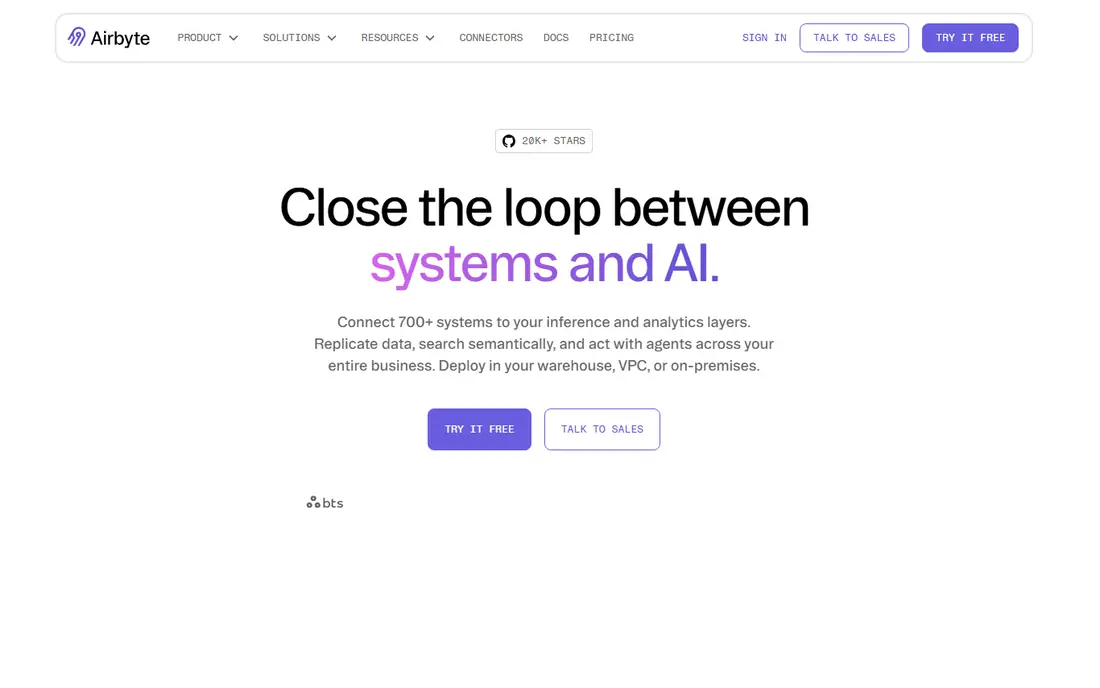
Airbyte appeals to teams that want openness and deployment choice. Its open source core can run self-hosted, while Airbyte Cloud offers a managed option with Standard plans from $20 per month in the listings we reviewed. Connector breadth is wide, including SaaS APIs, databases, files, and unstructured sources, with a no-code builder for custom connectors.
Airbyte Cloud pricing by credits can be harder to forecast than a flat plan, especially for high volume database sources. Teams should run a pilot with real volumes and check credit use before committing. For teams that value open source, self-hosting, and control over their data movement, Airbyte is the best alternative to Fivetran.
- Open source core
- Hundreds of connectors
- Self-hosted, cloud, and hybrid deployment
- Cloud pricing by credits needs careful modeling
- Some connectors need more tuning than Fivetran

Talend, now part of Qlik, suits enterprises with complex data logic that simple ELT cannot handle. Its Studio tools support detailed transformations, data quality checks, and job design, with connectors for databases, SaaS apps, and files. That depth helps teams that need to clean, join, and govern data before it reaches a warehouse or app.
Talend pricing is quote based, and enterprise deployments in third-party reports often run into five or six figures per year, so small teams should expect a serious budget conversation. Implementation also takes more effort than a managed ELT setup. For enterprises with complex pipelines and governance needs, Talend remains a capable and proven platform.
- Strong transformation and data quality tools
- Broad connector library
- Cloud and hybrid deployment
- Quote based pricing
- Implementation can be a major project
Informatica is the governance heavy pick in this list. Its Intelligent Data Management Cloud covers integration, data quality, master data, and governance, with AI assisted automation and detailed metadata. Large firms in regulated industries often choose Informatica when data lineage, quality, and compliance matter as much as movement speed.
Pricing by Informatica Processing Units is consumption based and can be hard to forecast without a pilot, and enterprise costs are high. Smaller teams will usually find Fivetran or Airbyte simpler and cheaper. For large enterprises that need a full data management platform, not just a pipeline tool, Informatica is a leading choice.
- Broad enterprise data management
- AI assisted automation and metadata
- Strong governance and compliance tools
- IPU consumption pricing can be hard to forecast
- Enterprise price point
Azure Data Factory suits teams already committed to Microsoft Azure. It builds visual ETL and ELT pipelines that move data between Azure services and many outside sources, with scheduling, monitoring, and integration with Azure Synapse and Microsoft Fabric. Pay-per-use pricing means small pipelines can start cheaply.
The limit is cloud scope. Teams that run mainly on AWS or Google Cloud will find a cloud neutral tool such as Fivetran or Airbyte simpler. Azure pricing also has several parts, including activity runs and data movement, so cost modeling needs a real pipeline test. For Azure shops, Data Factory is a natural and well integrated choice.
- Native Azure integration
- Visual pipeline design
- Pay for activities and data movement used
- Azure centered, so multi-cloud teams face extra work
- Pricing has many parts to model
SnapLogic bridges app integration and data integration, which suits firms that need both. Its visual Snaps connect SaaS apps, databases, and cloud services, with support for real-time and batch patterns. That breadth helps teams that move data between business apps as well as into warehouses.
SnapLogic pricing is quote based and enterprise focused, so small teams should expect a sales conversation and a mid five-figure starting point in third-party reports. Teams that only need warehouse ELT will find Fivetran simpler. Teams that need app workflows plus data pipelines will value SnapLogic as a single platform.
- Visual pipeline design with Snaps
- App and data integration in one platform
- Hybrid deployment options
- Quote based pricing
- Enterprise focus means higher entry cost
Boomi is best known for application integration, and its platform also covers data movement, API management, and workflow automation. With more than 1,000 connectors in vendor listings, it suits firms that connect many SaaS apps and need reliable, monitored integrations across departments. Cloud and hybrid deployment options help firms with on-prem systems.
Boomi pricing is quote based, with entry points around $1,000 per month in third-party reports for smaller deployments, rising fast for enterprise use. Simple ELT teams may find Boomi heavier than needed. For firms whose main problem is app-to-app integration at scale, Boomi is a proven enterprise platform.
- Very broad connector library
- App integration, API management, and data movement
- Cloud and hybrid deployment
- Quote based pricing
- Platform breadth can feel complex for simple ELT
Stitch offers a simpler take on cloud ELT for teams that do not need Fivetran scale or Talend complexity. It replicates data from apps and databases into a warehouse, with plans that set clear limits on sources, destinations, and Monthly Active Rows. Standard starts at $100 per month for 5 million Monthly Active Rows in the listings we reviewed, with a 14-day trial.
Stitch has fewer connectors and advanced features than Fivetran, and its plan limits can become a constraint as a team grows. For a small data team that wants a straightforward ELT tool with predictable plan tiers, Stitch is a practical and affordable starting point.
- Simple cloud ELT setup
- Clear source and destination limits by plan
- Talend heritage
- Fewer advanced features than Fivetran
- Plan limits on sources and destinations
How we picked these
We compared official feature pages, pricing pages, and public comparisons for data integration platforms that serve enterprise teams and are still actively developed. We favored platforms with broad connectors, monitoring, security, and deployment options, and we included managed ELT, complex ETL, and app integration. We did not claim hands-on testing, and we note that consumption pricing changes with volume, so readers should run a pilot with real data before buying.
How to choose an enterprise data integration platform
Start with the pattern you need most. If you mainly move SaaS and database data into a warehouse, shortlist Fivetran, Airbyte, and Stitch. If you need complex transformations and governance, compare Talend and Informatica. If you need app-to-app workflows, compare Boomi and SnapLogic, and if you live in Azure, test Azure Data Factory first.
Then model cost with real volumes, not vendor examples. Check how each platform meters rows, credits, or processing units, and test with your largest tables and most frequent syncs. Also check security, lineage, monitoring alerts, and support for your destinations. A platform that moves data well but hides failures will cost more in trust than it saves in license fees.
FAQ
What is the best enterprise data integration platform?
For most cloud data teams, Fivetran is the strongest managed ELT choice, with Airbyte as the best open alternative. Enterprises with complex transformation and governance needs should also evaluate Talend and Informatica.
What is the difference between ETL and ELT?
ETL transforms data before loading it into a destination, while ELT loads raw data first and transforms it inside the warehouse. ELT suits cloud warehouses and modern analytics, while ETL suits cases where data must be cleaned or governed before loading.
How much do enterprise data integration platforms cost?
Costs range from free or $20 per month for small ELT use to quote based enterprise contracts that can reach six figures per year. Consumption pricing means volume, connector count, and sync frequency drive the final bill, so pilot with real data.
Can these platforms handle real-time data?
Some can, with change data capture and frequent syncs, but real-time support varies by plan and source. Fivetran offers one-minute syncs on higher tiers, while other platforms vary, so check sync frequency for your exact sources before buying.
Do I need a data warehouse to use these tools?
No, but most ELT tools are designed to load into a warehouse such as Snowflake, BigQuery, or Databricks. App integration platforms such as Boomi and SnapLogic can move data between apps without a warehouse, which suits operational use cases.