8 Best Decision Intelligence Software for 2026
Compare the best decision intelligence software for 2026, with connected data, rules, models and workflows that help teams make faster, clearer choices.

- Editor's choice
 Quantexa Decision Intelligence Platform
Banks, insurers, and public sector teams that need a trusted view of customers and counterparties
Starts atSee websiteVisit quantexa.comFull review - Great alternative
 FICO Decision Management Platform
Lenders and insurers making many similar decisions every day
Starts atSee websiteVisit fico.comFull review - Also consider
 SAS Decision Management
Enterprises that want analytics, rules, and workflows in one governed system
Starts atSee websiteVisit sas.comFull review
TL;DR:
- Decision intelligence platforms connect scattered data, rules, and models so a decision can be traced, explained, and repeated.
- Quantexa, FICO, and SAS suit regulated, high-stakes decisions, while Aera, Peak, and Tellius suit faster operational planning.
- The data foundation matters more than the dashboard, because poor entity matching will weaken every recommendation the platform makes.
- Expect quoted, enterprise pricing across this group, and plan for a pilot tied to one decision, such as credit approval or demand planning.
Quick comparison
| Tool | Best for | Starts at | Free plan? | |
|---|---|---|---|---|
| Quantexa Decision Intelligence Platform | Banks, insurers, and public sector teams that need a trusted view of customers and counterparties | See website | No | Visit |
| FICO Decision Management Platform | Lenders and insurers making many similar decisions every day | See website | No | Visit |
| SAS Decision Management | Enterprises that want analytics, rules, and workflows in one governed system | See website | No | Visit |
 Aera Technology | Supply chain, finance, and operations teams that want faster, partly automated decisions | See website | No | Visit |
 IBM Decision Intelligence | Large enterprises already invested in IBM data, AI, and automation tools | See website | No | Visit |
 ACTICO Decision Management | Financial services and insurance teams that need explainable rules-led decisions | See website | No | Visit |
 Peak Decision Intelligence | Retailers and manufacturers improving demand, pricing, and inventory decisions | See website | No | Visit |
 Tellius | Analysts and business teams that want guided, AI-assisted decision support | See website | No | Visit |
The best decision intelligence software
Quantexa Decision Intelligence Platform
Best for: Banks, insurers, and public sector teams that need a trusted view of customers and counterparties
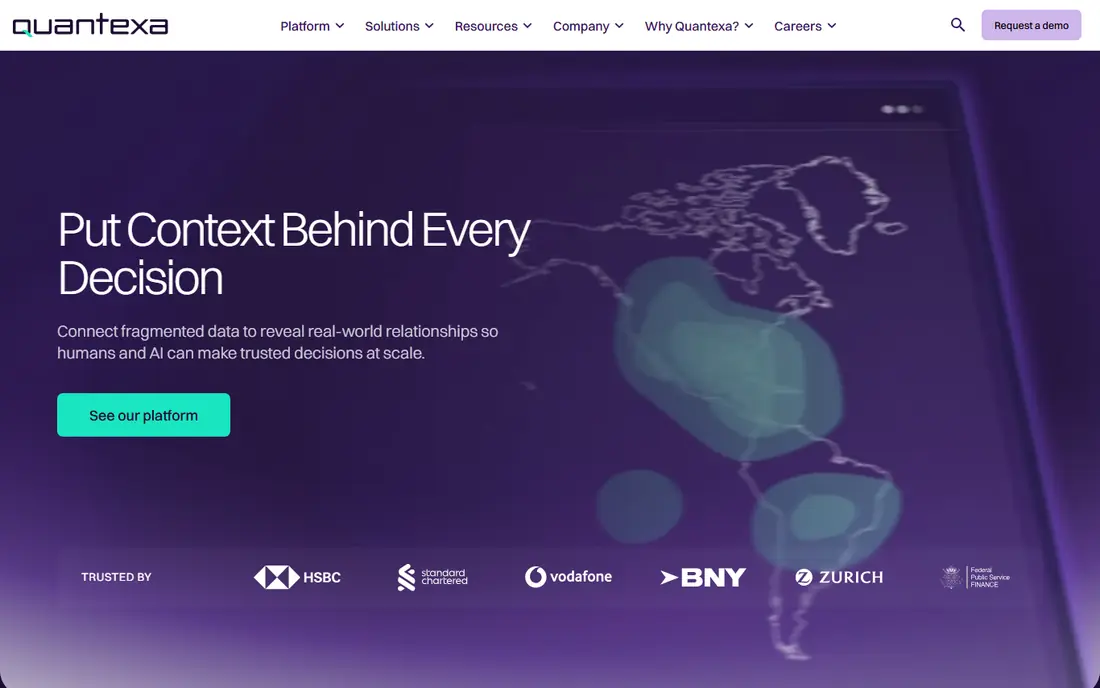
Quantexa builds its platform around connected data, matching records across systems even when names, addresses, or identifiers differ. That context layer then supports fraud detection, customer intelligence, risk checks, and compliance work from the same foundation, rather than rebuilding a view of the same customer for each use case. For regulated teams, the audit trail and explainability matter, because a decision that affects a customer or a payment needs a clear reason. The trade-off is scale and cost. Quantexa is an enterprise platform, and a rollout involves data work, governance, and integration with existing systems. Smaller companies will find it heavier than they need, and they should look at lighter analytics tools instead. For large organizations with messy, siloed data and high-stakes decisions, the connected foundation is the reason Quantexa appears so often in this category.
- Entity resolution and graph analytics that link fragmented records into a single context view
- Enterprise scope and implementation effort, with pricing that requires a sales discussion
FICO Decision Management Platform
Best for: Lenders and insurers making many similar decisions every day
FICO is best known for credit scoring, but its decision platform covers a wider set of operational choices, from loan approvals to fraud screening and collections treatment. Rules, predictive models, and optimization can be combined, tested, and changed under governance, so a team can update a policy without rebuilding the whole system. That control is valuable when regulators, auditors, or risk committees need to see exactly why a decision changed. The weakness is accessibility. FICO is built for serious volume and serious governance, which brings implementation work and cost that smaller firms may not justify. Teams should also check how much data science support they need to maintain models over time. For organizations where thousands of similar decisions must be consistent, auditable, and fast, FICO remains a natural shortlist pick.
- Mature rules, scores, and optimization for high-volume decisions, with strong governance controls
- Depth can mean a longer setup, and pricing is enterprise and quote-based
SAS Decision Management
Best for: Enterprises that want analytics, rules, and workflows in one governed system

SAS brings decades of analytics work to decision intelligence, letting teams design decision flows that combine data preparation, models, business rules, and human review. That breadth helps when a decision needs more than a single score, such as a claim that requires fraud checks, policy rules, and a manual review step. Governance features help teams track which version of a rule or model produced a given outcome. The drawback is scope. SAS can feel like a large platform for a team that only needs one planning or approval workflow, and buyers should be clear about which modules are included in a quote. Implementation also benefits from experienced SAS staff or partners. For large firms already using SAS for analytics, the decision platform is a logical extension rather than a separate island.
- Broad analytics heritage, with model management, rules, and decision flows in one environment
- Pricing and sales process are complex, and the platform can feel large for a single use case
Aera Technology
Best for: Supply chain, finance, and operations teams that want faster, partly automated decisions
Aera focuses on decisions that repeat every week, such as demand planning, inventory balancing, and order promising. Its platform monitors operational data, recommends actions, and can automate routine choices within limits set by the business. That approach suits companies where delay costs money, because a planner can approve a recommendation rather than rebuild a spreadsheet from scratch each cycle. The limit is domain fit. Aera is strongest for operational decisions, and it is less of a general customer intelligence or fraud platform than Quantexa or FICO. Buyers should also test data readiness, because automation built on late or inconsistent feeds will produce recommendations that planners stop trusting. For operations teams with steady data flows and repeatable decisions, Aera offers a clear, practical path.
- Decision skills and cognitive automation built for operational planning and execution
- Best fit is operational use, and value depends on clean operational data feeds
IBM Decision Intelligence
Best for: Large enterprises already invested in IBM data, AI, and automation tools
IBM offers decision intelligence as part of a wider data and AI portfolio, combining data integration, machine learning, rules, and automation. That breadth helps large companies that need decision workflows across many departments, from risk to supply chain, without adding a separate vendor for each area. Integration with IBM tools can also simplify governance for firms already standardized on that stack. The weakness is focus. IBM is a broad vendor, and decision intelligence is one capability among many, so buyers should confirm roadmap, support, and which components are actually included. Pricing is also enterprise and quote-based, which makes early comparison harder. For IBM-centered enterprises, the platform can still be a strong fit, especially where scale and existing contracts matter.
- Broad enterprise coverage across data, AI models, rules, and automation workflows
- Complex pricing and sales process, with no single narrow focus
ACTICO Decision Management
Best for: Financial services and insurance teams that need explainable rules-led decisions
ACTICO centers on business rules, letting non-technical experts model, test, and change decision logic without waiting for a full development cycle. That matters in lending, insurance underwriting, and compliance, where policy changes often and where each decision must be explained. The platform supports simulation, so teams can see how a rule change would affect approvals before it goes live. The drawback is market reach. ACTICO is well known in regulated European finance and insurance, but it may be less familiar to US buyers, and local partner coverage should be checked. It is also more rules-led than some AI-first platforms, which suits policy-heavy decisions but may need companion analytics for complex prediction. For teams that value clear, auditable rules above all, ACTICO is a strong, focused option.
- Clear rules modeling and decision automation, with governance suited to regulated work
- Lower visibility outside Europe and regulated finance, and a smaller partner ecosystem in some regions
Peak Decision Intelligence
Best for: Retailers and manufacturers improving demand, pricing, and inventory decisions
Peak, based in the UK, builds decision intelligence around commercial decisions such as what to stock, how to price, and where to allocate inventory. Its platform connects data, builds models, and presents recommendations in apps that planners and merchandisers can use without writing code. That outcome focus helps teams judge value, because success is measured in stock availability, margin, or waste rather than model accuracy alone. The limit is breadth. Peak is not a general fraud or credit decision platform, and buyers outside retail and manufacturing should check fit carefully. Pricing is also quote-based, and a pilot needs clear commercial targets to prove value. For retailers and manufacturers with messy demand data and repeatable commercial choices, Peak offers a focused alternative to general analytics platforms.
- Decision intelligence apps built around commercial outcomes, with AI models tied to business metrics
- Enterprise focus and implementation support needs, with less breadth for fraud or credit use
Tellius
Best for: Analysts and business teams that want guided, AI-assisted decision support
Tellius takes a different angle, helping business users ask questions in plain language and get guided explanations, comparisons, and drivers behind a metric. Instead of only showing a dashboard, it can explain why sales fell in a region or which factors drove a change, then suggest follow-up views. That makes it useful for teams that need faster understanding before they commit to a formal decision workflow. The trade-off is depth. Tellius is stronger for analysis and insight than for running high-volume automated decisions with strict governance, so it may sit alongside, rather than replace, a rules platform in regulated firms. Buyers should also test how it handles their data volume and security requirements. For midsize teams that want decision support without a heavy enterprise rollout, Tellius is an accessible entry point.
- Natural language questions, automated insights, and guided analysis for non-technical users
- Lighter enterprise decision automation than FICO, SAS, or Quantexa, and governance needs checking at scale
How we picked these
We focused on vendors named in the 2026 Gartner decision intelligence platform coverage and on platforms with a clear decision layer, not just dashboards or business intelligence tools. That meant looking for connected data, rules or models, workflow, and some form of audit or explanation, because a decision platform must show its working. We balanced regulated, high-stakes vendors with operational and analyst-friendly options, so the list covers different budgets and team sizes, even though most pricing here is quoted. We did not include pure business intelligence, pure machine learning platforms, or generic AI chat tools, because they lack the decision workflow and governance that define this category. Where pricing was not published, we used See website rather than inventing a figure. A pilot on one real decision, with clear success measures, remains the best test before a wider rollout.
What to check before you buy
Pick one decision to pilot
Choose a decision that repeats often, has measurable outcomes, and involves data from more than one system. Credit approval, demand planning, and claims triage are good examples. A pilot on a vague goal, such as better insights, will be hard to judge and easy to stall.
Check the data foundation first
Ask how the platform matches entities, handles duplicates, and tracks data lineage. If customer or product records cannot be linked reliably, recommendations will be weak no matter how good the models look in a demo. Request a data test on your own sample, not only a polished vendor dataset.
Demand explanation and control
For any decision that affects customers, staff, or money, ask how the platform explains a recommendation and how a human can override it. Check version control for rules and models, and confirm who can change a live decision flow. Strong governance slows a rollout slightly at first, but it prevents costly errors later.
FAQ
What is a decision intelligence platform?
It is software that connects data, rules, and models into a workflow that supports or automates a business decision. Unlike a dashboard, which only shows past results, a decision platform helps choose an action, records why that action was chosen, and tracks whether it worked. That record makes decisions repeatable and easier to audit.
What is the best decision intelligence tool?
The best tool depends on the decision type. Quantexa suits connected customer and risk decisions, FICO suits high-volume regulated approvals, and Aera suits operational planning. Tellius suits analyst-led insight, while SAS and IBM suit large enterprises that need broad coverage. Shortlist by decision type, not by vendor size alone.
How is decision intelligence different from business intelligence?
Business intelligence mainly reports what happened and helps users explore data. Decision intelligence goes further by recommending or automating the next action, using rules, models, and workflows. It also keeps a record of the decision and its outcome, so teams can learn which choices worked.
Do small businesses need decision intelligence software?
Most small businesses do not need an enterprise decision platform. A good analytics tool, clear rules in existing software, and a simple approval workflow often cover their needs. Decision intelligence earns its cost when decisions repeat at scale, involve many data sources, or carry regulatory risk.
How long does implementation take?
Timelines vary widely, from weeks for an analyst tool to months for an enterprise platform with complex data integration. Data cleanup, governance, and change management usually take longer than software installation. Ask vendors for a pilot timeline tied to one decision, with named owners on both sides.
Sources
https://www.quantexa.com https://www.fico.com https://www.sas.com https://www.aera.com https://www.ibm.com https://www.actico.com https://www.peak.ai https://www.tellius.com