Best Data Engineering Platforms for Integration in 2026: 9 Platforms Compared
We compared the best data engineering platforms for integration, covering ELT, ETL, streaming, governance, connectors, and pricing for data teams in 2026.

- Editor's choice
 Fivetran
Managed ELT with minimal maintenance
Starts atSee websiteVisit fivetran.comFull review - Great alternative
 Airbyte
Open-source ELT with custom connectors
Starts atSee websiteVisit airbyte.comFull review - Also consider
 Informatica IDMC
Enterprise integration and governance
Starts atSee websiteVisit informatica.comFull review
TL;DR:
- Fivetran and Stitch suit teams that want managed ELT with minimal maintenance, while Airbyte suits teams that want open-source control.
- Informatica, Talend, and Azure Data Factory suit enterprises with complex governance, legacy sources, and hybrid estates.
- AWS Glue and Matillion suit cloud warehouse teams that need Spark-scale processing or pushdown transformation.
- Hevo Data suits SaaS-centred teams that need real-time pipelines without a large data engineering staff.
- Price by rows, events, compute, or credits, not by headline plan, and pilot on your messiest source before you commit.
Quick comparison
| Tool | Best for | Starts at | Free plan? | |
|---|---|---|---|---|
| Fivetran | Managed ELT with minimal maintenance | See website | Yes | Visit |
| Airbyte | Open-source ELT with custom connectors | See website | Yes | Visit |
| Informatica IDMC | Enterprise integration and governance | See website | No | Visit |
 Qlik Talend | Integration plus data quality | See website | Free trial | Visit |
 AWS Glue | Large-scale ETL in AWS | See website | No | Visit |
 Azure Data Factory | Hybrid pipelines in Azure | See website | No | Visit |
 Matillion | Pushdown transformation on warehouses | See website | Free trial | Visit |
 Hevo Data | Real-time SaaS pipelines | See website | Yes | Visit |
 Stitch | Simple database replication | See website | Free trial | Visit |
The best data engineering platforms for integration
We compared vendor pricing pages, documentation, and public 2026 integration guides. The nine below cover managed ELT, open-source ELT, enterprise ETL, and cloud-native processing, so small teams and large enterprises can each find a fitting option. Integration here means moving, transforming, and governing data between apps, databases, and warehouses, not only copying files.
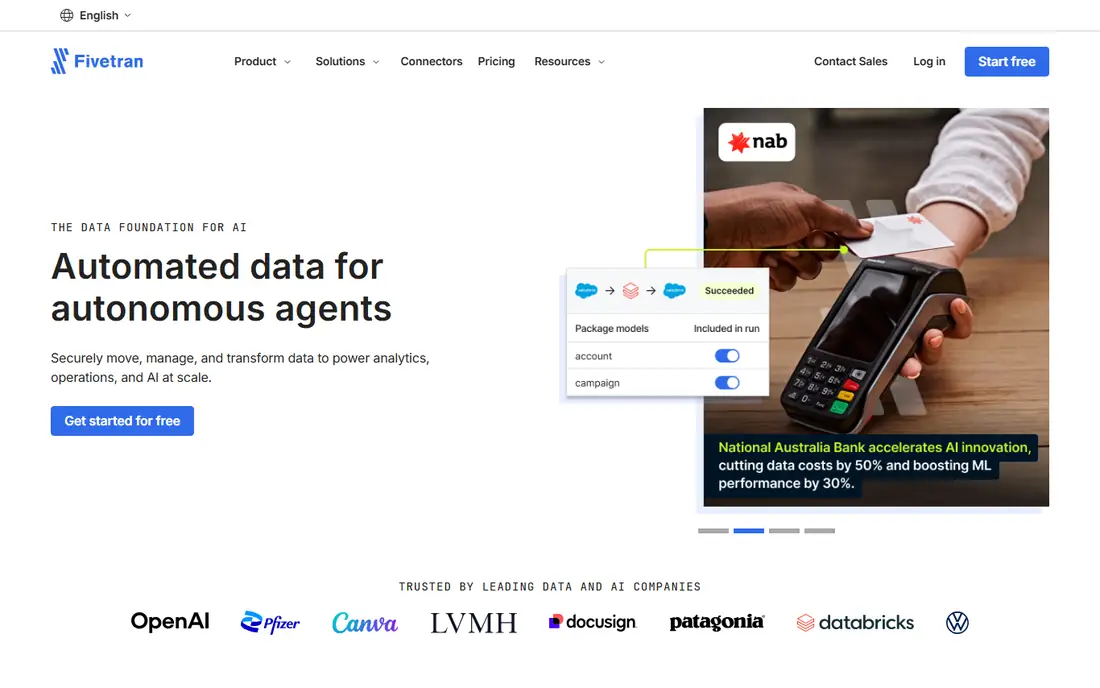
Fivetran automates data replication from SaaS apps, databases, and files into Snowflake, BigQuery, Databricks, Redshift, and other warehouses, with managed connectors that handle schema changes and incremental syncs. Data teams choose a source and a destination, and Fivetran keeps the pipeline running, which removes much of the maintenance work that custom scripts require. Its log-based change capture on databases also keeps warehouse data fresh without full reloads.
The cost model is the main watch point. Fivetran pricing is usage-based on monthly active rows, so a source with many changing rows can cost more than expected. Teams should pilot on their largest sources, set row alerts, and pair Fivetran with dbt or a warehouse transformation tool for modelling, since Fivetran focuses on loading, not full transformation.
- Large managed connector library
- Automatic schema handling
- Log-based change data capture on many sources
- Usage-based pricing grows with rows
- Transformation needs a separate tool or dbt
- Custom sources need extra work
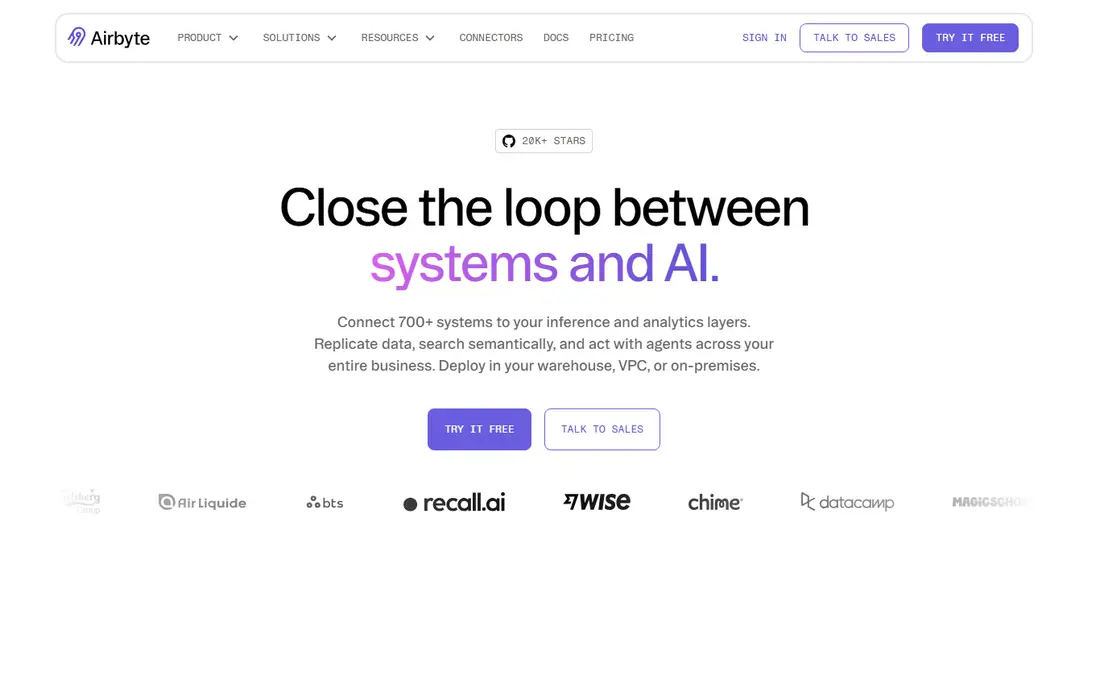
Airbyte offers an open-source ELT platform with a large connector catalogue, plus a cloud service for teams that do not want to run infrastructure. Its connector builder lets engineers create custom sources for internal apps and niche SaaS tools, which is a real advantage when a managed vendor does not cover a needed system. Self-hosting gives control over data residency and cost, while cloud hosting removes operations work.
Airbyte needs more engineering effort than Fivetran for setup, monitoring, and upgrades, especially when self-hosted. Teams with data engineering staff and custom source needs will value that control, while teams that want zero maintenance should compare Fivetran or Hevo first.
- Open-source core with many connectors
- Custom connector builder
- Cloud and self-hosted options
- Self-hosted setup needs engineering time
- Cloud pricing is usage based
- Support and SLAs depend on plan

Informatica Intelligent Data Management Cloud covers data integration, quality, lineage, master data, and governance in one enterprise platform. Its CLAIRE AI features help with mapping, data discovery, and quality rules, while its connector set covers legacy databases, mainframes, SaaS apps, and cloud warehouses. Large enterprises use it to govern data across many teams, regions, and compliance regimes.
Informatica is an enterprise purchase, with quoted, consumption-based pricing and implementation help often needed. Smaller teams should not start here unless governance, lineage, and master data are already core requirements. For a large estate with strict controls, Informatica breadth is hard to match with point tools alone.
- Broad integration, quality, lineage, and governance tools
- AI-assisted mapping
- Hybrid and multi-cloud support
- Enterprise pricing is quoted
- Implementation is complex
- Smaller teams will find it heavy
Qlik Talend Cloud combines data integration with data quality, governance, and transformation, plus Qlik Replicate for log-based change capture from databases. Its visual design tools help data engineers build pipelines without writing every job by hand, while quality rules catch bad data before it reaches a warehouse or dashboard. That combination suits enterprises that need both movement and trust in the same platform.
Pricing is quoted and based on data volume, so budgeting needs a clear sense of sources, rows, and refresh frequency. Teams should trial Talend on a complex source with quality issues, not only on a clean demo source, since quality tooling is where Talend earns its place over simpler ELT tools.
- Visual pipeline design
- Data quality and governance tools
- Qlik Replicate for change data capture
- Pricing is quoted by volume
- Platform breadth takes training
- Cloud and on-prem options add choice complexity
AWS Glue is a serverless ETL service for teams already on AWS, running Spark jobs to extract, transform, and load data between S3, Redshift, RDS, Athena, and other AWS services. Its data catalogue and crawlers discover schemas automatically, and its pay-as-you-go model charges for compute and runtime rather than a fixed licence. Large batch jobs, custom logic, and AWS-native pipelines are its natural fit.
Glue needs Spark or Python skills, and its cost depends on job size, frequency, and data processing units, so a poorly tuned job can cost more than expected. Multi-cloud teams may prefer a vendor-neutral tool, while AWS-centred teams will find Glue hard to beat for scale and integration depth.
- Serverless Spark ETL
- Data catalogue and schema discovery
- Deep S3, Redshift, and Athena integration
- Needs Spark or Python skills
- Pay-as-you-go compute can surprise
- AWS-only focus limits multi-cloud teams
Azure Data Factory is Microsoft cloud integration service for building pipelines between on-prem systems, Azure services, and SaaS apps. It offers copy activities for movement, data flows for transformation, and a self-hosted runtime for sources behind a firewall, plus options to lift and shift existing SSIS packages to Azure. That hybrid strength suits enterprises moving from on-prem SQL Server estates to Azure analytics.
Pricing is based on activity runs, compute, and data movement, so teams should model a typical month before comparing it with a flat-rate ELT tool. Simple SaaS-to-warehouse replication may be faster on Fivetran or Stitch, while hybrid, enterprise Azure pipelines are where Data Factory earns its keep.
- Copy and data flow activities
- Self-hosted runtime for on-prem sources
- SSIS lift-and-shift options
- Azure knowledge needed
- Data flow pricing needs modelling
- Interface can feel complex for simple replication
Matillion builds visual data pipelines that push transformation work down into the warehouse, rather than processing it in a separate engine, which keeps performance and cost tied to warehouse compute. It covers ingestion, transformation, orchestration, and, on higher editions, streaming change capture, with connectors for major warehouses and SaaS sources. Warehouse-centred data teams use it to build governed, repeatable pipelines without writing every job in code.
Matillion pricing is credit-based and quoted, so teams need a pilot on real warehouse workloads to judge cost. Teams without a warehouse yet, or with only simple replication needs, may find Fivetran, Airbyte, or Hevo simpler and cheaper to start.
- Visual workflows with pushdown to Snowflake, BigQuery, Databricks, and Redshift
- Streaming change capture on higher editions
- Strong warehouse focus
- Pricing is credit based and quoted
- Warehouse required
- Simpler replication jobs may be cheaper elsewhere
Hevo Data gives SaaS-centred teams a no-code ELT platform with visual pipelines, automatic schema mapping, and Python transformations for custom logic. It suits teams with limited data engineering staff that still need real-time or near real-time data from CRM, marketing, finance, and support tools into a warehouse. Its free tier lets small teams test real pipelines before paying.
Hevo pricing is based on events or rows, so high-volume sources need careful modelling, and very large enterprises with complex governance may still need Informatica or Talend. For midsize SaaS teams, Hevo balance of simplicity, speed, and real-time sync is a strong fit.
- Simple visual pipeline setup
- Automatic schema mapping
- Real-time and near real-time sync options
- Free tier limits events
- Paid plans rise with events
- Very large enterprise governance needs may need another tool
Stitch, now part of Talend, focuses on simple, reliable replication from databases and SaaS apps into warehouses, with a straightforward setup that small data teams can run without deep pipeline expertise. Its monthly active row pricing is easy to understand, and its managed connectors handle schema changes and incremental loads. For teams whose main need is getting data into a warehouse reliably, Stitch does that job well.
Stitch is not a full transformation or governance platform, so teams that need complex modelling should pair it with dbt or a warehouse transformation tool. Large, high-row sources should be piloted first, since row-based pricing can grow faster than expected on chatty sources.
- Simple setup for database and SaaS replication
- Monthly active row pricing
- Talend backing for enterprise support
- Fewer advanced transformation features than Matillion
- Pricing rises with rows
- Custom sources are limited
How we picked these
We compared vendor pricing pages, documentation, and public 2026 integration guides, and we kept only platforms that are live and cover real integration work: ingestion, transformation, orchestration, or governance. We judged connector breadth, change capture, transformation approach, deployment options, and pricing transparency, and we included managed, open-source, and enterprise options so different team sizes fit.
We did not run live pipelines on each platform for this guide. Our findings rest on official documentation, published pricing, and public reviews of setup, reliability, and cost behaviour. Confirm current connector lists, row or credit pricing, and change capture support for your sources before you commit, since those details change with each release.
How to choose an integration platform without regret
Start with your destination and your messiest source. If the destination is a cloud warehouse and the sources are standard SaaS apps, a managed ELT tool such as Fivetran, Hevo, or Stitch will be fastest. If the sources include legacy databases, mainframes, or custom internal systems, an enterprise or open-source tool with custom connectors, such as Informatica, Talend, or Airbyte, will save pain later.
Check change capture and schema handling early. Ask whether the platform uses log-based capture, how it handles schema changes, deleted rows, and late-arriving data, and what happens when a source API changes. A pipeline that silently drops rows or duplicates data will corrupt dashboards and forecasts, and fixing that trust problem takes longer than any initial setup saving.
Pilot on real data, with real volume, for at least two weeks. Measure rows processed, cost per run, failure rate, latency, and how often the team must intervene. A demo on a clean, small source tells you little about a production source with messy dates, duplicate keys, and changing schemas. Use the pilot to set alerts, runbooks, and a rollback plan before the pipeline becomes critical.
Governance is part of integration, not an extra
Decide who owns each pipeline, where lineage is recorded, and how personal data is handled, before you scale to dozens of sources. Tools with lineage, quality checks, and access controls help, but they only work if the team uses them consistently. A simple, documented pipeline that everyone trusts beats a complex pipeline that only one engineer understands.
FAQ
What is the difference between ETL and ELT?
ETL extracts data, transforms it in a separate engine, then loads the result into a warehouse. ELT loads raw data into the warehouse first, then transforms it there, using warehouse compute. ELT suits cloud warehouses and managed tools such as Fivetran and Airbyte, while ETL suits legacy systems and Spark-based tools such as AWS Glue. Many modern platforms blend both, so check the actual workflow, not only the label.
Which data engineering platform is best for a small team?
Fivetran, Hevo Data, and Stitch are our top picks for small teams, because they offer managed connectors, simple setup, and free tiers or trials. Airbyte also works if the team has engineering skills and wants open-source control. Choose based on your sources, warehouse, and row or event volume, and pilot on your largest source before paying.
How much do data integration platforms cost?
Costs vary by model: Fivetran and Stitch charge by monthly active rows, Hevo charges by events, Matillion charges by credits, and AWS Glue and Azure Data Factory charge by compute and activity. Enterprise tools such as Informatica and Talend use quoted, volume-based pricing. Model your real source volume and refresh frequency, and set alerts, since a chatty source can raise the bill fast.
Do I need a data warehouse before I pick an integration tool?
Not always, but most tools on this list assume a warehouse destination such as Snowflake, BigQuery, Databricks, or Redshift. Small teams can start with a warehouse trial and a managed ELT tool, and add transformation with dbt or warehouse tools as needs grow. If you have no warehouse yet, confirm which destinations each tool supports and what a minimal warehouse setup costs.
How do I handle schema changes in a pipeline?
Choose a platform that detects schema changes, logs them, and lets you decide whether to propagate, pause, or alert on them. Test with a source that adds columns, renames fields, and changes types, and check how downstream dashboards behave. A platform that silently breaks or silently drops new fields will cause more harm than one that pauses and alerts.
Is open-source Airbyte better than managed Fivetran?
It depends on team skills and control needs. Airbyte gives open-source control, custom connectors, and self-hosting, which suits engineering-heavy teams with niche sources. Fivetran gives managed maintenance, broader managed connector support, and less operations work, which suits teams that want pipelines to just run. Compare total cost, including engineering time, not only licence or usage fees.
Sources
- https://fivetran.com
- https://airbyte.com
- https://www.informatica.com
- https://www.qlik.com
- https://aws.amazon.com/glue
- https://azure.microsoft.com/en-us/products/data-factory
- https://www.matillion.com
- https://hevodata.com
- https://www.stitchdata.com
- https://www.astera.com/type/blog/data-integration-tools-for-businesses