Coding Platform for Beginners: 7 Options Side by Side (2026)
Weighing the best coding platform for beginners? We lined up 7 products by cost, free access and fit. Each pick comes with its main catch. Choose faster.
- Editor's choice
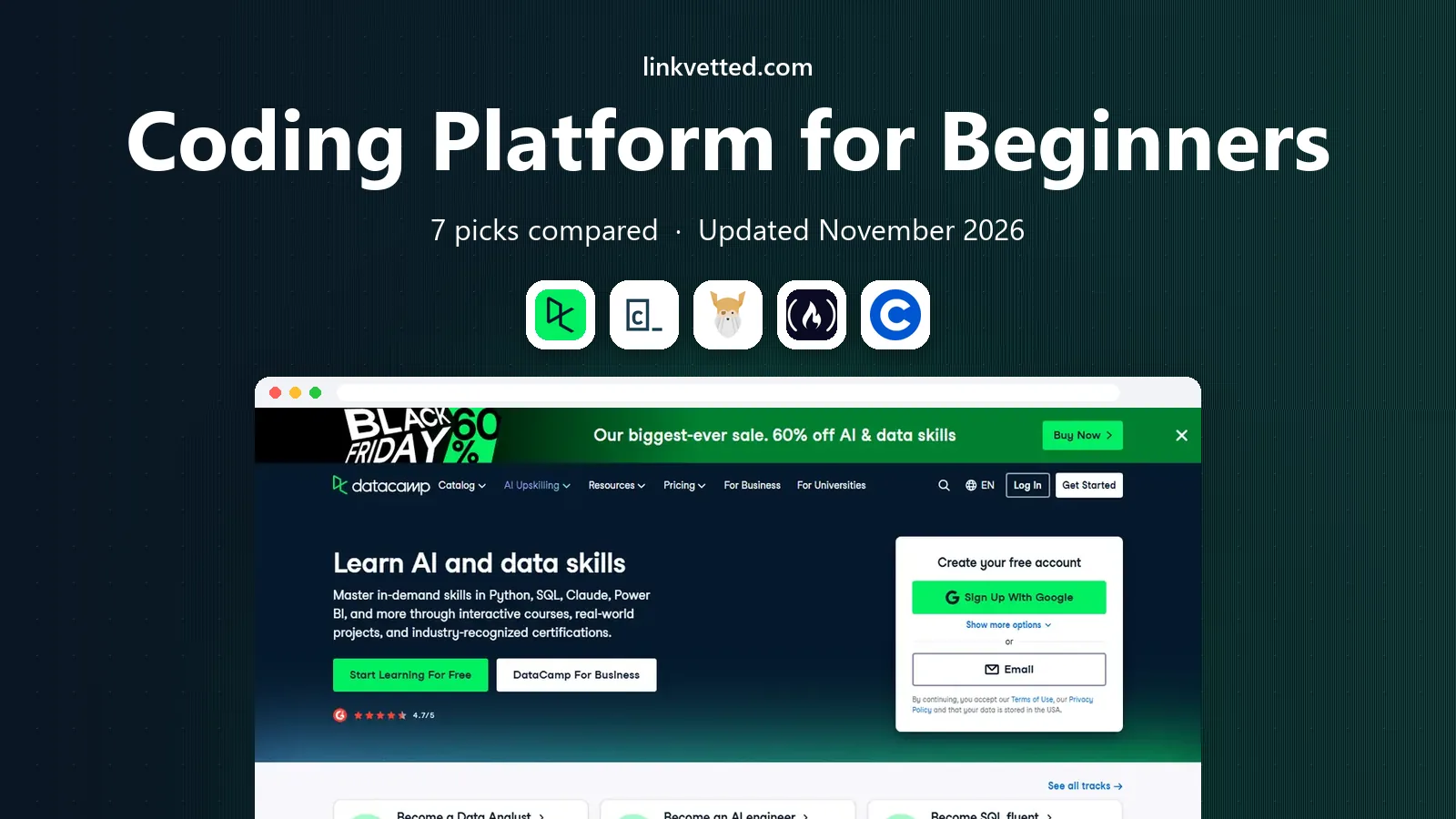
 DataCamp
Data science and Python
Starts atSee websiteVisit datacamp.comFull review - Great alternative
 Codecademy
Interactive beginner lessons
Starts atSee websiteVisit codecademy.comFull review - Also consider
 The Odin Project
Free full-stack web dev path
Starts atSee websiteVisit theodinproject.comFull review
Direct answer
For data science and Python, DataCamp is where this list starts. Codecademy is better for interactive beginner lessons, and The Odin Project is better for free full-stack web dev path. Prices, free plans and limits for all 7 tools follow.
TL;DR:
- DataCamp takes the first slot, best suited to data science and Python.
- Scrimba fits learn by editing live code.
- 7 out of 7 tools include a free plan, among them DataCamp, Codecademy, The Odin Project and freeCodeCamp.
- The main caution on The Odin Project: strictly web development, no data science or mobile.
- DataCamp, Scrimba and the 5 others all sell by quote; expect sales conversations before you see a price.
Quick comparison
| Tool | Best for | Starts at | Free plan? | |
|---|---|---|---|---|
| DataCamp | Data science and Python | See website | Yes | Visit |
| Codecademy | Interactive beginner lessons | See website | Yes | Visit |
| The Odin Project | Free full-stack web dev path | See website | Yes | Visit |
 freeCodeCamp | Full free coding curriculum | See website | Yes | Visit |
 Coursera | University-backed certificates | See website | Yes | Visit |
 Khan Academy | Absolute first steps | See website | Yes | Visit |
 Scrimba | Learn by editing live code | See website | Yes | Visit |
Coding Platform for Beginners profiles
If you are comparing coding platform for beginners, this page covers 7 tools in one place: what each is best for, what it costs to start, whether it has a free plan, and the main limit to know about.
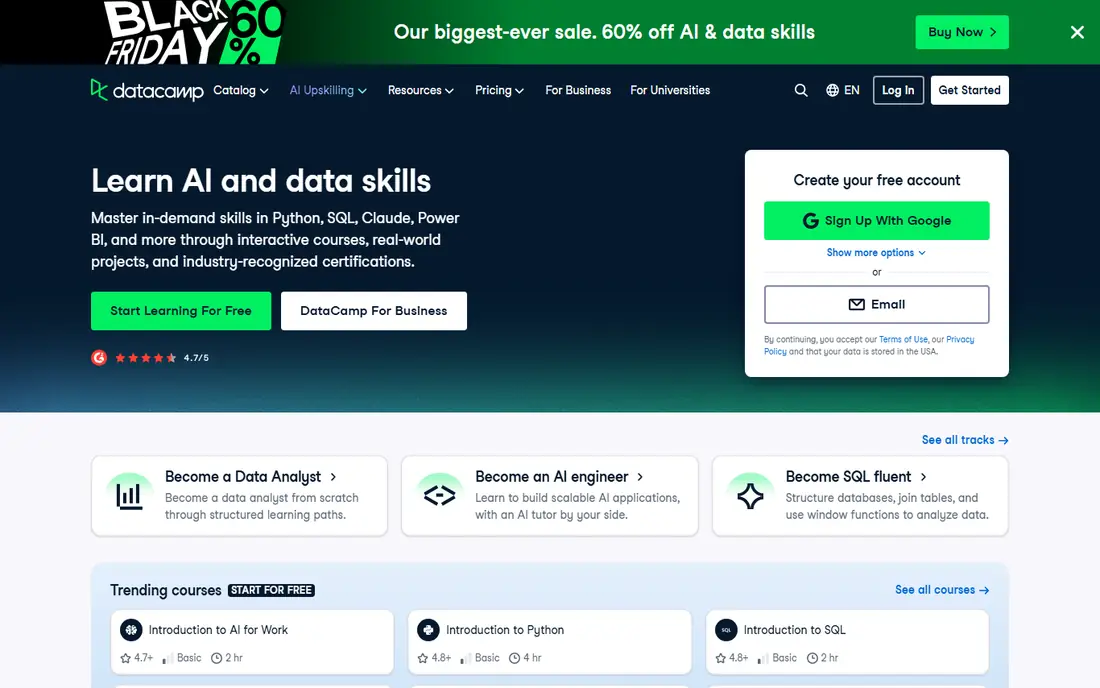
DataCamp makes the most sense for data science and Python. Career tracks bundle dozens of courses into a coherent path, and the workspace feature lets you practice on real datasets.
No starting price is listed for DataCamp here; confirm pricing on the vendor site. Free access exists with DataCamp.
What to check first: Niche focus.
- Career tracks for data analyst
- Data scientist and AI
- Not for web or app development

Codecademy makes the most sense for interactive beginner lessons. Codecademy made interactive learning normal. Beyond that, for someone deciding whether coding is for them, ten minutes on Codecademy answers the question.
Watch-outs: real depth is behind Plus or Pro.
In daily use, the honest catch is the paywall. The free Basic plan handles introductory courses, but career paths, projects and interview prep need Plus or Pro. Codecademy shows no starting price here, so confirm the cost on the vendor site. A free plan is available with Codecademy.
- Short lessons with instant feedback
- Built-in editor means zero setup
- Exercises can feel shallow compared with full projects
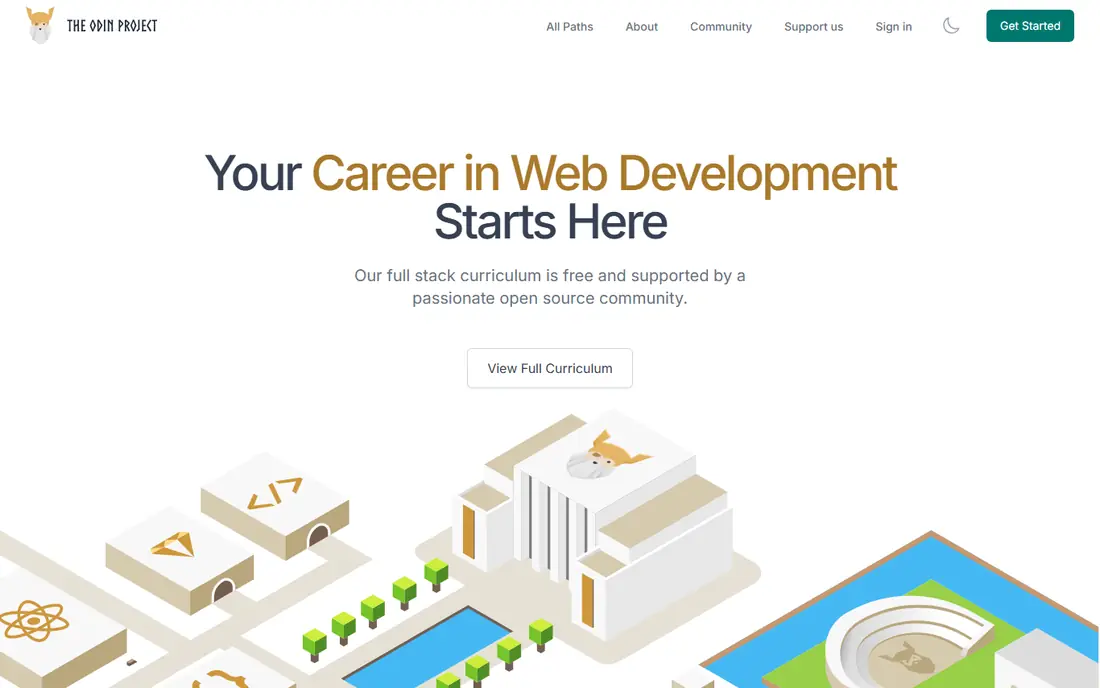
Pick The Odin Project if this describes you: free full-stack web dev path. Along the way it forces you to use Git, GitHub, the command line and Linux or WSL, which is exactly the tooling real jobs need. This is the free choice for anyone aiming at web development employment.
Limits to weigh: Strictly web development.
Worth adding: the Odin Project was built by working developers who thought bootcamps left out the practical parts. Its foundations path includes HTML, CSS and JavaScript, then splits into Ruby on Rails or Node.js tracks. On top of that, beginners who want a gentle on-ramp frequently start with freeCodeCamp and move to The Odin Project once they can code without hand-holding. The Odin Project shows no starting price here, so confirm the cost on the vendor site. A free plan is available with The Odin Project.
- Teaches tooling like Git and Linux alongside code
- Opinionated full-stack path with real projects
- No data science or mobile
freeCodeCamp targets full free coding curriculum. If you need accountability, pair it with a local study group or one premium course for structure.
In daily use, the biggest strength is also the honest catch: everything is free, but nobody is checking your work. Beginners who need a teacher looking over their shoulder tend to stall around the JavaScript algorithms section. No starting price is listed for freeCodeCamp here; confirm pricing on the vendor site. freeCodeCamp has a free plan.
Where it falls short: Quality varies across sections.
- Large community and nonprofit mission
- Fully free with no paywall on certifications
- You depend on forums and Discord
Coursera was built for University-backed certificates. Coursera is where university courses meet mass access. Its programming catalog comes with Python for Everybody from the University of Michigan, the Princeton algorithms sequence and Google's own certificates.
What to check first: Monthly subscription gets costly quick.
Coursera Plus bills monthly or yearly, and a slow learner can pay multiple months for one specialization. It makes sense if the credential matters for your job search or if your employer reimburses it. More specifically, for pure skill-building, the free alternatives above deliver the same knowledge without the invoice. You can audit most courses free, which means video and readings cost nothing; paying opens up graded assignments and the shareable certificate. No starting price is listed for Coursera here; confirm pricing on the vendor site. Free access exists with Coursera.
- Courses from real universities like Stanford and Michigan
- Free audit choice on most courses
- Course quality varies between partner institutions
Khan Academy serves absolute first steps. Its intro to JavaScript and HTML/CSS courses are among the most approachable on the internet, with short videos and a drawing-based playground that makes coding feel like play.
Limits to weigh: Not a path to employment.
No starting price is listed for Khan Academy here; confirm pricing on the vendor site. Khan Academy has a free plan.
- Fully free forever
- Well suited to younger learners and total newcomers
- Computing section is thin beyond basics
Scrimba is a good fit for learn by editing live code. Instructors record screencasts where you can pause the video, edit the code in the same window and resume watching.
Limits to weigh: Largely web development, narrow beyond that.
There is no data science, no back-end depth, no mobile. For everyday use, the system centres on front-end web development: HTML, CSS, JavaScript, React, TypeScript. Pricing for Scrimba is not stated here, so ask the vendor for current figures. Free access exists with Scrimba.
- Interactive screencasts you can pause and edit
- Solid front-end focus with modern tools
- Smaller catalog than the big systems
How the list was put together
Selection started from tools commonly considered for coding platform for beginners, then narrowed to 7 that have clear pricing information or a clear quote process. Figures are shown as the vendors publish them. Billing terms, seat minimums and add-ons can change the real cost. Order on the page follows fit for the typical buyer first, then price transparency and free access. Your own requirements should decide the final pick.
Pre-purchase checklist
- Confirm the entry price with every vendor: no tool from DataCamp to Scrimba shows a fixed starting price.
- Check what the free option really includes: DataCamp, Codecademy, The Odin Project and others offer a free plan, and usage caps differ.
- Before choosing DataCamp, weigh its main limit: niche focus, not for web or app development.
- Find out what support Scrimba includes on your plan, and whether onboarding help costs extra.
- Confirm the exact DataCamp plan that includes your must-have features.
FAQ
Which programming language should a beginner learn first?
Python is cleaner to read and dominates data science; JavaScript is the language of the web and lets you see leads to a browser at once. Pick one based on your goal and go deep instead of sampling three.
Which options for coding platform for beginners have a free plan?
On this list, 7 of 7 tools include a free plan, among them DataCamp, Codecademy, The Odin Project and freeCodeCamp. Caps on seats, usage or features are common, so test the free plan against your real workload.
How long does it take a beginner to learn coding?
Most people need three to six months of consistent daily practice to become comfortable with one language, and six to twelve months to be job-ready for an entry-level web or data role.
Do these tools publish their prices?
No. None of the tools, from DataCamp to Scrimba, shows a fixed starting price here, so budget time for quotes.
Can I try these tools before paying?
Often, yes. DataCamp, Codecademy, The Odin Project and others have a free plan. Use your own data and a real task during the test, and check what the free tier or trial limits before you rely on it.
Is a premium coding system worth it over free ones?
Only if you need structure, feedback or a credential. Free systems like freeCodeCamp and The Odin Project teach the same skills. Pay when you know you learn quicker with guidance, or when an employer will value the certificate.