8 Best CI CD Platforms with Blue Green Deployment in 2026
Compare 8 best CI CD platforms with blue green deployment, including GitHub Actions, GitLab, and Argo CD, with current pricing and honest trade-offs for teams.

- Editor's choice
 GitHub Actions
Teams already hosting code on GitHub
Starts atFree, then from $4 per user per month for TeamVisit github.comFull review - Great alternative
 GitLab CI CD
Teams wanting code, CI, and deployment in one place
Starts atFree, then from $29 per user per month for PremiumVisit about.gitlab.comFull review - Also consider
 Jenkins
Teams needing full pipeline control
Starts atFree open source softwareVisit jenkins.ioFull review
TL;DR:
- GitHub Actions and GitLab CI CD suit teams already using those code platforms, with blue green support through workflows and integrations.
- Jenkins and CircleCI offer flexible pipelines for teams that need custom deployment logic.
- AWS CodeDeploy and Azure DevOps fit cloud native teams on AWS or Azure, with native rollback tools.
- Argo CD and Spinnaker suit Kubernetes teams that need GitOps and advanced deployment strategies.
Quick comparison
| Tool | Best for | Starts at | Free plan? | |
|---|---|---|---|---|
| GitHub Actions | Teams already hosting code on GitHub | Free, then from $4 per user per month for Team | Yes | Visit |
| GitLab CI CD | Teams wanting code, CI, and deployment in one place | Free, then from $29 per user per month for Premium | Yes | Visit |
| Jenkins | Teams needing full pipeline control | Free open source software | Yes | Visit |
 CircleCI | Teams wanting fast cloud pipelines | Free, then from $15 per month | Yes | Visit |
 AWS CodeDeploy | AWS teams needing native blue green deploys | Pay per use on AWS | Free trial | Visit |
 Azure DevOps | Microsoft and Azure teams | Free, then from $6 per user per month | Yes | Visit |
 Argo CD | Kubernetes teams using GitOps | Free open source software | Yes | Visit |
 Spinnaker | Large teams needing multi cloud deployments | Free open source software | Yes | Visit |
The best CI CD platforms with blue green deployment
We compared these options on fit, pricing, and the details that matter in daily use, and the list below covers a range of budgets and team sizes. Each pick earns its place for a different reason, so start with your own workflow, then check the trade offs that matter most to you.
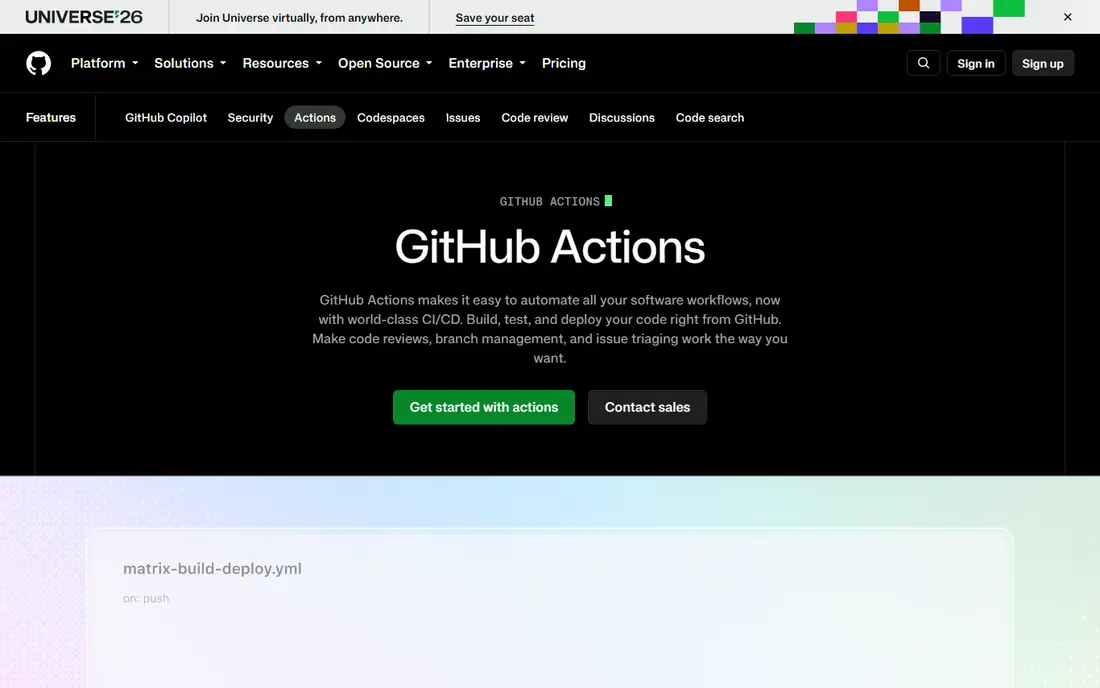
GitHub Actions is the natural pick for teams already on GitHub. Workflows can build, test, and deploy, and blue green patterns work through environments, actions, and deployment tools that manage traffic switching.
The catch is assembly. Blue green support is not a single button for every stack, so you will combine workflows, actions, and your platform deployment tools. Check the current pricing page before you buy, since plans and included features change over time, and run a trial with your real data where a free plan or trial is available.
- Tight GitHub integration
- Large marketplace
- Flexible workflow automation
- Blue green logic often needs actions or scripts
- Costs rise with minutes and runners

GitLab CI CD suits teams that want one platform from code to production. Its pipelines, environments, and deployment tools support blue green patterns, and built in security scanning reduces the need for extra tools.
The catch is tiering. Advanced deployment and compliance controls sit on Premium or higher, so check the tier that covers your needs. Check the current pricing page before you buy, since plans and included features change over time, and run a trial with your real data where a free plan or trial is available.
- Code, CI, security, and deployment in one platform
- Strong environment support
- Premium features needed for advanced deployment controls
- Self hosting adds work
Jenkins remains the flexible choice for teams that want full control. Its plugin library covers almost any build and deployment pattern, including blue green deployments through deployment plugins and scripts.
The catch is ownership. You manage Jenkins, plugins, security, and scaling, so the free software label hides real operating work. Check the current pricing page before you buy, since plans and included features change over time, and run a trial with your real data where a free plan or trial is available.
- Free and highly extensible
- Huge plugin library
- Runs anywhere
- Setup and upkeep fall to your team
- Blue green logic needs plugins and scripts
CircleCI is a strong cloud pipeline choice for teams that value speed. Its runners, caching, and orbs help builds finish fast, and deployment orbs support blue green patterns with Kubernetes and cloud platforms.
The catch is integration. Blue green logic often comes through orbs and external deployment tools, so test your exact stack during a trial. Check the current pricing page before you buy, since plans and included features change over time, and run a trial with your real data where a free plan or trial is available.
- Fast cloud runners
- Good Docker and Kubernetes support
- Clear pipeline config
- Blue green support depends on orbs and deployment tools
- Costs rise with usage
AWS CodeDeploy is the direct blue green tool for AWS workloads. It supports blue green deployments for EC2, Lambda, and ECS, with traffic shifting and automatic rollback if alarms trigger.
The catch is cloud scope. CodeDeploy is AWS focused, so multi cloud teams will need another tool or a wrapper to cover other clouds. Check the current pricing page before you buy, since plans and included features change over time, and run a trial with your real data where a free plan or trial is available.
- Native blue green for EC2, Lambda, and ECS
- Automatic rollback
- CloudWatch integration
- AWS only focus
- Learning curve for multi cloud teams
Azure DevOps suits teams already using Azure and Microsoft tools. Its pipelines support blue green patterns through deployment jobs, environments, and Azure deployment tools, with rollback options built in.
The catch is breadth. The suite covers many tools, so small teams may find setup heavier than GitHub Actions or CircleCI. Check the current pricing page before you buy, since plans and included features change over time, and run a trial with your real data where a free plan or trial is available.
- Pipelines, repos, and boards in one suite
- Strong Azure deployment support
- Best value inside Microsoft ecosystem
- Interface can feel broad for small teams
Argo CD is the GitOps standard for Kubernetes deployments. It syncs cluster state from Git, shows drift, and rolls back cleanly, while Argo Rollouts adds blue green and canary strategies.
The catch is scope. Argo CD is Kubernetes focused, so teams without Kubernetes will need a different CI CD platform for blue green work. Check the current pricing page before you buy, since plans and included features change over time, and run a trial with your real data where a free plan or trial is available.
- GitOps model for Kubernetes
- Clear sync and rollback
- Strong for blue green with Argo Rollouts
- Kubernetes only
- Setup and learning curve for new GitOps teams
Spinnaker is built for large, multi cloud deployment programs. Its pipelines support blue green, canary, and red black strategies across clouds, with approval gates and rollback controls for critical releases.
The catch is operations. Spinnaker needs a skilled platform team to run and maintain, so smaller teams should prefer a managed CI CD tool. Check the current pricing page before you buy, since plans and included features change over time, and run a trial with your real data where a free plan or trial is available.
- Multi cloud deployment strategies
- Strong blue green and canary support
- Mature pipelines
- Complex setup and operations
- Needs skilled platform team
How we picked these
We compared official pricing pages, documentation, and feature pages for each platform, and we checked blue green support, rollback tools, Kubernetes support, and cloud coverage. We favored tools that are live and actively maintained in October 2026, and we kept the list mixed from hosted CI CD to open source deployment tools. We did not claim hands on testing, and we used See website where pricing is usage based or open source.
How to pick a CI CD platform for blue green deployment
Start with your runtime. A Kubernetes app, an AWS Lambda function, and a traditional server app each need different blue green tooling, and a platform that excels at one may be weak at another. List your environments, traffic routing method, database migration pattern, and rollback needs before you shortlist.
Test traffic switching and rollback, not just builds
A blue green deployment is only safe if traffic shifts cleanly and rolls back fast when health checks fail. Test the full flow in staging, including database changes, session handling, and external integrations, and confirm how long rollback takes. A pipeline that builds fast but rolls back slowly is not a safe blue green tool.
Count pipeline and runner costs at real volume
Hosted CI CD pricing often depends on minutes, users, or concurrent runners, so model costs at your real build frequency. Open source tools look free, but hosting, upkeep, and platform team time add cost, so compare total effort, not just license price. A managed tool can be cheaper once you count engineering time.
FAQ
What is blue green deployment?
Blue green deployment runs two identical environments, with one live and one idle. You deploy to the idle environment, test it, then switch traffic to it, which makes rollback as simple as switching traffic back.
Which CI CD platform is best for blue green deployment on Kubernetes?
Argo CD with Argo Rollouts and Spinnaker are strong for Kubernetes blue green and canary strategies. GitHub Actions, GitLab, and CircleCI can also drive Kubernetes deployments through their pipelines and deployment tools.
Can GitHub Actions do blue green deployment?
Yes, through workflows, environments, and deployment actions or tools that manage traffic switching. The exact setup depends on your cloud or Kubernetes platform, so test it with your real stack.
Is blue green deployment better than canary deployment?
Blue green switches all traffic at once after testing, while canary shifts a small share first to check for issues. Blue green is simpler to reason about, while canary reduces blast radius for risky changes.
Do I need to change my database for blue green deployment?
Often yes, since database changes must work with both old and new app versions during the switch. Use backward compatible migrations, expand then contract patterns, and test rollback with real data in staging.