6 Business Analytics Tool Replacing Legacy BI Worth Shortlisting in 2026
Best business analytics tool replacing legacy BI in 2026: 6 contenders with entry costs and free tiers. Plain-spoken summaries throughout. Updated for 2026.
- Editor's choice
 Domo
Governed data for AI and business insights
Starts atSee websiteVisit domo.comFull review - Great alternativeOracle Analytics Cloud
Self-service discovery with enterprise reporting
Starts atSee websiteVisit oracle.comFull review - Also consider
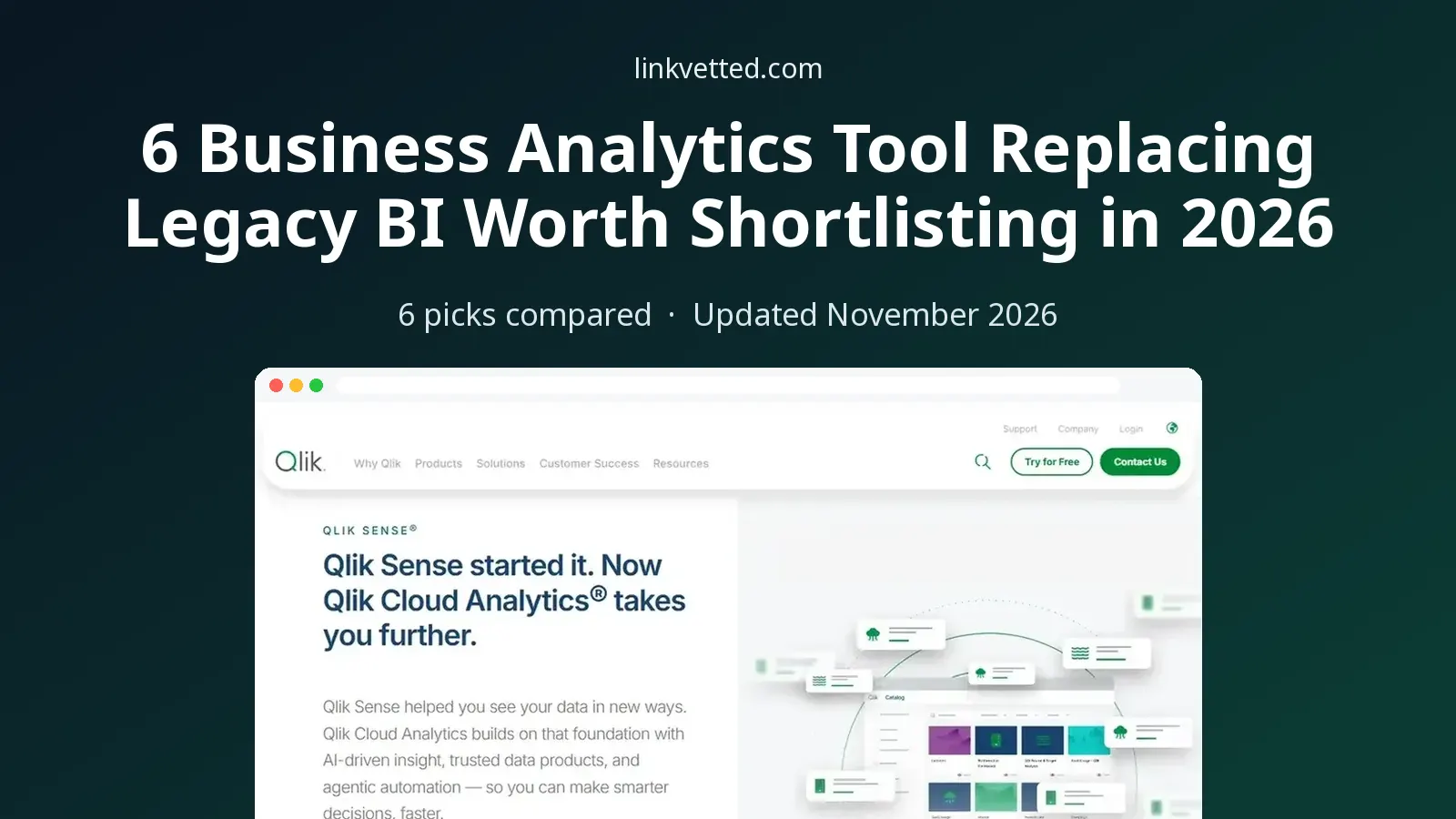
 Qlik Sense
End-to-end data integration and analytics
Starts atSee websiteVisit qlik.comFull review
Direct answer
Domo comes first here, mainly for governed data for AI and business insights. Listed starting prices: Tableau from $15 per user per month. Alternatives: Oracle Analytics Cloud for self-service discovery with enterprise reporting, and Qlik Sense for end-to-end data integration and analytics. Prices, free plans and limits for all 6 tools follow.
TL;DR:
- Domo sits first on this list: governed data for AI and business insights.
- Tableau stands alone as the one tool in this list with a free plan.
- A fair warning about Oracle Analytics Cloud: may need Oracle ecosystem familiarity.
- Tableau fits visual analytics and wide data connectivity.
Last checked November 2026. Prices and plan details were read from the vendors' own pages in November 2026; vendors change plans often, so confirm the current price on the vendor site before you buy.
Quick comparison
| Tool | Best for | Starts at | Free plan? | |
|---|---|---|---|---|
| Domo | Governed data for AI and business insights | See website | Free trial | Visit |
| Oracle Analytics Cloud | Self-service discovery with enterprise reporting | See website | Not stated | Visit |
| Qlik Sense | End-to-end data integration and analytics | See website | Not stated | Visit |
| SAP Analytics Cloud | Integrated BI, planning, and predictive analysis | See website | Not stated | Visit |
 Looker | Governed semantic layer and embedded analytics | See website | Not stated | Visit |
 Tableau | Visual analytics and wide data connectivity | $15 per user per month | Yes | Visit |
Every option for business analytics tool replacing legacy BI explained
This LinkVetted guide covers 6 options for business analytics tool replacing legacy BI. Each profile lists a starting price, free plan details, strengths and drawbacks, so you can drop poor fits quickly.
Domo serves governed data for AI and business insights. Domo strengthens the whole data journey with AI and data products. It links and moves data from any source, prepares and expands data access for exploration, and accelerates business-critical insights.
As for the details, Domo's thorough approach may need significant setup and governance planning, which could be heavy for smaller teams. If you need a more straightforward visualization tool, consider Tableau or Looker. This comparison lists no price for Domo; ask the vendor. Free options: Free trial.
Where it is weaker: Can be overwhelming for small teams. Best features of Domo: Links and moves data from any source.
- Accelerates business-critical insights
- Prepares and expands data access
- May need setup for data governance
Oracle Analytics Cloud
Best for: Self-service discovery with enterprise reporting
Oracle Analytics Cloud works best for self-service discovery with enterprise reporting. Oracle Analytics Cloud is a thorough analytics option that merges self-service discovery with enterprise reporting and advanced analytics. It helps uncover hidden data insights with predictive capabilities.
Beyond that, the system's breadth can introduce complexity, and setup may need specialized skills. Also, if you seek a more simplified visualization experience, consider Tableau or Qlik Sense. Pricing for Oracle Analytics Cloud is not stated here, so ask the vendor for current figures. As for free access: Not stated.
What to check first: Can be complicated to configure.
- Advanced analytics and predictive capabilities
- Thorough analytics option
- May need Oracle ecosystem familiarity
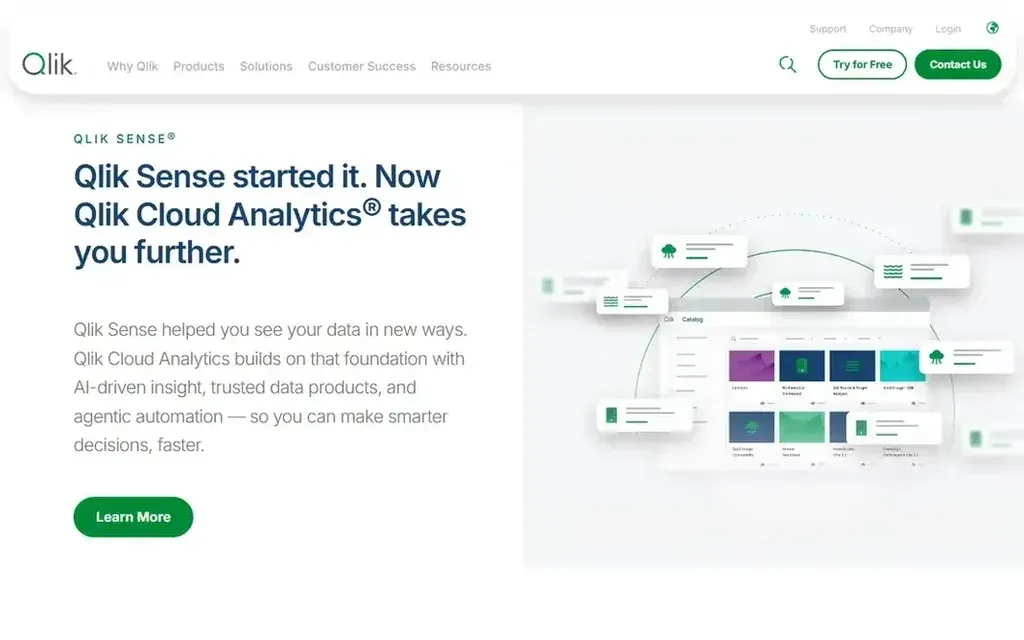
In short, Qlik Sense is for end-to-end data integration and analytics. Qlik Sense, now with Talend, delivers a data fabric and next-level insights through end-to-end data integration, data quality, and analytics options. The breadth of Qlik's product can mean a steeper ramp-up time, and managing the combined stack may need dedicated resources.
What to check first: May need training for full use.
From a buyer's view, if you prefer a more focused visualization tool, consider Tableau. The associative engine helps users explore data freely and uncover hidden relationships. Qlik Sense shows no starting price here, so confirm the cost on the vendor site. Free access: Not stated.
- Associative analytics engine
- End-to-end data fabric approach
- Integration with Talend can add complexity
SAP Analytics Cloud
Best for: Integrated BI, planning, and predictive analysis
For integrated BI, planning, and predictive analysis, SAP Analytics Cloud is a natural candidate. It suits organizations that require to combine historical reporting with forward-looking planning in a single product, particularly those already using SAP systems.
Where it is weaker: Best value for SAP-centric environments.
If you need a more straightforward standalone visualization tool, Tableau or Domo could be alternatives. This comparison lists no price for SAP Analytics Cloud; ask the vendor. Free options: Not stated.
- Cloud-based for accessibility
- Supports collaborative decision-making
- May be complicated to implement
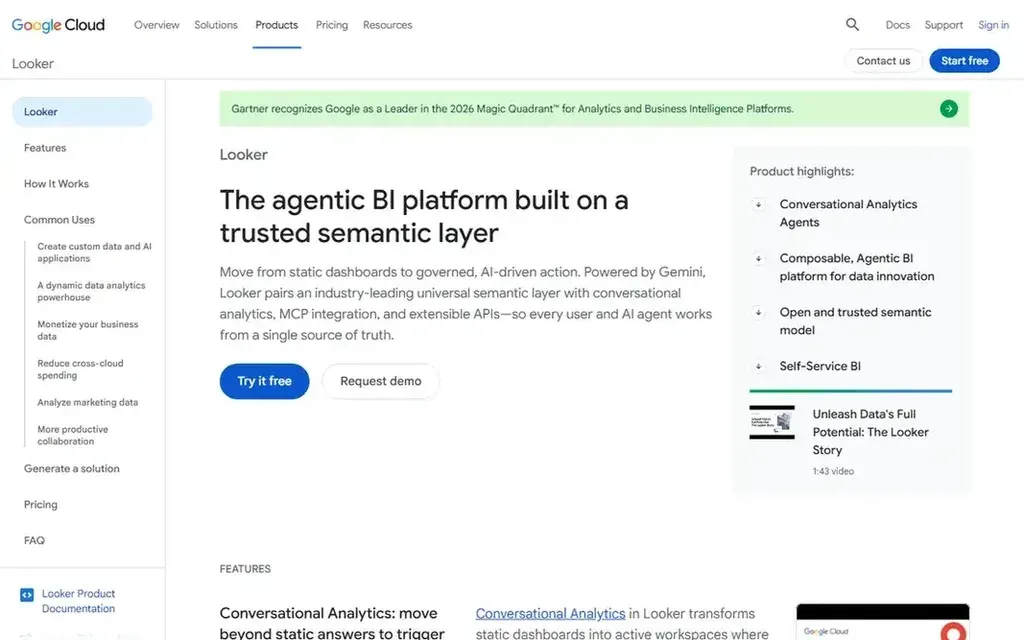
Pick Looker if this describes you: governed semantic layer and embedded analytics. Looker is Google Cloud's agentic business intelligence and embedded analytics product. It brings together metrics with a trusted semantic layer and Gemini agents, making it right for organizations that require consistent definitions and embedded analytics in other applications.
Drawbacks to consider: Needs setup of semantic model.
If you need fast, drag-and-drop visual exploration without deep modeling, Tableau might be a better fit. Looker's strength in governance means it depends on a well-defined semantic model, which can need upfront effort. Pricing for Looker is not stated here, so ask the vendor for current figures. On free options: Not stated.
- Trusted semantic layer for unified metrics
- Embedded analytics capabilities
- May be less adaptable for ad hoc visual exploration
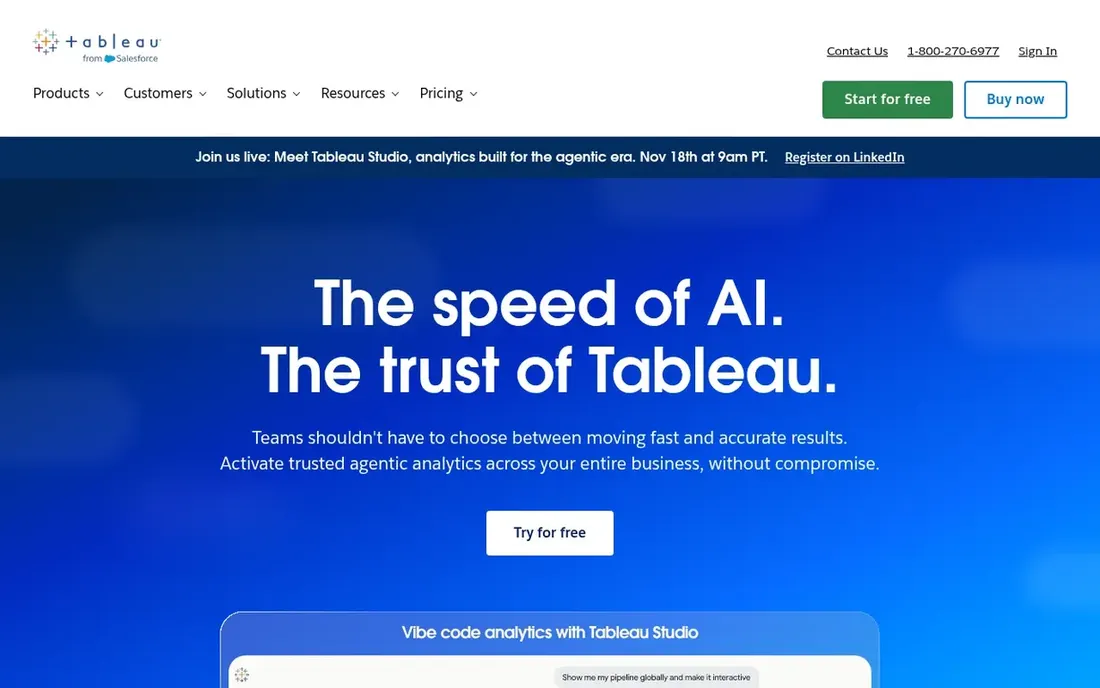
Tableau makes the most sense for visual analytics and wide data connectivity. Tableau is a business intelligence and analytics system that helps users see and understand their data. It permits connecting to almost any database, then dragging and dropping to produce visualizations and sharing them with a click.
Limits to weigh: Can be resource-intensive for large datasets.
In practice, if you need a tightly governed semantic layer or embedded analytics, consider Looker instead. From a buyer's view, Tableau's adaptability can come with a ramp-up time for complicated examines, and performance may vary with very large datasets. Tableau starts at: $15 per user per month. A free plan is available with Tableau.
- Simple sharing of insights
- Drag-and-drop visualization creation
- May need training for advanced use
Our selection method
LinkVetted looked at what each vendor publishes: pricing, plan limits, feature coverage for business analytics tool replacing legacy BI and stated drawbacks. No hands-on testing is claimed. Figures are shown as the vendors publish them. Billing terms, seat minimums and add-ons can change the real cost. We ordered the tools by general fit, then by how clearly pricing is shown, then by free access. A buyer with unusual needs may reorder them.
Things to verify first
- Ask Domo, Oracle Analytics Cloud, Qlik Sense and others for a written quote, since no starting price is shown.
- Look at the free plan from Tableau closely: its caps decide whether it is usable for real work.
- Take the trial from Domo and push a live task through it before you pay.
- Before choosing Domo, weigh its main limit: may need setup for data governance.
- Add up seats, add-ons and usage charges for Oracle Analytics Cloud before comparing it with cheaper entries.
- Confirm minimum seats and billing terms with Qlik Sense before you commit to an annual plan.
FAQ
What is the cheapest option for business analytics tool replacing legacy BI in this list?
On published monthly entry prices, Tableau is the lowest here at $15 per user per month. Entry price is only part of the cost, because seats, add-ons and billing terms can change the total. All 6 picks in this business analytics tool replacing legacy BI comparison list a starting price, free plan details and the main limits on their cards above.
Do these tools publish their prices?
Not all of them. Domo, Oracle Analytics Cloud, Qlik Sense and others publish no starting price, so expect a quote request for those. The rest, Tableau included, show a starting price, though seats and billing terms still change the final cost.
How are the tools for business analytics tool replacing legacy BI ordered?
The order follows typical fit for business analytics tool replacing legacy BI, with Domo first and Tableau last, then price clarity and free access. It is editorial judgement, not a score, so another team could rank the tools differently.
Which options for business analytics tool replacing legacy BI have a free plan?
Tableau is the only tool in this list with a free plan. Free plans usually cap users, projects or features, so check the limits on the vendor page. One other tool offers a trial instead. For the full picture, the cards above cover all 6 entries of this business analytics tool replacing legacy BI list, including price, free plan and limits.
How does Tableau compare to Looker for replacing legacy BI?
Tableau excels at visual exploration and wide data connectivity, whereas Looker emphasizes a governed semantic layer and embedded analytics. Tableau may be better for ad hoc analysis, whereas Looker fits organizations needing consistent metrics across applications.
Sources
- https://www.domo.com
- https://www.oracle.com/business-analytics/analytics-cloud.html
- https://www.qlik.com
- https://www.sap.com/products/technology-platform/cloud-analytics.html
- https://cloud.google.com/looker
- https://www.tableau.com