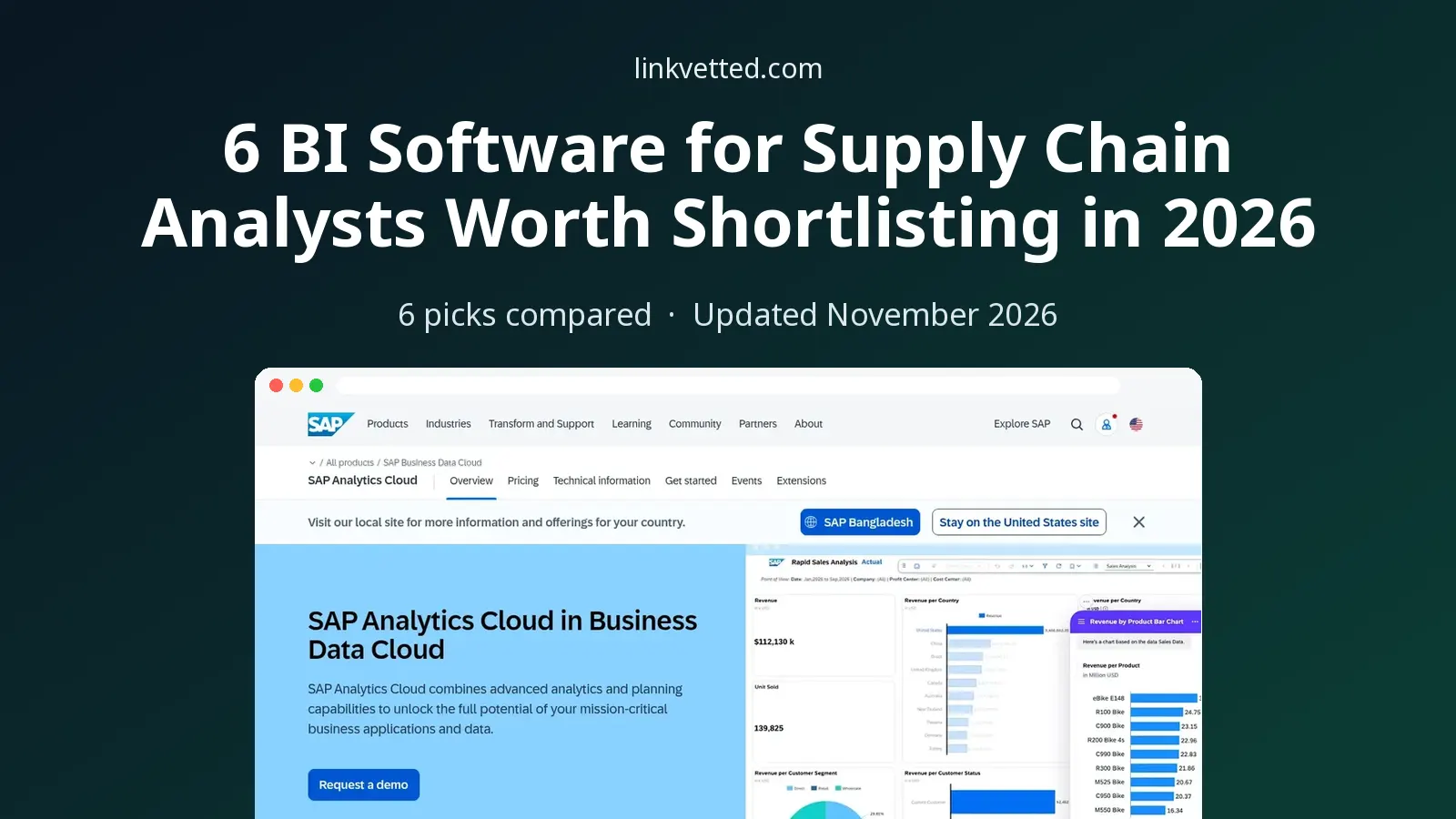
6 BI Software for Supply Chain Analysts Worth Shortlisting in 2026
Best BI software for supply chain analysts: 6 contenders ranked by fit, with entry costs and free tiers. The catches are listed up front. Prices included.
- Editor's choiceOracle Analytics Cloud
Enterprise reporting with advanced analytics
Starts atSee websiteVisit oracle.comFull review - Great alternativeSAP Analytics Cloud
SAP shops needing BI plus planning
Starts atSee websiteVisit sap.comFull review - Also consider
 Domo
Governed data pipelines for AI and insight
Starts atSee websiteVisit domo.comFull review
Direct answer
Oracle Analytics Cloud is the first pick on this list for enterprise reporting with advanced analytics. Listed starting prices: Tableau from $15 per user per month. SAP Analytics Cloud is better for SAP shops needing BI plus planning, and Domo is better for governed data pipelines for AI and insight. Prices, free plans and limits for all 6 tools follow.
TL;DR:
- Top of the list is Oracle Analytics Cloud, which targets enterprise reporting with advanced analytics.
- The main caution on Domo: wide product scope needs coordination.
- Only Tableau offers a free plan among these 6 tools.
- Qlik Sense is the one to check for associative exploration with data integration.
- Tableau has the lowest monthly starting price in this list: $15 per user per month.
Last checked November 2026. Prices and plan details were read from the vendors' own pages in November 2026; vendors change plans often, so confirm the current price on the vendor site before you buy.
Quick comparison
| Tool | Best for | Starts at | Free plan? | |
|---|---|---|---|---|
| Oracle Analytics Cloud | Enterprise reporting with advanced analytics | See website | Not stated | Visit |
| SAP Analytics Cloud | SAP shops needing BI plus planning | See website | Not stated | Visit |
| Domo | Governed data pipelines for AI and insight | See website | Free trial | Visit |
 Sisense | Embedding analytics into supply chain apps | See website | Free trial | Visit |
 Tableau | Visual exploration of supply chain data | $15 per user per month | Yes | Visit |
 Qlik Sense | Associative exploration with data integration | See website | Not stated | Visit |
BI Software for Supply Chain Analysts compared in detail
LinkVetted put together this guide to BI software for supply chain analysts for readers who want a clear shortlist without reading every vendor page. It compares 6 tools on starting price, free plans, who each one suits and where each one falls short.
Oracle Analytics Cloud
Best for: Enterprise reporting with advanced analytics
Oracle Analytics Cloud is aimed squarely at enterprise reporting with advanced analytics. Analysts wanting a lighter visual-first tool may prefer Tableau, whereas embedded use cases may point to Sisense.
Limits to weigh: Best fit within Oracle landscapes.
From a buyer's view, for supply chain analysts, that mix supports both everyday operational reporting and deeper investigation of demand or supplier patterns. No starting price is listed for Oracle Analytics Cloud here; confirm pricing on the vendor site. Free access: Not stated.
- Predictive and advanced analytics included
- Self-service discovery plus enterprise reporting
- Feature breadth can complicate administration
SAP Analytics Cloud
Best for: SAP shops needing BI plus planning
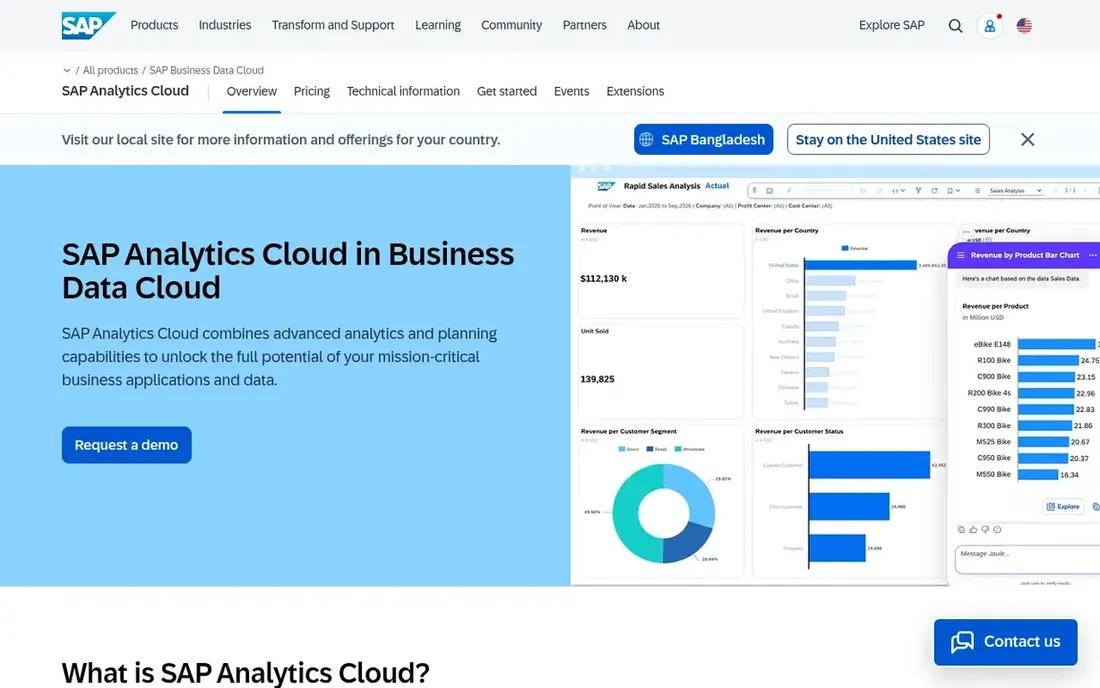
In short, SAP Analytics Cloud is for SAP shops needing BI plus planning. SAP Analytics Cloud is a cloud analytics product that brings business intelligence, planning and predictive analysis together.
Planning depth also includes configuration effort. If you chiefly need standalone visual analytics, Tableau or Qlik Sense may be more straightforward choices. Pricing for SAP Analytics Cloud is not stated here, so ask the vendor for current figures. Trial and free access: Not stated.
Trade-offs to know: Configuration can be involved.
- Combines BI
- Suits SAP-centric landscapes
- Most value appears inside SAP environments
Domo is designed for governed data pipelines for AI and insight. Domo presents itself around governed data for AI agents, with products spanning the data journey. For supply chain work, that means pulling together inventory, transportation and supplier feeds before analysis.
In daily use, analysts can link and move data from plenty of sources, prepare it, and expand access for exploration before accelerating business-critical insights. Since Domo spans data movement, preparation and insight delivery, coordinating roles and governance takes deliberate effort. As for the details, teams seeking only chart building may find the scope bigger than needed. This comparison lists no price for Domo; ask the vendor. Free plan details: Free trial.
Trade-offs to know: Data governance setup takes effort.
- Links and moves data from plenty of sources
- Prepares and expands data access
- Wide system scope needs coordination
Sisense makes the most sense for embedding analytics into supply chain apps. Sisense is an AI-powered embedded analytics product that aims to turn data into revenue through pro-code, low-code and no-code adaptability.
It suits product and engineering teams that require analytics woven into applications, with choices for different skill levels. Check the vendor site for Sisense pricing; none is listed in this comparison. On free options: Free trial.
Honest limits: Needs development resources for integration.
- Pro-code
- Low-code and no-code adaptability
- Embedded focus may not suit standalone BI
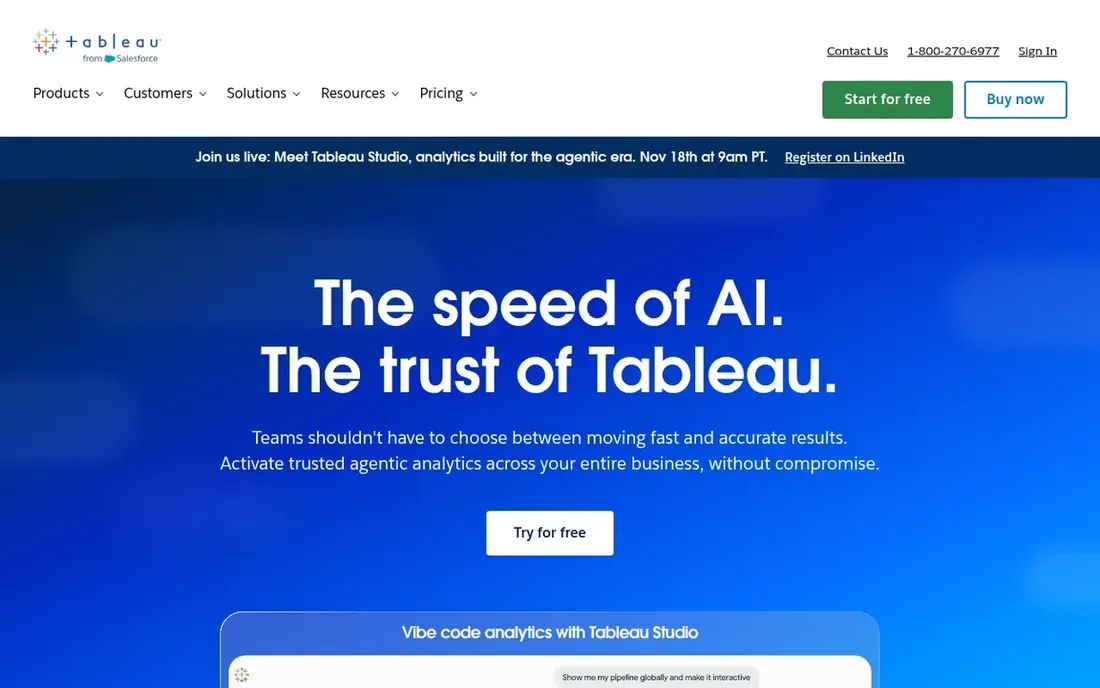
Tableau is built with visual exploration of supply chain data in mind. Shared views publish with a click, which helps supply chain teams circulate inventory and logistics findings.
It suits analysts who value quick visual exploration and want an adaptable workspace for blending operational data from multiple systems. Starting cost for Tableau: $15 per user per month. Tableau has a free plan.
Where it falls short: Advanced governance needs planning.
- Links to almost any database
- Share dashboards with a click
- Complicated models can need careful setup
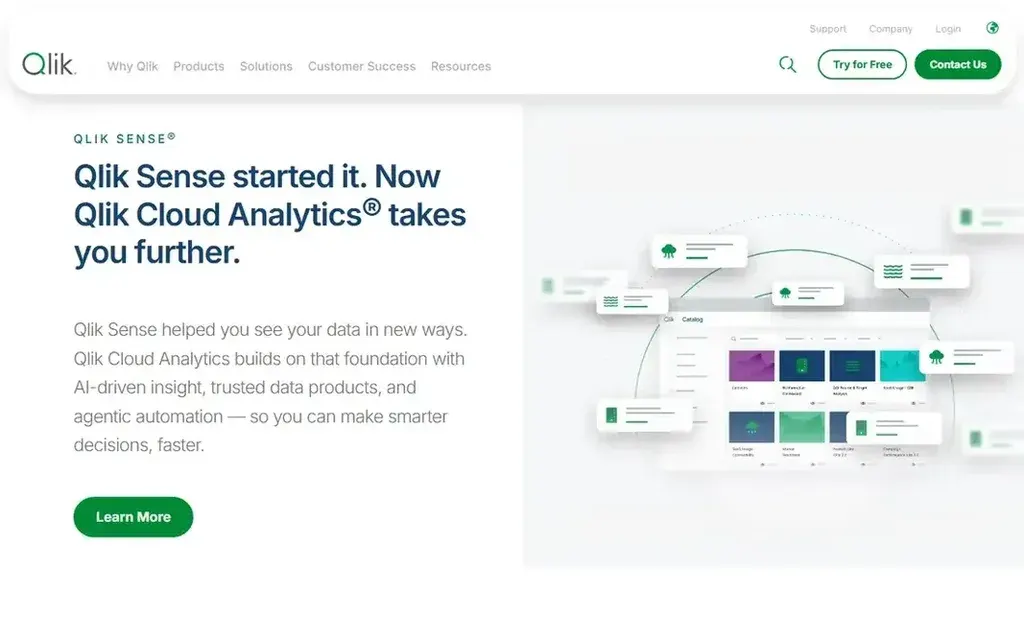
Qlik Sense serves associative exploration with data integration. The system emphasizes associative exploration, letting analysts follow relationships across supply, demand and logistics data instead of querying one chart at a time. The wider suite also means more components to configure and govern.
For everyday use, the associative approach differs from the drag-and-drop style plenty of analysts know, so onboarding takes time. Teams wanting a more straightforward visual-first start may prefer Tableau, whereas SAP-centric organizations may lean toward SAP Analytics Cloud. Pricing for Qlik Sense is not stated here, so ask the vendor for current figures. Free plan details: Not stated.
Limits to weigh: Learning curve for the associative model.
- End-to-end analytics positioning
- Associative analytics engine
- Breadth of suite can overwhelm newcomers
What went into this list
Selection started from tools commonly considered for BI software for supply chain analysts, then narrowed to 6 that have clear pricing information or a clear quote process. Treat prices as a snapshot: vendors change plans often, so check the vendor site for the figure that applies today. Tools are placed by general fit for BI software for supply chain analysts, with price clarity and free access as tie-breakers. A different team can reasonably rank them differently.
Pre-purchase checklist
- Confirm the entry price on the vendor page. For Oracle Analytics Cloud, SAP Analytics Cloud, Domo and others that means a quote rather than a fixed price.
- Test the free plan from Tableau against your real workload before relying on it.
- Use real work to test the free trial from Domo and Sisense, rather than a demo project.
- Read the limits listed for Oracle Analytics Cloud first: feature breadth can complicate administration.
- Ask the daily users to test SAP Analytics Cloud on a live task before you roll it out to everyone.
- Ask Tableau how an export works before you move any records in; an easy exit lowers the risk.
FAQ
Which options for BI software for supply chain analysts have a free plan?
Tableau is the only tool in this list with a free plan. Free plans usually cap users, projects or features, so check the limits on the vendor page. Several others offer a trial instead. Each of the 6 options in this BI software for supply chain analysts guide has its own card above with the price, free plan and limits.
Can I try these tools before paying?
Often, yes. Tableau has a free plan and Domo and Sisense offer a free trial. Use your own data and a real task during the test, and check what the free tier or trial limits before you rely on it. All 6 picks in this BI software for supply chain analysts comparison list a starting price, free plan details and the main limits on their cards above.
Which BI tool is a good match for supply chain analysts new to analytics?
Start with Oracle Analytics Cloud if you need enterprise reporting with advanced analytics. SAP Analytics Cloud is the better match for SAP shops needing BI plus planning, and Domo for governed data pipelines for AI and insight. The best choice depends on budget, team size and workflow.
How are the tools for BI software for supply chain analysts ordered?
Oracle Analytics Cloud sits first and Qlik Sense last because the order follows typical fit for BI software for supply chain analysts, then price clarity and free access. It is a judgement call, so read each profile for fit and limits.
Do these tools publish their prices?
Not all of them. Oracle Analytics Cloud, SAP Analytics Cloud, Domo and others publish no starting price, so expect a quote request for those. The rest, Tableau included, show a starting price, though seats and billing terms still change the final cost.
Sources
- https://www.oracle.com/business-analytics/analytics-cloud.html
- https://www.sap.com/products/technology-platform/cloud-analytics.html
- https://www.domo.com
- https://www.sisense.com
- https://www.tableau.com
- https://www.qlik.com