7 Best Data Platforms for 2026
Shortlisting the best data platforms? 7 products compared on cost, free access and ideal buyer. The weak spots sit next to the strengths. See the full list.

- Editor's choice
 Firebolt
High-speed analytics engineering
Starts atSee websiteVisit firebolt.ioFull review - Great alternative
 Palantir Foundry
Operational data with heavy governance
Starts atSee websiteVisit palantir.comFull review - Also consider
 Snowflake
SQL analytics at enterprise scale
Starts atSee websiteVisit snowflake.comFull review
Direct answer
This list puts Firebolt first for high-speed analytics engineering. Palantir Foundry is the stronger choice for operational data with heavy governance, while Snowflake suits SQL analytics at enterprise scale. All 7 tools are compared below on price, free plan and limits.
TL;DR:
- Firebolt sits first on this list: high-speed analytics engineering.
- Starburst is the one to check for Querying data where it lives.
- Google BigQuery stands alone as the one tool in this list with a free plan.
- One limit worth knowing about Domo: pricing scales steeply with usage.
- Every tool from Firebolt to Starburst works by quote, with no list price shown.
Quick comparison
| Tool | Best for | Starts at | Free plan? | |
|---|---|---|---|---|
| Firebolt | High-speed analytics engineering | See website | Free trial | Visit |
| Palantir Foundry | Operational data with heavy governance | See website | No | Visit |
| Snowflake | SQL analytics at enterprise scale | See website | Free trial | Visit |
 Domo | Warehouse plus BI in one subscription | See website | Free trial | Visit |
 Google BigQuery | Serverless analytics on Google Cloud | See website | Yes | Visit |
 Databricks | Lakehouse for engineering and AI workloads | See website | Free trial | Visit |
 Starburst | Querying data where it lives | See website | Free trial | Visit |
Data Platforms compared in detail
LinkVetted put together this guide to data platforms for readers who want a clear shortlist without reading every vendor page. It compares 7 tools on starting price, free plans, who each one suits and where each one falls short.
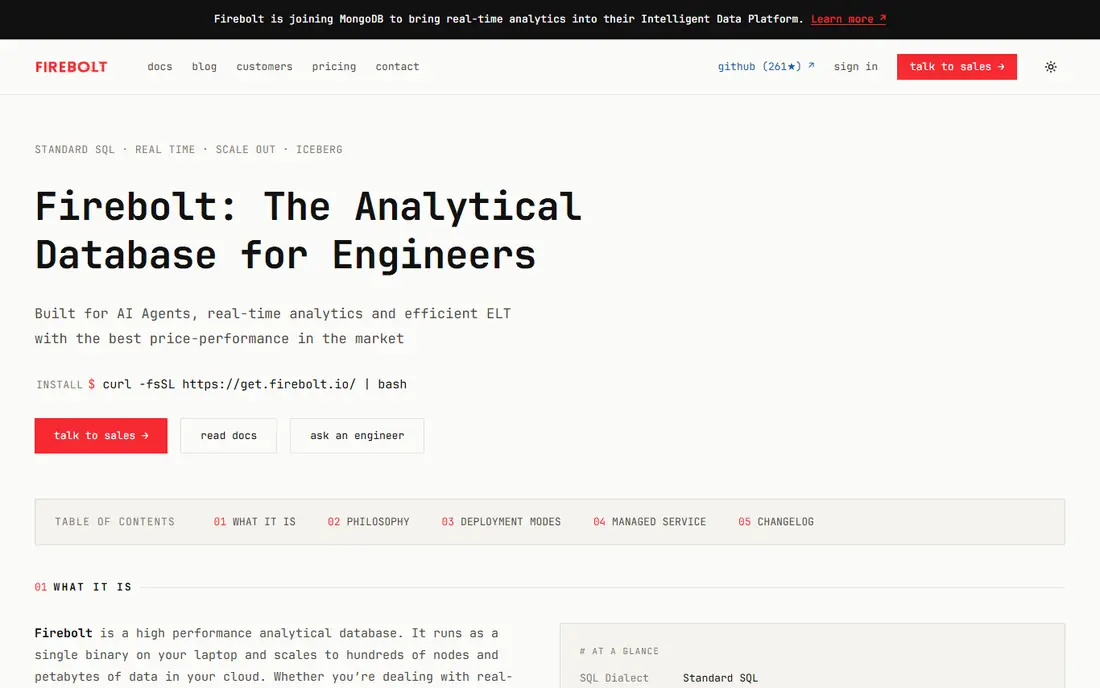
Firebolt targets high-speed analytics engineering. Firebolt is an engineering-led warehouse made for speed: sub-second queries on large datasets with efficient resource use. Also, the ecosystem is proportionally smaller: fewer connectors, fewer community resources, fewer consultants who know it.
Limits to weigh: Fewer native integrations.
For everyone else, the safe incumbents remain safer. Also, for teams whose workload is performance-sensitive and who have the engineering skill to evaluate properly, Firebolt's benchmarks are impressive. Worth adding: as a younger company it carries more vendor risk than Snowflake or the cloud giants. No starting price is listed for Firebolt here; confirm pricing on the vendor site. Free options: Free trial.
- Efficient compute usage
- Very quick query performance for analytics workloads
- Company is younger with a shorter track record

Palantir Foundry works best for operational data with heavy governance. Foundry is not a warehouse with dashboards; it is an operating system for organizational data, modeling real entities like patients, aircraft or supply chains in an ontology that applications build on.
Where it shines: health and industry.
Trade-offs to know: Enterprise pricing and long implementations.
Standard reporting and analytics teams will find it heavyweight. Palantir Foundry does not show a starting price in this comparison, so check the vendor site for current pricing. Palantir Foundry does not include a free plan.
- Ontology models real-world operations
- Proven in defense
- Needs significant organizational commitment

Snowflake serves SQL analytics at enterprise scale. Snowflake made the cloud data warehouse boring in the best way: no servers to run, storage and compute billed separately, and SQL that analysts already know.
What to check first: Costs surprise teams that do not govern compute.
Compute charges accrue whenever queries run, and an unoptimized dashboard refreshing every five minutes becomes a line item. Teams that implement resource watches, auto-suspend and query governance do fine; teams that do not get an unpleasant invoice. Pricing for Snowflake is not stated here, so ask the vendor for current figures. Free options: Free trial.
- Huge partner and integration ecosystem
- Near-zero administration
- Data egress and multi-cloud add complexity
In short, Domo is for warehouse plus BI in one subscription. Business-led teams get from question to dashboard in days, and the connector library spans the SaaS tools mid-sized businesses actually use.
Watch-outs: Enterprise data teams frequently prefer best-of-breed.
Check the vendor site for Domo pricing; none is listed in this comparison. Free access: Free trial.
- Huge connector library
- Merges data system and visualization in one tool
- Pricing scales steeply with usage
For serverless analytics on Google Cloud, Google BigQuery is a natural candidate. BigQuery's pitch is radical simplicity: point it at data, run SQL, pay for what you scan. Worth adding: partitioning, clustering and the flat-rate editions exist precisely to control this, but they need knowledge.
Limits to weigh: Data transfer costs need watching.
There is no warehouse to size, no cluster to tune. The free level (ample monthly allowances for storage and queries) lets small teams run real analytics for nothing. On top of that, organizations already on Google Cloud get the smoothest experience with native integrations across the stack. Google BigQuery shows no starting price here, so confirm the cost on the vendor site. Google BigQuery includes a free tier.
- Very good for huge ad-hoc queries
- Ample free level for getting started
- On-demand query pricing punishes unoptimized SQL
Pick Databricks if this describes you: Lakehouse for engineering and AI workloads. The adaptability costs simplicity. Teams without data engineering skills find Databricks harder to adopt than Snowflake.
Points against: Cost management needs engineering discipline.
The usage-based pricing across plenty of workload types needs active management. More specifically, for a finance team that just needs dashboards, it is more system than necessary. Its AI features for building LLM applications on enterprise data are now a major reason firms choose it. This comparison lists no price for Databricks; ask the vendor. Trial and free access: Free trial. Strengths: Delta Lake brings reliability to data lakes.
- Brings together data engineering
- SQL analytics and machine learning
- Overkill for straightforward BI reporting
Starburst works best for Querying data where it lives. Starburst, built on open-source Trino, lets analysts run SQL across data wherever it sits: S3, Snowflake, Postgres, Elasticsearch and more, without centralizing everything first. Also, for organizations with data spread across systems that cannot or should not move, federation beats migration.
Trade-offs to know: Performance relies on underlying sources.
Best features of Starburst: Built on open-source Trino.
It is an extra system to operate, not a replacement for storage. For everyday use, everyone else is normally better served centralizing in a warehouse first. This comparison lists no price for Starburst; ask the vendor. Trial and free access: Free trial.
- Avoids expensive data movement
- Lakes and databases
- Another layer to handle
Selection criteria
Pricing pages, product documentation and feature lists were the main sources, and every entry carries at least one honest drawback. Figures are shown as the vendors publish them. Billing terms, seat minimums and add-ons can change the real cost. Position on the page reflects fit for a typical buyer first, with price clarity and free access breaking ties. Treat it as a guide, not a ruling.
Before you commit
- Ask each vendor, from Firebolt to Starburst, for a written quote; none of them publishes a starting price.
- Test the free plan from Google BigQuery against your real workload before relying on it.
- Take the trial from Firebolt, Snowflake, Domo and others and push a live task through it before you pay.
- Before choosing Firebolt, weigh its main limit: smaller ecosystem than the giants.
- Check the integration list for Domo against the tools you run today, and note which ones need a higher plan.
- Compare total cost, not headline price: for Google BigQuery, add extra seats, add-ons and any usage-based charges.
FAQ
How are the tools for data platforms ordered?
Firebolt sits first and Starburst last because the order follows typical fit for data platforms, then price clarity and free access. It is a judgement call, so read each profile for fit and limits.
Is Firebolt the right pick for everyone comparing data platforms?
No single tool suits every team. Firebolt comes first because it fits high-speed analytics engineering, while Palantir Foundry suits operational data with heavy governance and Snowflake suits SQL analytics at enterprise scale. Match the tool to your own size, budget and workflow before deciding.
Do I need a data platform or just a BI tool?
Small businesses frequently start with the database they have plus a BI tool, and adopt a dedicated data system when queries slow down, data grows, or governance becomes necessary.
Which options for data platforms have a free plan?
Google BigQuery is the only tool in this list with a free plan. Free plans usually cap users, projects or features, so check the limits on the vendor page. Several others offer a trial instead.
Do these tools publish their prices?
No. None of the tools, from Firebolt to Starburst, shows a fixed starting price here, so budget time for quotes.