Best Embedded BI Tools in 2026: 9 Tools Compared
Compare the best embedded bi tools for 2026, with Sisense, Tableau, Power BI, Looker and more, plus pricing and developer options for teams. for growing teams.

- Editor's choice
 Sisense
Turnkey embedded analytics
Starts atSee websiteVisit sisense.comFull review - Great alternative
 Tableau
Visualization quality
Starts at$15 per monthVisit tableau.comFull review - Also consider
 Power BI Embedded
Microsoft-centered teams
Starts atSee websiteVisit microsoft.comFull review
TL;DR:
- Sisense is our pick for product teams that want turnkey embedded dashboards with strong developer tools.
- Tableau leads on visualization quality, but its per-user pricing grows fast at scale.
- Power BI Embedded suits Microsoft-centered teams, with capacity pricing from about $735 per month for A1 capacity.
- Looker is best for governed metrics on Google Cloud, thanks to its LookML semantic layer.
- Per-user pricing breaks down at scale, so model your cost at 10 times your current user count before you sign.
Quick comparison
| Tool | Best for | Starts at | Free plan? | |
|---|---|---|---|---|
| Sisense | Turnkey embedded analytics | See website | Free trial | Visit |
| Tableau | Visualization quality | $15 per month | Free trial | Visit |
| Power BI Embedded | Microsoft-centered teams | See website | Free trial | Visit |
 Looker | Governed metrics on Google Cloud | See website | No | Visit |
 ThoughtSpot | Search-driven embedded analytics | $25 per month | Free trial | Visit |
 Qlik Sense | Deep exploration | $30 per month | Free trial | Visit |
 GoodData | API-first embedded BI | See website | Free trial | Visit |
 Metabase | Low-cost embedded dashboards | Free | Yes | Visit |
 Holistics | Code-based embedded analytics | $800 per month | Free trial | Visit |
The best embedded BI tools
The best embedded BI software puts dashboards inside your product, with your branding, your permissions, and your data, without making users open a separate analytics app. We compared official pricing pages, embedding docs, and developer features, and favored tools with clear multi-tenant support and honest pricing models.
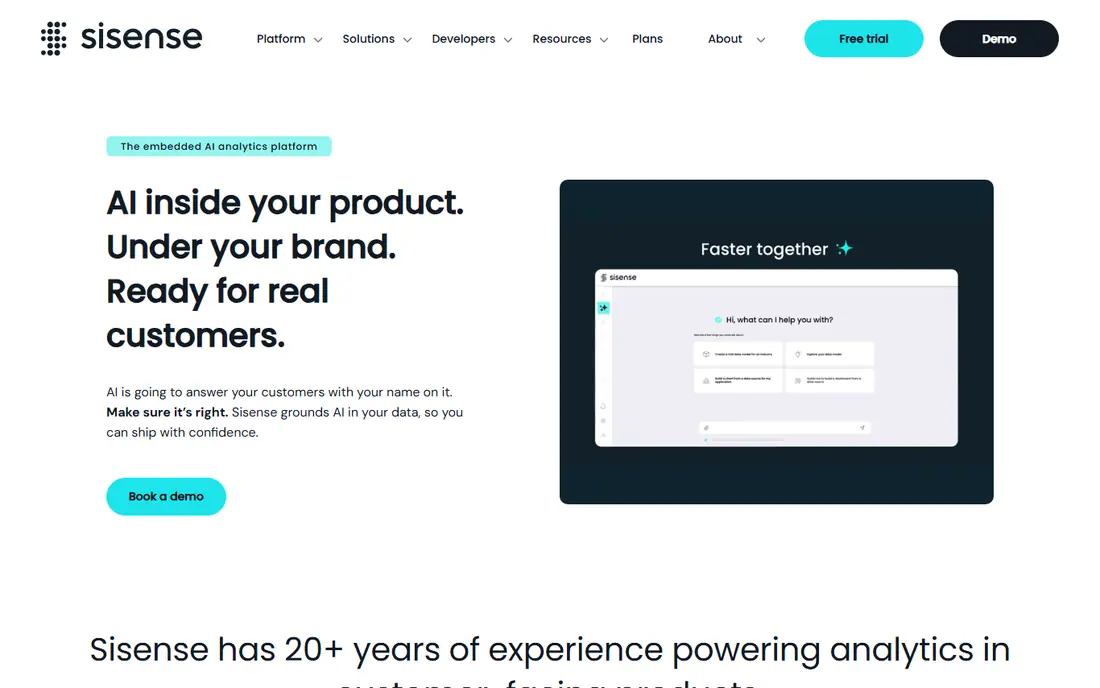
Sisense is built for software teams that want to embed analytics as a product feature, not as an afterthought. Its embedding SDK, white-label options, and dashboard widgets let you place charts inside your app with your branding. The in-memory engine handles complex dashboards well, and its AI features help users explore data.
Pricing is quote-based, with mid-market deployments reported from about $25,000 to $150,000 per year. That range means you need a sales conversation and a clear user model before you budget. For a product team that wants a mature, turnkey embedded platform, Sisense remains a top pick.
- Developer-friendly embedding
- Strong dashboard widgets
- In-memory engine
- Pricing is custom
- Setup effort for custom builds

Tableau leads on visualization. Its chart library, formatting control, and exploration tools are the standard other tools are judged against, and its Embedding API v3 plus Connected Apps support modern single sign-on embedding. Product teams that care most about how dashboards look will find Tableau hard to beat.
The cost model is the catch. Viewer starts at $15 per user per month, Explorer at $42, and Creator at $75, with enterprise tiers roughly doubling those rates. At customer scale, per-user pricing can dwarf the value of the dashboards. Model your cost at scale, and check Tableau Embedded licensing carefully, before you commit.
- Best chart library
- Embedding API v3
- Strong exploration tools
- Per-user costs grow fast
- Enterprise pricing is quote-based
Power BI Embedded lets Microsoft-centered teams embed reports in their apps using Azure capacity, rather than per-user licenses for every viewer. A1 capacity is reported from about $735 per month, and Pro starts at $14 per user per month for authors. That capacity model can be cheaper than per-user pricing at scale.
Licensing complexity is the downside. Capacity tiers, author licenses, and Fabric options interact in ways that need careful mapping. Teams already on Microsoft 365 and Azure will get the most value. Teams outside that stack should compare Sisense or GoodData first.
- Deep Microsoft integration
- Capacity pricing
- Broad visualization library
- Licensing is complex
- Best value requires Microsoft stack commitment
Looker, now part of Google Cloud, is best for teams that need one governed definition of every metric. Its LookML semantic layer defines metrics in code, with Git version control, so every dashboard uses the same numbers. Embedding via its SDK and single sign-on fits product teams on Google Cloud.
Pricing is custom, with reports from about $35,000 per year and higher for larger deployments. LookML also takes time to learn, and small teams may find it heavy. For a data team that values governance over speed, Looker is the strongest embedded BI platform here.
- LookML semantic layer
- Git-native modeling
- Warehouse-native queries
- Pricing is custom
- LookML learning curve is steep
ThoughtSpot Everywhere embeds search-driven analytics, so users can type a question and get a chart, rather than only viewing a fixed dashboard. Its Spotter AI agent helps with follow-up questions, and Liveboards let users explore without learning a query language. That self-service model suits non-technical customers.
Essentials starts at $25 per user per month, with Pro at $50, and Enterprise custom. Per-user costs and AI query caps on lower tiers need checking at scale. If your customers want to ask questions, not just read dashboards, ThoughtSpot is the pick.
- Natural language search
- Spotter AI agent
- Liveboards for exploration
- Per-user pricing
- AI query caps on lower tiers
Qlik Sense uses an associative engine that lets users explore data freely, seeing how selections affect every chart at once. That model suits analysts and curious users who want to dig, not just view a report. Embedding options support product use, and Qlik Sense Business starts from $30 per user per month billed annually.
The learning curve is steeper than Tableau or ThoughtSpot, and enterprise pricing moves to capacity-based quotes. For a team that values deep exploration over simple dashboards, Qlik Sense is a strong choice. For simple embedded charts, a lighter tool may be faster.
- Associative engine
- Free-form exploration
- Strong data prep
- Steeper learning curve
- Enterprise pricing is capacity-based
GoodData is built API-first for software vendors. Its React components, headless BI options, and metrics-as-code approach suit product teams that want analytics as code, deployed like the rest of their app. Multi-tenant workspaces are a core design point, not a workaround.
Pricing is custom, with reports from about $30,000 per year for larger deployments. That developer-first model needs engineering time, so non-technical teams may prefer Sisense or Metabase. For an API-led product team, GoodData is one of the cleanest embedded BI platforms available.
- API-first design
- React components
- Headless BI options
- Pricing is custom
- Needs developer time to get the most from it
Metabase is the low-cost entry point. Self-hosting is free, cloud plans are published, and interactive embedding via iframe is easy to set up. Small teams can embed a dashboard in a day, without a sales call or a large budget. That speed makes it a favorite for startups.
Governance is limited, with no central semantic layer, and multi-tenant use needs manual work. You will outgrow Metabase when you need strict metric governance or complex tenant isolation. Until then, it is the best embedded BI tool for a small team on a budget.
- Free self-hosted option
- Easy interactive embedding
- Fast setup
- Limited governance
- Multi-tenant support needs manual work
Holistics offers code-based embedded analytics with published pricing from $800 per month, which is rare in this category. Its AML modeling language, native Git, and CI/CD support suit data teams that want analytics as code, with governed metrics and drag-and-drop exploration for business users.
The code model means casual users will need data team support, and its community is smaller than Tableau or Power BI. For a warehouse-native team that wants transparent pricing and version control, Holistics is a compelling mid-price pick. Check its dashboard templates for your use case during the trial.
- Published pricing from $800 per month
- Git and CI/CD
- Warehouse-native queries
- Smaller community than Tableau
- Code model suits data teams, not casual users
How we picked these
We compared official pricing pages, embedding documentation, and developer features, and favored tools with current embedding APIs, single sign-on, and multi-tenant support. We kept a mix of turnkey, code-based, and low-cost options, and we noted where pricing is custom. Tools without a current embedding story, or without active maintenance, did not make the list.
How to choose an embedded BI tool without regret
Start with your pricing model at scale. Per-user pricing looks cheap at 100 users and painful at 10,000, while capacity or flat-rate pricing stays predictable. Ask every vendor for a quote at your projected user count in two years, not just today, and get it in writing.
Next, check tenant isolation, permissions, and branding. Can each customer see only their own data, with your logo and colors, and with single sign-on from your app. Test that flow with two fake tenants before you buy. Finally, check developer experience: embedding SDK quality, docs, and Git support matter more than a demo dashboard, since your team will live with the SDK for years.
Build versus buy
Building dashboards from scratch gives full control, but it costs engineering time for charts, filters, permissions, and performance. Buying an embedded BI tool trades some control for speed and maintenance. Most product teams buy, and use their engineering time on the data model and the user experience around the dashboards.
FAQ
What is the best embedded BI tool?
Sisense is the best turnkey pick for product teams, Tableau is best for visualization quality, and Looker is best for governed metrics. The best embedded BI tool for you depends on pricing model, governance needs, and whether your team prefers code or drag-and-drop tools.
What is embedded BI software?
Embedded BI software puts dashboards, charts, and analytics inside another app, such as a SaaS product or customer portal, so users see insights without opening a separate tool. It includes branding, permissions, and single sign-on, so each customer sees only their own data.
How much does embedded BI cost?
Costs range from free with Metabase self-hosted, to $800 per month with Holistics, to custom quotes from about $25,000 per year with Sisense and higher with Looker. Per-user tools like Tableau and ThoughtSpot start low per user but grow fast at customer scale. Always model cost at projected scale.
Is Power BI Embedded good for SaaS products?
Yes, if your team is Microsoft-centered. Power BI Embedded offers capacity pricing that can beat per-user costs at scale, plus a broad chart library. Licensing is complex, so map capacity, author licenses, and viewer access before you commit.
What is the best embedded BI platform for startups?
Metabase is the best startup pick, with a free self-hosted option and fast embedding. Holistics is a strong next step when you need governance and published pricing. Start simple, and move to Sisense or GoodData when tenant scale and governance demand it.
Does embedded BI require coding?
It depends on the tool. Metabase and Tableau offer low-code embedding, while Looker, GoodData, and Holistics need code for modeling and deployment. Check your team's skills and the SDK docs during a trial, since developer experience varies widely.