Best Brokerage Apps for Beginners in 2026: 8 Apps Compared
We compared the best brokerage apps for beginners on commissions, fractional shares, education and account types, so first time investors can start safely.
- Editor's choice
 Fidelity
Best overall for beginners
Starts at$0 commissionVisit fidelity.comFull review - Great alternative
 Charles Schwab
Education and practice trading
Starts at$0 commissionVisit schwab.comFull review - Also consider
 Robinhood
Simplest first trades
Starts at$0 commissionVisit robinhood.comFull review
TL;DR:
- Fidelity is the best overall pick for beginners, with $0 stock and ETF commissions, fractional shares from $1, strong research and retirement accounts.
- Charles Schwab is close behind, with $0 commissions, extensive education and paper trading through thinkorswim for practice.
- Robinhood is the simplest first app, while Webull suits beginners who want charts and paper trading from the start.
- This is not financial advice. Investing carries risk, including loss of money, so start small, diversify and check fees beyond headline commissions.
- Commission free does not mean cost free. Check options fees, spreads, account fees and cash sweep terms before you fund an account.
Quick comparison
| Tool | Best for | Starts at | Free plan? | |
|---|---|---|---|---|
| Fidelity | Best overall for beginners | $0 commission | Yes | Visit |
| Charles Schwab | Education and practice trading | $0 commission | Yes | Visit |
| Robinhood | Simplest first trades | $0 commission | Yes | Visit |
 Webull | Charts and paper trading | $0 commission | Yes | Visit |
 SoFi Invest | Simple plus automated investing | $0 commission | Yes | Visit |
 E*TRADE | Research and options tools | $0 commission | Yes | Visit |
 Public | Simple multi asset investing | $0 commission | Yes | Visit |
 Vanguard | Long term index investing | $0 commission | Yes | Visit |
The best brokerage apps for beginners
A brokerage app, also called one of the best brokerage platforms for beginners, is where you buy stocks, ETFs and other investments. For beginners, the differences that matter are not just commissions, which are $0 at most major brokers for US stocks and ETFs. They are account types, fractional shares, education, research quality and how easy the app is to use without making rushed trades. The apps below cover those needs in different ways.
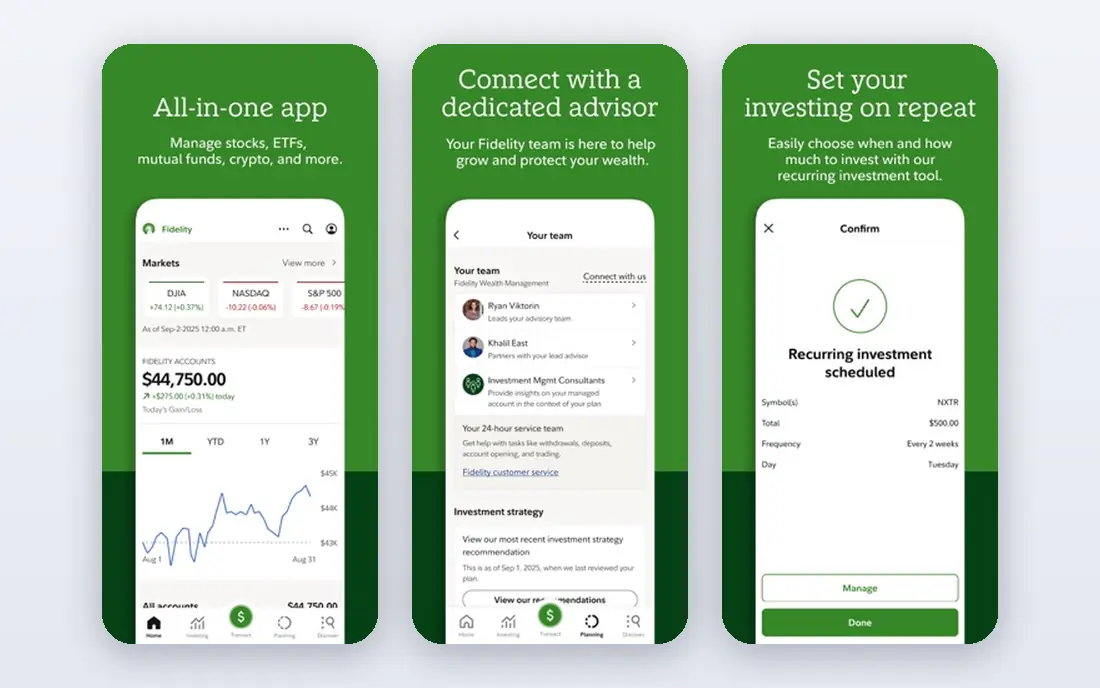
Fidelity is our pick for most beginners because it covers the whole journey, not just the first trade. You can open a taxable brokerage account, a Roth IRA or a traditional IRA in the same app, buy fractional shares from $1, and read research and education material before you invest. Customer support is also strong, which matters when you have a question about a transfer or a tax form.
The app packs in many features, so new users may feel overwhelmed by research tabs, planning tools and account types. Start with one account and one broad ETF or a small list of stocks, and ignore advanced tools until you need them. For a beginner who wants one broker that can grow with them, Fidelity is the safest default.
- $0 stock and ETF commissions
- Fractional shares from $1
- Strong research and retirement accounts
- App has many features, which can feel busy at first
- Options contracts cost $0.65 each
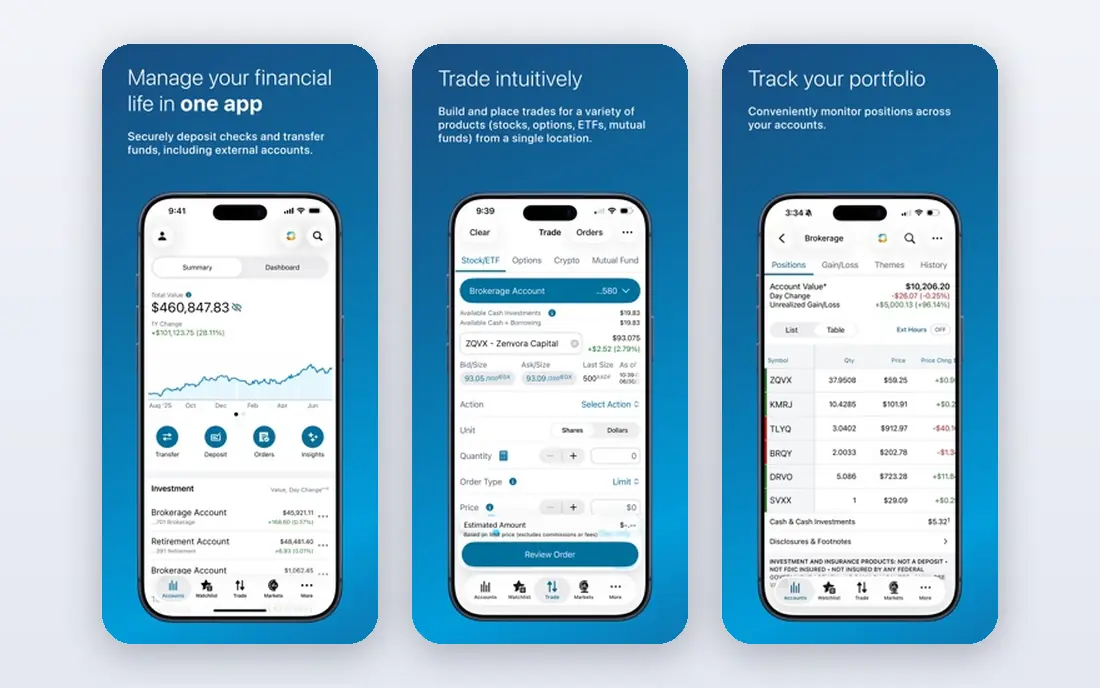
Charles Schwab is a close second and the best pick if you want to learn by practicing first. Its education library covers investing basics, retirement planning and market concepts in plain language, and thinkorswim offers paper trading, where you trade with virtual money before risking real dollars. Schwab Intelligent Portfolios also offers a managed option for beginners who prefer automation.
Fractional share options are more limited than Fidelity, with Schwab Stock Slices covering S&P 500 stocks rather than every stock, and some mutual funds carry transaction fees. Those limits rarely matter for a beginner starting with ETFs. If education and practice matter most to you, Schwab is an excellent first broker.
- $0 stock and ETF commissions
- Extensive education
- Paper trading through thinkorswim
- Fractional shares are more limited than Fidelity
- Some mutual funds carry transaction fees
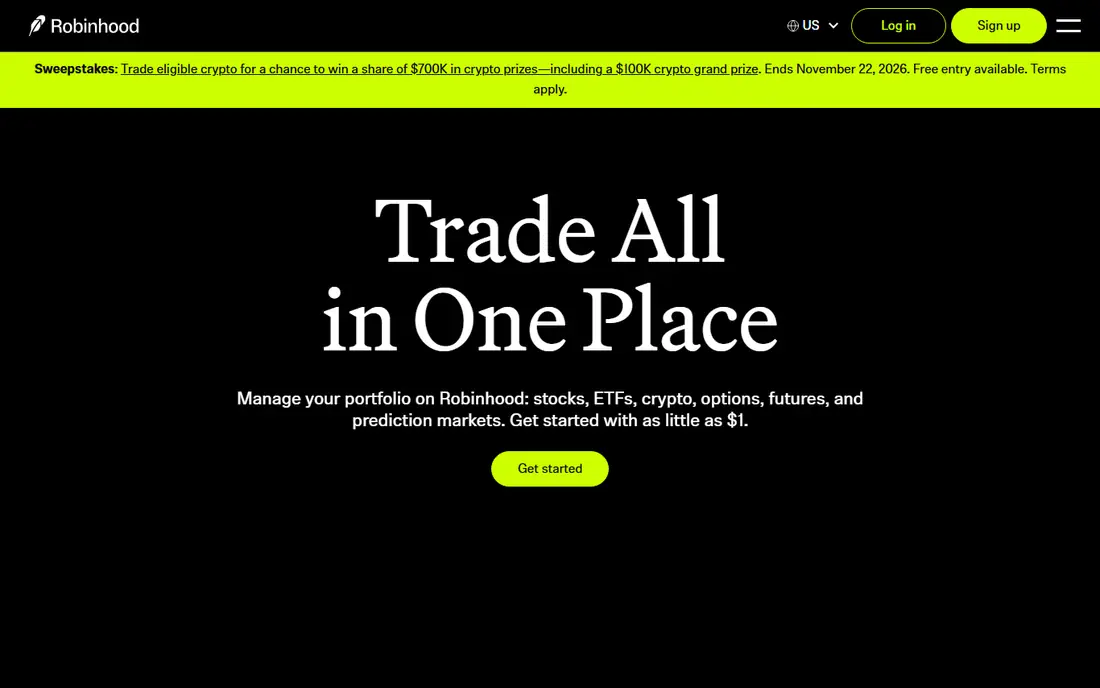
Robinhood remains the simplest first app for a total beginner. Opening an account, finding a stock or ETF, and placing a fractional order from $1 takes very little time, and the interface hides most advanced features until you look for them. Options contracts carry no per contract fee at Robinhood, which is unusual, though options trading is risky and not suitable for most beginners.
Research tools are thinner than Fidelity or Schwab, and there are no physical branches for in person help. Robinhood Gold, at $5 per month, adds research and other features, but beginners do not need it to start. If simplicity is your main barrier, Robinhood removes it. Pair it with outside reading on diversification and long term investing.
- Simplest interface
- Fractional shares from $1
- Stocks, ETFs, options and crypto in one app
- Limited research tools
- No physical branches
- Support can be slow at peak times
Webull suits beginners who want to learn charts and practice trading from the start. It offers $0 commissions on US stocks and ETFs, detailed charts and technical tools, and a paper trading mode to practice without real money. That combination appeals to beginners who are curious about market analysis but do not want to pay for a pro platform yet.
The interface is busier than Robinhood, with more data on screen, which can tempt new users into frequent trading. Frequent trading usually hurts beginners, so use charts to learn, not to chase daily moves. Webull is best for a beginner who wants data depth and practice tools, and who can set a long term plan and stick to it.
- $0 stock and ETF commissions
- Strong charts
- Paper trading
- No options contract fee in many cases
- Interface is busier than Robinhood
- Research and education are thinner than Schwab
SoFi Invest is a good pick for beginners who would rather not pick stocks at all, or who want banking and investing together. Active Investing offers $0 commissions and fractional shares from $5, while automated investing builds and rebalances a portfolio based on your goals and risk tolerance. The app is clean, and the wider SoFi platform covers checking, savings and loans.
Advanced tools are thinner than Fidelity, Schwab or E*TRADE, and there is no paper trading mode. That is fine for a beginner focused on long term, automated investing, but active traders will outgrow it. SoFi also won a best broker for beginners award in 2026 from Motley Fool Money, which reflects its beginner friendly design.
- $0 commissions
- Clean app
- Automated investing option
- Banking and investing in one place
- Fewer advanced tools than Fidelity or Schwab
- No paper trading
E*TRADE, now part of Morgan Stanley, balances research and tools for beginners who want room to grow. You get $0 commissions on US stocks and ETFs, fractional shares, research from several providers, and paper trading to practice. Account types cover taxable brokerage, IRAs and other retirement accounts, so a beginner can start simple and add complexity later.
The platform has many tools, which can feel busy compared with Robinhood or SoFi. Options contracts cost $0.65 each, the standard rate at most large brokers, so options traders should factor that in. For a beginner who wants solid research and a platform that will still fit in a few years, E*TRADE is a strong, balanced choice.
- $0 stock and ETF commissions
- Strong research
- Paper trading
- Broad account types
- Interface has many tools for a beginner
- Options contracts cost $0.65 each
Public suits beginners who want a simple app that covers several asset types in one place. You can invest in stocks, ETFs and crypto, plus other assets offered on the platform, with fractional shares and a clean interface. Social features let you see what other investors discuss, though you should treat those posts as conversation, not advice.
Research depth is thinner than the large brokers, and Public Premium, at $10 per month, adds features that beginners do not need at first. The social feed can also encourage copying trades without understanding them, so use it for ideas and do your own reading before you invest. For a simple, multi asset start, Public is easy to use.
- $0 stock and ETF commissions
- Fractional shares
- Stocks, ETFs, crypto and other assets in one app
- Research is thinner than Fidelity or Schwab
- Premium features cost $10 per month
Vanguard is the best home for long term index fund investors. Its own index funds and ETFs carry some of the lowest expense ratios available, often around 0.03 to 0.04 percent on flagship funds, and its IRAs and retirement tools suit a set and hold strategy. Stock and ETF commissions are $0, and there is no account minimum for ETFs.
The app and website trail rivals for active trading, charting and research, and customer service quality has drawn mixed reviews. Vanguard is not the pick for frequent traders or options. For a beginner whose plan is to buy broad index funds regularly and hold them for years, Vanguard keeps costs low and the strategy simple, which is exactly what most beginners need.
- $0 stock and ETF commissions
- Very low cost index funds
- Strong retirement accounts
- App trails rivals for active trading
- Customer service reviews are mixed
How we picked these
We compared official pricing pages, commission schedules, account types, fractional share minimums, education libraries and app features for US brokers active in October 2026. We favored brokers with $0 stock and ETF commissions, no or low account minimums, SIPC membership and clear fee pages, and we noted where options fees, premium tiers or limited fractional shares change the cost. This article is educational only and is not financial advice.
How to start safely as a beginner
Start with an emergency fund and a plan
Invest only money you do not need soon, after you have a basic emergency fund and high interest debt handled. Decide your goal, time horizon and risk tolerance before you pick investments, and write the plan down. A written plan helps you stay invested when markets fall, which is when beginners most often sell at the wrong time.
Favor broad diversification over single stock bets
A broad stock market or S&P 500 ETF spreads risk across hundreds of companies, while a single stock can fall sharply on company news. Many beginners start with one broad ETF, add regular contributions, and learn about individual stocks slowly. Diversification does not remove risk, but it removes the risk of one company failing.
Check the full fee picture
Headline commissions are $0 at most brokers here, but options contracts, premium tiers, spreads on crypto, margin interest and cash sweep rates still cost money. Read the fee schedule for the broker you choose, and avoid margin borrowing as a beginner, since borrowed money magnifies losses as well as gains.
FAQ
What is the best brokerage platform for beginners?
Fidelity is the best overall pick, with $0 commissions, fractional shares from $1, strong research and retirement accounts. Charles Schwab is close for education and practice trading, and Robinhood is simplest for a first trade. The best brokerage platforms for beginners all share $0 stock and ETF commissions, so pick on education, account types and ease of use.
How much money do I need to start investing?
Most brokers here have no account minimum, and fractional shares let you start with $1 at Fidelity and Robinhood, or $5 at SoFi. You do not need a large sum to learn. Start small, invest regularly if you can, and increase contributions as your income and confidence grow.
Is investing through an app safe?
Reputable US brokers are members of SIPC, which protects your account up to $500,000, including $250,000 in cash, if the broker fails. That protection does not cover investment losses, which are always possible. Use strong passwords, two factor authentication and the official app, and never share login codes with anyone.
Should beginners trade options or crypto first?
No, in most cases. Options and crypto are volatile and complex, and beginners can lose money quickly, especially with borrowed money or margin. Start with broad ETFs and learn the basics of risk, diversification and fees first. If you later explore options or crypto, use only money you can afford to lose and learn the risks fully first.
Do I need a Roth IRA as well as a brokerage account?
Many beginners benefit from both. A taxable brokerage account is flexible, with no contribution limits and withdrawals at any time. A Roth IRA offers tax free growth if you qualify, but has annual contribution limits and withdrawal rules. Open the account type that fits your goal, and consider a Roth IRA for long term retirement saving alongside a taxable account.
Sources
- https://www.fidelity.com/trading/commissions-margin-rates
- https://www.schwab.com/pricing
- https://robinhood.com/us/en/about/commission-fee-schedule/
- https://www.webull.com/pricing
- https://www.sofi.com/invest/
- https://www.etrade.com/pricing
- https://public.com/disclosures
- https://investor.vanguard.com/investment-products/fees