Best Baseball Card Value App in 2026: 8 Apps Compared
Compare the best baseball card value apps for scanning, grading checks and sold prices, so you can tell a raw card estimate from a real sale. See details.
- Editor's choice
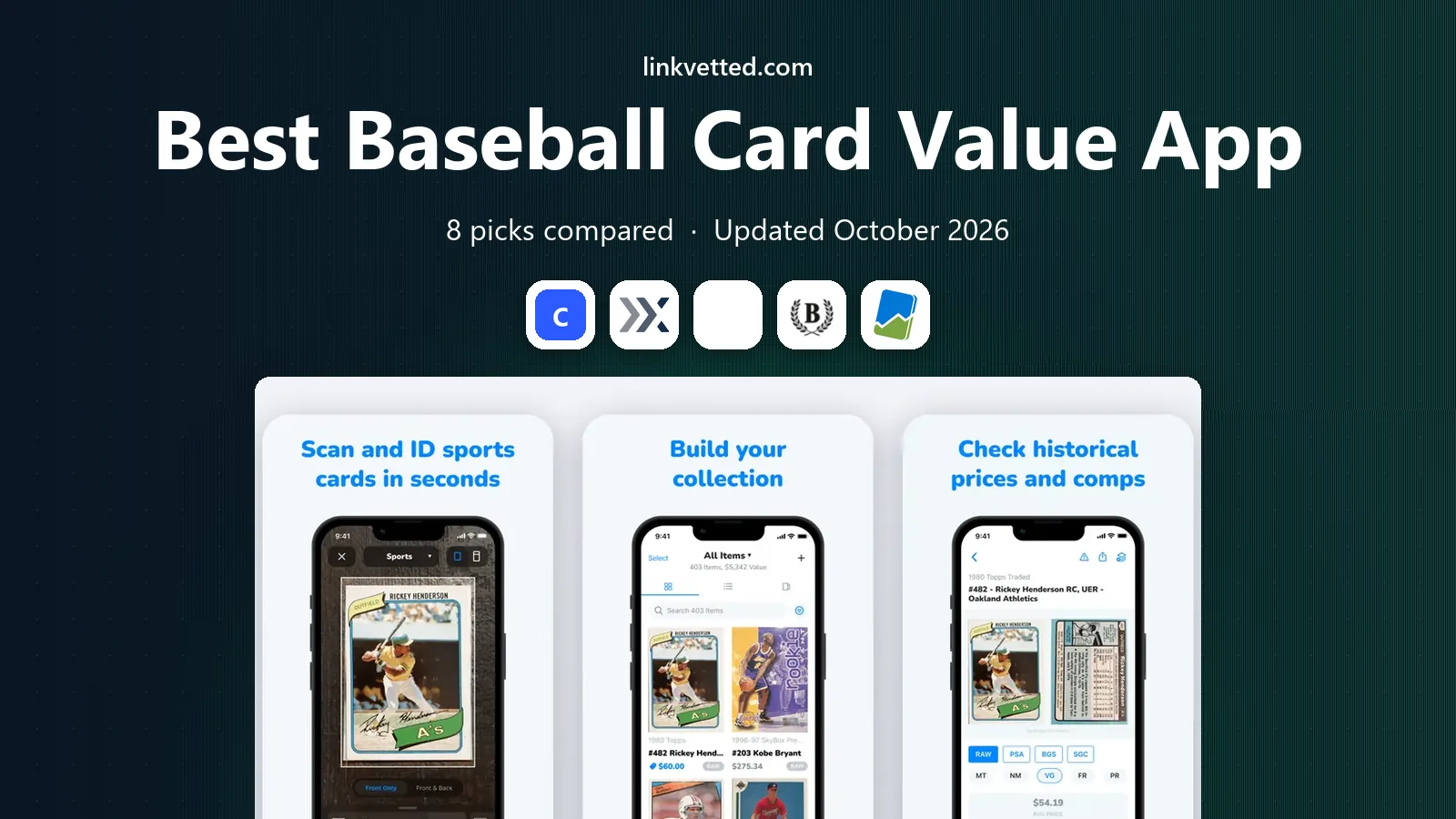
 CollX
Free scanning and trading
Starts atFreeVisit collx.comFull review - Great alternative
 Ludex
Accurate scans and parallels
Starts atFreeVisit ludex.comFull review - Also consider
 PSA
Graded card values and population
Starts atFreeVisit psacard.comFull review
TL;DR:
- CollX is the best free starting scanner for casual collectors, while Ludex is stronger on parallels and market data.
- A scanner value is an estimate, not a sale price, so check recent eBay sold listings before you buy, sell or grade.
- PSA, Beckett and Card Ladder help with graded cards and portfolio tracking, where condition changes value most.
- SportsCardsPro and 130Point are useful for checking real sold prices without paying for a full scanner plan.
- Condition, grade and centering move a card value far more than a quick scan can capture.
Quick comparison
| Tool | Best for | Starts at | Free plan? | |
|---|---|---|---|---|
| CollX | Free scanning and trading | Free | Yes | Visit |
| Ludex | Accurate scans and parallels | Free | Yes | Visit |
| PSA | Graded card values and population | Free | Yes | Visit |
 Beckett | Price guide and grading info | See website | Yes | Visit |
 SportsCardsPro | Quick value checks | Free | Yes | Visit |
 Card Ladder | Portfolio tracking with sales data | See website | Yes | Visit |
 130Point | Real eBay sold prices | Free | Yes | Visit |
 eBay | Sold listings and selling | Free | Yes | Visit |
The best baseball card value apps
Baseball card values depend on set, year, parallel, condition and grade. A good value app should identify the card correctly, show recent sales and warn you when its number is only an estimate. These eight cover scanning, grading and real market checks.

CollX is the easiest free scanner for most collectors. Point your phone camera at a card, get an identification and an estimated market value, then catalog it or offer it for trade in the built-in marketplace. The database covers baseball, football, basketball and hockey, and the social features help casual collectors swap cards without leaving the app.
Accuracy is the caution. Published comparisons note that CollX estimates can lag eBay sold prices, and a single scan cannot judge centering, corners and surface as well as a grader. Use CollX to build your collection list and spot cards worth a closer look, then confirm any important value with sold listings before you sell or grade.
- Free unlimited scans in basic use
- Large card database
- Built-in marketplace and trading community
- Values are marketplace estimates and can lag sold prices
- Paid Gold adds features at 9.99 dollars per month in some listings
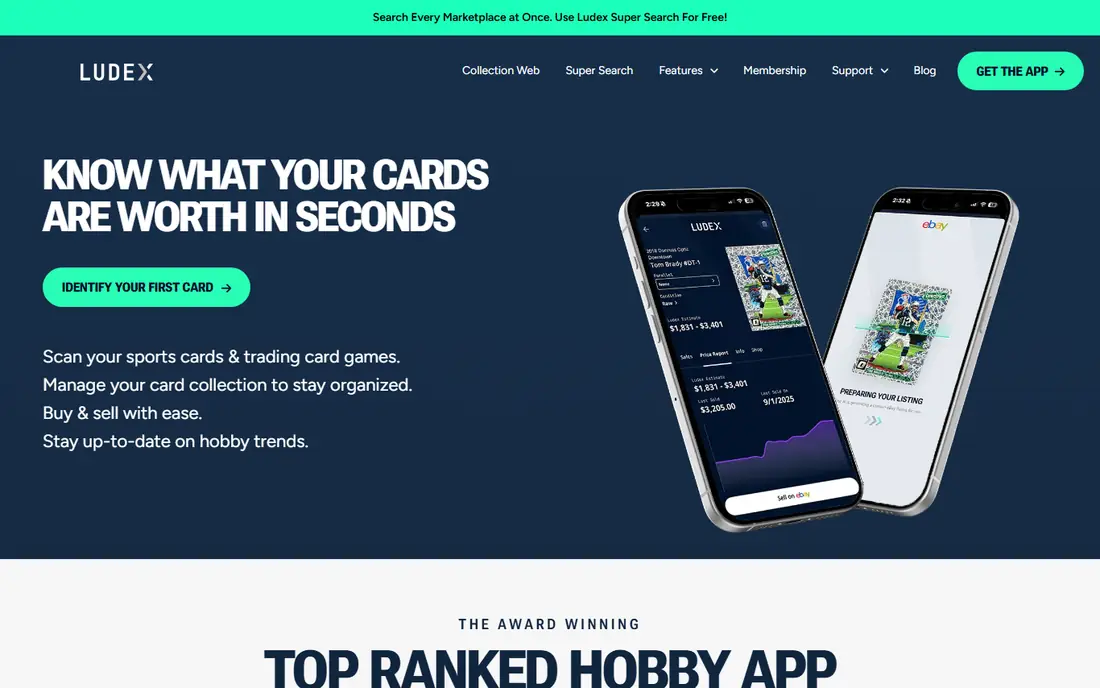
Ludex is a strong alternative when parallels and tricky variations matter. Its AI scan identifies set, year and parallel, then matches the card against market data to give an estimated value. Sellers can use the List-It tool to connect an eBay account and pre-fill listings from scans, which saves time when you list many cards.
Published listings differ on Premium pricing, with some noting around 4.99 dollars per month and others noting 50 dollars per year for membership features, so check the current app listing. Ludex also covers trading card games, which helps collectors who hold both sports and TCG cards. For pure graded-card pricing, pair it with PSA or Card Ladder.
- Fast AI identification for sports and trading cards
- EBay List-It integration for sellers
- Market trend data
- Premium pricing varies by listing, from around 4.99 dollars per month to higher plans
- Graded splits are thinner than PSA tools
PSA, Professional Sports Authenticator, is the grading company most collectors check first for graded values. Its app and site give population reports, which show how many copies exist at each grade, plus auction prices realized and card details. That grade-level data matters, because a PSA 10 can sell for many times the price of the same card raw or at a lower grade.
The PSA app is free to browse, but grading itself costs money and turnaround varies by service level, so check current grading fees before you submit cards. For raw cards, use a scanner first, then use PSA data to decide whether grading is worth the fee. For a graded collection, PSA is essential.
- Grading population reports and card facts
- Auction prices realized for graded cards
- Trusted grading brand
- Grading fees are separate and vary by card value and service level
- App is best for graded cards, not raw scans
Beckett has published card price guides for decades, and its modern app and site continue that work with card values, grading information and marketplace links. Collectors use Beckett to check a card across sets and grades, compare vintage and modern values, and learn about grading through Beckett Grading Services. That history makes it a useful cross-check against scanner estimates.
Full guide access may sit behind a subscription, so check the current Beckett pricing page for the tier you need. The interface can also feel dense if you only want a quick scan value. For research, vintage cards and grading context, Beckett remains a trusted second source.
- Long-running price guide tradition
- Grading services and population data
- Covers vintage and modern cards
- Full price guide access may require a subscription
- Site and app can feel dense for new collectors
SportsCardsPro is a handy free check when you already know the card you own. Search by player, set and year, and get an estimated value without installing a scanner app. That simplicity helps when you work through a box of cards at a desk, or when you want a second estimate after a scan.
Treat its numbers with care. Published comparisons note that SportsCardsPro uses its own method, which can inflate some values compared with recent sold prices. Use it to spot candidates worth research, then confirm with eBay sold listings or 130Point before you price a card for sale.
- Free quick value lookups
- Simple search by player, set and year
- Useful for bulk collection checks
- Values use a proprietary method and can differ from sold prices
- No camera scanning in the same way as CollX or Ludex
Card Ladder is built for collectors who track a portfolio, not only a single card. It pulls eBay sale data, tracks collection value over time and offers player indexes and market trends. That view helps you see whether a player market is rising or falling, and whether a card you own is part of a wider trend or a one-off sale.
Free access covers basic tracking, with paid tiers for deeper features, so check the current Card Ladder pricing page. Index data can swing with a few high sales, so do not treat a daily index move as a firm value for your copy. For a growing collection, Card Ladder gives the clearest long-term picture on this list.
- Portfolio value tracking from eBay sales data
- Player indexes and market trends
- Good for larger collections
- Paid tiers needed for full features
- Index swings can overstate short-term changes
130Point is the reality check every collector should use. It shows eBay sold listings, including accepted best-offer prices where available, so you see what buyers actually paid, not what an app estimates. That data is free and works in a browser, which makes it easy to check a card before you buy, sell or pay for grading.
The site does not scan cards or catalog a collection, so you need to know the set, year and parallel first, often from CollX or Ludex. Use 130Point as the final step: scan to identify, check graded data if relevant, then confirm with recent sold prices. That sequence avoids the most common pricing mistake in the hobby.
- Free access to eBay sold and auction data
- Shows best-offer accepted prices in many cases
- No scanner estimate bias
- No camera scanning or collection catalog
- Best-offer data depends on eBay listing type
eBay remains the largest real market for baseball cards, and its sold-listings filter is a core valuation tool. Filter completed sales by sold items, match your card set, year, parallel and grade, and compare only listings with similar condition. That discipline gives a far better value than any single app estimate, because you see the actual market.
Selling on eBay carries fees and requires good photos, accurate titles and honest condition notes. A poor photo or vague title can cut the price, even for a good card. For buying, eBay gives the widest choice, but check seller feedback and graded-card certification before paying a premium price.
- Largest card marketplace with sold-listing filter
- Direct selling with buyer protection
- Wide vintage and modern supply
- Fees apply to sales
- Sold prices vary with condition, title and photos
How we picked these
We compared official app pages, scanner reviews and published October 2026 comparisons for baseball card tools. We favored tools that identify cards correctly, show real sales data or graded data, and remain available on mobile or web. We kept both scanners and sales-data tools, because scanning alone does not give a reliable value. Where a vendor price was not clearly published, we used See website. We also noted where estimates differ from sold prices, because that gap is the main risk for collectors.
How to value a baseball card without overpaying
Start with identification, not price. Scan the card, confirm set, year, parallel and any variation, then check the back for print details that scanners sometimes miss. Next, judge condition honestly: look at corners, edges, centering and surface under good light, and compare with graded examples if you can. A card that looks mint at a glance may grade lower once centering is measured.
Then check sold prices, not asking prices. Use eBay sold listings and 130Point, filter for the same grade or raw condition, and ignore outlier sales that do not match your copy. For graded cards, check PSA population and auction prices realized. If the card might grade high, get a pre-grade opinion or compare with similar graded sales before paying a grading fee. Keep a simple record of purchase price, sold comps and grade, so future sales do not rely on memory.
FAQ
What is the best app for baseball card values?
CollX is the best free scanner for casual collectors, while Ludex is stronger on parallels. For a reliable value, pair either scanner with eBay sold listings or 130Point, because scanner values are estimates.
How accurate are baseball card scanner apps?
Scanners are good at identification, but their values are estimates based on market data and can differ from recent sales. Parallels, condition and grade cause the largest gaps, so always confirm an important card with sold listings.
What is the best app to value baseball cards for free?
CollX free tier, SportsCardsPro and 130Point all offer free value checks. Use CollX to scan and catalog, then 130Point to confirm what similar cards actually sold for.
Should I grade a card before selling it?
Grade only if the graded value, minus grading and selling fees, clearly beats the raw sale price. Check PSA population and recent graded sales first, and be honest about centering and corners, because grading can lower, not raise, a weak card value.
Do vintage baseball cards need a different tool?
Vintage cards benefit from Beckett and PSA data, because set variations and population matter more than a quick scan. Scanners still help with identification, but confirm vintage values with graded sales and price guide data.
Can I sell baseball cards directly from a value app?
CollX offers a marketplace, and Ludex offers eBay List-It integration for sellers. eBay itself remains the largest selling channel, with the widest buyer pool, though fees and listing work apply.