Best Automated AI Trading App in 2026: 8 Apps Compared
Compare the best automated AI trading app and platform for signals, backtesting and hands-off strategies, with pricing, risks and broker connections explained.
- Editor's choice
 Trade Ideas
Active stock traders
Starts at$89 per monthVisit trade-ideas.comFull review - Great alternative
 TrendSpider
Automated chart analysis
Starts at$82 per monthVisit trendspider.comFull review - Also consider
 Tickeron
AI trading robots
Starts atSee websiteVisit tickeron.comFull review
TL;DR:
- Trade Ideas is our pick for active stock traders because its Holly AI signals and live scanning are the most developed here.
- Composer is the best starting point for hands-off investors who want to build a strategy visually and automate it.
- TrendSpider suits chart-based traders who want automated analysis, backtesting and alerts without writing code.
- Crypto traders should look at 3Commas and Pionex, which are built around bots for always-on markets.
- This is not financial advice, and trading carries risk: no AI tool can guarantee profits, and past signals do not predict future results.
Quick comparison
| Tool | Best for | Starts at | Free plan? | |
|---|---|---|---|---|
| Trade Ideas | Active stock traders | $89 per month | Yes | Visit |
| TrendSpider | Automated chart analysis | $82 per month | No | Visit |
| Tickeron | AI trading robots | See website | Yes | Visit |
 Composer | Hands-off automated strategies | Free | Yes | Visit |
 Capitalise.ai | Plain-English strategy automation | Free | Yes | Visit |
 Danelfin | AI stock scores and research | See website | Yes | Visit |
 Magnifi | Plain-English investing research | See website | Yes | Visit |
 3Commas | Crypto trading bots | $15 per month | Yes | Visit |
The best automated AI trading app
Automated AI trading apps use algorithms to scan markets, generate signals, backtest ideas and, in some cases, place trades through a connected broker. The best automated AI trading platform for you depends on what you trade, how much control you want, and how much you are willing to pay each month. A note before the list: this is not financial advice, and trading carries risk, including the risk of losing money. Test any tool on paper trades first, and never trade money you cannot afford to lose.
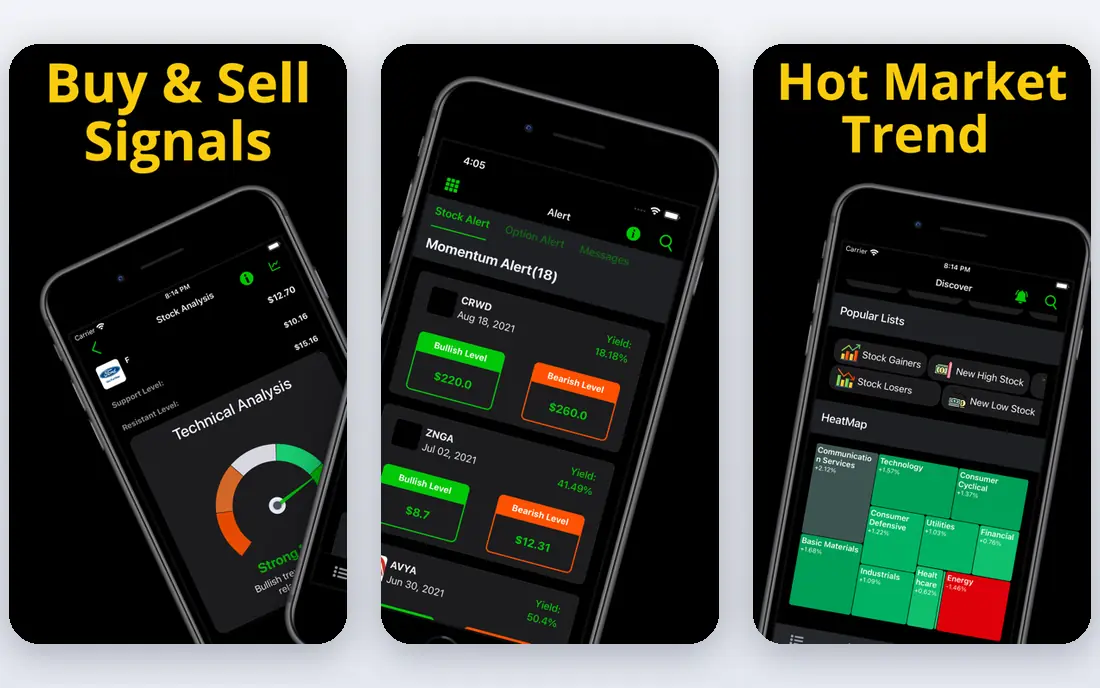
Trade Ideas is the most established AI trading platform on this list, built for day traders who watch the market live. Its Holly AI engine evaluates many algorithms each night and presents a curated set of signals, while live scanners flag unusual volume, breakouts and momentum during the session. The Basic plan starts at $89 per month billed annually, or $127 month to month.
The catch is that Holly signals require Premium, which starts at $178 per month billed annually, and that price only makes sense for traders who are active every day. A newer feature, Money Machine, was described by the vendor as an alpha release running in simulated mode, so treat it as early-stage rather than proven. Start with the trial and paper trading before paying for Premium.
- Holly AI signals with entry, stop and target
- Live scanning across US stocks
- OddsMaker backtesting on Premium
- Premium is expensive at $178 per month billed annually
- Best features sit on the higher plan
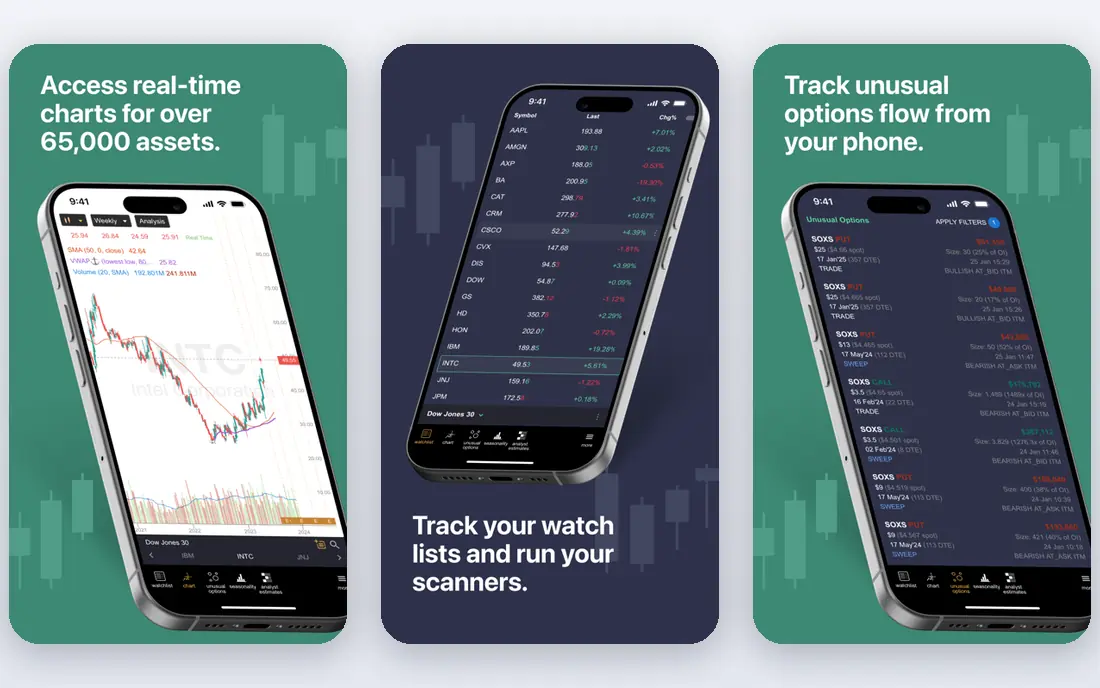
TrendSpider automates the chart work that technical traders usually do by hand: trendlines, patterns, indicators and multi-timeframe analysis update as prices move. Its backtesting tools let you test an idea against historical data, and alerts can notify you when a setup appears. Pricing starts around $82 per month on some plans, with higher tiers reaching several hundred dollars per month depending on term and features.
The main drawback is total cost. AI assistant allowances and other add-ons are priced on top of the base plan, so check the full monthly total before subscribing. TrendSpider fits traders who already think in charts and want that analysis done faster, rather than traders looking for a fully hands-off robot.
- Automated trendlines and chart patterns
- Backtesting on every plan
- Sidekick AI assistant
- Higher plans climb steeply
- Add-ons sit on top of the base subscription
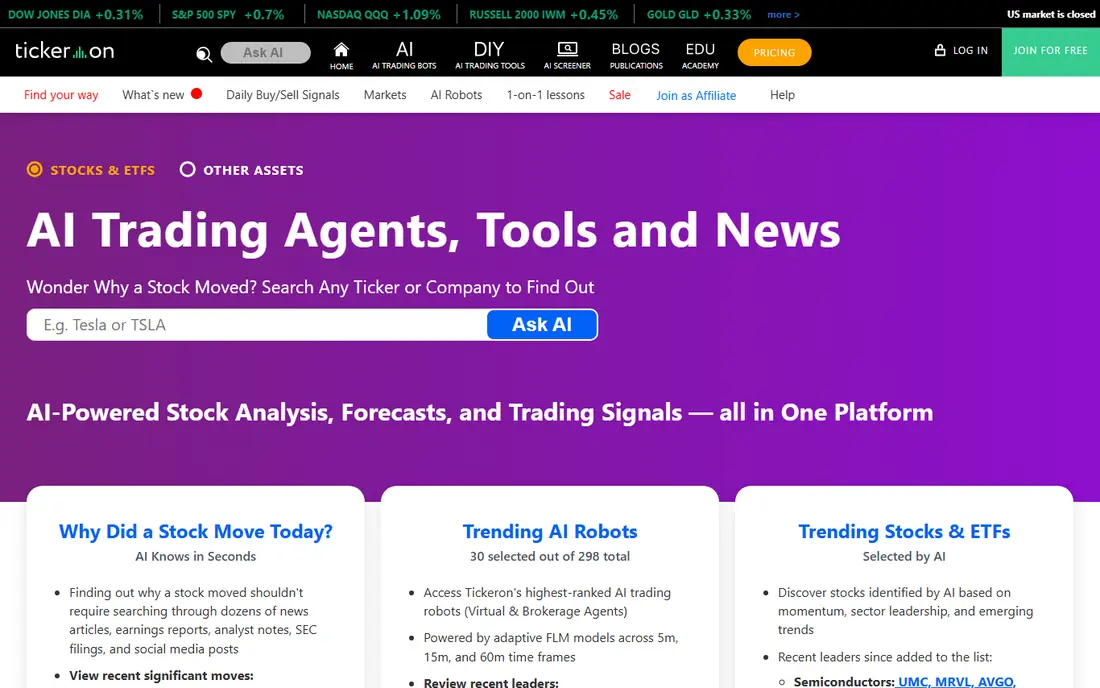
Tickeron sells AI robots: prebuilt strategies for stocks, ETFs, forex and crypto that publish their own track records. That model appeals to traders who want a ready-made strategy rather than building one from scratch. Pattern recognition tools also scan for chart patterns and trend changes across markets, and a free trial lets you explore before paying.
Pricing is the weak point for comparison, since it varies by robot, plan and timeframe, so confirm the exact package price for the robot you want before subscribing. Treat published track records with care: a robot that performed well in one market period may not repeat that performance, and this is not financial advice.
- Prebuilt AI robots with published track records
- Pattern recognition across markets
- Free trial available
- Pricing varies by robot and timeframe
- Past robot performance does not predict future results
Composer lets you build an automated investing strategy by dragging blocks together, like a visual recipe, and then it handles rebalancing and execution for you. The free Starter plan covers building and backtesting, while paid plans add automated trading. Reported Pro pricing is around $32 per month billed annually, with a lower tier around $10 per month.
Composer is the best automated AI trading app for investors who want automation without day trading or coding. The limit is scope: it covers stocks and ETFs, not crypto or forex, and automated execution depends on its supported brokerage connections. It is a good first step for hands-off investors who still want control over the strategy.
- Visual, no-code strategy builder
- Automated rebalancing and execution
- Free Starter plan for building and backtesting
- US stocks and ETFs only
- Pro features require a paid plan
Capitalise.ai turns a plain-English description of a trading idea into an automated strategy, with backtesting to check it against historical data. That removes the coding barrier that keeps many traders from automating, and supported brokers allow live execution once a strategy is ready. A free plan covers getting started, with paid plans for more live strategies and features.
The catch is that free plan limits mean serious users will pay, and writing a strategy in plain English still requires a clear trading idea: the tool automates your rules, it does not invent a profitable strategy for you. It suits traders who know what they want to automate but do not want to write code.
- Write strategies in plain English, no code needed
- Backtesting included
- Broker connections for execution
- Free plan has limits on live strategies
- Advanced features require paid plans
Danelfin gives each stock and ETF an AI score based on technical, fundamental and sentiment data, with explanations for why a stock scores well or poorly. That makes it useful for research and idea screening, especially for investors who want a second opinion before buying. A free tier covers basic scores, with paid plans for full access.
Danelfin is not a trading robot: it does not place trades for you, so you still need a broker and your own decision process. Scores are a starting point for research, not a buy signal, and they should be checked against your own analysis. Use it to narrow a watchlist, not to replace judgment.
- AI scores for thousands of stocks and ETFs
- Plain explanations of each score
- Free tier for basic research
- Research tool, not a full execution platform
- Premium scores require a paid plan
Magnifi is an investing research assistant: you ask questions in plain English, and it returns stocks, ETFs, screens and model portfolios matched to what you described. That conversational approach suits newer investors who find traditional screeners hard to use. A free tier is available, with paid features for deeper research.
The limit is that Magnifi is a research tool, not a broker or a trading bot, so trades still happen elsewhere. Its answers are only as good as the question you ask, and model portfolios are starting points, not personalized advice. Pair it with your own research and a clear risk plan.
- Ask investing questions in plain English
- Screens and model portfolios
- Investing assistant for research
- Not an execution platform
- Check current pricing before subscribing
3Commas is built for crypto automation, with bots for dollar-cost averaging, grid trading and smart trades that manage entries and exits. It connects to major exchanges through API keys, and paper trading lets you test a bot before risking real funds. Paid plans start around $15 per month billed annually and rise to around $105 per month for the top tier.
Crypto automation carries its own risks: markets move at night and on weekends, API keys must be guarded carefully, and a bot can keep trading through a sharp move if its rules allow it. Use read-only keys where possible for monitoring, grant trade access only when you mean to automate, and start small.
- DCA, grid and smart trade bots
- Works across major crypto exchanges
- Paper trading for testing
- Crypto markets are volatile and run around the clock
- Higher tiers needed for more bots
How we picked these
We compared official feature pages, pricing pages and public user reviews for AI trading tools that offer signals, backtesting, strategy automation or bots, and we favored platforms that are active in 2026 with clear broker connections. We checked published prices where vendors list them and used "See website" where pricing varies by plan or robot. We did not claim hands-on testing, and nothing here is financial advice; trading carries risk and past performance does not guarantee future results.
How to use an AI trading app without blowing up your account
Start with paper trading. Every serious platform here offers a trial, a free tier or simulated trading, and a month of paper results tells you more than any marketing page. Track whether the signals or bots actually fit your schedule: a day trading tool is useless if you can only check markets in the evening.
Set risk rules before you automate. Decide the most you will risk per trade, the most you will lose in a day, and when you will stop a strategy that is losing. Write those rules down and configure them in the tool where possible, since automation without limits is how small losses become large ones.
Finally, check the total monthly cost against your account size. A $178 per month subscription needs real trading profits just to break even, which is a high bar for a small account. For most beginners, a free or low-cost tool like Composer or Danelfin is the smarter first step.
FAQ
What is the best AI automated trading platform?
Trade Ideas is the best AI automated trading platform for active stock traders, thanks to Holly AI signals and live scanning. Composer is better for hands-off investors who want visual strategy building, and TrendSpider is better for chart-based traders. The best automated AI trading app depends on whether you day trade, swing trade or invest for the long term.
What are the best AI automated trading apps for beginners?
Composer and Danelfin are the friendliest starting points, since both have free plans and do not require coding. Capitalise.ai also suits beginners who want to automate a simple idea in plain English. Beginners should paper trade first and avoid expensive subscriptions until they have a tested strategy.
Can AI trading apps guarantee profits?
No, and any tool that promises guaranteed profits should be avoided. AI trading apps can scan faster, backtest ideas and execute rules without emotion, but markets change and past signals do not predict future results. This is not financial advice, and trading carries risk, including the possible loss of your investment.
Do I need a broker to use an AI trading app?
Most of these apps need a broker connection for live trading, while research tools like Danelfin and Magnifi work without one. Trade Ideas, Composer, Capitalise.ai and 3Commas connect to supported brokers or exchanges through official APIs. Check that your broker is supported before paying, and review the access you grant when connecting an account.
Is automated trading safe?
Automated trading is not risk-free, even with a well-known platform. Risks include market volatility, strategy failure, API key misuse and subscription costs that eat into returns. Reduce risk by paper trading first, starting with small amounts, using strong account security, and setting stop losses and daily loss limits.