Best AI Tools for Writers in 2026: 8 Tools Compared
Compare the best AI tools for writers, from drafting and editing to fiction and marketing copy, with pricing, free plans, and honest limits explained.
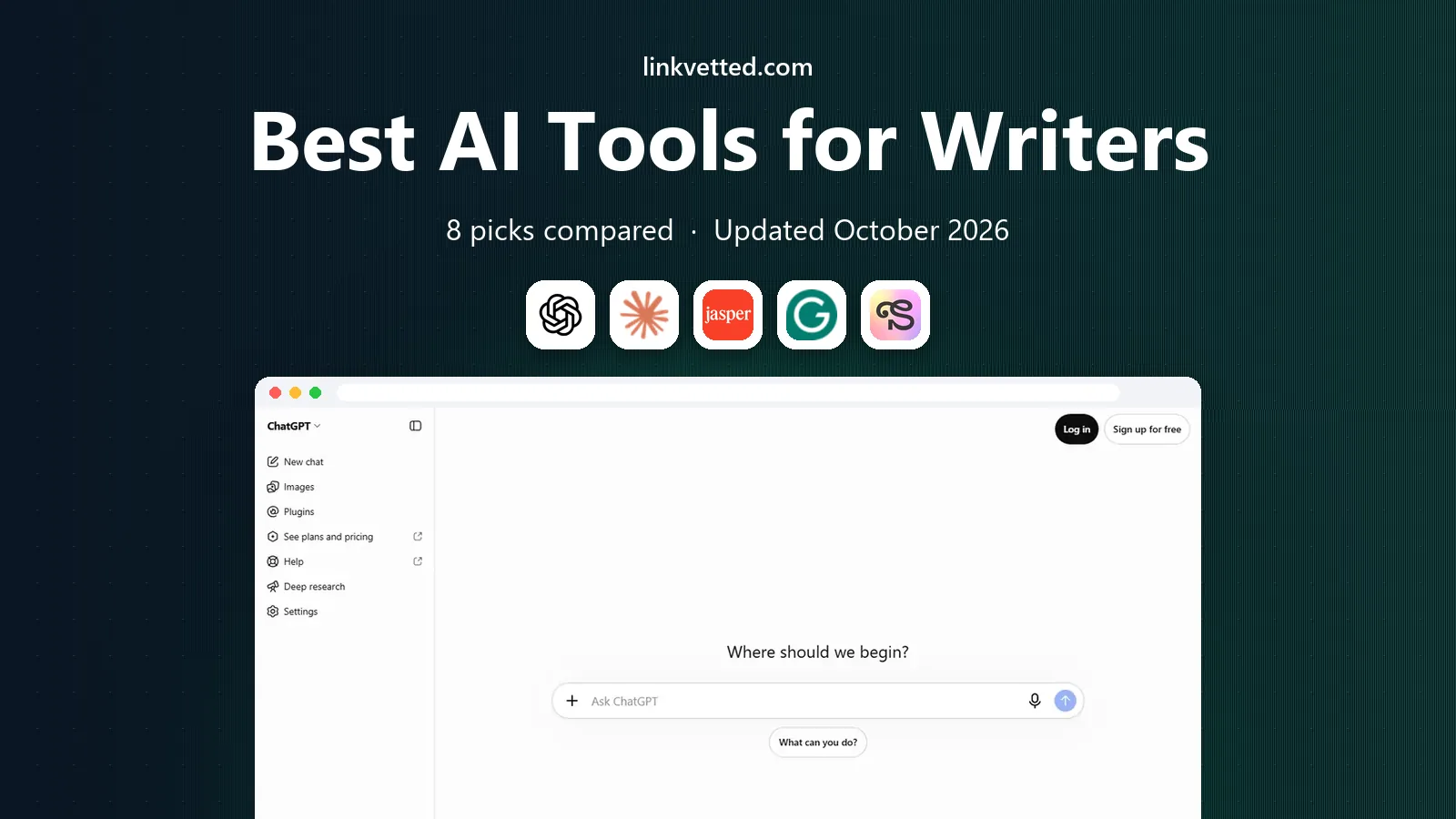
- Editor's choice
 ChatGPT
All-round drafting and editing
Starts at$20 per monthVisit chatgpt.comFull review - Great alternative
 Claude
Natural long-form prose
Starts at$20 per monthVisit claude.comFull review - Also consider
 Jasper
Marketing teams and brand voice
Starts at$69 per monthVisit jasper.aiFull review
TL;DR:
- ChatGPT and Claude are the most flexible starting points for drafting, outlining, and editing across many kinds of writing.
- Grammarly and ProWritingAid are better when the draft already exists and the job is clarity, grammar, and style.
- Sudowrite is the clearest fit for fiction writers, while Jasper and Copy.ai are built around marketing teams and brand voice.
- Rytr offers the lowest entry price in this list, but its output needs more checking on longer pieces.
- Our pick for most writers is a general chatbot plus a dedicated editor, rather than one expensive tool for every job.
Quick comparison
| Tool | Best for | Starts at | Free plan? | |
|---|---|---|---|---|
| ChatGPT | All-round drafting and editing | $20 per month | Yes | Visit |
| Claude | Natural long-form prose | $20 per month | Yes | Visit |
| Jasper | Marketing teams and brand voice | $69 per month | Free trial | Visit |
 Grammarly | Grammar, tone, and polish | $12 per month | Yes | Visit |
 Sudowrite | Fiction and creative writing | $10 per month | No | Visit |
 ProWritingAid | Deep manuscript editing | $10 per month | Yes | Visit |
 Copy.ai | Sales and marketing workflows | $29 per month | No | Visit |
 Rytr | Budget short-form copy | $9 per month | Yes | Visit |
The best AI tools for writers
The best AI writer software depends on the job. Some tools draft from a prompt, some polish a finished draft, and some help a novelist shape a story. The eight below cover those jobs without pretending one tool does them all equally well.

ChatGPT is the easiest default when a writer needs help with many tasks in one place. It can turn rough notes into a draft, tighten a paragraph, suggest headlines, or build an outline for a long article. The paid Plus plan, at $20 per month, gives higher limits than the free version, which matters for writers who use it daily.
The main limit is accuracy and voice. ChatGPT can invent details, quote sources that do not exist, or smooth a piece into a generic tone. Writers who check facts, keep their own notes close, and rewrite in their own voice will get far more value from it than writers who paste the first draft straight into print.
- Very flexible across formats
- Strong for outlines, rewrites, and brainstorming
- Large ecosystem of apps and integrations
- Output needs fact checking
- Long drafts can drift from the original brief

Claude is our pick for writers who care most about how a long piece reads. Its prose tends to feel less mechanical than many rivals, and it handles long documents, chapter revisions, and careful rewrites with fewer awkward turns. The Pro plan costs $20 per month, with a free plan for lighter use.
Claude still needs the same care as any AI tool. It can miss facts, overstate a point, or follow a prompt too literally. It is also less of a marketing workflow tool than Jasper, so teams that need brand voice libraries and campaign templates may want a second tool. For books, essays, and long articles, though, Claude is a strong first choice.
- Strong, readable long-form drafts
- Good at editing and summarizing long documents
- Clear handling of tone and structure
- Free plan has usage limits
- Fewer marketing templates than Jasper or Copy.ai

Jasper is built for marketing teams rather than lone writers. Its brand voice features help a team keep tone consistent across blog posts, ads, and product pages, and its templates cover common marketing formats. That structure saves time when several people write for one brand.
The price reflects that focus. At $69 per seat per month for Pro, Jasper is hard to justify for a single writer who mainly needs drafting help. Solo writers will usually do better with ChatGPT or Claude plus an editor. Marketing teams that publish often and need consistency will see the value more clearly.
- Brand voice training
- Many marketing templates
- Team collaboration features
- High entry price for solo writers
- More than most individuals need
Grammarly is an editing tool first, and that is why it still earns a place on this list. It checks grammar and spelling in browsers, documents, and email, and its paid plan adds tone, clarity, and AI assisted rewriting. The free plan is useful on its own, while Pro costs $12 per month when billed annually.
Grammarly will not write a novel or a marketing campaign from scratch, and writers should not expect it to. Its strength is the last pass, when a draft is close and small errors or clumsy sentences are the main problem. Pair it with a drafting tool and the two together cover most everyday writing.
- Works where writers already type
- Free plan covers basic checks
- Tone and clarity suggestions are practical
- Not built for full draft generation
- Paid plan is billed annually for the lowest monthly rate
Sudowrite is the most fiction focused tool here. It helps novelists expand a scene, describe a setting, brainstorm plot beats, and push past a stuck chapter. The Hobby and Student plan costs $10 per month when billed annually, or $19 per month when billed monthly, so annual billing makes a real difference.
Fiction writers should still pair Sudowrite with an editor. It does not replace Grammarly or ProWritingAid for grammar and style checks, and its output needs shaping to fit a consistent voice. For writers who draft stories rather than marketing copy, that trade-off is easy to accept.
- Story tools such as beats and description help
- Built for novelists
- Focused creative workflow
- No free plan
- Weak as a grammar checker on its own
ProWritingAid suits writers who want a detailed edit, not just a spell check. Its reports cover style, repetition, pacing, sentence variety, and other issues that matter in a manuscript. The Premium plan costs $10 per month when billed annually, and a free plan covers basic checks.
New users may find the number of reports overwhelming, and it helps to start with two or three reports rather than running them all at once. ProWritingAid is also weaker for fresh drafting than ChatGPT or Claude. Used as an editing partner after a draft exists, it is one of the most thorough tools in this list.
- Many editing reports for style and pacing
- Works with Scrivener and Google Docs
- Free plan for basic checks
- Interface can feel busy at first
- AI generation is more limited than chatbot tools
Copy.ai aims at teams that produce a lot of sales and marketing content on a repeatable pattern. It can help draft outreach, product descriptions, and campaign copy, and its workflow features help teams reuse prompts and formats. The Chat plan starts at $29 per month for five seats in the pricing we reviewed.
That team focus is also its limit for individual writers. A novelist or essayist will find less here than in Claude or Sudowrite, and a solo blogger may find Rytr cheaper. For a small marketing team that needs steady output in a consistent format, Copy.ai is a practical middle ground between a chatbot and a full enterprise platform.
- Workflow automation for sales and marketing
- Useful templates for outreach and content
- Team friendly
- Less suited to fiction or long-form essays
- Entry price is higher than budget tools
Rytr is the budget pick in this list, and its appeal is simple. The free plan covers 10,000 characters per month, and the Unlimited plan costs $9 per month, or less when billed annually. For short social posts, product blurbs, and email drafts, that price is hard to beat.
Longer work is where Rytr shows its limits. Extended articles can lose structure, repeat phrases, or need more rewriting than drafts from Claude or ChatGPT. Writers on a tight budget can still use Rytr well, especially if they write short pieces and edit with care, but they should not expect it to carry a book or a long report on its own.
- Low entry price
- Free plan for short pieces
- Simple interface for quick copy
- Weaker on long-form work
- Output needs heavier editing than premium tools
How we picked these
We compared official pricing pages, feature pages, and public reviews for AI writing tools that are still available and widely used. We looked for a mix of drafting, editing, fiction, and marketing tools, and we checked free plans, entry prices, and limits that affect everyday use. We did not claim hands-on testing, and we note that prices change often, so readers should confirm the current plan before subscribing.
How to choose the right AI writing tool
Start with the job, not the brand. If you need fresh drafts, start with ChatGPT or Claude. If you need a cleaner draft, start with Grammarly or ProWritingAid. If you write fiction, test Sudowrite. If you run a marketing team, compare Jasper and Copy.ai on brand voice and workflow, not just price.
Then check three practical points. First, does the free plan or trial cover your real workload, or will you hit limits in week one. Second, does the tool work where you write, such as Google Docs, Word, or Scrivener. Third, can you keep control of facts and voice, with time set aside to check sources and rewrite key passages. The best AI writer tool is the one that fits those checks and leaves your writing sounding like you.
FAQ
What is the best AI tool for writers overall?
For most writers, ChatGPT or Claude is the best starting point, because both handle drafting, outlining, and editing across many formats. Add Grammarly or ProWritingAid when editing matters more than drafting, and add Sudowrite for fiction.
Can AI writing tools replace a human editor?
No. AI tools catch many errors and suggest useful rewrites, but they miss context, invent facts, and flatten voice. A human editor, or at least a careful self-edit, is still needed for work that will be published under your name.
Are there free AI tools for writers?
Yes. ChatGPT, Claude, Grammarly, ProWritingAid, and Rytr all offer free plans with limits. Free plans suit light use and testing, while heavy daily use usually needs a paid plan.
Which AI writer is best for fiction?
Sudowrite is the strongest fiction pick in this list, because its tools are built around story beats, scenes, and description. Pair it with an editing tool for grammar and style, since Sudowrite is not a full editor.
Do AI writing tools check for plagiarism?
Some tools include plagiarism checks, but coverage varies by plan and product. Writers should check the plan details and run their own checks for work that must be original, rather than assuming every tool includes it.