6 AI-Powered CMS Platforms Worth Shortlisting in 2026
Best AI-Powered CMS platforms: 6 contenders ranked by fit, with entry costs and free tiers. Strengths and weak spots are spelled out. Skim the table first.
- Editor's choice
 Adobe Experience Manager
Integrated enterprise content and assets
Starts atSee websiteVisit business.adobe.comFull review - Great alternative
 WordPress VIP
Enterprise managed WordPress at scale
Starts atSee websiteVisit wpvip.comFull review - Also consider
 Sanity
Structured content for agents and apps
Starts at$15 per seat per monthVisit sanity.ioFull review
Direct answer
This list puts Adobe Experience Manager first for integrated enterprise content and assets. Listed starting prices: Sanity from $15 per seat per month, Storyblok from $99.00 a month and Webflow from $15 per month. If your case is different, WordPress VIP suits enterprise managed WordPress at scale and Sanity suits structured content for agents and apps. All 6 tools are compared below on price, free plan and limits.
TL;DR:
- Adobe Experience Manager is the opening pick, best for integrated enterprise content and assets.
- Check the limits for WordPress VIP before you commit: built on WordPress conventions.
- Drupal fits open source, highly structured content.
- Sanity has the lowest monthly starting price in this list: $15 per seat per month.
- A free plan is available from 2 of the 6 tools: Sanity, Webflow.
Last checked November 2026. Prices and plan details were read from the vendors' own pages in November 2026; vendors change plans often, so confirm the current price on the vendor site before you buy.
Quick comparison
| Tool | Best for | Starts at | Free plan? | |
|---|---|---|---|---|
| Adobe Experience Manager | Integrated enterprise content and assets | See website | Not stated | Visit |
| WordPress VIP | Enterprise managed WordPress at scale | See website | Not stated | Visit |
| Sanity | Structured content for agents and apps | $15 per seat per month | Yes | Visit |
 Storyblok | Headless CMS with visual editing | $99.00 a month | Free trial | Visit |
 Webflow | Visual site building with built-in CMS | $15 per month | Yes | Visit |
 Drupal | Open source, highly structured content | See website | Not stated | Visit |
The full AI-Powered CMS platforms list
If you are comparing AI-Powered CMS platforms, this page covers 6 tools in one place: what each is best for, what it costs to start, whether it has a free plan, and the main limit to know about.
Adobe Experience Manager
Best for: Integrated enterprise content and assets
Adobe Experience Manager serves integrated enterprise content and assets. Teams already using Adobe creative and marketing tools frequently find the integration valuable. In daily use, consider a lighter headless or visual CMS when speed and simplicity matter more than deep enterprise integration.
Honest limits: Needs specialist implementation.
From a buyer's view, AEM is an enterprise product with substantial configuration and operational demands, so smaller teams may find it disproportionate to their needs. It also assumes investment in the wider Adobe ecosystem to realize full value. No starting price is listed for Adobe Experience Manager here; confirm pricing on the vendor site. As for free access: Not stated.
- Supports digital enrollment workflows
- Merges asset management and CMS
- Enterprise-scale complexity
WordPress VIP is aimed squarely at enterprise managed WordPress at scale. Pick it when WordPress familiarity, managed scale and compliance are priorities, and look elsewhere if you want a visual no-code builder or a different content model. The vendor cites enterprise customers, an uptime commitment, and FedRAMP authorization with SOC 2 Type 2 certification.
Limits to weigh: Built on WordPress conventions.
WordPress VIP is an enterprise content product and managed WordPress offering. VIP is built around WordPress, so teams wanting a completely headless or non-WordPress architecture may prefer another product. Its enterprise orientation can also be more than a small team needs. Pricing for WordPress VIP is not stated here, so ask the vendor for current figures. As for free access: Not stated.
- High-availability uptime commitments
- Managed enterprise WordPress product
- Enterprise focus may exceed small team needs
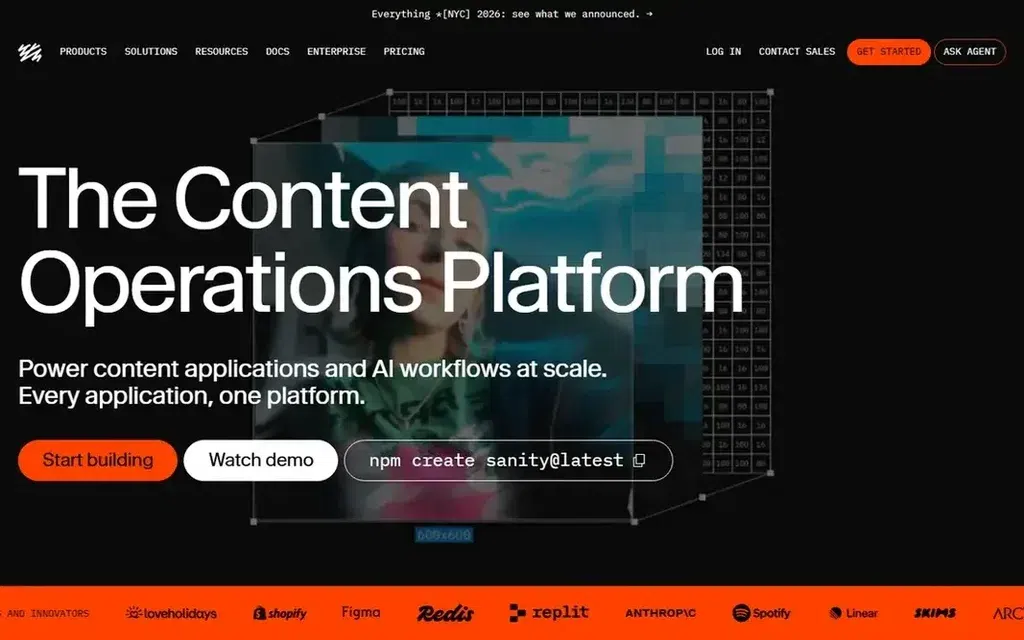
Pick Sanity if this describes you: structured content for agents and apps. Its focus is structured content that can be reused across digital products, which suits organizations treating content as data that feeds several experiences. Sanity leans toward developers and content architects, so marketing teams expecting a ready-made site builder may need more setup.
Downsides: Developer-oriented configuration.
In daily use, teams with engineering support and a need for adaptable content models tend to get the most from it, particularly when content must serve both traditional sites and AI-driven applications. Consider a combined product if you want publishing and hosting in one place, and choose Sanity when structured, reusable content across plenty of applications is the core requirement. What you pay to start with Sanity: $15 per seat per month. A free plan is available with Sanity.
- Content operating system positioning
- Structured content model
- Not a turnkey marketing site builder
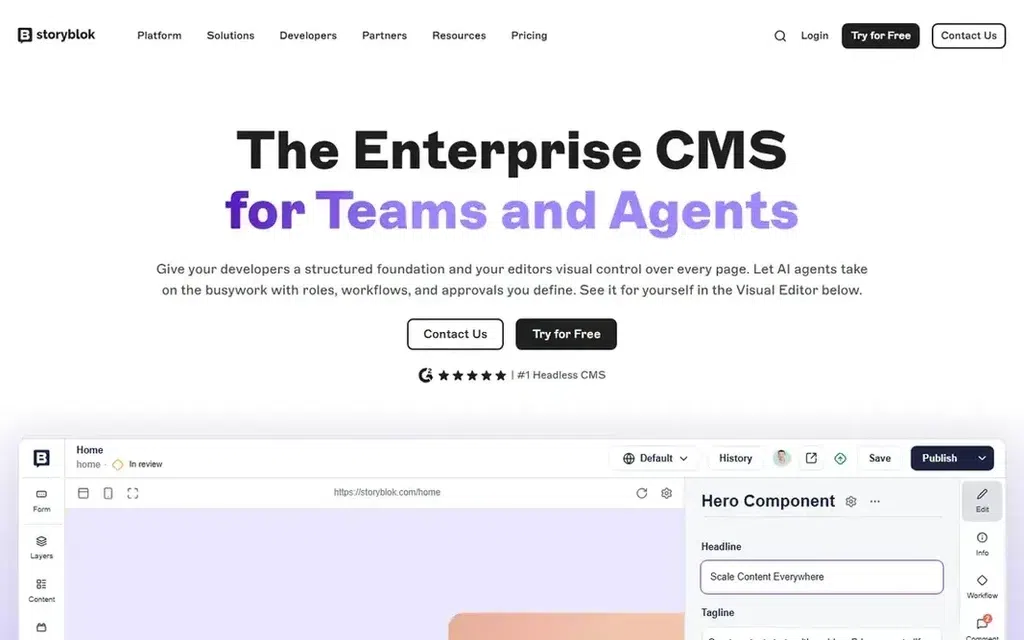
Storyblok makes the most sense for headless CMS with visual editing. It suits organizations that want marketing autonomy without giving up a structured, API-driven content backend.
Trade-offs to know: Not a full hosting or design suite.
- Visual editor on a headless CMS
- Separates content from presentation
- Needs developer setup for some uses
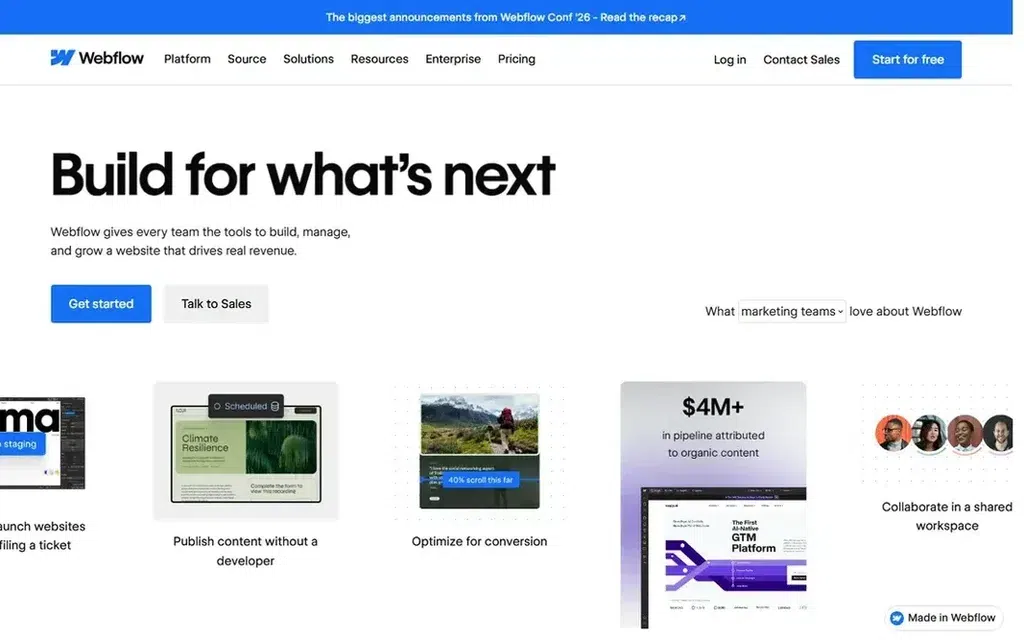
In short, Webflow is for visual site building with built-in CMS. Webflow describes itself as an agentic web system for modern firms, handling design, build, optimization and ranking in AI search. Beyond that, since the product centers on a visual builder and hosted infrastructure, teams with heavy custom application logic or strict code-level control may find it limiting.
CMS, hosting and answer engine optimization are built in, and the vendor positions it for enterprise-grade security. It performs well when visual control and speed to publish matter more than deep backend customization. Beyond that, otherwise Webflow includes most marketing site needs in one place. On cost, Webflow starts like this: $15 per month. A free plan is available with Webflow.
The main drawbacks: Less suited to completely custom codebases.
- Enterprise-grade security choices
- Design
- Visual model can constrain complicated builds
Drupal is aimed squarely at open source, highly structured content. Drupal is a long-established open source content management system known for adaptable content modeling, granular permissions and a module ecosystem that lets teams shape the product around their needs. Choose Drupal when openness, extensibility and long-term control of the codebase outweigh convenience.
Honest limits: AI features rely on added modules.
Drupal demands more technical involvement than hosted, marketing-focused products, and upgrades and configuration need planning. AI capabilities are generally added through contributed modules and integrations instead of being the product's central pitch. No starting price is listed for Drupal here; confirm pricing on the vendor site. As for free access: Not stated.
- Open source with a large community
- Adaptable content modeling
- Steeper ramp-up time
How these tools were picked
LinkVetted looked at what each vendor publishes: pricing, plan limits, feature coverage for AI-Powered CMS platforms and stated drawbacks. No hands-on testing is claimed. Seat minimums, billing terms and add-ons can move the real cost, so the starting prices here are a guide and not a quote. Tools are placed by general fit for AI-Powered CMS platforms, with price clarity and free access as tie-breakers. A different team can reasonably rank them differently.
What to confirm before you sign up
- Confirm the entry price on the vendor page. For Adobe Experience Manager, WordPress VIP and Drupal that means a quote rather than a fixed price.
- Read the fine print on the free plans from Sanity and Webflow; seat, project and feature caps differ.
- Use real work to test the free trial from Storyblok, rather than a demo project.
- Read the limits listed for Adobe Experience Manager first: enterprise-scale complexity.
- Map your must-have features to a specific Adobe Experience Manager plan before you compare prices.
- Ask whether WordPress VIP integrates with your current software, and whether that comes standard or as an add-on.
FAQ
Do these tools publish their prices?
Not all of them. Adobe Experience Manager, WordPress VIP and Drupal publish no starting price, so expect a quote request for those. The rest, Sanity included, show a starting price, though seats and billing terms still change the final cost.
Should I choose a headless CMS or a combined product?
Combined systems like Webflow bundle design, CMS and hosting for quicker launches. The right choice relies on how plenty of channels you serve and how much frontend control your team wants.
Which options for AI-Powered CMS platforms have a free plan?
On this list, Sanity and Webflow include a free plan. Caps on seats, usage or features are common, so test the free plan against your real workload. One other tool offers a trial instead.
Can I try these options before paying?
Often, yes. Sanity and Webflow have a free plan and Storyblok offers a free trial. Use your own data and a real task during the test, and check what the free tier or trial limits before you rely on it. All 6 picks in this AI-Powered CMS platforms comparison list a starting price, free plan details and the main limits on their cards above.
Are open source CMS platforms a solid fit for AI features?
The tradeoff is that your team takes on more configuration and maintenance. Managed and vendor-packaged systems usually present AI features as part of the product instead.
What is the cheapest option for AI-Powered CMS platforms in this list?
On published monthly entry prices, Sanity is the lowest here at $15 per seat per month. Entry price is only part of the cost, because seats, add-ons and billing terms can change the total. For the full picture, the cards above cover all 6 entries of this AI-Powered CMS platforms list, including price, free plan and limits.
Sources
- https://business.adobe.com/products/experience-manager/adobe-experience-manager.html
- https://wpvip.com
- https://www.sanity.io
- https://www.storyblok.com
- https://webflow.com
- https://www.drupal.org