Best AI Evaluation Tools for Production in 2026: 8 Tools Compared
We compared AI evaluation tools for production, from tracing and LLM-as-judge scoring to datasets and CI gates, with current prices and self-hosting notes.
- Editor's choice
 LangSmith
LangChain and LangGraph teams
Starts at$39 per seat per monthVisit langchain.comFull review - Great alternative
 Langfuse
Open-source tracing and evals
Starts at$29 per monthVisit langfuse.comFull review - Also consider
 Braintrust
Eval-driven development and CI gates
Starts at$249 per monthVisit braintrust.devFull review
TL;DR:
- Langfuse is our value pick for production evaluation, with open-source self-hosting, a free cloud tier and paid cloud from $29 per month.
- Braintrust suits teams that want evaluation-first development, with datasets, experiments and CI gates in one platform, starting at $249 per month for Pro.
- LangSmith is the smoothest choice for LangChain and LangGraph teams, at $39 per seat per month for Plus, but per-seat costs add up fast.
- Arize AX and its open-source Phoenix project suit teams that already use OpenTelemetry and want tracing plus evaluation in one system.
- Start with a small set of scored production traces, not a huge metric library, because a few trusted scores you act on beat dozens you ignore.
Quick comparison
| Tool | Best for | Starts at | Free plan? | |
|---|---|---|---|---|
| LangSmith | LangChain and LangGraph teams | $39 per seat per month | Yes | Visit |
| Langfuse | Open-source tracing and evals | $29 per month | Yes | Visit |
| Braintrust | Eval-driven development and CI gates | $249 per month | Yes | Visit |
 Arize AX | OpenTelemetry tracing and evals | $50 per month | Yes | Visit |
 Galileo | Agent evals and runtime guardrails | $100 per month | Yes | Visit |
 HoneyHive | OpenTelemetry evals and prompt management | See website | Yes | Visit |
 Promptfoo | Open-source testing and red teaming | Free | Yes | Visit |
 Comet Opik | Low-cost open-source evals | $19 per month | Yes | Visit |
The best AI evaluation tools for production
Production AI fails in quiet ways. A model returns a confident but wrong answer, a retrieval step pulls the wrong document, or an agent picks the wrong tool, and the HTTP status still says success. We compared official pricing pages, tracing and dataset features, and self-hosting options to find tools that score real production traffic and turn those scores into fixes.
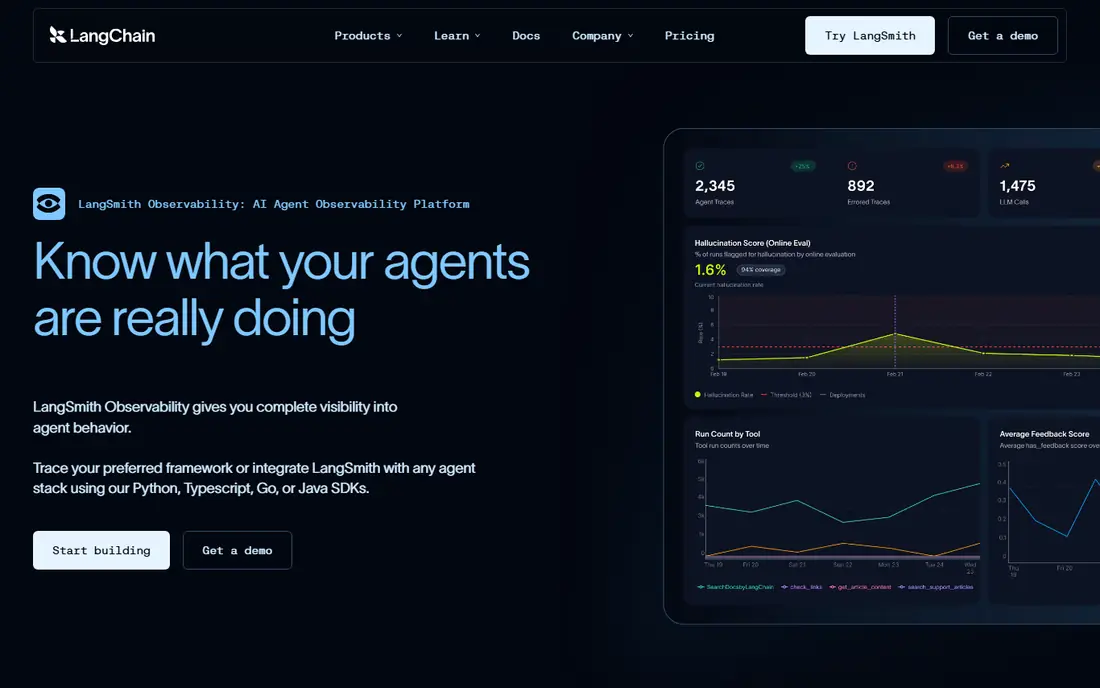
LangSmith is the natural evaluation home for teams already building with LangChain or LangGraph. Traces capture chains, agents and tool calls in detail, datasets let you rerun the same prompts after a model or prompt change, and human annotation workflows help teams build trusted ground truth. Evaluators, including LLM-as-judge scoring, can run on production traces or on experiment runs, so regressions show up before a bad change reaches users.
The cost model needs care. Plus costs $39 per seat per month, with usage charges on top, and the free tier covers only 5,000 traces a month, which a busy production app can use quickly. Default retention is also short on lower plans, with longer retention on paid tiers. If your stack is LangChain-based, LangSmith saves setup time. If it is not, a framework-neutral tool may give similar value at lower cost.
- Deep LangChain and LangGraph tracing
- Datasets and human annotation
- Strong experiment comparison
- Per-seat pricing adds up for larger teams
- Short default retention on lower plans
Langfuse combines tracing, prompt management, datasets and evaluation in an open-source platform that teams can self-host or use as a cloud service. That flexibility is its main appeal. You can start free in the cloud, move to Core at $29 per month, or run the system yourself when data control or cost matters more than managed hosting. Scores can come from code evaluators, LLM-as-judge models or human annotators, and results feed back into prompt versions and experiments.
The billing detail to watch is units. Langfuse counts observations, so a multi-step agent with many spans uses more units than a single chat call. Self-hosting also requires running Postgres, ClickHouse, Redis and object storage, which is real operational work. For teams that want open code, clear pricing and a full evaluation loop, Langfuse remains the best value in this list.
- Open-source core with free self-hosting
- Prompt management and datasets
- Unlimited users on paid cloud plans
- Unit billing counts every observation, so agent traces can grow costly
- Self-hosting needs several services

Braintrust is built around a simple idea: treat evaluation like testing for software. You build datasets, run experiments against them, compare scores across prompts and models, and block a release in CI when scores drop. That workflow suits teams shipping AI features often, because it turns a vague worry about quality into a repeatable check. The free Starter plan is generous, while Pro starts at $249 per month with longer retention and more scoring capacity.
The Pro entry price is the main barrier for a solo developer or a tiny team, though the free tier covers early work well. Braintrust also does not offer general self-hosting, so teams with strict data rules need the Enterprise path. For product teams that want evals to gate releases, rather than only to watch production, Braintrust is our first recommendation.
- Evaluation-first workflow
- Datasets, experiments and CI integration
- Generous free Starter tier
- Pro price is high for small teams
- No self-hosting outside Enterprise
Arize AX pairs production tracing and evaluation with the open-source Phoenix project, which teams can run locally for debugging and experiment work. That OpenTelemetry base matters for organisations that already standardise on OTel for other services, because AI traces can sit alongside application traces in familiar tooling. AX Pro starts at $50 per month, with a free tier for smaller use, and adds evaluation, drift detection and longer retention.
Agent workloads deserve a warning. Each span counts toward metering, so a long multi-tool agent run uses far more spans than a single model call, and costs can rise faster than expected. Teams should estimate spans per trace before committing, and use sampling for high-volume traffic. For OTel shops and teams that also monitor classic machine learning models, Arize is a strong, coherent choice.
- OpenTelemetry-native tracing
- Open-source Phoenix for local work
- Drift and performance monitoring
- Span metering can burn fast on agent workloads
- Enterprise features need higher plans
Galileo focuses on agents in production, with metrics for hallucination, retrieval quality, tool selection and workflow compliance, plus a graph view that shows how an agent moved through its steps. Its Luna evaluator models aim to score a large share of traffic at lower cost than a frontier judge model, and its Agent Protect guardrails can block or change outputs that break policy before they reach users. A free tier covers 5,000 traces, while Pro has been listed at $100 per month for 50,000 traces.
The caveat is change. Galileo was acquired by Cisco in 2026 and now sits under Splunk, so new customers should confirm current pricing, plans and data terms before signing a long contract. That uncertainty aside, Galileo is one of the few tools here that combines evaluation with live enforcement, which matters for customer-facing agents that take actions.
- Agent-specific metrics
- Low-cost evaluator models
- Runtime guardrails that can block bad outputs
- Pricing and roadmap changed after the Splunk acquisition
- Enterprise terms need a sales conversation
HoneyHive is an AI observability and evaluation platform built on OpenTelemetry, with tracing, datasets, experiments and prompt management for agents and LLM apps. Engineers, product managers and domain experts can review the same traces and scores, which helps when quality problems need both technical and product judgement. The free tier covers 10,000 events a month for up to five users, with API access included, and paid pricing is available on request.
The main drawback is pricing clarity. With no fixed public starting price for paid plans, teams must talk to sales to compare HoneyHive with Langfuse or Braintrust. Self-hosting is also limited to Enterprise. For teams that like OTel tracing and want a hosted evaluation platform with a usable free tier, HoneyHive is still worth a trial, especially for prompt-heavy products.
- OpenTelemetry tracing
- Datasets, experiments and prompt versions
- Free tier with API access
- Pricing is not fully published
- Self-hosting is Enterprise only
Promptfoo is different from the hosted platforms above, because its core is free and open source and it runs locally or in CI. You define test cases, run prompts against many models and providers, score outputs with assertions or LLM judges, and add red teaming checks for prompt injection, harmful outputs and other failure modes. That code-driven style suits engineering teams that already test software in CI and want evaluation in the same pipeline.
The trade-off is polish and production hosting. Self-hosting at production scale is not recommended without the Enterprise tier, and the experience is more configuration than point-and-click dashboards. For pre-release testing, prompt comparison and security checks, Promptfoo is excellent and free. For continuous production monitoring, pair it with a hosted tracing tool from this list.
- Free open-source core
- Strong prompt testing and red teaming
- Runs locally and in CI
- Production-scale hosting needs Enterprise
- Interface is more code-driven than hosted rivals
Comet Opik, from Comet, offers tracing, datasets, prompt management and evaluation with an open-source core and a low-cost cloud option. Pro Cloud starts at $19 per month, which makes it one of the cheapest hosted paths in this list, and a free tier lets small teams test the full loop before paying. LLM-as-judge evaluators, human feedback and experiment tracking cover the main production needs without a large contract.
Opik has a smaller community and integration set than LangSmith or Langfuse, so teams with unusual frameworks should check SDK support first. It also lacks the brand familiarity that helps when asking a large enterprise for approval. For budget-conscious teams that want hosted evaluation without a $249 entry price, Opik is a practical and honest choice.
- Open-source core
- Low Pro Cloud price
- Tracing, datasets and LLM-as-judge evals
- Smaller ecosystem than LangSmith or Langfuse
- Some advanced features need higher plans
How we picked these
We compared official pricing pages, free tiers, tracing and dataset features, evaluator options, and self-hosting terms. We favoured tools that score production traffic, not only pre-release tests, and that let teams rerun evaluations after a prompt or model change. We also kept a mix of hosted, open-source and low-cost options, because production evaluation budgets range from zero for a side project to enterprise contracts for a large product.
How to set up production evaluation without drowning in metrics
Score a small, real sample first
Pick the ten most important user journeys, collect a few hundred real traces for each, and score them with two or three metrics you trust, such as factual accuracy, tool correctness and user feedback. Fix the worst failures before adding more metrics.
Separate online scoring from offline experiments
Use cheap evaluators or sampling for live traffic, so every request does not need an expensive judge call. Reserve full evaluation runs for offline experiments, where you compare a new prompt or model against a fixed dataset and decide whether to ship it.
Make scores block bad releases
Connect evaluation to CI or a release checklist, so a drop in a key score stops a rollout or triggers a review. A dashboard nobody acts on is only decoration, while a single gated score can prevent a quiet quality regression from reaching users.
FAQ
What is the best AI evaluation tool for production?
Langfuse is our value pick for most teams, with open-source self-hosting and cloud from $29 per month. Braintrust is stronger for eval-gated releases, while LangSmith is smoothest for LangChain teams.
Do I need tracing and evaluation, or just evaluation?
You need both. Tracing shows what the model, retrieval step and tools actually did, while evaluation scores whether that result was good. Without traces, a bad score is hard to debug, and without scores, traces are only logs you rarely read.
How much do AI evaluation tools cost in production?
Free tiers cover small projects, while paid entry points in this list range from $19 per month for Opik and $29 for Langfuse to $249 for Braintrust Pro. Usage charges for traces, spans and judge calls matter as much as the base price, so estimate volume before choosing.
Can I self-host an AI evaluation tool?
Yes. Langfuse, Arize Phoenix, Promptfoo and Opik offer open-source cores you can self-host, though managed hosting saves operational work. LangSmith and Braintrust limit self-hosting to Enterprise plans, so check data rules before committing.
What is LLM-as-judge evaluation?
LLM-as-judge means using a model to score outputs against a rubric, for example whether an answer is grounded in retrieved documents or follows instructions. It scales better than human review, but judges can be biased or inconsistent, so validate them against human scores on a sample first.
How do I stop evaluation costs from exploding on agents?
Sample production traffic instead of scoring every trace, use cheaper evaluator models for routine checks, and reserve frontier judges for high-risk cases. Also count spans per agent trace when comparing prices, since agent workloads use far more spans than single chat calls.