Best 409A Valuations Providers Service in 2026: 8 Providers Compared
Compare the best 409a valuations providers service options for startups today. We review 8 firms, prices, timelines, audit support, and limits in 2026.
- Editor's choice
 Pulley
Cap table plus 409A bundle
Starts at$1,200 per yearVisit pulley.comFull review - Great alternative
 Eqvista
Low-cost valuation bundle
Starts at$990 per yearVisit eqvista.comFull review - Also consider
 Carta
Large platform plus valuations
Starts atSee websiteVisit carta.comFull review
TL;DR:
- Pulley is our pick for seed and growth startups that want cap table management and 409A valuations in one plan.
- Eqvista suits early-stage companies that want a low published starting price for a valuation bundle.
- Carta suits larger startups already on its equity platform, but its total cost needs a quote and careful comparison.
- A 409A valuation is a tax compliance document, not a fundraising valuation, so choose a provider your auditors will accept.
- This is not tax or legal advice, and you should confirm timing and method with your accountants and lawyers before granting options.
Quick comparison
| Tool | Best for | Starts at | Free plan? | |
|---|---|---|---|---|
| Pulley | Cap table plus 409A bundle | $1,200 per year | No | Visit |
| Eqvista | Low-cost valuation bundle | $990 per year | No | Visit |
| Carta | Large platform plus valuations | See website | No | Visit |
 Qapita | Analyst-led standalone valuations | $3,000 per year | No | Visit |
 Kruze Consulting | Startup accounting plus valuations | See website | No | Visit |
 Armanino | Mid-market advisory valuations | See website | No | Visit |
 Shareworks by Morgan Stanley | Global equity administration | See website | No | Visit |
 Ledgy | International equity and valuations | See website | No | Visit |
The best 409A valuations providers service
A 409A valuation sets the fair market value of your common stock for tax purposes, and it decides the strike price for employee stock options. The IRS expects a reasonable, independent valuation, and a weak report can create tax risk for employees and audit problems for the company. We compared providers on valuation method, audit support, turnaround, cap table integration, and total cost, not just on a headline report price.
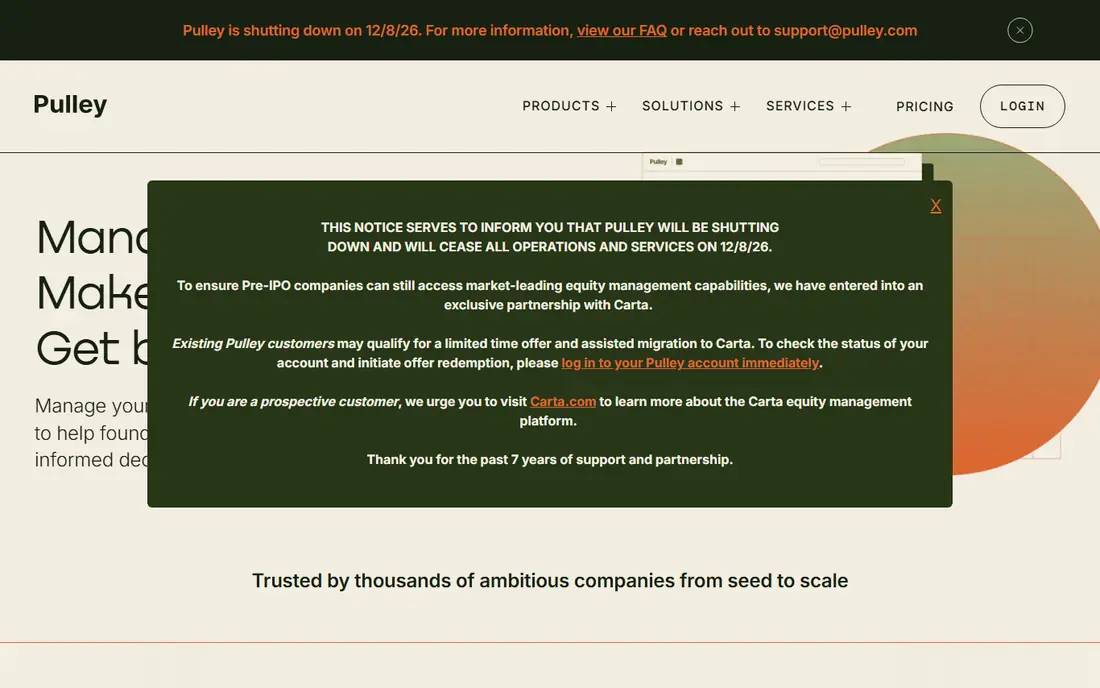
Pulley offers cap table management with tiered pricing, starting at 1,200 dollars per year for its Startup plan for up to 25 stakeholders. Its Growth plan, at 3,500 dollars per year for up to 40 stakeholders, includes 409A valuations, electronic exercises, board approvals, and HRIS integration. That bundle suits seed and growth companies that want one platform for equity and valuations, with modelling tools for fundraising and hiring plans. Pulley onboarding is concierge-led, which helps founders who are setting up a cap table for the first time.
The limits are tier boundaries. Startup plan buyers do not get a 409A, so a company that only needs a valuation must pay for Growth or buy a separate service. ASC 718 expense reporting sits in the Enterprise tier, which is custom priced, so companies approaching audit-heavy stages should confirm that cost early. Pulley is our pick for startups that want cap table and valuation together and that fit within its stakeholder tiers.
- Clear tiered pricing
- Fundraising modelling
- 409A included on Growth plan
- 409A not included on Startup plan
- ASC 718 needs Enterprise tier
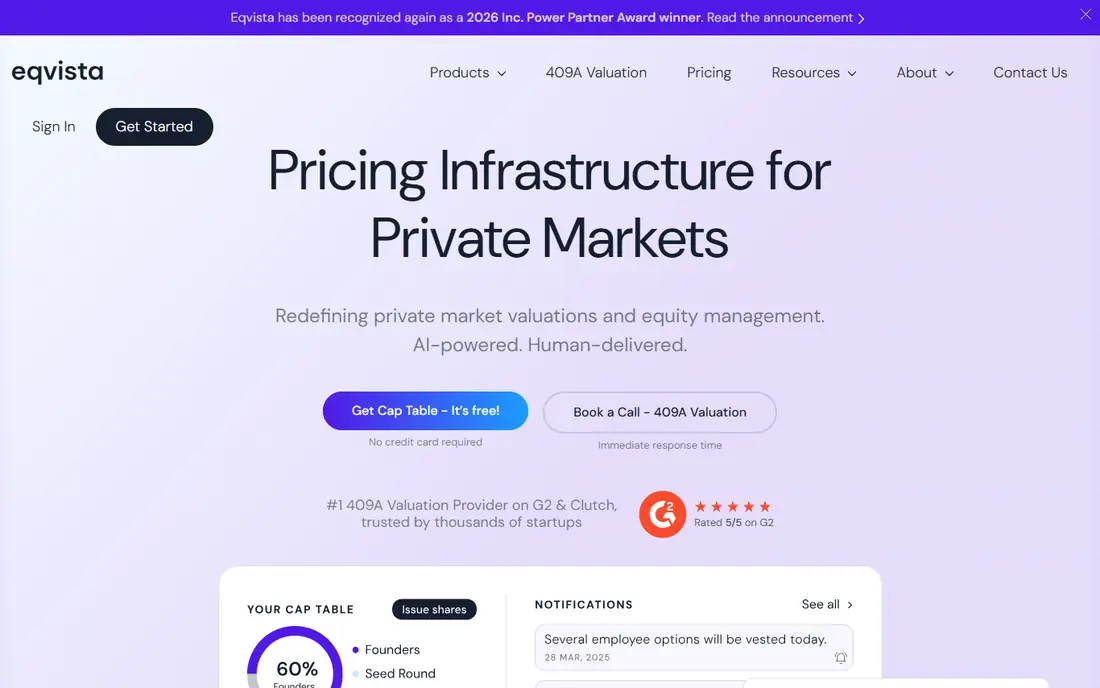
Eqvista offers a valuation bundle that starts at 990 dollars per year for pre-revenue and pre-funding companies, rising to 1,290 dollars for friends-and-family or angel-funded companies, 1,990 dollars at seed, and 2,590 dollars at Series A, with later stages custom priced. The bundle includes premium cap table tools and unlimited 409A updates and renewals within the term, which helps companies that expect a material event and need a refresh. Its free cap table tier for up to 20 stakeholders also lowers the entry cost for very early teams.
Stage-based pricing means the quote depends on funding, revenue, and capital structure, so the starting price is not a guaranteed invoice for a complex cap table. Eqvista suits early-stage companies that want a published, lower-cost bundle and that expect one or two valuation updates per year. Larger or more complex companies should compare Eqvista with an analyst-led firm before committing.
- Low published bundle starting price
- Unlimited updates on bundles
- Free cap table for small teams
- Stage-based pricing rises with funding
- Custom pricing at later stages
Carta is the largest equity management platform in the US, with cap table, fundraising, equity administration, and 409A valuation services. Its valuations are included on Grow and Scale tiers without a separate per-valuation charge, and its reports are widely recognised by auditors and law firms. For a company already on Carta, adding a valuation through the same platform avoids cap table migration and keeps equity data in one place. Carta also supports tender offers, secondary transactions, and later-stage equity needs that smaller platforms cannot match.
Carta pricing is quote-based beyond its free Launch tier for very small companies, and total costs can be high once platform fees, stakeholder charges, and add-ons combine. Published broker data puts median Carta spend well above smaller rivals, though actual prices vary by stage and size. Carta suits growth and later-stage companies that need a full equity platform and that value auditor familiarity. Early-stage founders should compare Carta with Pulley and Eqvista on two-year total cost.
- Widest equity platform
- Valuations included on higher tiers
- Strong audit familiarity
- Quote-based pricing
- Total cost can be high
- 409A is an add-on for many plans
Qapita offers standalone 409A valuations without requiring you to move your cap table to its platform, which is a real advantage for companies happy with their current equity tool. Its Growth plan is listed at 3,000 dollars per year with a 409A included, and its reports are signed by CFA charterholders with a dedicated analyst who can walk auditors through the methodology. That analyst access matters when an auditor questions an assumption, since a named reviewer can explain the model rather than leaving you with a generic PDF.
Qapita costs more than Eqvista bundles at entry level, and ASC 718 and enterprise reporting sit in higher tiers. It suits seed to growth companies that want a standalone valuation, a named analyst, and audit-ready documentation. If you also need cap table management, compare the combined cost of Qapita plus your current platform against a Pulley or Carta bundle.
- Standalone 409A without platform switch
- CFA-signed reports
- Auditor walkthroughs
- Higher entry price than bundle rivals
- Enterprise features custom priced
Kruze Consulting is a startup-focused accounting firm that provides 409A valuations alongside bookkeeping, tax, and CFO services for venture-backed companies. That combination helps founders who want valuation, tax, and finance advice from one team that understands startup capital structures. Kruze analysts handle common startup scenarios, including SAFE notes, convertible notes, and priced rounds, and they can coordinate valuation timing with option grants and board approvals.
Pricing is quote-based and depends on cap table complexity and service scope, so you need a scoping call for an accurate figure. Kruze suits venture-backed startups that already need accounting support and that want valuation advice linked to tax planning. A company that only needs a standalone valuation may find a platform bundle cheaper, but the integrated advice can justify the premium for complex files.
- Startup accounting expertise
- 409A alongside tax and finance
- Founder-friendly guidance
- Quote-based pricing
- Valuations part of a wider service
Armanino is a large accounting and advisory firm with valuation services for startups, growth companies, and mid-market firms, including 409A valuations, purchase price allocations, and complex equity structures. Its teams handle cross-border issues, multiple share classes, and heavily scrutinised cap tables that platform providers may refer to a specialist firm. For a company approaching an IPO, an acquisition, or a difficult audit, that advisory depth is valuable, and its reports carry the weight of an established firm.
Armanino prices are higher than platform bundles, often in the 5,000 to 10,000 dollar range or more for a valuation, and turnaround can be slower for simple early-stage files. It suits mid-market and later-stage companies with complex structures or audit pressure. Early-stage startups with a simple cap table will usually get a faster, cheaper valuation from Pulley, Eqvista, or Qapita.
- Established advisory firm
- Complex valuation experience
- Audit support
- Higher prices than platform providers
- Slower for simple early-stage files
Shareworks by Morgan Stanley provides equity administration for private and public companies, with global payroll, settlement, and reporting tools alongside valuation support. Its strength is scale and global reach, including companies with employees in many countries and complex stock plans. For a late-stage or public company, Shareworks offers administration depth that startup platforms cannot match, with support for secondary transactions and global compliance.
Setup is complex and pricing is quote-based, with minimums that make Shareworks costly for a seed-stage startup. Small companies should not choose Shareworks for a single 409A, since the platform cost will outweigh the valuation benefit. Shareworks suits larger, global companies that need equity administration and valuation together under one established provider.
- Global equity administration
- Morgan Stanley backing
- Public company support
- Quote-based pricing
- Complex setup for small startups
Ledgy is an equity management platform focused on European and international teams, with compliance tools, employee portals, and secondary trading support. Its plans start from around 3,000 euros per year, and it handles multi-country equity plans that US-only platforms struggle with. For a startup with employees and investors across Europe, Ledgy can simplify equity administration and valuation coordination in a way that a US platform cannot.
Ledgy is less suited to a purely US startup that needs a US 409A report for IRS purposes, since US valuation rules and auditor expectations differ. International companies should confirm whether Ledgy valuation support covers their US entity or whether a US provider is also needed. Ledgy is our pick for international teams that need equity and valuation support across borders, not for a simple US seed-stage valuation.
- European and international compliance
- Employee portals
- Secondary trading support
- Higher entry price
- US-focused startups may need a US specialist too
How we picked these
We compared official provider pages and recent published pricing comparisons from 2026, focusing on valuation method, audit support, turnaround, cap table integration, and total annual cost. We favoured providers that publish at least a starting price or tier, and we noted where pricing is quote-based. This is not tax or legal advice, and valuation timing and method should be confirmed with your accountants and lawyers.
How to choose and time a valuation
Order a valuation before you grant options, not after, since the strike price must reflect fair market value at grant date. A valuation is generally valid for up to 12 months, but a material event such as a priced round, a major revenue change, or a secondary sale can require a refresh sooner. Gather a clean cap table, SAFEs, convertible notes, financial projections, and board minutes before you engage a provider, since missing data is the most common cause of delay.
Ask each provider what method it will use, such as an option pricing model backsolve after a priced round or a discounted cash flow model for a pre-revenue company, and ask what a revision costs if your auditor pushes back. Compare two-year total cost, not just the first report price, including cap table fees, update fees, and ASC 718 reporting if you need it. A cheap first report that charges heavily for updates can cost more than a bundle with unlimited refreshes.
FAQ
What is a 409A valuation?
A 409A valuation is an independent appraisal of your private company common stock fair market value for US tax purposes under Section 409A. It sets the strike price for stock options so employees are not taxed on a bargain at grant. It is not the same as a fundraising valuation, which prices preferred shares sold to investors.
How often do I need a new 409A valuation?
Generally every 12 months, or sooner after a material event such as a priced funding round, a major business change, or a secondary transaction. If you plan option grants, order the valuation early enough that the report is ready before the grant date. Your lawyers and accountants can confirm whether an event triggers a refresh.
How much does a 409A valuation cost?
Platform bundles start around 990 dollars per year for very early companies, while standalone and analyst-led valuations often range from 2,500 to 10,000 dollars or more depending on complexity. Large advisory firms charge more for complex or later-stage files. Always compare the full annual cost, including updates and reporting, not just a single report price.
How long does a 409A valuation take?
Simple early-stage valuations often take one to two weeks, while post-seed and Series A files take two to four weeks, and complex later-stage files can take longer. Delays usually come from incomplete cap table data or missing financials, so prepare documents before you engage a provider. Rush service is available from some firms at a higher price.
Can I do a 409A valuation myself?
The IRS allows a qualified internal valuation in some cases, but most venture-backed startups use an independent provider because auditors and investors expect a third-party report. An internal valuation also creates risk if the method or assumptions are challenged. Talk to your lawyers before choosing an internal route.
What method do providers use for a 409A?
After a priced round, providers often use an option pricing model backsolve, which works backwards from the preferred share price to estimate common stock value. For pre-revenue companies, they may use income, market, or asset approaches, or a hybrid. Ask your provider to explain its method and assumptions in plain terms before you sign.