Shopping Cart Web Software in 2026: The 6 Best Options Side by Side
Comparing the best shopping cart web software? 6 contenders, each with entry cost, free tier and best-fit buyer. Real limits included. Checked this month.

- Editor's choice
 Wix eCommerce
All-in-one site and store
Starts atSee websiteVisit wix.comFull review - Great alternative
 Adobe Commerce
Enterprise B2B and B2C
Starts atSee websiteVisit business.adobe.comFull review - Also consider
 Salesforce Commerce Cloud
Commerce within Salesforce
Starts atSee websiteVisit salesforce.comFull review
Direct answer
Wix eCommerce is the first pick on this list for all-in-one site and store. Listed starting prices: WooCommerce from $29 per month and Shopify from $19 per month. If your case is different, Adobe Commerce suits enterprise B2B and B2C and Salesforce Commerce Cloud suits Commerce within Salesforce. The other 3 tools in the list cover narrower or pricier cases.
TL;DR:
- Wix eCommerce is the opening pick, best for all-in-one site and store.
- One limit worth knowing about Salesforce Commerce Cloud: implementation can be involved.
- None of the 6 tools, from Wix eCommerce to Shopify, has a free plan, so budget for a subscription or use a trial.
- The cheapest monthly starting price in the list is $19 per month, offered by Shopify.
Last checked November 2026. Prices and plan details were read from the vendors' own pages in November 2026; vendors change plans often, so confirm the current price on the vendor site before you buy.
Quick comparison
| Tool | Best for | Starts at | Free plan? | |
|---|---|---|---|---|
| Wix eCommerce | All-in-one site and store | See website | Not stated | Visit |
| Adobe Commerce | Enterprise B2B and B2C | See website | Not stated | Visit |
| Salesforce Commerce Cloud | Commerce within Salesforce | See website | Not stated | Visit |
 BigCommerce | Scalable multi-channel commerce | See website | Not stated | Visit |
 WooCommerce | Open-source WordPress keeps | $29 per month | Not stated | Visit |
 Shopify | All-in-one hosted commerce | $19 per month | Free trial | Visit |
Shopping Cart Web Software profiles
Short on time? The summary and table above give the quick view of 6 tools for shopping cart web software, and the profiles that follow give the detail behind each entry.
Choose Wix eCommerce for all-in-one site and store. Wix eCommerce is an all-in-one ecommerce system that lets you produce a configurable online store and start selling in several places.
More specifically, as a hosted builder, Wix supplies less low-level control than open-source options, which can matter for unusual technical requirements. For everyday use, choose Wix eCommerce when ease of building and an integrated site and store are priorities. Check the vendor site for Wix eCommerce pricing; none is listed in this comparison. Trial and free access: Not stated.
Downsides: Advanced customization may be constrained.
- All-in-one ecommerce system
- Configurable site builder
- Hosted environment limits code control
Pick Adobe Commerce if this describes you: enterprise B2B and B2C. Adobe Commerce, formerly Magento, is described as an AI-powered composable ecommerce product for B2B and B2C that provides personalized experiences at global scale.
Downsides: Needs technical resources.
Beyond that, Adobe Commerce is complicated and generally demands dedicated development and operations resources. Beyond that, choose it when enterprise scale, composability, and deep personalization are central requirements. Adobe Commerce does not show a starting price in this comparison, so check the vendor site for current pricing. As for free access: Not stated.
- AI-powered composable system
- B2B and B2C support
- Complicated to implement
Think of Salesforce Commerce Cloud for Commerce within Salesforce. Salesforce Commerce Cloud is Salesforce's commerce system, intended for companies that want to link shopping experiences with customer data and other Salesforce tools.
Downsides: Implementation can be involved.
More specifically, choose it when tight integration with Salesforce data and processes is the priority. Commerce Cloud can involve significant implementation effort and is most compelling inside the Salesforce ecosystem. Salesforce Commerce Cloud does not show a starting price in this comparison, so check the vendor site for current pricing. Free options: Not stated.
- Commerce Cloud platform
- Fits connected customer data
- Best value within Salesforce stack

In short, BigCommerce is for scalable multi-channel commerce. The product's breadth can be more than a tiny store needs, and configuration may take effort.
Smaller sellers or those wanting the simplest possible setup might look at lighter choices. BigCommerce describes commerce aimed at momentum, powering buying experiences across brands, regions, and channels from a single scalable foundation. This comparison lists no price for BigCommerce; ask the vendor. Free options: Not stated.
Honest limits: May be complicated for very small catalogs.
- Supports brands, regions, channels
- Single scalable foundation
- Feature depth can need setup time
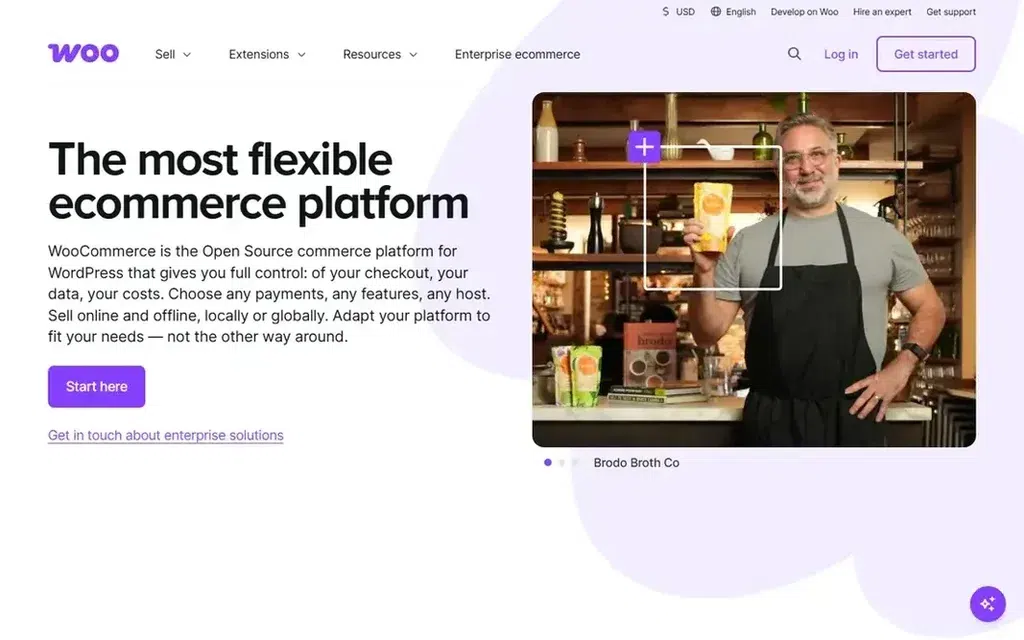
WooCommerce is designed for open-source WordPress keeps. WooCommerce is the open-source ecommerce system that helps merchants and developers build businesses for the long term.
Drawbacks to consider: Self-managed hosting and maintenance.
Beyond that, pick WooCommerce when openness and long-term ownership outweigh practical administration. On top of that, running WooCommerce means managing hosting, updates, and technical maintenance yourself or through a partner. Entry price for WooCommerce: $29 per month. As for free access: Not stated.
- Aimed at merchants and developers
- Open-source product
- Needs WordPress knowledge

Think of Shopify for all-in-one hosted commerce. Shopify presents itself as an all-in-one commerce product for businesses. Its homepage highlights AI tools and features to handle plenty of parts of a business beyond the storefront.
Honest limits: Hosted model limits deep server control.
Because Shopify is a hosted system, you trade some infrastructure control for convenience. Consider Shopify when speed of setup and integrated management matter more than deep customization. Entry price for Shopify: $19 per month. As for free access: Free trial.
- All-in-one product
- Wide business management features
- Can need apps for niche needs
How we compared the tools
Each tool was reviewed on what its vendor publishes: price, plan limits, core features and stated drawbacks. We did not run hands-on tests. Where a vendor does not publish a price, the entry says quote. Where a price depends on seats or billing term, the entry says so. The order reflects how well each tool fits the most common buying scenario for shopping cart web software, then price clarity, then free plan access. It is a starting point, not a verdict.
Pre-purchase checklist
- Ask Wix eCommerce, Adobe Commerce, Salesforce Commerce Cloud and BigCommerce for a written quote, since no starting price is shown.
- Run a trial of Shopify with real work before paying for a year; your own workflow is the best test.
- Read the limits listed for Wix eCommerce first: hosted environment limits code control.
- Make sure Salesforce Commerce Cloud lets you export your data in a format another tool can read.
- Get the contract term, renewal terms and any onboarding fees from Adobe Commerce in writing.
FAQ
What is the cheapest option for shopping cart web software in this list?
On published monthly entry prices, Shopify is the lowest here at $19 per month. Entry price is only part of the cost, because seats, add-ons and billing terms can change the total. For the full picture, the cards above cover all 6 entries of this shopping cart web software list, including price, free plan and limits.
How are the tools for shopping cart web software ordered?
Wix eCommerce sits first and Shopify last because the order follows typical fit for shopping cart web software, then price clarity and free access. It is a judgement call, so read each profile for fit and limits.
Does any tool for shopping cart web software here have a free plan?
No tool in this list, Wix eCommerce and Shopify included, has a permanent free plan. Shopify offer a trial. Trials and quotes are the usual route, so plan a short evaluation period.
Can I use these systems for B2B selling?
Adobe Commerce and Salesforce Commerce Cloud explicitly target B2B and B2C scenarios, and BigCommerce supports multi-channel commerce. Others may support B2B through features or integrations, so check vendor documentation for your specific requirements.
How do I migrate my store between shopping cart platforms?
Migration generally involves exporting product, customer, and order data and mapping it to the new product's structure. Check each vendor's documentation and support choices, and plan for redirects and testing before switching.
Which shopping cart software is a good match for a small business?
Wix eCommerce is the pick this page puts first, mainly for all-in-one site and store. If your situation differs, Adobe Commerce suits enterprise B2B and B2C, and Salesforce Commerce Cloud suits Commerce within Salesforce. Compare price and limits before you decide.
Sources
- https://www.wix.com/ecommerce
- https://business.adobe.com/products/magento/magento-commerce.html
- https://www.salesforce.com/commerce
- https://www.bigcommerce.com
- https://woocommerce.com
- https://www.shopify.com