Shopify Plus Alternatives in 2026: 8 Platforms Compared
Compare the best shopify plus alternatives for high-volume stores, with current prices, B2B features, checkout control and migration notes included today

- Editor's choice
 BigCommerce
Closest hosted alternative
Starts at$39 per monthVisit bigcommerce.comFull review - Great alternative
 Adobe Commerce
Deep enterprise customization
Starts atSee websiteVisit business.adobe.comFull review - Also consider
 WooCommerce
Open-source control
Starts atFreeVisit woocommerce.comFull review
TL;DR:
- BigCommerce is the closest hosted alternative to Shopify Plus, with similar pricing tiers and strong B2B and multi-storefront features.
- Adobe Commerce and Salesforce Commerce Cloud suit large enterprises that need deep customization and already have development teams.
- WooCommerce and Medusa suit teams that want open-source control and lower platform fees, provided they can manage hosting and maintenance.
- Shopware, VTEX and Wix cover different niches: European mid-market commerce, Latin American and global enterprise, and simpler high-growth stores.
- Total cost matters more than the headline plan: add apps, payment fees, development and migration before comparing any platform with Shopify Plus.
Quick comparison
| Tool | Best for | Starts at | Free plan? | |
|---|---|---|---|---|
| BigCommerce | Closest hosted alternative | $39 per month | Free trial | Visit |
| Adobe Commerce | Deep enterprise customization | See website | No | Visit |
| WooCommerce | Open-source control | Free | Yes | Visit |
 Salesforce Commerce Cloud | Large enterprise commerce | See website | No | Visit |
 Shopware | European mid-market stores | See website | Yes | Visit |
 Medusa | Developer-led headless commerce | Free | Yes | Visit |
 VTEX | Global enterprise commerce | See website | No | Visit |
 Wix | Simpler high-growth stores | See website | Free trial | Visit |
The best Shopify Plus alternatives
We compared official pricing pages, feature pages and public documentation for commerce platforms that can handle high-volume stores today. The eight below cover hosted, open-source and headless options, so you can match platform control to team capability.

BigCommerce is the first platform most Shopify Plus merchants evaluate, because the model is familiar: hosted, maintained and scaled by the vendor, with apps for extra features. It adds native B2B tools, customer groups, price lists, multi-storefront management and channel selling to Amazon, eBay and social platforms. For a merchant leaving Shopify over fees, checkout limits or B2B needs, BigCommerce is the lowest-friction move.
Standard is $39 per month, or $29 on annual billing, Plus $105, or $79 annual, and Pro $399, or $299 annual, with Enterprise custom. Watch the sales limits and the 2026 payment provider fee: plans auto-upgrade when trailing sales exceed thresholds, and orders through non-approved gateways can attract a fee. Price your expected sales band, not just the entry tier, before comparing totals with Shopify Plus.
- Hosted SaaS with B2B, multi-storefront and channel features
- No separate hosting to manage
- Strong API and app ecosystem
- Sales limits force plan upgrades
- Transaction fee on some payment providers in 2026
- Enterprise pricing is custom

Adobe Commerce, formerly Magento Commerce, is the enterprise open-source platform for merchants that need control Shopify Plus does not offer. Complex catalogs, custom pricing, multi-warehouse inventory, B2B quotes and tailored checkout flows are all possible, with a large extension marketplace. That flexibility is why large retailers with in-house or agency development teams choose it.
Pricing is custom and quoted by Adobe, so we list See website. Total cost includes hosting, development, maintenance, security patching and upgrades, which can exceed a SaaS subscription by a wide margin. Adobe Commerce suits merchants whose requirements genuinely need custom code; if a hosted platform covers your needs, the extra control is rarely worth the extra cost and effort.
- Deep customization and B2B workflows
- Large extension marketplace
- Strong for complex catalogs and pricing
- Custom pricing
- Needs developers and hosting management
- Implementation time and cost are high
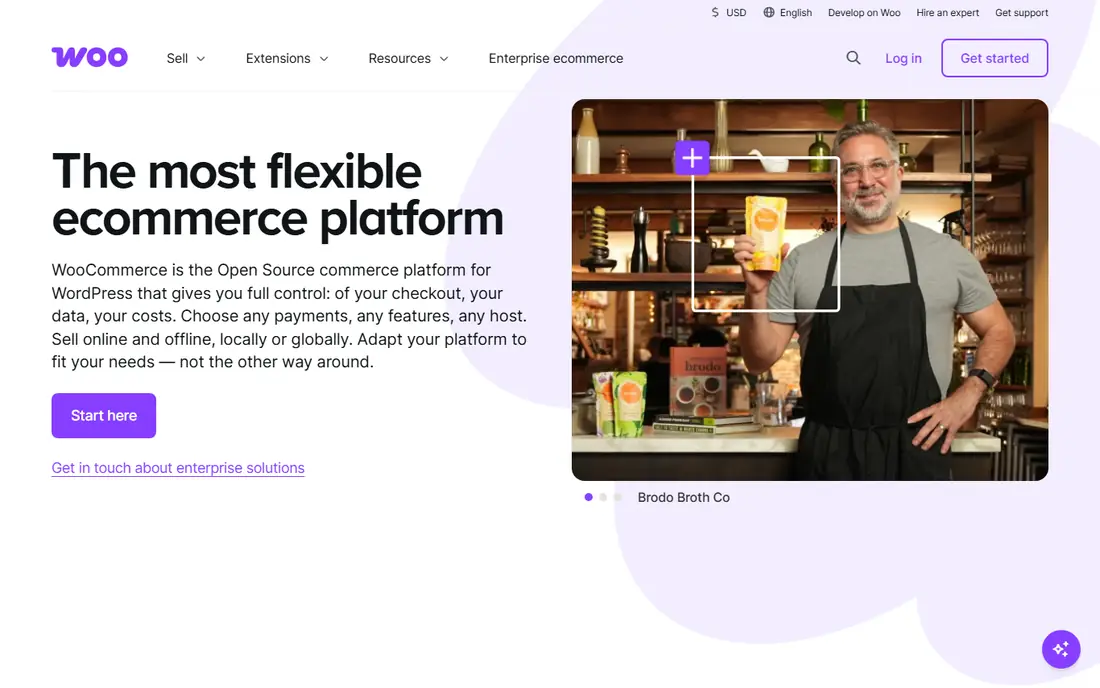
WooCommerce turns a WordPress site into a store, with a free core plugin and paid extensions for subscriptions, bookings, B2B pricing, payments and shipping. It suits merchants who already run WordPress, want full data ownership, and have a developer or agency to manage hosting and maintenance. Checkout, content and commerce live in one system, which helps content-led brands.
The plugin itself is free, but hosting, a theme, extensions, payment fees and maintenance are real costs, and a high-traffic store needs proper caching and hosting to stay fast. WooCommerce can scale, but it does not scale by itself the way a hosted platform does. Choose it for control and WordPress fit, not because free sounds cheaper: price the full stack before comparing it with Shopify Plus.
- Free core plugin for WordPress
- Huge extension ecosystem
- Full control over checkout, data and hosting
- You manage hosting, security and updates
- Extension costs add up
- Performance needs optimization at scale
Salesforce Commerce Cloud serves large brands that need enterprise commerce integrated with Salesforce CRM, service and marketing tools. It offers AI-driven personalization, promotions, order management and B2B commerce at a scale that suits global retailers. For a company already invested in Salesforce, the unified customer view is a strong advantage.
Pricing is custom and typically based on gross merchandise volume, often reported at one to two percent of GMV, so we list See website. That model means a high-volume store can pay far more than a flat SaaS fee, even before implementation and partner costs. Salesforce Commerce Cloud fits large enterprises with complex needs and budgets to match; mid-sized merchants will usually find BigCommerce or Shopware more practical.
- Enterprise scale, AI and personalization
- B2C and B2B commerce
- Deep Salesforce ecosystem integration
- GMV-based pricing can be very high
- Implementation is a major project
- Needs specialist partners
Shopware is a German commerce platform popular in Europe and growing internationally, with an open-source Community edition and commercial Rise, Evolve and Beyond plans. It offers flexible product, content and B2B features, headless commerce options, and a marketplace of extensions. Merchants that sell heavily in Europe, or need a European data and partner base, often shortlist it.
We list pricing as See website because commercial plans are quoted or tiered by GMV and features. The Community edition is free to use, but hosting, extensions and support still cost money. Shopware suits mid-market merchants that want open-source flexibility with commercial support, provided they can find an agency or partner with Shopware experience in their market.
- Flexible open-source core with commercial plans
- Strong in Europe
- B2B features and headless options
- Smaller US ecosystem than Shopify or BigCommerce
- Agency help often needed
- Pricing varies by plan
Medusa is an open-source, headless commerce platform built for developers who want to compose a store from modules rather than accept a monolithic platform. It covers products, orders, customers, carts and promotions through APIs, and teams can build a custom storefront with modern frameworks. That modular design suits brands with unique checkout, subscription or marketplace needs.
The core is free and open source, so we list Free as the starting price, with a commercial Cloud offering for hosted use. Medusa is not a plug-and-play Shopify replacement: it needs developers to build and maintain the storefront, integrations and hosting. For a developer-led brand that values control and modern architecture, it is an exciting alternative; for a merchant without developers, a hosted platform is safer.
- Open-source headless commerce
- Modular architecture
- Developer-friendly APIs and customization
- Needs a development team
- No hosted storefront out of the box
- Ecosystem is younger than WooCommerce or Adobe
VTEX is an enterprise commerce platform used by large retailers and brands, with strengths in marketplace selling, order management, promotions and multi-store operations. It is particularly strong in Latin America and among global brands that need to run many stores, channels and fulfillment models from one platform. Its composable approach lets teams adopt modules as needed.
Pricing is custom, so we list See website. VTEX suits enterprise merchants with complex omnichannel needs, not small stores looking for a quick Shopify Plus replacement. If your business runs marketplaces, multiple brands or complex fulfillment, VTEX deserves a demo; if you run a single high-growth store, BigCommerce or WooCommerce will be faster to launch.
- Enterprise commerce with marketplace and OMS features
- Strong in Latin America and global retail
- Composable architecture
- Custom pricing
- Implementation with partners
- Smaller US small-business ecosystem
Wix is not a like-for-like Shopify Plus replacement for complex B2B or enterprise needs, but it is a legitimate alternative for simpler high-growth stores. Its drag-and-drop builder, templates, product management, payments and marketing tools let a small team launch and run a store without developers. For a brand whose store is straightforward and whose team values design control, Wix can be enough.
We list pricing as See website because Wix business and commerce plans vary by region and features, with a free tier for testing. Check transaction fees, storage, product limits and app costs for your plan before comparing totals. Wix suits merchants leaving Shopify Plus because they overbought enterprise features; it does not suit merchants leaving because they need deeper B2B, checkout or integration control.
- Easy store setup with drag-and-drop design
- Built-in marketing and bookings
- Lower learning curve
- Less B2B and enterprise depth than Shopify Plus rivals
- App and transaction costs vary
- Migration from Shopify needs planning
How we picked these
We compared official pricing pages, feature pages and public documentation for commerce platforms that can serve high-volume stores today. We included hosted, open-source and headless options because a Shopify Plus alternative is not one kind of platform: some merchants want a simpler hosted move, others want full control. We did not claim hands-on testing; our comparison rests on vendor documentation and reported user experience.
Where pricing was custom, GMV-based or variable, we wrote See website rather than presenting an estimate as a vendor price. Where a published tier price was consistent, we used it and noted sales limits or fees that change the total.
How to migrate from Shopify Plus without breaking sales
Start with a requirements list, not a platform demo. Write down checkout needs, B2B pricing, subscriptions, international selling, integrations for ERP, CRM and fulfillment, and the apps you cannot live without. A platform that looks cheaper but misses a core integration will cost more in workarounds than it saves in subscription fees.
Next, plan data and redirects. Export products, customers, orders, discounts and content, map fields to the new platform, and plan 301 redirects for every important URL so search rankings and bookmarks survive. Test checkout, payments, taxes, shipping and email flows on a staging store with real orders before go-live, and keep Shopify running until the new store is proven.
Finally, time the move carefully. Avoid peak sales periods, plan a rollback if the launch fails, and tell customers about any account or password changes in advance. Migration is a project, not a weekend task, for a high-volume store: allow weeks for data, design, testing and training, and budget for agency help if your team has not migrated a store before.
FAQ
What is the best Shopify Plus alternative?
BigCommerce is the best direct hosted alternative for most high-volume merchants, because its model, B2B tools and pricing tiers are closest to Shopify Plus. Adobe Commerce and Salesforce Commerce Cloud suit larger enterprises with development teams, while WooCommerce and Medusa suit teams that want open-source control. The best choice depends on your B2B needs, checkout control and in-house technical capacity.
Is BigCommerce cheaper than Shopify Plus?
It can be, but not always. BigCommerce entry tiers start at $39 per month, far below Shopify Plus, yet enterprise BigCommerce is custom priced and sales limits can force upgrades. Compare total cost: subscription, payment fees, apps, development and migration, at your actual sales volume. A merchant with high GMV and a preferred payment provider may save on BigCommerce, while a merchant on Shopify Payments may not.
Can I migrate from Shopify Plus to WooCommerce?
Yes. WooCommerce offers migration tools and importers for products, customers and orders, and agencies regularly migrate Shopify stores to WordPress. Plan redirects, checkout testing and app replacements carefully, because Shopify apps do not transfer directly. WooCommerce gives you data control, but you take on hosting, security and maintenance that Shopify previously handled.
Do Shopify Plus alternatives support B2B selling?
Yes, with different depth. BigCommerce, Adobe Commerce, Salesforce Commerce Cloud, Shopware and VTEX all offer B2B features such as customer groups, price lists, quotes and net payment terms, while WooCommerce and Medusa support B2B through extensions or custom development. Wix offers simpler B2B features, so check whether it covers your specific pricing, approval and ordering workflows before choosing it.
What is headless commerce, and do I need it?
Headless commerce separates the storefront from the back-end commerce engine, so developers can build a custom front end while the platform handles products, carts and orders. Medusa, Shopware, Adobe Commerce and VTEX support headless approaches. You need it only if your front-end experience, performance or channel needs cannot be met by a standard storefront; otherwise a hosted theme is faster and cheaper.
How long does it take to leave Shopify Plus?
A simple hosted move can take four to eight weeks, while a complex enterprise migration to Adobe Commerce or Salesforce Commerce Cloud can take several months. Data mapping, design, integrations, checkout testing and staff training drive the timeline more than the platform itself. Allow a testing period with real orders, and avoid launching during your busiest sales season if you can.