Etsy Alternatives in 2026: 8 Platforms Compared
Looking for Etsy alternatives for handmade sellers in 2026? Here we compare Shopify, Amazon Handmade, eBay, Big Cartel, WooCommerce, and more, with fees.

- Editor's choice
 Shopify
Your own branded store
Starts at$39 per monthVisit shopify.comFull review - Great alternative
 Amazon Handmade
Built-in Amazon traffic
Starts atSee websiteVisit amazon.comFull review - Also consider
 eBay
Resale and one-off handmade items
Starts atSee websiteVisit ebay.comFull review
TL;DR:
- Shopify is our pick for sellers who want their own brand and store, with a full online store from $39 per month for Basic.
- Amazon Handmade and eBay suit sellers who want built-in traffic, but marketplace fees and competition are higher.
- Big Cartel is the simplest low-cost option for artists with a small catalog, starting free for up to five products.
- WooCommerce suits sellers who already use WordPress and want full control, while Squarespace and Wix suit design-led small stores.
Quick comparison
| Tool | Best for | Starts at | Free plan? | |
|---|---|---|---|---|
| Shopify | Your own branded store | $39 per month | Free trial | Visit |
| Amazon Handmade | Built-in Amazon traffic | See website | No | Visit |
| eBay | Resale and one-off handmade items | See website | No | Visit |
 Big Cartel | Small artist shops | Free | Yes | Visit |
 WooCommerce | WordPress sellers | Free | Yes | Visit |
 Squarespace | Design-led small stores | See website | Free trial | Visit |
 Wix | Easy drag-and-drop stores | See website | Free trial | Visit |
 Society6 | Print-on-demand art products | Free | Yes | Visit |
The best Etsy alternatives
Etsy works well for discovery, but its fees, search rules, and competition push many sellers to look elsewhere. The platforms below fall into two groups: marketplaces that bring traffic, and store builders that give you control. Most successful sellers use one of each.

Shopify is the best Etsy alternative for sellers who want a store that looks and feels like their brand, not another marketplace listing. Basic is $39 per month, with a full online store, discount codes, and support for in-person sales through its point-of-sale tools. You control the domain, the design, the email list, and the customer data, which matters once repeat buyers become your main source of sales.
The trade is traffic. Etsy brings shoppers who are already searching for handmade goods, while Shopify brings almost none on its own. You will need social media, email, markets, or search traffic to fill the store. If you already have an audience, Shopify is usually the right move. If you have none, pair it with a marketplace until your own traffic grows.
- Full store, checkout, and apps
- Strong payment and shipping tools
- Easy to scale from first sale to a team
- Monthly fee plus payment processing
- You must drive your own traffic
- App costs can add up
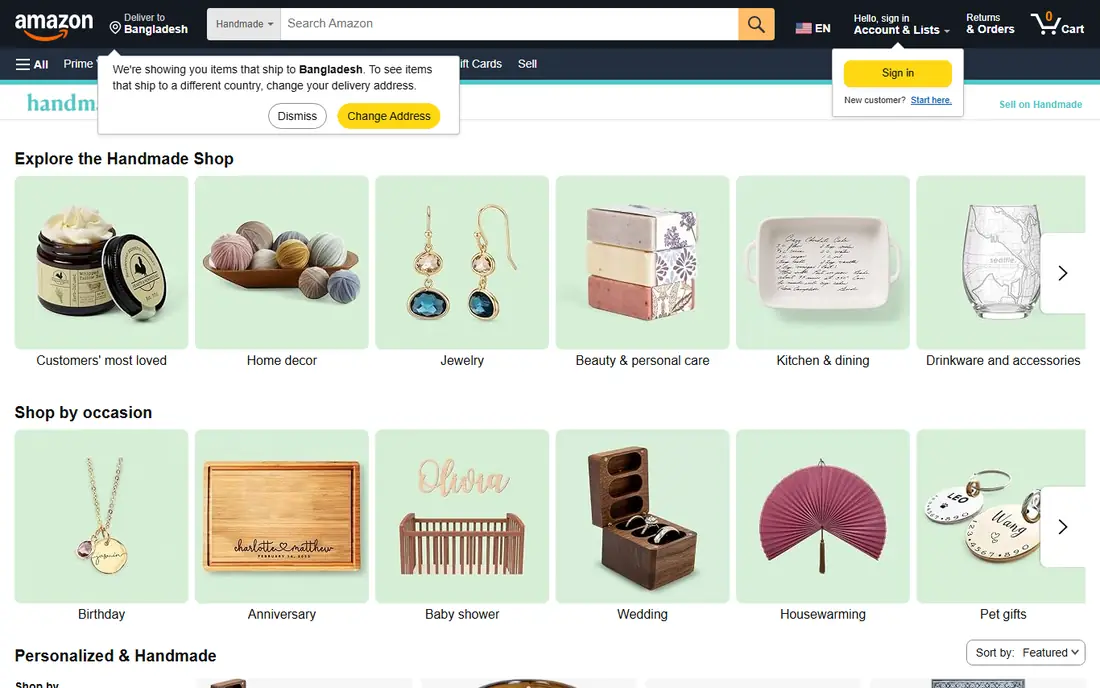
Amazon Handmade is the closest marketplace alternative to Etsy in sheer traffic. It is open to artisans who make their own products, with a storefront that highlights the maker story behind each item. For sellers whose products also suit gift buyers and everyday shoppers, Amazon can bring far more views than a new standalone store.
Fees and rules are the catch. Amazon charges referral fees that vary by category, and you must meet its handmade criteria and policies. Fulfillment by Amazon can help with shipping, but it adds its own fees. Use Handmade when your products have broad appeal and you can price for fees, and keep your own store for repeat customers.
- Access to Amazon shoppers and Prime-style trust
- Artisan-only storefront
- Fulfillment options available
- Application and approval required
- Referral fees per sale
- Strict handmade rules and competition

eBay is not a handmade-first marketplace, but it is a practical Etsy alternative for sellers with vintage goods, craft supplies, seconds, or one-off pieces. Its buyer pool is enormous, and fixed-price listings work well for repeatable items, while auctions suit rare or collectible pieces. Many sellers use eBay to clear stock that does not fit their main shop.
The downside is brand. eBay listings feel like a marketplace sale, not a maker story, and fees apply to the item price and shipping. It is best as a second channel, not a replacement for a branded store, especially for sellers whose work depends on storytelling and repeat custom.
- Huge buyer pool
- Strong for vintage, supplies, and one-off items
- Auction and fixed-price options
- Fees on sales and shipping
- Buyer protection can favor buyers in disputes
- Less of a handmade brand story
Big Cartel has served independent artists for years, and it remains the simplest free alternative to Etsy for a small shop. The free Gold plan covers five products, while Platinum at $15 per month covers 50 products and Diamond at $30 per month covers 500 products. Big Cartel charges no platform transaction fee, though Stripe or PayPal processing fees still apply.
Big Cartel suits a maker with a focused catalog who wants a clean shop without a monthly bill. It is less suited to a large store that needs abandoned-cart recovery, advanced discounts, or a wide app library. For a first store, or a side shop next to Etsy, it is hard to beat on simplicity and cost.
- Free plan for up to five products
- No platform transaction fees
- Simple setup for artists and makers
- Product limits on lower plans
- Fewer built-in marketing tools than Shopify
- Limited app ecosystem
WooCommerce turns a WordPress site into a full store, which makes it the best free alternative for sellers who already run a WordPress blog or portfolio. The core plugin is free, you own your customer data, and you can add extensions for subscriptions, bookings, memberships, or wholesale as your business grows. There is no monthly platform fee, though hosting, a domain, and payment processing still cost money.
The catch is responsibility. You handle updates, backups, and security, or you pay a host to help. Sellers who like control and already use WordPress will find that trade worthwhile. Sellers who want a hosted, hands-off store should choose Shopify, Squarespace, or Wix instead.
- Free core plugin
- Full control over design, data, and checkout
- Huge extension library
- No monthly platform fee
- You pay for hosting and maintenance
- Setup takes more technical work
- Security and updates are your job
Squarespace suits makers whose work sells on looks. Its templates are clean, its image handling is strong, and a portfolio, blog, and store can live on one site. For photographers, illustrators, ceramicists, and designers, that presentation can matter as much as the checkout itself.
Squarespace is less flexible than Shopify for large catalogs, complex shipping rules, or a deep app stack, and lower plans may carry transaction fees, so check the current commerce plan details before you commit. For a small, design-led shop with a clear product range, it is a polished and manageable Etsy alternative.
- Polished templates
- Blogging and portfolio tools included
- Straightforward checkout and inventory
- Fewer apps than Shopify
- Transaction fees on lower plans
- Less flexible for complex stores
Wix is the easiest store builder on this list for a seller who wants to design a shop without code. You drag elements into place, add products, connect a payment provider, and publish. It also includes tools for email marketing, bookings, and social posts, which helps a solo seller who does everything themselves.
Wix works best for small to mid-size stores. Larger sellers may find Shopify or WooCommerce more flexible for inventory, shipping, and integrations. Check the current commerce plan pricing, since the right plan depends on whether you need online payments, subscriptions, or advanced shipping, and avoid paying for add-ons you will not use.
- Very easy drag-and-drop builder
- Many templates
- Built-in marketing and booking tools
- Commerce features vary by plan
- Moving to another platform later is harder
- Costs rise with add-ons
Society6 is a different kind of Etsy alternative, because you do not make or ship the product. You upload artwork, Society6 prints it on items such as prints, phone cases, cushions, and apparel, and handles production and shipping. That makes it ideal for illustrators and photographers who want to sell art without holding stock.
Margins are the trade. Society6 sets base prices and pays artists a margin on each sale, so earnings per item are lower than selling your own prints. It works best as an extra income channel next to a main shop, where the same artwork can earn in several formats without extra work from you.
- Free to open a shop
- No inventory or shipping to handle
- Art applied to many product types
- Lower margins than selling your own stock
- Limited control over pricing and fulfillment
- Discovery depends on the platform
How we picked these
We compared official pricing, fee pages, and seller documentation for platforms that accept handmade, art, vintage, or small-batch sellers and are available to US sellers in October 2026. We favored platforms with a clear seller path, real checkout and payment tools, and a current product. Where fees vary by category or plan, we say so and point you to the vendor fee page, because a single fee figure would mislead sellers with different product types.
Should you leave Etsy completely
For most sellers, the answer is no, at least at first. Etsy still brings discovery that a new store cannot match, especially for niche handmade search terms. A safer plan is to keep Etsy for discovery, build your own store for repeat buyers, and use a print-on-demand channel for artwork that suits it.
Compare the full cost per sale
Add the monthly fee, listing fee, transaction fee, payment processing fee, and any advertising spend, then divide by the number of orders. A free platform with high per-sale fees can cost more than a $39 monthly store once volume grows, while a paid store with no sales is wasted money. Revisit the math every few months as your order volume changes.
FAQ
What are the best alternatives to Etsy for sellers?
Shopify is the best overall alternative for a branded store, Amazon Handmade and eBay are the best for built-in traffic, and Big Cartel is the best low-cost option for a small catalog. WooCommerce suits WordPress users, while Squarespace and Wix suit design-led small stores. The right mix often includes one marketplace and one of your own.
Are there free alternatives to Etsy?
Yes. Big Cartel offers a free plan for up to five products, WooCommerce core is free apart from hosting, and Society6 is free to open. Payment processing fees still apply on sales, and free plans carry limits, so check product caps and transaction fees before you list a full catalog.
Is Shopify better than Etsy?
Shopify is better for brand control, customer data, and repeat sales, while Etsy is better for discovery and built-in handmade search traffic. Many sellers use both: Etsy to be found, Shopify to keep repeat buyers and avoid paying marketplace fees on every repeat order.
Can I sell handmade items on Amazon?
Yes, through Amazon Handmade, which is open to artisans who make their own products and pass an application review. It brings large traffic, but referral fees apply and handmade rules are strict. It suits products with broad gift appeal, while niche handmade work may still do better on Etsy or your own store.
Do I need my own website if I sell on Etsy?
You do not need one to start, but your own store gives you an email list, repeat-buyer data, and freedom from marketplace fee and search changes. Start with a simple store on Big Cartel or Shopify, link it from your Etsy shop where allowed, and grow it as repeat orders increase.