The 5 Best Remote Support Software for Therapists in 2026, Ranked
5 best remote support software for therapists, with entry costs, free tiers and the buyer each one serves. Verdicts stay brief and factual. Prices included.

- Editor's choice
 Cisco Webex
Enterprise-grade meetings and devices
Starts atSee websiteVisit webex.comFull review - Great alternative
 Doxy.me
Straightforward telehealth-only video sessions
Starts atSee websiteVisit doxy.meFull review - Also consider
 Zoom
Familiar video meetings with wide features
Starts atSee websiteVisit zoom.usFull review
Direct answer
Start with Cisco Webex if you need enterprise-grade meetings and devices. Listed starting prices: SimplePractice from $49 a month. Doxy.me is the stronger choice for straightforward telehealth-only video sessions, while Zoom suits familiar video meetings with wide features. The full list of 5 tools follows, with prices and free plan facts.
TL;DR:
- Cisco Webex is the opening pick, best for enterprise-grade meetings and devices.
- Cisco Webex stands alone as the one tool in this list with a free plan.
- For organizations already using Microsoft tools, Microsoft Teams is worth a look.
- A fair warning about SimplePractice: broad system may feel heavy for solo video-only use.
- SimplePractice is the lowest-priced starter here at $49 per month.
Last checked November 2026. Prices and plan details were read from the vendors' own pages in November 2026; vendors change plans often, so confirm the current price on the vendor site before you buy.
Quick comparison
| Tool | Best for | Starts at | Free plan? | |
|---|---|---|---|---|
| Cisco Webex | Enterprise-grade meetings and devices | See website | Yes | Visit |
| Doxy.me | Straightforward telehealth-only video sessions | See website | Not stated | Visit |
| Zoom | Familiar video meetings with wide features | See website | Not stated | Visit |
 SimplePractice | All-in-one HIPAA-compliant practice management | $49 a month | Free trial | Visit |
 Microsoft Teams | Organizations already using Microsoft tools | See website | Not stated | Visit |
Remote Support Software for Therapists compared in detail
Short on time? The summary and table above give the quick view of 5 remote support software for therapists, and the profiles that follow give the detail behind each entry.
Think of Cisco Webex for enterprise-grade meetings and devices. Cisco Webex is a collaboration platform offering meetings, calling, customer experience tools and devices, with AI features woven through. More specifically, therapists wanting a purpose-built system should compare against behavioral health products.
Worth adding: Webex is aimed at wide organizational collaboration instead of therapy workflows, so it does not supply clinical documentation or billing. Its depth may be unnecessary for a solo practitioner. This comparison lists no price for Cisco Webex; ask the vendor. Cisco Webex offers a free plan.
Downsides: Not built for clinical records.
- Suited to bigger organizations
- Meetings
- Enterprise orientation may overwhelm solo practices

Doxy.me makes the most sense for straightforward telehealth-only video sessions. Doxy.me is a telehealth product built around secure video visits for providers. Clinicians with complicated administrative needs should compare it against full EHR products.
For everyday use, for therapists who already have recordkeeping handled elsewhere and mainly need a dependable, privacy-minded way to hold remote sessions, it is a focused choice that avoids the complexity of a full practice suite. As a telehealth-first product, it does not replace documentation, scheduling or billing systems, so practices wanting one integrated product may have to pair it with other software. Doxy.me shows no starting price here, so confirm the cost on the vendor site. On free options: Not stated.
Where it falls short: Not a full EHR or billing system.
- Telehealth system centred on providers
- Secure video positioning for clinical use
- Restricted beyond video visit workflows
Where Zoom fits: familiar video meetings with wide features. Zoom is a collaboration product centered on video meetings, with extra tools for chat, phone, webinars and events. Its familiarity makes it simple for clients to join sessions without installing unfamiliar software.
It can serve administrative calls and team meetings alongside client sessions. Practices that want compliance handled inside the software should consider a dedicated behavioral health product instead. Worth adding: therapists who value a widely used, feature-rich meeting tool frequently start here. It does not offer therapy records, notes or billing. Zoom shows no starting price here, so confirm the cost on the vendor site. On free options: Not stated.
Points against: General-purpose tool, not therapy-specific.
- Adaptable for both clinical and admin calls
- Phone and webinar tools
- Clinical safeguards must be configured
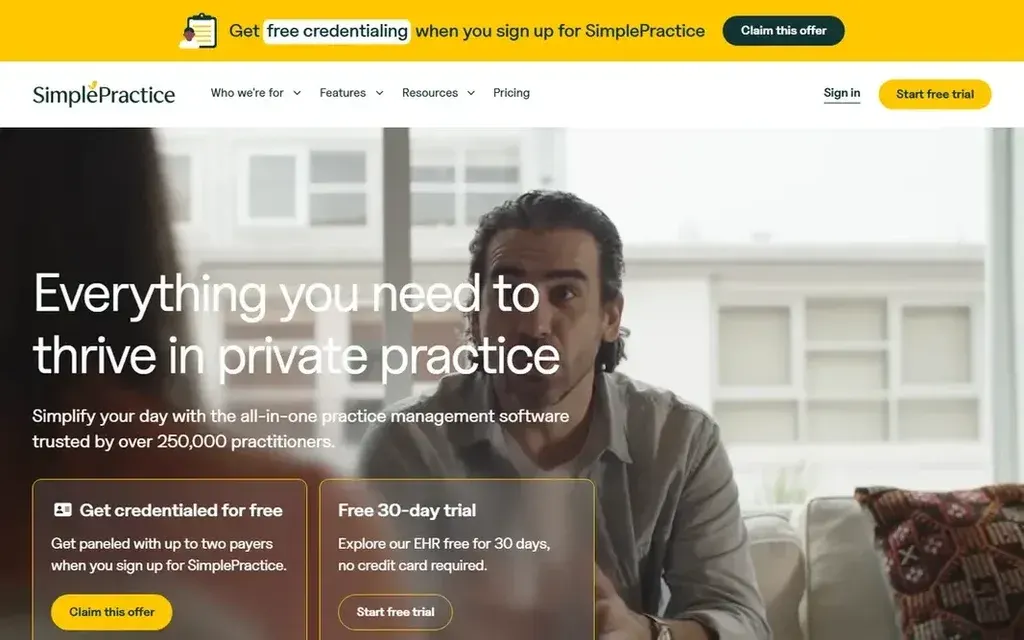
SimplePractice works best for all-in-one HIPAA-compliant practice management. Solo practitioners with straightforward workflows might prefer a lighter telehealth-only option.
In practice, SimplePractice is an EHR and practice management product pitched at health and wellness professionals, including therapists. Also, confirm current feature details and compliance documentation on the vendor site before committing, since offerings evolve. SimplePractice starts at: $49 per month. Free plan details: Free trial.
Drawbacks to consider: Feature depth varies by practice needs. Best features of SimplePractice: Merges records.
- Scheduling and video visits
- Made for health and wellness professionals
- Wide product may feel heavy for solo video-only use
Microsoft Teams is designed for organizations already using Microsoft tools. Teams is aimed at general collaboration, so it lacks therapy-specific records, notes and billing, and clinical use needs careful configuration and compliance review. Also, solo therapists may find it heavier than needed.
Limits to weigh: Setup and administration can be involved.
In daily use, for group practices or clinics already working within Microsoft productivity tools, it keeps conversations, documents and meetings in one organized place. It can support both clinical video sessions and the administrative coordination around them, which fits bigger teams more than solo practitioners. No starting price is listed for Microsoft Teams here; confirm pricing on the vendor site. Free access: Not stated.
What works well: Meetings.
- Files and conversations stay organized together
- Suits practices using Microsoft productivity tools
- General collaboration focus, not clinical
Our selection method
The comparison looks at four things: starting price, free access, how well the feature set matches remote support software for therapists, and the main limit of each tool. Plan names, prices and limits change often. Treat the figures here as a starting point and verify them with the vendor. The order reflects how well each tool fits the most common buying scenario for remote support software for therapists, then price clarity, then free plan access. It is a starting point, not a verdict.
Before you commit
- Ask Cisco Webex, Doxy.me, Zoom and Microsoft Teams for a written quote, since no starting price is shown.
- Test the free plan from Cisco Webex against your real workload before relying on it.
- Run a trial of SimplePractice with real work before paying for a year; your own workflow is the best test.
- Read the limits listed for Cisco Webex first: enterprise orientation may overwhelm solo practices.
- Involve the people who will use Zoom daily; a short pilot beats a long feature checklist.
- Total up the real monthly cost of Microsoft Teams, including add-ons, extra users and usage-based fees.
FAQ
Do therapists need a therapy-specific product for remote sessions?
General meeting tools can work if you configure privacy settings carefully and manage documentation separately. Weigh how much administration you want in a single place.
Can I try these tools before paying?
Often, yes. Cisco Webex has a free plan and SimplePractice offers a free trial. Use your own data and a real task during the test, and check what the free tier or trial limits before you rely on it.
Is Cisco Webex the right pick for everyone comparing remote support software for therapists?
No single tool suits every team. Cisco Webex comes first because it fits enterprise-grade meetings and devices, while Doxy.me suits simple telehealth-only video sessions and Zoom suits familiar video meetings with broad features. Match the tool to your own size, budget and workflow before deciding.
Which options for remote support software for therapists have a free plan?
Cisco Webex is the only tool in this list with a free plan. Free plans usually cap users, projects or features, so check the limits on the vendor page. One other tool offers a trial instead.
Do these tools publish their prices?
Not all of them. Cisco Webex, Doxy.me, Zoom and Microsoft Teams publish no starting price, so expect a quote request for those. The rest, SimplePractice included, show a starting price, though seats and billing terms still change the final cost.
Sources
- https://www.webex.com
- https://doxy.me
- https://zoom.us
- https://www.simplepractice.com
- https://www.microsoft.com/en-us/microsoft-teams/group-chat-software