6 Best Remote Patient Monitoring Software for Small Business for 2026, Vetted and Compared
Best remote patient monitoring software for small business in 2026: 6 contenders with entry costs and free tiers. Pros and cons for every tool. Prices checked.
- Editor's choicePrevounce
Building a structured remote care program
Starts atPricing on requestVisit prevounce.comFull review - Great alternativeOptimize Health
Nurse-led chronic care support
Starts atPricing on requestVisit optimize.healthFull review - Also considerHealthArc
All-in-one RPM with billing support
Starts atPricing on requestVisit healtharc.ioFull review
Direct answer
This list puts Prevounce first for building a structured remote care program. Alternatives: Optimize Health for Nurse-led chronic care support, and HealthArc for all-in-one RPM with billing support. Details and limits for the rest of the 6 tools are below. None of these vendors publish plan prices, so pricing is on request for every option.
TL;DR:
- Prevounce sits first on this list: building a structured remote care program.
- None of the 6 tools, from Prevounce to Cadence, has a free plan, so budget for a subscription or use a trial.
- No starting price is shown for any of the 6 tools, Prevounce and Cadence included, so plan time for sales calls.
- Tenovi comes with a trade-off: hardware-centric instead of care management.
- For scaled chronic disease monitoring, Cadence is worth a look.
Last checked November 2026. Pricing on request: vendors did not publish plan prices when this guide was last checked (November 2026), so ask each vendor for a written quote.
Quick comparison
| Tool | Best for | Starts at | Free plan? | |
|---|---|---|---|---|
| Prevounce | Building a structured remote care program | Pricing on request | Not stated | Visit |
| Optimize Health | Nurse-led chronic care support | Pricing on request | Not stated | Visit |
| HealthArc | All-in-one RPM with billing support | Pricing on request | Not stated | Visit |
| Tenovi | Plug-and-play connected device programs | Pricing on request | Not stated | Visit |
| CareCentra | Predictive respiratory care programs | Pricing on request | Not stated | Visit |
| Cadence | Scaled chronic disease monitoring | Pricing on request | Not stated | Visit |
The full remote patient monitoring software for small business list
Short on time? The summary and table above give the quick view of 6 tools for remote patient monitoring software for small business, and the profiles that follow give the detail behind each entry.
Prevounce
Best for: Building a structured remote care program
Prevounce is designed for building a structured remote care program. Prevounce supplies a remote patient monitoring system paired with a chronic care management system, positioned around establishing a high-performing remote care program.
Downsides: Program setup requires planning.
In practice, getting value relies on thoughtful program design, so teams without staff time for setup may struggle to launch rapidly. This comparison lists no price for Prevounce; ask the vendor. Free options: Not stated.
- Merges monitoring and chronic care management
- Remote patient monitoring system plus CCM product
- Less specialized in predictive analytics
Optimize Health
Best for: Nurse-led chronic care support
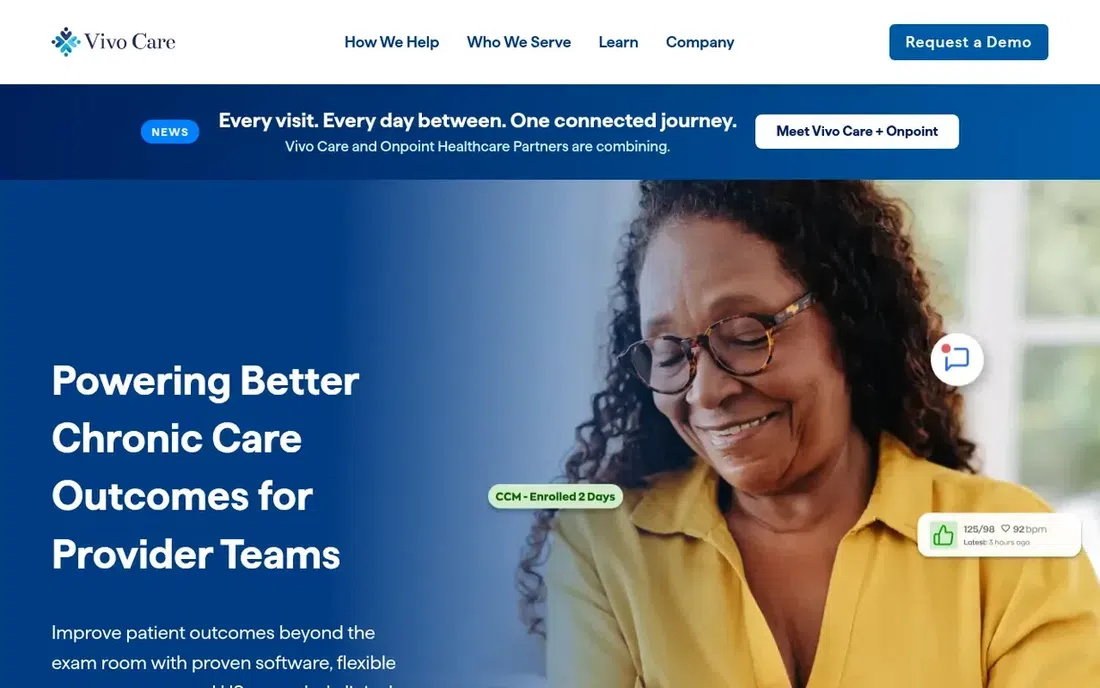
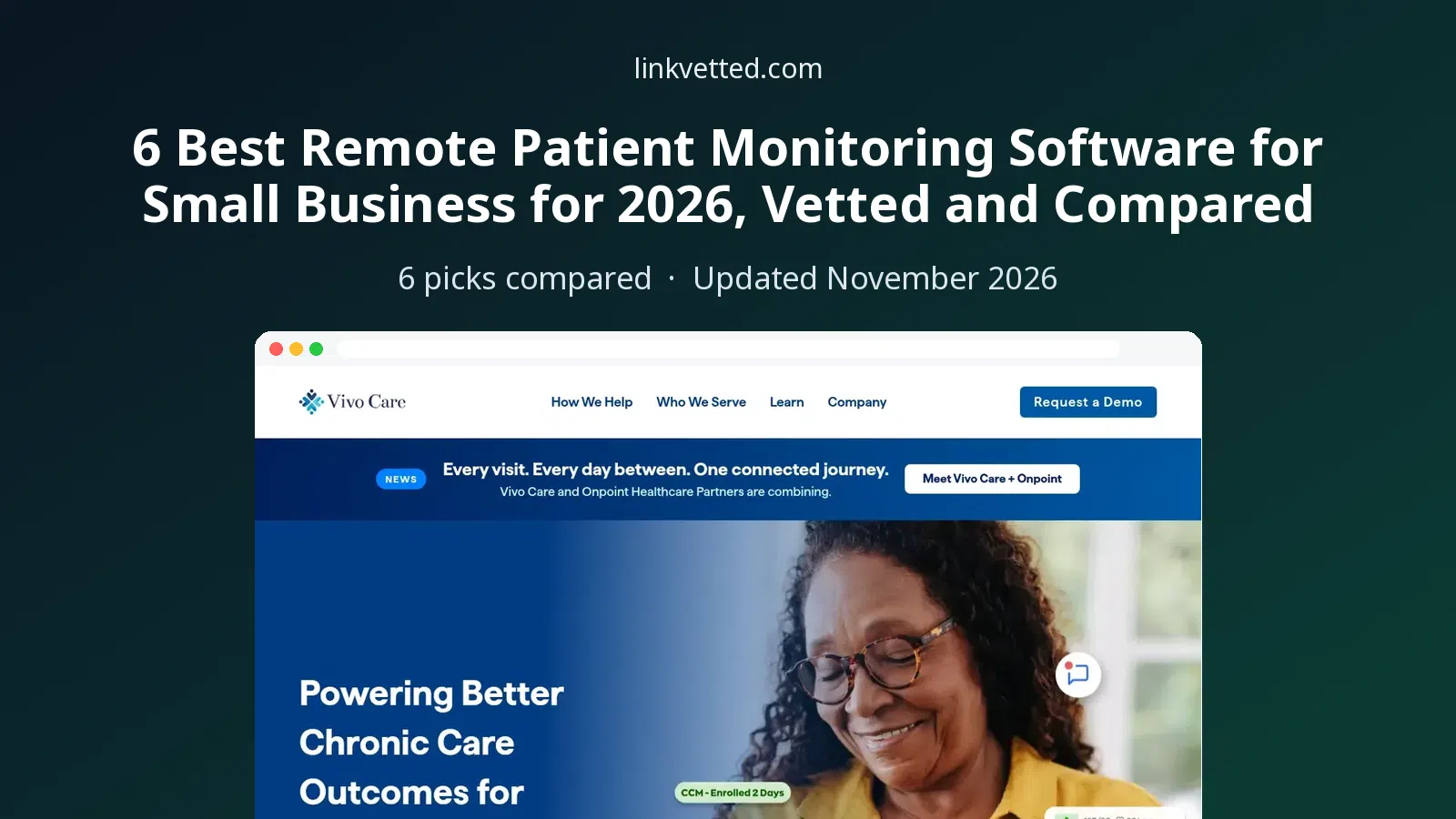
Optimize Health targets Nurse-led chronic care support. Optimize Health, presented as Vivo Care, supports chronic care management, remote patient monitoring and advanced primary care management for provider teams.
Points against: Clinical support model may not suit every practice.
No starting price is listed for Optimize Health here; confirm pricing on the vendor site. Trial and free access: Not stated.
- Powers CCM
- Designed for provider teams
- Focus is chronic care instead of acute monitoring
HealthArc
Best for: All-in-one RPM with billing support
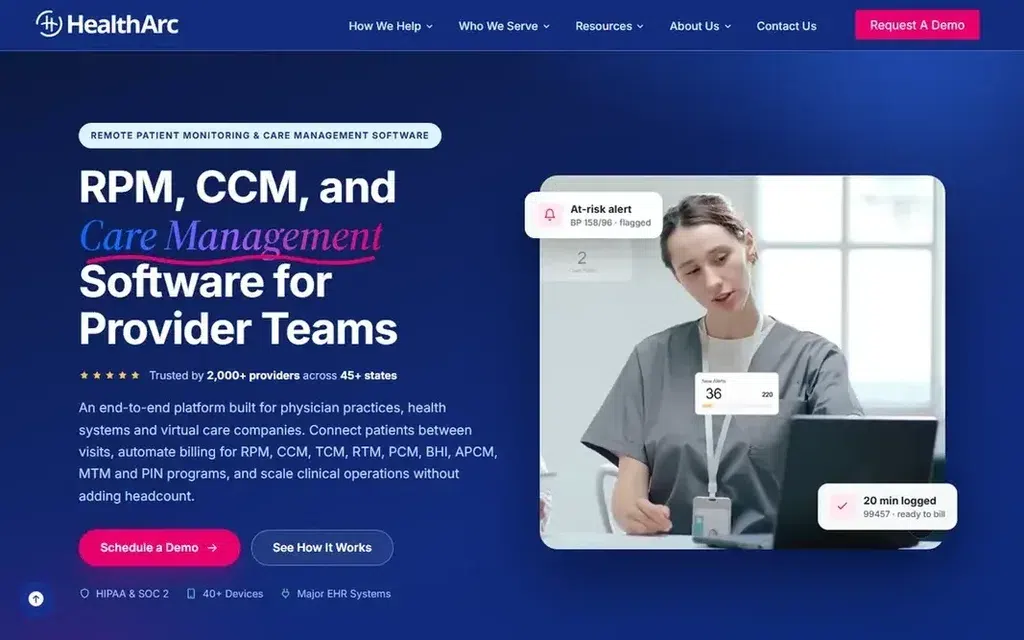
For all-in-one RPM with billing support, HealthArc is a natural candidate. HealthArc gives connected remote patient monitoring alongside chronic care management, remote therapeutic monitoring and transitional care management.
Honest limits: Wide feature set may take time to configure.
Pick something more straightforward if you only need device data capture, and choose HealthArc when billing and care management workflows matter. HealthArc does not show a starting price in this comparison, so check the vendor site for current pricing. Trial and free access: Not stated.
- Connected RPM, CCM
- Automatic workflows and billing support
- Small teams may not need every module
Tenovi
Best for: Plug-and-play connected device programs
Pick Tenovi if this describes you: plug-and-play connected device programs. Tenovi centres on remote patient monitoring hardware, with a wide catalog of FDA-cleared devices and a plug-and-play cellular gateway that powers RPM and RTM programs.
Limits to weigh: Hardware-centric instead of care management.
Tenovi is primarily a device and connectivity layer, so practices seeking built-in care management or billing workflows will need extra software. Beyond that, choose it when device breadth and straightforward cellular connectivity are the priority, and look elsewhere for a full clinical and billing suite. This comparison lists no price for Tenovi; ask the vendor. Free plan details: Not stated.
- Plug-and-play cellular gateway
- Supports RPM and RTM programs
- Software depth relies on your product
CareCentra
Best for: Predictive respiratory care programs
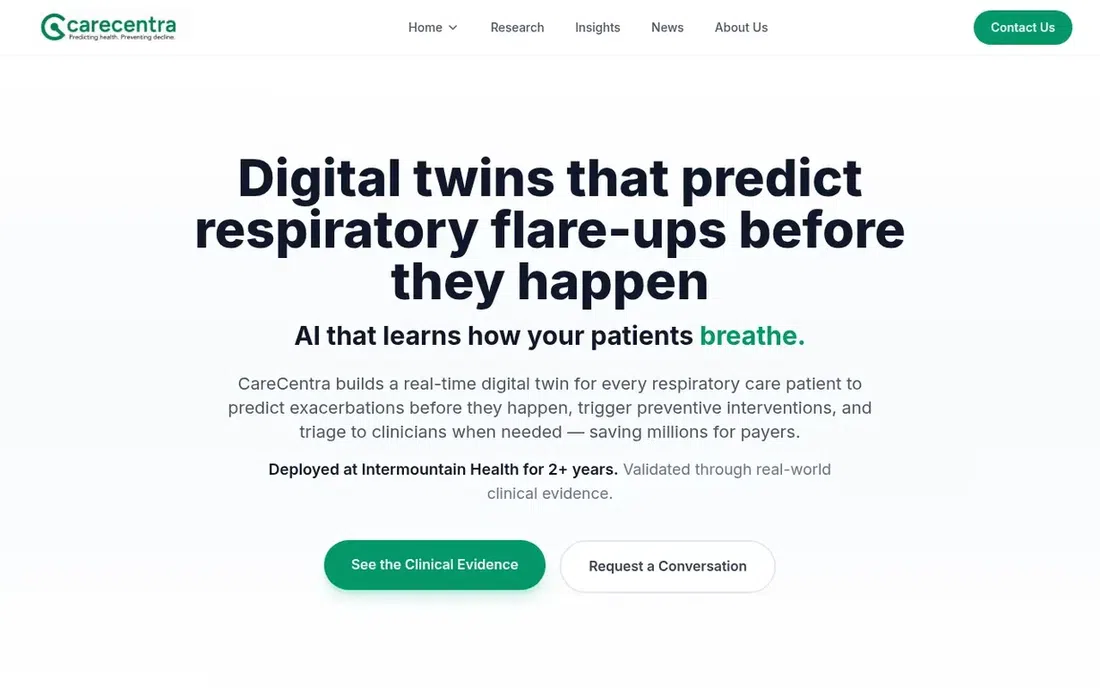
Where CareCentra fits: predictive respiratory care programs. CareCentra centers on digital twin technology for respiratory care, using live models to predict COPD and asthma exacerbations days to weeks ahead.
The main drawbacks: Narrow focus on respiratory care.
Consider it when respiratory exacerbation prediction is the core goal, and look at broader RPM suites when you need device management and billing workflows alongside monitoring. For everyday use, since the product is built around respiratory digital twins, practices seeking wide-ranging RPM across numerous chronic conditions may find it less complete. Check the vendor site for CareCentra pricing; none is listed in this comparison. Free access: Not stated.
- Live digital twins for respiratory conditions
- Designed around early intervention
- Less suited to general chronic conditions
Cadence
Best for: Scaled chronic disease monitoring
Cadence makes the most sense for scaled chronic disease monitoring. Cadence offers remote patient monitoring and chronic disease management with a clinical AI orientation, aiming to boost outcomes and cut cost at scale. Its senior care focus and proactive approach suit organizations that want monitoring paired with intelligence that flags issues before they escalate.
Points against: AI-driven model may need workflow adjustment.
The scale-oriented positioning may be more than a very small practice needs, and adopting an AI-driven workflow needs staff comfort with new processes. Consider it when proactive chronic care at expanding volume is the goal, and weigh more straightforward tools for a single-provider setup. Pricing for Cadence is not stated here, so ask the vendor for current figures. Free plan details: Not stated.
- Remote monitoring plus chronic disease management
- Meant to work ahead of problems
- Positioned toward larger-scale operations
How we compared the tools
The comparison looks at four things: starting price, free access, how well the feature set matches remote patient monitoring software for small business, and the main limit of each tool. Where a price is missing, the vendor does not list one publicly or ties it to a quote. Always confirm before budgeting. Tools are placed by general fit for remote patient monitoring software for small business, with price clarity and free access as tie-breakers. A different team can reasonably rank them differently.
What to check before you buy
- Ask each vendor, from Prevounce to Cadence, for a written quote; none of them publishes a starting price.
- Before choosing Prevounce, weigh its main limit: program setup needs planning.
- Before rolling out Optimize Health, verify the integrations your workflow depends on.
- Find out whether the entry plan of Prevounce covers your must-haves or only a trimmed-down version.
- Look at the help docs and support options for CareCentra before you commit.
FAQ
What should a small practice look for in remote patient monitoring software?
Focus on ease of setup, device compatibility and whether billing and care management workflows are included. Small teams benefit from systems that cut administrative steps and offer clear support during launch.
How are the tools for remote patient monitoring software for small business ordered?
The order follows typical fit for remote patient monitoring software for small business, with Prevounce first and Cadence last, then price clarity and free access. It is editorial judgement, not a score, so another team could rank the tools differently.
Does any tool for remote patient monitoring software for small business here have a free plan?
No tool in this list, Prevounce and Cadence included, has a permanent free plan. Trials and quotes are the usual route, so plan a short evaluation period.
Can I try these tools before paying?
Not by default. None of the tools, from Prevounce to Cadence, lists a free plan or a free trial here, so ask each vendor for a demo before committing.
Do these tools publish their prices?
No. None of the tools, from Prevounce to Cadence, shows a fixed starting price here, so budget time for quotes.
Sources
- https://www.prevounce.com
- https://optimize.health
- https://www.healtharc.io
- https://www.tenovi.com
- https://www.carecentra.com
- https://cadence.care