PR Measurement Tools in 2026: The 6 Best Options Side by Side
A practical comparison of the best PR measurement tools for 2026, covering media monitoring, coverage tracking, share of voice and reporting features.
- Editor's choice
 Brandwatch
Social and news listening at scale
Starts atSee websiteVisit brandwatch.comFull review - Great alternative
 Prowly
Campaign outreach plus coverage reporting
Starts atSee websiteVisit prowly.comFull review - Also consider
 Meltwater
Media intelligence and sentiment reporting
Starts atSee websiteVisit meltwater.comFull review
Direct answer
My top pick is Brandwatch for broad media monitoring and share-of-voice analysis, because its documentation covers social and news listening in one place. For earned-media coverage tracking and outreach reporting, I suggest Prowly. If your team cares most about analyst-style media intelligence and sentiment, Meltwater is the better fit. All three are established platforms, and the right choice depends on which metrics you report most often.
TL;DR:
- PR measurement tools track coverage, sentiment, share of voice and message pickup, not just link counts.
- The best tool for you depends on whether you report mostly to clients, executives or an in-house comms team.
- Media monitoring and PR software often overlap, so check which module actually includes the metrics you need.
- Ask vendors how they handle sentiment accuracy and duplicate coverage before you commit to a contract.
- Reporting and export options matter as much as data collection, because most PR reporting ends up in a deck.
Last checked November 2026. Plan prices are not quoted in this guide because they change often; see each vendor's own pricing page for current figures before you buy.
Quick comparison
| Tool | Best for | Starts at | Free plan? | |
|---|---|---|---|---|
| Brandwatch | Social and news listening at scale | See website | Not stated | Visit |
| Prowly | Campaign outreach plus coverage reporting | See website | Free trial | Visit |
| Meltwater | Media intelligence and sentiment reporting | See website | Not stated | Visit |
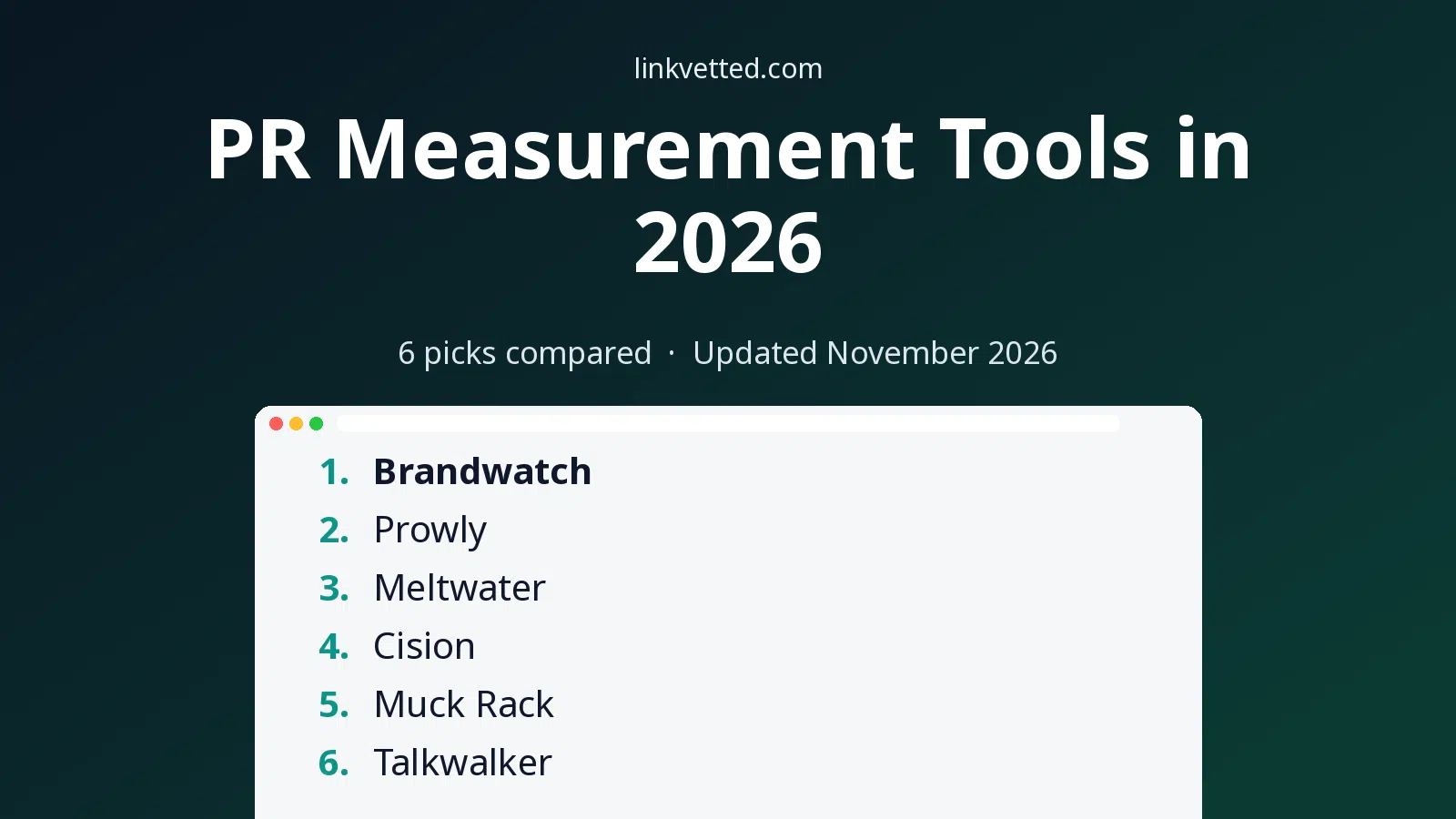
 Cision | Large comms teams and agencies | See website | Not stated | Visit |
 Muck Rack | Media relations with coverage tracking | See website | Not stated | Visit |
 Talkwalker | Social listening and share of voice | See website | Not stated | Visit |
The best PR measurement tools compared
I compared these tools from vendor documentation and public sources rather than hands-on tests. I looked at what each platform says it measures, how reporting works, and where the limits sit for a small agency or in-house team. The picks below are established products, and I have noted where a tool is stronger on monitoring than on PR workflow.
Brandwatch is a listening and social intelligence platform that PR teams use to track mentions, sentiment and share of voice across social channels and news. It fits teams that need a wide view of conversation around a brand, campaign or issue, and it is often used alongside a dedicated media relations tool.
For PR measurement, the platform is useful when you need to show how a message travelled beyond earned coverage. You can build queries around campaign terms, compare volumes over time, and pull sentiment and share-of-voice views into reports. That makes it a reasonable fit for agencies that report on both media coverage and social conversation.
The limit is scale. A small team may find the platform broader than it needs, and query building takes some care. Skip it if you only need a simple coverage log and clip report.
- Broad monitoring across social and news sources
- share-of-voice and sentiment analysis
- consumer and media listening in one platform
- Can feel heavy for small teams
- setup needs planning
Prowly is PR software with a media database, pitch workflow, newsroom and monitoring. It suits PR teams and agencies that want outreach and measurement in one place, so coverage can be tied back to the campaign that produced it.
The measurement side covers media monitoring, coverage tracking and reports you can share with clients. Because the tool also handles pitching, you can connect a campaign to the coverage it generated without exporting between systems. That is the main reason I list it for teams that run outreach themselves.
The trade-off is depth. If your reporting depends on advanced sentiment modelling or large-scale social listening, a dedicated listening platform will go further. Skip Prowly if you only need monitoring and already have outreach covered.
- Combines media database, outreach and coverage tracking
- reporting tied to campaigns
- media monitoring included in the workflow
- Analytics depth is lighter than listening-first platforms
- best value if you also run outreach there
Meltwater is a media intelligence platform used by comms teams for monitoring, sentiment analysis, share of voice and media relations. It fits organisations that need a formal reporting rhythm across print, online, broadcast and social sources.
For PR measurement, the platform is built around dashboards and reports that can be scheduled for stakeholders. You can track coverage volume, sentiment and share of voice against competitors, and combine that with media contact workflows. That makes it a common choice for teams that report to executives on a fixed cycle.
The limits are practical. Onboarding and query setup take effort, and the contract is aimed at professional teams. Skip it if you need a lightweight tool for a single small client.
- Media monitoring across many sources
- sentiment and share-of-voice reporting
- media relations and social listening modules
- Enterprise setup takes time
- contract terms need careful review
Cision is a long-established PR and media intelligence provider with a media database, monitoring, analytics and reporting. It suits larger comms teams and agencies that need a single vendor across media relations and measurement.
On the measurement side, Cision covers coverage tracking, sentiment and reporting views that can be shared with stakeholders. Because the suite spans contacts and monitoring, teams can connect outreach activity to the coverage it produced. That is useful when you report on both effort and outcome.
The main limit is complexity. What you get depends on the modules in your contract, so you need to confirm which analytics features are included. Skip it if you want a narrow, low-overhead monitoring tool.
- Media database and monitoring in one suite
- coverage reporting and analytics
- established in PR workflows
- Modules vary by contract
- suite can be complex to navigate
Muck Rack is a PR platform built around a media database, monitoring and reporting. It fits PR teams that want to find journalists, manage outreach and then measure the coverage that follows, without moving between separate tools.
For measurement, Muck Rack tracks coverage and lets you build reports around the outlets, journalists and campaigns you care about. Because the platform is media-relations focused, the reporting tends to map well to the way PR teams describe their work: who was pitched, what was published and where.
The limit is scope. It is not a broad social listening platform, so teams that need large-scale conversation analysis should pair it with something else. Skip it if your reporting is mostly social sentiment.
- Media database and monitoring together
- coverage reports tied to outreach
- journalist profiles and pitching workflow
- Aimed at professional PR teams
- analytics are media-relations focused
Talkwalker is a consumer intelligence and social listening platform that PR teams use to track mentions, sentiment and share of voice. It fits teams that want to measure conversation around a brand or campaign across social and web sources.
For PR measurement, the platform is useful for share-of-voice comparisons and campaign listening. You can build queries around topics and competitors, then report on volume and sentiment over time. That helps when a client asks how a campaign changed the conversation, not just how many clips it produced.
The limit is orientation. Talkwalker is built around listening, so a pure PR coverage report may need extra setup. Skip it if you only need a simple media monitoring log.
- Listening across social and web sources
- share-of-voice and sentiment views
- visual and image recognition features
- Listening-first, so PR reporting needs setup
- can be more than a small team needs
How I chose
I chose these tools by reading vendor documentation and public sources, then matching each product to common PR measurement jobs: coverage tracking, sentiment, share of voice and stakeholder reporting. I did not run hands-on tests, and I have not used every platform in a live account. Where a tool is stronger on listening than on media relations, I said so.
I also weighed fit and limits. A large comms team needs different reporting than a small agency, and a tool that is excellent for social listening may be awkward for a simple clip report. I left out products where I could not confirm a current official homepage or where the public documentation did not clearly describe PR measurement features. Treat the list as a starting point for your own demo requests.
What to check before you buy
- Confirm which sources the tool monitors, including online news, broadcast, print and social, and whether your key outlets are covered.
- Ask how duplicate coverage is handled, because syndicated articles can inflate counts.
- Check how sentiment is scored and whether you can review or correct misclassified mentions.
- Confirm that reports can be exported or scheduled in the format your stakeholders expect.
- Ask how share of voice is calculated and which competitor set you can define.
- Check contract length, seat limits and what happens to historical data if you leave.
FAQ
What should a PR measurement tool measure?
At minimum, it should track coverage volume, outlet and journalist, message pickup, sentiment and share of voice. Many teams also want referral traffic or link data from earned coverage. Decide which of these you report on before you compare vendors, because tools differ in how much of each they cover.
Can I measure PR without a paid tool?
Yes, for small volumes. You can log coverage in a spreadsheet and use free alerts for mentions. The limits appear when you need sentiment at scale, share-of-voice comparisons or scheduled reports for stakeholders. At that point a paid platform usually saves time, but check whether a free trial covers your main use case first.
How accurate is sentiment analysis in PR tools?
Accuracy varies by language, source and topic, and no tool is perfect. Vendor documentation usually describes the model but not its error rate. Before buying, ask for a demo using your own coverage and check how the tool classifies sarcasm, mixed mentions and industry jargon. Plan for some manual review in your reporting workflow.
Do these tools replace a media database?
Not always. Some platforms combine a media database with monitoring, while others focus on listening or analytics. If your team pitches regularly, check whether contacts, lists and outreach tracking are included. If you already have a database, a monitoring-first tool may be enough.
How do I compare PR measurement tools fairly?
Use the same brief for every vendor: your key outlets, languages, competitor set and reporting format. Ask each vendor to show a live report built from your own coverage examples. Compare the setup effort, contract terms and export options, not just the feature list, because reporting work often happens outside the tool.
Sources
- https://www.brandwatch.com
- https://prowly.com
- https://www.meltwater.com
- https://www.cision.com
- https://muckrack.com
- https://www.talkwalker.com