5 AI Pitch Writing Tools for PR Worth Shortlisting in 2026
A practical look at the best AI pitch writing tools for PR, compared from vendor documentation and public sources, with limits and buying checks.
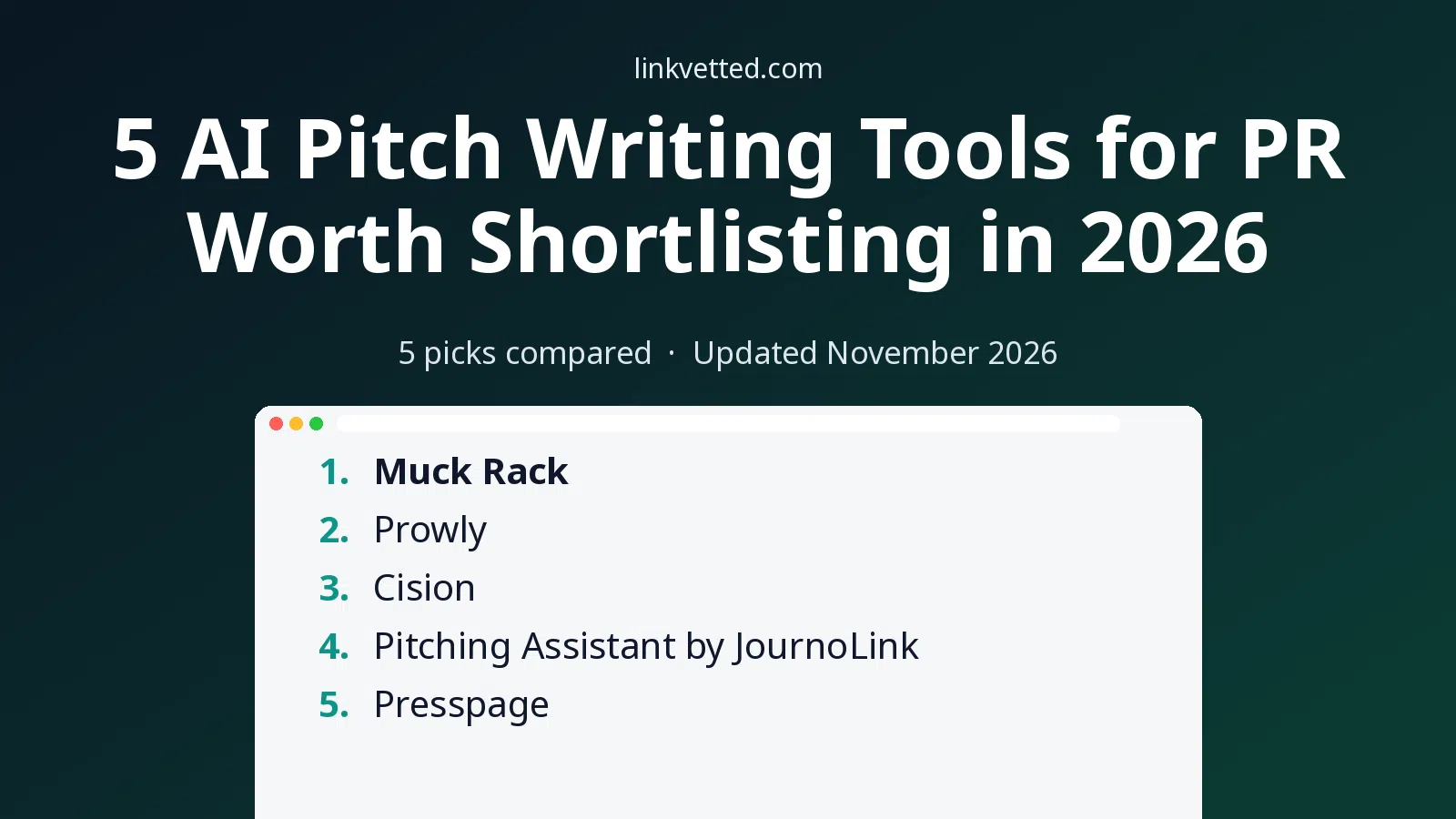
- Editor's choice
 Muck Rack
Media database with AI pitch drafting
Starts atSee websiteVisit muckrack.comFull review - Great alternative
 Prowly
Campaign pitching with a hosted newsroom
Starts atSee websiteVisit prowly.comFull review - Also consider
 Cision
Large PR teams with broad media reach
Starts atSee websiteVisit cision.comFull review
Direct answer
My first pick is Muck Rack, because it combines a media database with AI-assisted pitch drafting inside one workflow, which suits most PR teams. For teams that want a lighter writing assistant, I point to Prowly for campaign-style pitching with a newsroom and Cision for teams that already use a large media database. The right choice depends on whether you mainly need drafting help or a full media-relations platform.
TL;DR:
- AI pitch tools help most with first drafts, subject lines and personalisation, not with final judgement on what to send.
- A media database matters as much as the writing features, because a good pitch to the wrong journalist still fails.
- Check how each tool handles contact data, exports and permissions before you commit a team to it.
- Most vendors publish feature pages and help docs, so you can compare workflows before a demo.
- Treat AI output as a draft: verify names, outlets, recent coverage and any claims before sending.
Last checked November 2026. Plan prices are not quoted in this guide because they change often; see each vendor's own pricing page for current figures before you buy.
Quick comparison
| Tool | Best for | Starts at | Free plan? | |
|---|---|---|---|---|
| Muck Rack | Media database with AI pitch drafting | See website | Not stated | Visit |
| Prowly | Campaign pitching with a hosted newsroom | See website | Free trial | Visit |
| Cision | Large PR teams with broad media reach | See website | Not stated | Visit |
| Pitching Assistant by JournoLink | Simple pitch help for small teams | See website | Not stated | Visit |
| Presspage | Newsroom publishing with pitch support | See website | Not stated | Visit |
The best AI pitch writing tools for PR compared
I compared these tools from vendor documentation, help pages and public sources, and I did not run hands-on tests. The notes below describe what each vendor says it does, where the workflow fits, and where it may not suit a small agency or in-house team.
Muck Rack is a media relations platform built around a journalist database, monitoring and reporting. In the context of AI pitch writing, it fits teams that want to find contacts and draft outreach in the same place rather than moving between a database and a separate writing tool. It suits agencies and in-house PR teams that pitch regularly and need a record of who was contacted.
The vendor documents AI features for drafting pitches and subject lines, and for summarising coverage. For a PR workflow, that means you can start from a journalist profile, check recent coverage, then produce a first draft and edit it. I would still rewrite the opening line by hand, because the specific reason you are emailing that person is the part that earns a reply.
The main limit is scope. If you only need help writing a pitch and already have your own media list, a full platform may be more than you need. Small teams should ask about seats and contract length before going further.
- Large media database
- AI-assisted pitch and subject line drafting
- Media monitoring and reporting in one place
- Full platform may be heavy for very small teams
- Pricing is quote-based
Prowly is a PR software suite from Semrush that covers media databases, pitch sending, a newsroom and reporting. For AI pitch writing, it fits small and mid-sized teams that want to run a campaign end to end: build a list, write and personalise a pitch, send it, and publish supporting material to a newsroom. The free trial makes it easier to see the workflow before committing.
The vendor documents AI assistance in the pitch editor, which helps with drafts and variations. In practice, that is most useful when you have several journalist segments and need slightly different versions of the same story. The newsroom also gives you a link to include in the pitch, which can make the email more concrete.
The main drawback is that the strongest setup comes from using the wider suite. If you only want a writing helper, the platform may be more than you need. Check how contacts are stored and exported before you move a list in.
- Media database and pitch sending together
- Newsroom feature for published stories
- AI writing help in the editor
- Best features sit in the paid suite
- Smaller database than the largest vendors
Cision is one of the long-established PR platforms, covering media databases, distribution, monitoring and analytics. For AI pitch writing, it suits larger departments that need a single system across several markets and want drafting help next to contact data. The breadth is the point: one place for lists, outreach and coverage records.
The vendor documents AI features across its products, including help with content and pitch-related tasks. In a PR workflow, that can reduce time spent on first drafts and on adapting a pitch for different regions. The trade-off is that a broad suite asks more of the people using it, so training and process matter.
If your team is small or your needs are mainly writing, a full suite may be hard to justify. Ask for a walkthrough of the specific drafting features you would use rather than the whole platform.
- Large media contact database
- Suite covers monitoring and distribution
- AI features documented for PR workflows
- Large suite can take time to learn
- Pricing is quote-based
Pitching Assistant by JournoLink
Best for: Simple pitch help for small teams
JournoLink is a UK-focused service for small businesses and startups that want to reach journalists. Its Pitching Assistant is built around helping you write and send pitches to relevant contacts. For AI pitch writing, it fits founders and small teams who do not have a PR specialist and need a guided path from story idea to email.
The value is in the constraints. Instead of a blank editor, you get prompts and a contact route, which can be more useful for someone writing their first pitch than a feature-heavy platform. The writing help is there to get you moving, not to replace your knowledge of the story.
The limit is scale and depth. Teams with large lists, multiple markets or complex reporting will likely outgrow it. Check the current coverage and features on the vendor site before relying on it for a big campaign.
- Aimed at small businesses and startups
- Combines pitch help with journalist connections
- Straightforward setup
- Less depth than enterprise platforms
- Smaller reach than major databases
Presspage
Best for: Newsroom publishing with pitch support
Presspage is a newsroom platform for brands that publish stories, press releases and media assets. It is included here because a good pitch often points to a good newsroom page, and Presspage documents AI help for content work. It fits organisations that publish regularly and want their owned media to support outreach.
For pitch writing, the practical benefit is the link you include. A clear newsroom page with assets, quotes and contact details gives a journalist a reason to open the email and a place to check facts. The AI features help with drafting and adapting published content, which can feed the pitch itself.
The drawback is that Presspage is not a media database or a dedicated pitch tool. If your main gap is finding journalists and writing personalised emails, you will need another product alongside it. Treat it as part of the stack, not the whole answer.
- Strong newsroom and storytelling features
- Helps keep published material consistent
- Useful for brands with regular news
- Not a dedicated pitch writing tool
- May need a separate media database
How I chose
I chose these tools by reading vendor documentation, help pages and public product information, and by looking at how each one fits a real PR pitching workflow: find a contact, understand their recent work, write a pitch, send it and record the outcome. I did not run hands-on tests, and I have not used every feature in every product. The aim is to describe what each vendor says it offers and where the limits are.
I left out tools where I could not confirm a current, official product page, and I avoided anything that depends on bulk sending or scraped lists. I also weighed fit over feature count: a small agency and a large comms team need different things. Where a product is part of a larger suite, I noted that, because the cost and learning curve usually come from the suite rather than the writing feature alone.
What to check before you buy
- Confirm the tool covers the markets and languages you pitch in, not just your home market.
- Ask how contact data is sourced and whether you can export your lists if you leave.
- Check whether AI drafting is included in the plan you are quoted or sold as an add-on.
- Ask for a short trial or demo using one real pitch, not a generic sample.
- Confirm how sent pitches and replies are logged, so your team can avoid duplicate outreach.
- Check data protection terms and where contact data is stored, especially for EU contacts.
FAQ
What are AI pitch writing tools for PR?
They are software products that help PR teams draft pitches, subject lines and follow-ups, often alongside a media database or newsroom. Some focus on writing, others on choosing the right journalists. Most vendors now include some AI assistance in their editors, so the difference is usually in the surrounding workflow rather than the writing alone.
Can AI write a pitch I can send as it is?
Sometimes, but I would not rely on it. AI drafts are useful starting points, yet they often miss the specific reason you are contacting that journalist. Check names, outlets, recent coverage and any claims before sending. Treat the output as a draft that a person edits, not as a finished email.
Do I need a media database as well as a writing tool?
If you already have a maintained list, a writing tool may be enough. If you are building lists from scratch, a database is usually the more important purchase, because a well-written pitch to the wrong person still fails. Several tools in this guide combine both, which can reduce the number of systems you manage.
Are free plans enough for regular PR pitching?
Free plans and trials are useful for checking a workflow, but they usually limit contacts, sends or features. For regular pitching, check what the paid plan includes before you build a process around a free tier. The vendor's current pricing page is the only reliable source for what is included.
How do I compare these tools without wasting demos?
Write down your three most common pitch types and ask each vendor to show those, using your own example. Ask about contact coverage in your market, export rules and what the AI features actually do. A focused demo on your real work tells you more than a broad tour of the platform.
Sources
- https://muckrack.com
- https://prowly.com
- https://www.cision.com
- https://www.journolink.com
- https://www.presspage.com