Best Observability Software for Remote Teams in 2026: Prices, Free Plans and 6 Picks
6 best observability software for remote teams, compared on pricing, free plans and best-fit use. Each profile ends with a plain caveat. Easy to scan.
- Editor's choiceSumo Logic
Cloud log management and live insights
Starts atSee websiteVisit sumologic.comFull review - Great alternative
 Splunk Observability Cloud
Unifying security and observability at scale
Starts at$6 a month, per CPU core, billed yearlyVisit splunk.comFull review - Also consider
 Elastic Observability
Search-powered observability on Elasticsearch
Starts atSee websiteVisit elastic.coFull review
Direct answer
Our first pick is Sumo Logic, best for Cloud log management and live insights. Listed starting prices: Splunk Observability Cloud from $6 a month, per CPU core, billed yearly, Datadog from $8 per committer a month and Grafana Cloud from $19 a month. Splunk Observability Cloud is better for unifying security and observability at scale, and Elastic Observability is better for search-powered observability on Elasticsearch. Prices, free plans and limits for all 6 tools follow.
TL;DR:
- The list opens with Sumo Logic, aimed at Cloud log management and live insights.
- New Relic suits AI-assisted root-cause analysis and MTTR reduction.
- What to know about Elastic Observability first: search-first approach may not suit all teams.
- The cheapest monthly starting price in the list is $6 per month, per CPU core, billed annually, offered by Splunk Observability Cloud.
Last checked November 2026. Prices and plan details were read from the vendors' own pages in November 2026; vendors change plans often, so confirm the current price on the vendor site before you buy.
Quick comparison
| Tool | Best for | Starts at | Free plan? | |
|---|---|---|---|---|
| Sumo Logic | Cloud log management and live insights | See website | Free trial | Visit |
| Splunk Observability Cloud | Unifying security and observability at scale | $6 a month, per CPU core, billed yearly | Yes | Visit |
| Elastic Observability | Search-powered observability on Elasticsearch | See website | Free trial | Visit |
 Datadog | Unified cloud monitoring across apps and services | $8 per committer a month | Free trial | Visit |
 Grafana Cloud | Open-standard observability without lock-in | $19 a month | Yes | Visit |
 New Relic | AI-assisted root-cause analysis and MTTR reduction | $10 per user a month | Yes | Visit |
Observability Software for Remote Teams compared in detail
If you are comparing observability software for remote teams, this page covers 6 tools in one place: what each is best for, what it costs to start, whether it has a free plan, and the main limit to know about.
Sumo Logic
Best for: Cloud log management and live insights
Sumo Logic serves Cloud log management and live insights. The SIEM emphasis may be more than some teams need. In daily use, pick Sumo Logic when cloud log management and live insights are the core needs.
The main drawbacks: May need extra tools for traces.
In daily use, the product is built around cloud-native data sources. Sumo Logic gives you cloud log management, monitoring, and SIEM tools with live insights for web and SaaS-based apps. Sumo Logic shows no starting price here, so confirm the cost on the vendor site. Free access: Free trial.
- Live insights for web and SaaS apps
- Solid cloud log management
- Focus is narrower than full-stack suites
Where Splunk Observability Cloud fits: unifying security and observability at scale. Splunk Observability Cloud is part of a data product that brings together security and observability at petabyte scale. It is built for organizations that want to stop threats and prevent downtime at machine speed.
The main drawbacks: Can be complicated to administer.
The product can be complicated to administer and may need specialized skills on the team. In daily use, consider Splunk when security and observability data have to be handled together at scale. Starting cost for Splunk Observability Cloud: $6 per month, per CPU core, billed annually. Splunk Observability Cloud includes a free tier.
- Brings together security and observability
- Takes care of large data volumes
- May need specialized skills
Elastic Observability makes the most sense for search-powered observability on Elasticsearch. The search-first model may not match teams looking for a purely dashboard-driven experience.
It also assumes some familiarity with Elasticsearch concepts. Pricing for Elastic Observability is not stated here, so ask the vendor for current figures. Free plan details: Free trial.
Where it is weaker: Search-first approach may not suit all teams.
- Integrates search and observability
- Part of a broader data product
- Needs Elasticsearch knowledge
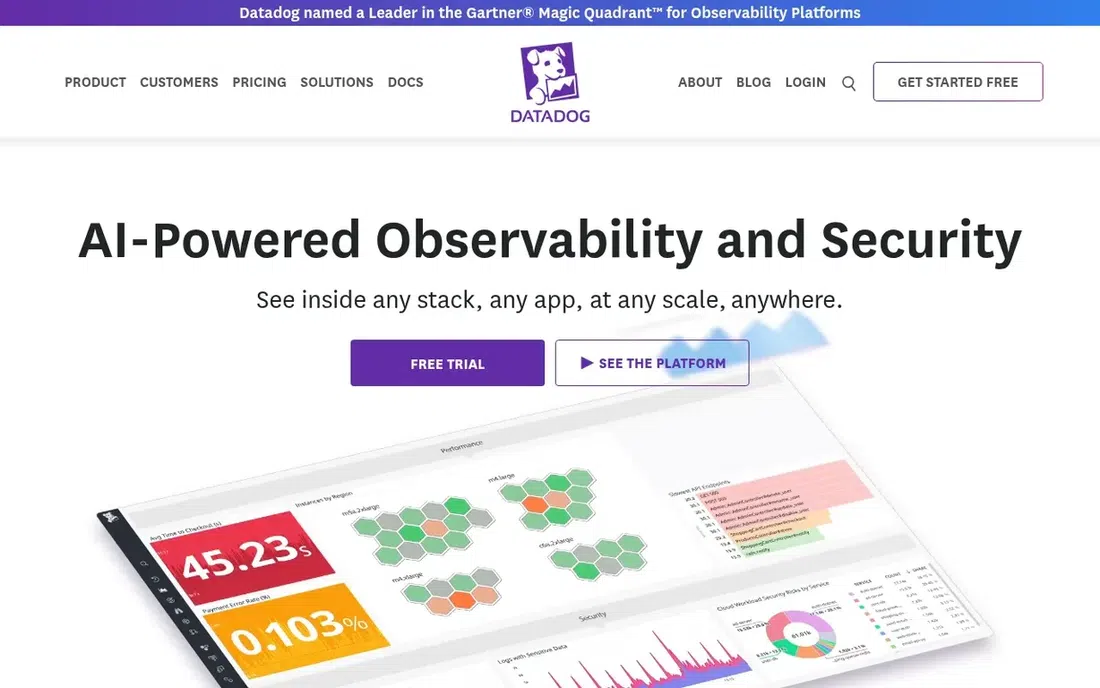
In short, Datadog is for unified cloud monitoring across apps and services. As for the details, the breadth of features can mean a steeper setup and more configuration work for smaller teams.
Drawbacks to consider: Costs scale with usage.
In practice, consider Datadog when you want a single monitoring layer across numerous services. In practice, the system is built to provide distributed engineers a typical view of system health. Datadog cost at the entry level: $8 per committer per month. Free options: Free trial.
- Single place for metrics from plenty of sources
- Wide integration coverage
- Can become complicated to configure
Think of Grafana Cloud for open-standard observability without lock-in. Grafana Cloud is a full-stack observability product built on open standards. It brings together metrics, logs, traces, profiles, and business data, and is meant to help teams avoid lock-in whereas ensuring reliability.
Teams without experience in the Grafana ecosystem may face a ramp-up time. From a buyer's view, pick Grafana Cloud when openness and avoiding lock-in are central requirements. Worth adding: since it is built on open standards, some assembly and configuration may be required compared to completely managed suites. Grafana Cloud starts at: $19 per month. A free plan is available with Grafana Cloud.
Drawbacks to consider: Some assembly may be needed.
- Built on open standards
- Brings together metrics, logs, traces, profiles
- Needs familiarity with open-source tools
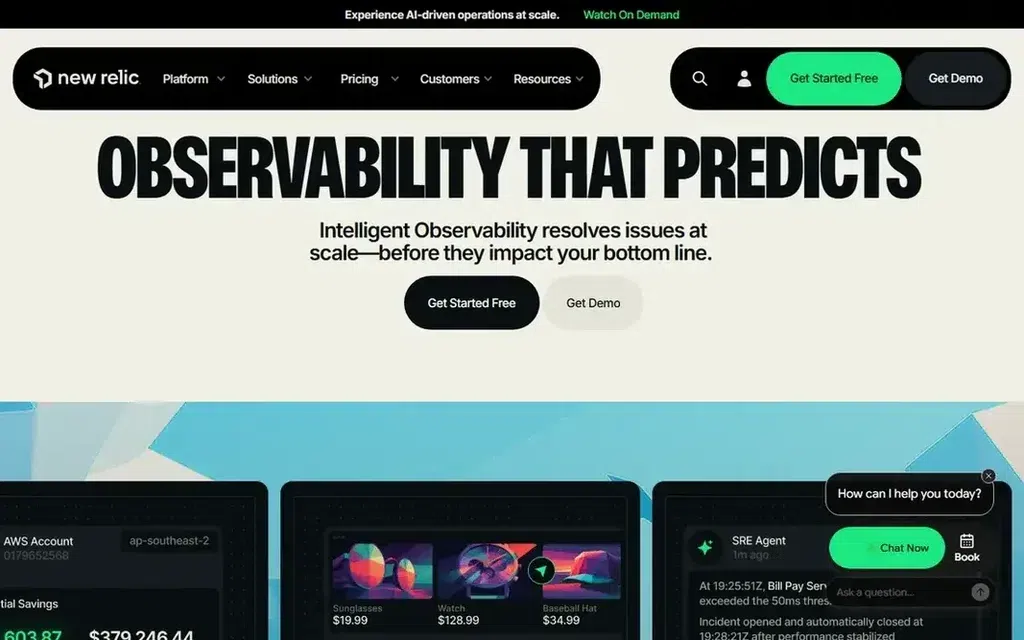
New Relic is aimed squarely at AI-assisted root-cause analysis and MTTR reduction. New Relic is an AI-powered observability system that correlates telemetry across your whole stack. It is targeted at teams that want to isolate root causes rapidly and reduce mean time to resolution.
Trade-offs to know: Needs thoughtful data ingestion planning.
Pick New Relic when quicker root-cause analysis across a complicated stack is the priority. On top of that, for remote teams, that correlation can help engineers in different locations diagnose issues without long handoffs. New Relic pricing: $10 per user per month. Free access exists with New Relic.
- Correlates telemetry across the stack
- Focus on reducing MTTR
- Can be overwhelming for beginners
Selection criteria
What to check before you buy
- Ask Sumo Logic and Elastic Observability for a written quote, since no starting price is shown.
- Check what the free option really includes: Splunk Observability Cloud, Grafana Cloud and New Relic offer a free plan, and usage caps differ.
- Run a trial of Sumo Logic, Elastic Observability and Datadog with real work before paying for a year; your own workflow is the best test.
- Before choosing Sumo Logic, weigh its main limit: focus is narrower than full-stack suites.
- Work out what Elastic Observability costs with your real seat count, add-ons and usage, not just the entry price.
- Confirm minimum seats and billing terms with Splunk Observability Cloud before you commit to an annual plan.
FAQ
Is open-standard observability important for distributed engineering?
Open standards can cut lock-in and make it simpler for engineers to use familiar open-source tools. Teams that value adaptability commonly prioritize this, but completely managed suites may cut setup effort.
Can log-focused tools like Sumo Logic replace full-stack observability?
Sumo Logic concentrates on cloud log management, monitoring, and SIEM, which may not include deep tracing needs. Consider your signal coverage before choosing a log-focused product.
What is the cheapest option for observability software for remote teams in this list?
On published monthly entry prices, Splunk Observability Cloud is the lowest here at $6 per month, per CPU core, billed annually. Entry price is only part of the cost, because seats, add-ons and billing terms can change the total. Prices, free plan details and limits for all 6 tools in this observability software for remote teams roundup sit on the individual cards above.
Can I try these tools before paying?
Often, yes. Splunk Observability Cloud, Grafana Cloud and New Relic have a free plan and Sumo Logic, Elastic Observability and Datadog offer a free trial. Use your own data and a real task during the test, and check what the free tier or trial limits before you rely on it.
Which options for observability software for remote teams have a free plan?
Splunk Observability Cloud, Grafana Cloud and New Relic offer a free plan in this list. Free plans usually cap users, projects or features, so check the limits on the vendor page. Several others offer a trial instead.
How are the tools for observability software for remote teams ordered?
The order follows typical fit for observability software for remote teams, with Sumo Logic first and New Relic last, then price clarity and free access. It is editorial judgement, not a score, so another team could rank the tools differently.
Sources
- https://www.sumologic.com
- https://www.splunk.com
- https://www.elastic.co
- https://www.datadoghq.com
- https://grafana.com
- https://newrelic.com