6 Best Observability Platforms for Serverless Apps for 2026, Vetted and Compared
Best observability platforms for serverless apps in 2026: 6 tools with starting prices, free plans and limits. Details on cost, catches and fit. Pick by budget.
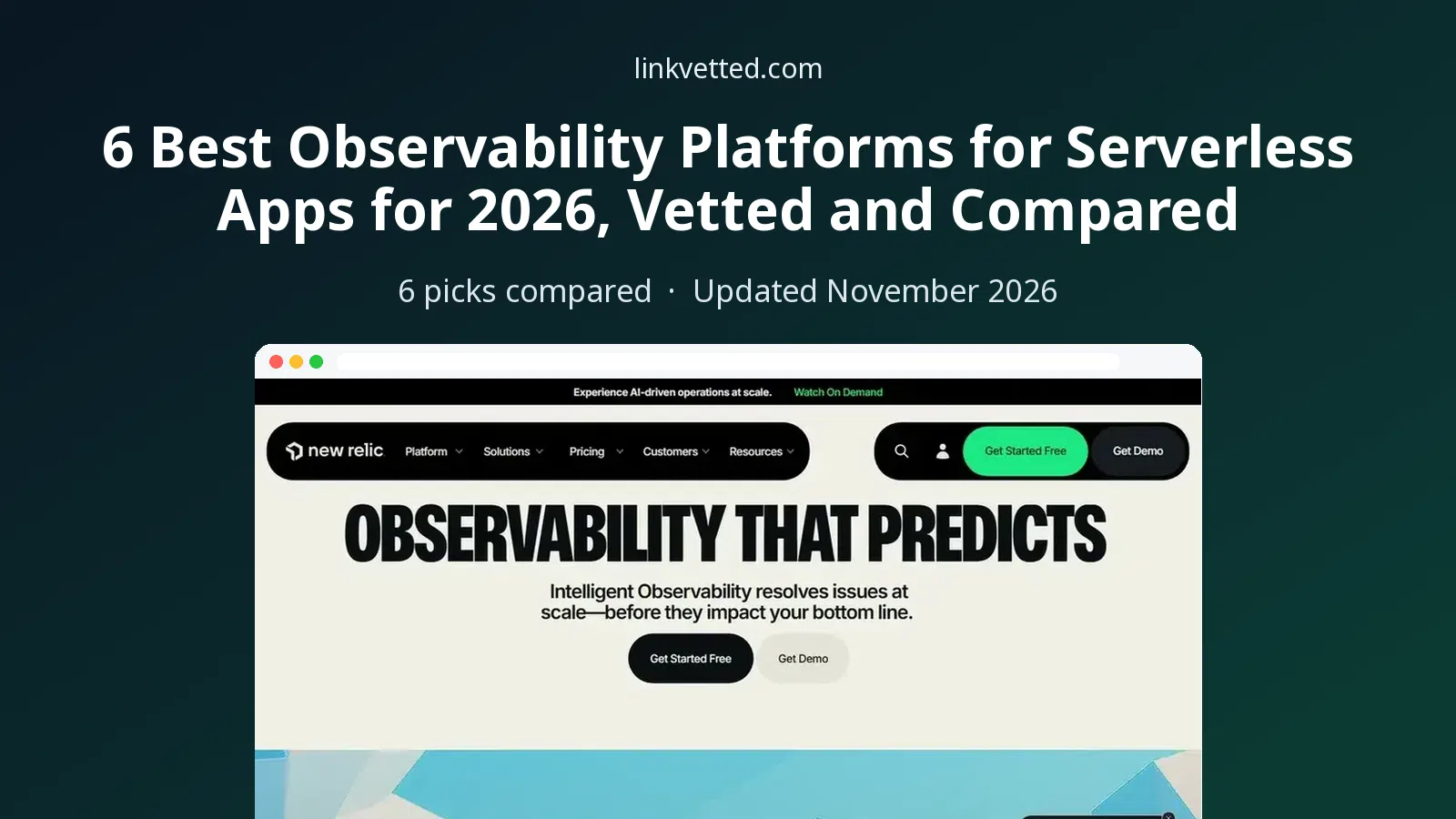
- Editor's choice
 Elastic Observability
Search-driven observability on Elasticsearch
Starts atSee websiteVisit elastic.coFull review - Great alternative
 New Relic
AI-assisted root cause correlation
Starts at$10 per user a monthVisit newrelic.comFull review - Also consider
 Datadog
Centralized cloud monitoring across services
Starts at$8 per committer per monthVisit datadoghq.comFull review
Direct answer
Elastic Observability leads the list, best for search-driven observability on Elasticsearch. Listed starting prices: New Relic from $10 per user a month, Datadog from $8 per committer per month and Dynatrace from $7 per host a month. New Relic fits AI-assisted root cause correlation; Datadog fits centralized cloud monitoring across services. The full list of 6 tools follows, with prices and free plan facts.
TL;DR:
- Number one here is Elastic Observability, a fit for search-driven observability on Elasticsearch.
- Splunk Observability Cloud fits large-scale security and observability data.
- 2 of 6 tools offer a free plan: New Relic, Splunk Observability Cloud.
- For the cheapest start, look at Splunk Observability Cloud: $6 per month, per CPU core, billed annually.
- One limit worth knowing about Elastic Observability: search-centric model needs tuning for some teams.
Last checked November 2026. Prices and plan details were read from the vendors' own pages in November 2026; vendors change plans often, so confirm the current price on the vendor site before you buy.
Quick comparison
| Tool | Best for | Starts at | Free plan? | |
|---|---|---|---|---|
| Elastic Observability | Search-driven observability on Elasticsearch | See website | Free trial | Visit |
| New Relic | AI-assisted root cause correlation | $10 per user a month | Yes | Visit |
| Datadog | Centralized cloud monitoring across services | $8 per committer per month | Free trial | Visit |
 Dynatrace | Combined observability, AI and automation | $7 per host a month | Free trial | Visit |
| Sumo Logic | Cloud log management and SIEM | See website | Free trial | Visit |
 Splunk Observability Cloud | Large-scale security and observability data | $6 a month, per CPU core, billed yearly | Yes | Visit |
Observability Platforms for Serverless Apps profiles
Choosing observability platforms for serverless apps usually comes down to price, fit and limits. This LinkVetted guide sets 6 tools side by side on those three points, with the facts kept short and checkable.
Where Elastic Observability fits: search-driven observability on Elasticsearch. For serverless apps, search-driven analysis of logs and events can be valuable when investigating sporadic function behavior.
Watch-outs: Search-centric model needs tuning for some teams.
Pick Elastic Observability when search and analytics are central to how you investigate incidents. Teams wanting a turnkey monitoring service may prefer a managed alternative. No starting price is listed for Elastic Observability here; confirm pricing on the vendor site. Free plan details: Free trial.
- Deployable data system orientation
- Powered by Elasticsearch search and analytics
- Operational ownership varies by deployment
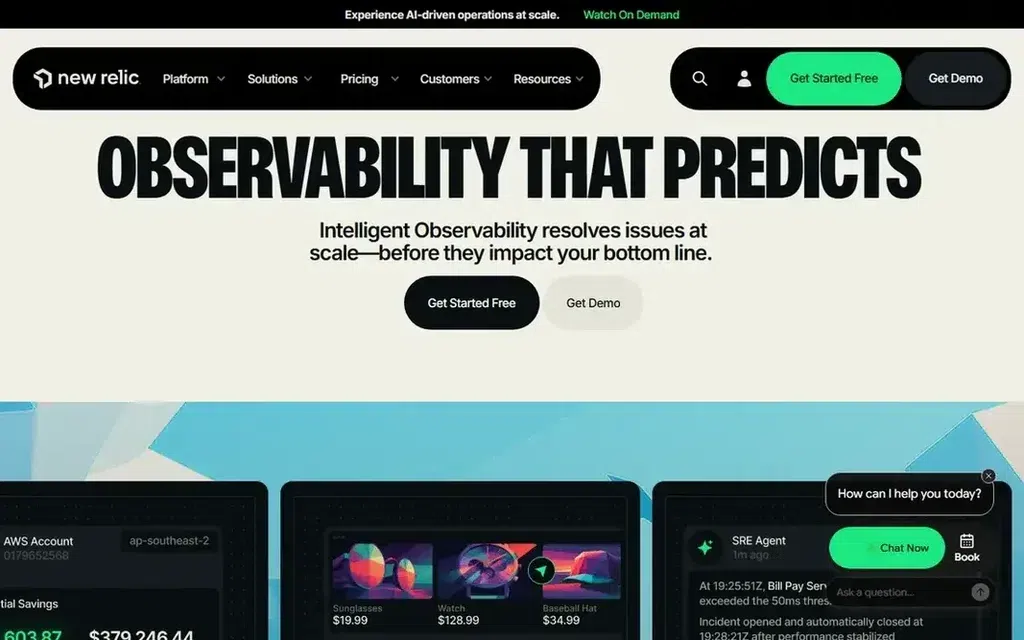
New Relic makes the most sense for AI-assisted root cause correlation. The platform's breadth also carries a ramp-up time. For everyday use, consider alternatives if you mainly need straightforward log search or a narrowly scoped monitoring setup.
Where it falls short: Correlation relies on consistent instrumentation.
In practice, AI-assisted correlation fits best when instrumentation is consistent across services, so gaps in coverage can weaken results. New Relic describes itself as an AI-powered observability product that correlates telemetry across your whole stack so you can isolate root cause and cut MTTR. Entry price for New Relic: $10 per user per month. New Relic has a free plan.
- Focus on reducing MTTR
- Correlates telemetry across the full stack
- System breadth takes time to learn
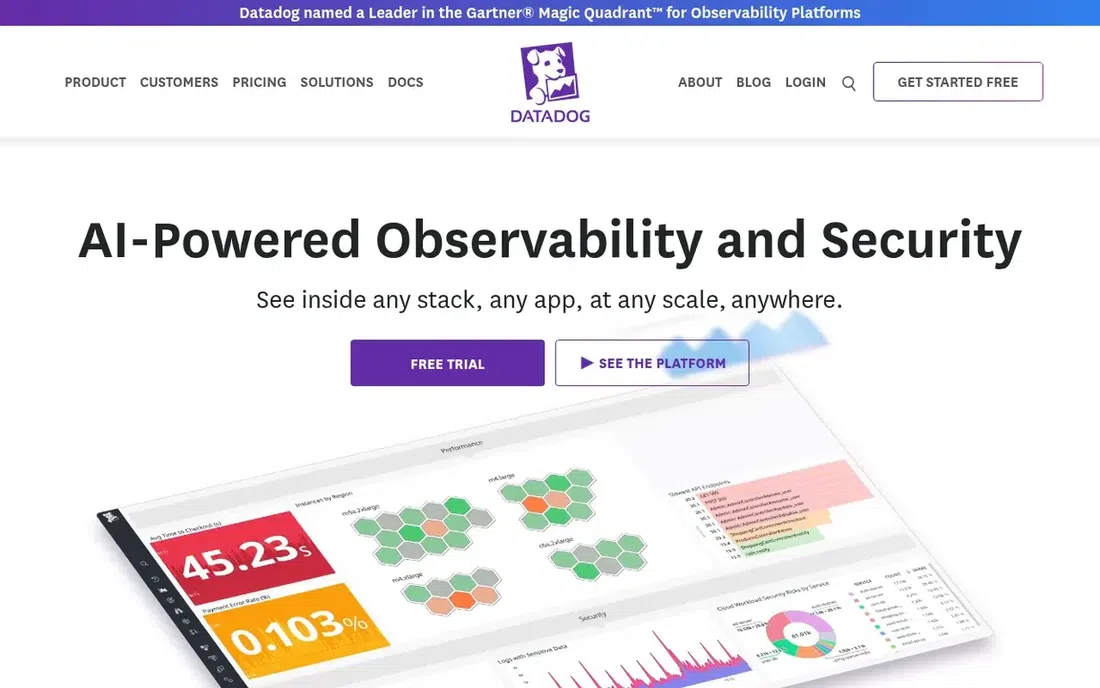
In short, Datadog is for centralized cloud monitoring across services. Datadog presents itself as cloud monitoring as a service, letting you see metrics from all of your apps, tools and services in one place.
From a buyer's view, teams with narrow needs may prefer a lighter, standards-focused stack. Choose Datadog when centralized visibility across plenty of services is the priority and you can invest time in configuration. Starting cost for Datadog: $8 per committer per month. On free options: Free trial.
Trade-offs to know: Costs can grow with telemetry volume.
- Wide integration story across tools
- Single place for metrics from apps and services
- Feature depth can mean a busy interface
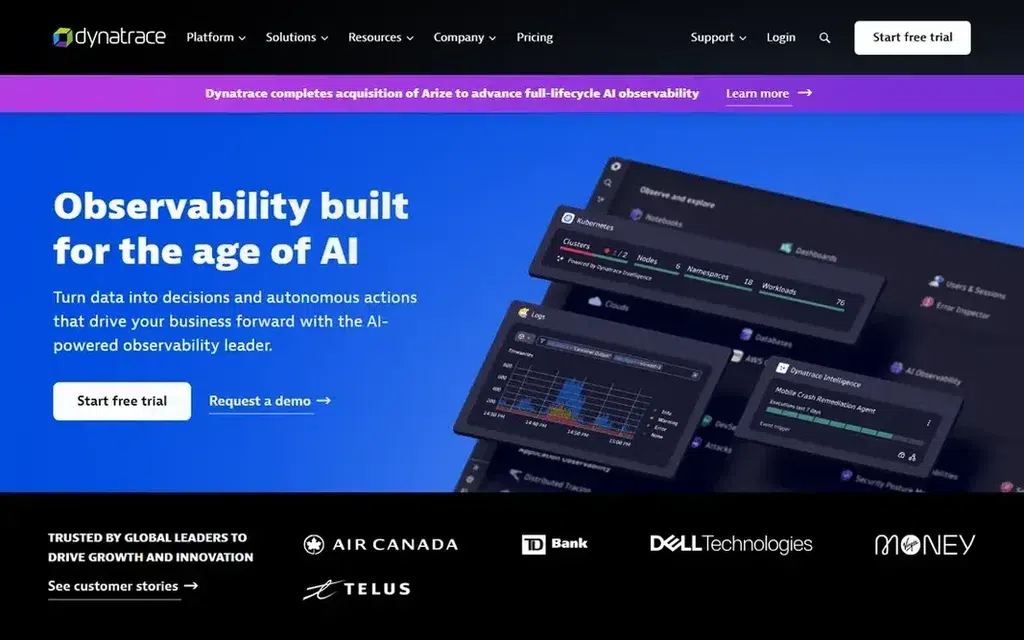
Dynatrace is aimed squarely at combined observability, AI and automation. For serverless environments, that consolidation can appeal to teams that want monitoring, automation and security signals governed together instead of scattered across separate tools. The platform's scope can be more than a small team needs, and getting value from automation features takes planning.
Where it is weaker: Product scope can feel heavy for small teams.
Pick Dynatrace when integrated automation and security alongside observability are genuine requirements. Beyond that, teams seeking a minimal, open-standards stack may find it heavier than necessary. On cost, Dynatrace starts like this: $7 per host per month. On free options: Free trial.
- Application security included in the product
- Observability
- Adoption needs planning and enablement
Sumo Logic
Best for: Cloud log management and SIEM
Sumo Logic is aimed squarely at Cloud log management and SIEM. Sumo Logic offers cloud monitoring, log management and SIEM tools with live insights for web and SaaS-based apps.
Also, the system's emphasis leans toward logs and security analytics instead of deep full-stack tracing, so tracing-centric teams may need complementary tooling. More specifically, pick Sumo Logic when log management and SIEM are the core requirements. Sumo Logic does not show a starting price in this comparison, so check the vendor site for current pricing. Free plan details: Free trial.
Where it falls short: Feature set spans multiple distinct use cases.
- Live insights for web and SaaS apps
- SIEM tools alongside operational insights
- Less emphasis on full-stack tracing depth
For large-scale security and observability data, Splunk Observability Cloud is a natural candidate. Splunk positions its data product for security, observability and AI, unifying security and observability at petabyte scale.
Trade-offs to know: Product complexity needs dedicated skills.
For everyday use, for serverless apps in data-heavy organizations, that combination can keep operational and security telemetry in one governed environment. Choose Splunk when unifying security and observability data at scale is a stated organizational goal. Entry price for Splunk Observability Cloud: $6 per month, per CPU core, billed annually. Free access exists with Splunk Observability Cloud.
- Designed for petabyte-scale workloads
- Brings together security and observability data
- Scale orientation may exceed small team needs
How we compared the tools
For each of the 6 tools we noted price, free plan or trial, fit for observability platforms for serverless apps and the main limit, using vendor pages and documentation. Treat prices as a snapshot: vendors change plans often, so check the vendor site for the figure that applies today. Tools are placed by general fit for observability platforms for serverless apps, with price clarity and free access as tie-breakers. A different team can reasonably rank them differently.
What to check before you buy
- Confirm the entry price on the vendor page. For Elastic Observability and Sumo Logic that means a quote rather than a fixed price.
- Read the fine print on the free plans from New Relic and Splunk Observability Cloud; seat, project and feature caps differ.
- Use real work to test the free trial from Elastic Observability, Datadog, Dynatrace and Sumo Logic, rather than a demo project.
- Before choosing Elastic Observability, weigh its main limit: search-centric model needs tuning for some teams.
- Test how quickly Splunk Observability Cloud answers a pre-sales question; it hints at how support will feel later.
- Confirm you can export your data from Elastic Observability, so leaving later does not mean losing records.
FAQ
Is an open-standards system better for serverless apps?
Open standards can cut lock-in and keep instrumentation portable as your function estate grows. The tradeoff is more configuration choices, so weigh that against your team's product expertise.
Can I try these options before paying?
Often, yes. New Relic and Splunk Observability Cloud have a free plan and Elastic Observability, Datadog, Dynatrace and Sumo Logic offer a free trial. Use your own data and a real task during the test, and check what the free tier or trial limits before you rely on it.
What is the cheapest option for observability platforms for serverless apps in this list?
On published monthly entry prices, Splunk Observability Cloud is the lowest here at $6 per month, per CPU core, billed annually. Entry price is only part of the cost, because seats, add-ons and billing terms can change the total. For the full picture, the cards above cover all 6 entries of this observability platforms for serverless apps list, including price, free plan and limits.
Do these tools publish their prices?
Not all of them. Elastic Observability and Sumo Logic publish no starting price, so expect a quote request for those. The rest, New Relic included, show a starting price, though seats and billing terms still change the final cost.
Which options for observability platforms for serverless apps have a free plan?
New Relic and Splunk Observability Cloud offer a free plan in this list. Free plans usually cap users, projects or features, so check the limits on the vendor page. Several others offer a trial instead.
Sources
- https://www.elastic.co
- https://newrelic.com
- https://www.datadoghq.com
- https://www.dynatrace.com
- https://www.sumologic.com
- https://www.splunk.com