5 News Monitoring APIs Worth Shortlisting in 2026
A practical guide to the best news monitoring APIs in 2026, compared from vendor documentation and public sources, with limits and buying checks.
- Editor's choiceNewsAPI.ai
News search and event tracking
Starts atSee websiteVisit newsapi.aiFull review - Great alternative
 SerpApi
Web results with a news filter
Starts atSee websiteVisit serpapi.comFull review - Also considerGDELT
Developers building their own pipeline
Starts atSee websiteVisit gdeltproject.orgFull review
Direct answer
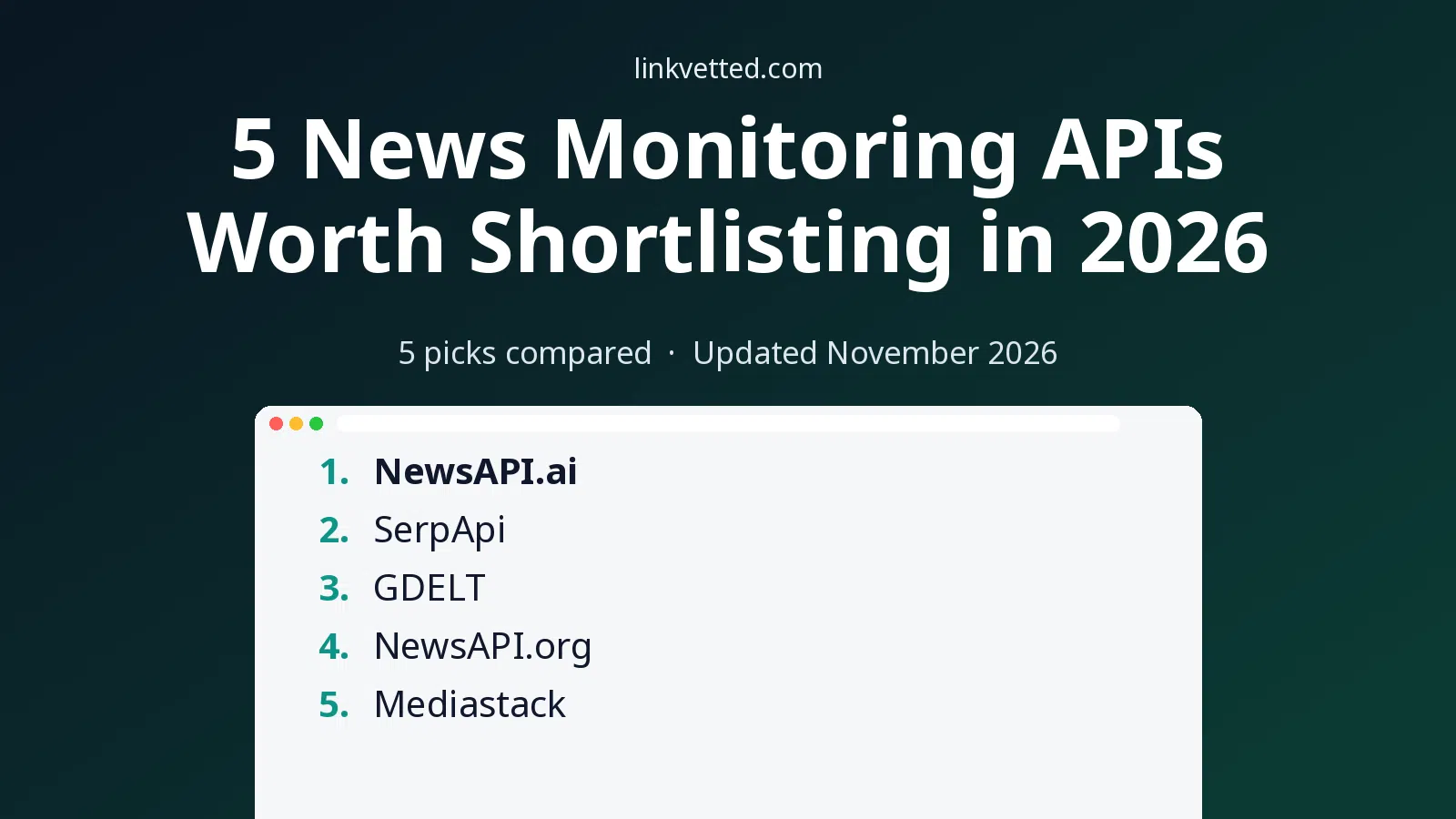
My first pick is NewsAPI.ai (Event Registry), because it is built as a news-specific API with search, topic tracking and event data rather than a general web index. For teams that want broad web coverage with a news filter, I point to SerpApi. For developers who prefer to control the crawl and storage themselves, I suggest GDELT. Each fits a different job, and none of them is the right answer for every team.
TL;DR:
- A news monitoring API is only as good as its source list and update frequency, so check both before you commit.
- Coverage of local outlets and non-English press varies a lot between providers, and that gap matters most for regional brands.
- Most APIs charge by request volume, so your query design and polling schedule drive the real cost more than the headline plan.
- Some providers restrict how you store, cache or redistribute results, and those terms can affect your product plans.
- A trial run with your own keywords and outlets tells you more than any feature list.
Last checked November 2026. Plan prices are not quoted in this guide because they change often; see each vendor's own pricing page for current figures before you buy.
Quick comparison
| Tool | Best for | Starts at | Free plan? | |
|---|---|---|---|---|
| NewsAPI.ai | News search and event tracking | See website | Free trial | Visit |
| SerpApi | Web results with a news filter | See website | Free trial | Visit |
| GDELT | Developers building their own pipeline | See website | No free plan | Visit |
| NewsAPI.org | Quick prototypes and small projects | See website | Free plan | Visit |
| Mediastack | Simple keyword monitoring | See website | Free plan | Visit |
The best news monitoring APIs compared
I compared these tools from vendor documentation and public sources, not from hands-on tests. I read the API references, pricing pages and terms where they were available, then weighed coverage claims, query options and limits against typical monitoring jobs. Treat this as a starting map for your own trial, not a verdict on performance.
NewsAPI.ai
Best for: News search and event tracking
NewsAPI.ai, from Event Registry, is a news-specific API rather than a general web search index. It is aimed at teams that need to search articles, follow topics over time and pull structured event data. If your monitoring job is mostly "what is being written about us and our market," this is the closest fit to that brief among the tools here.
The workflow is built around saved queries and topics. You define keywords, sources or concepts, then poll the API for new matches and pull article metadata such as title, source, date and URL. Event data adds a structured layer on top, which helps when you want to group coverage rather than read it article by article. That suits media monitoring dashboards and alerting tools.
The main limit is cost predictability. Credit-based plans mean a broad query set or frequent polling can use up your allowance faster than expected. Teams with very high volumes, or those who need guaranteed coverage of a specific niche outlet, should check the source list and pricing model before committing.
- News-focused index
- topic and event tracking
- multiple language coverage
- Credit-based pricing needs planning
- coverage depends on its source list
SerpApi returns structured data from search engine results pages, including a news vertical. It fits teams that want to monitor what appears in search for a set of queries, rather than subscribe to a single news index. If your monitoring is tied to search visibility, this keeps news and web results in one place.
In practice you send a query with the news engine selected and get back parsed results with titles, links, sources and timestamps. That makes it easy to feed a dashboard or a spreadsheet without writing your own parser. Scheduled runs over a keyword list give you a simple monitoring loop, and the same account can cover other search verticals if you need them.
The drawback is that you are paying per search, so a large keyword list polled often adds up. It is also a search-results view of the news world, not a full article archive, so historical depth depends on what the engine returns. Skip it if you need a complete, deduplicated news database.
- Returns structured search results
- news vertical available
- handles result parsing
- Priced by searches
- not a dedicated news archive
GDELT
Best for: Developers building their own pipeline
GDELT is an open research project that monitors news media worldwide and publishes structured datasets, including a document API. It is not a commercial product with a support desk, which is exactly why some engineering teams prefer it. You get access to a large global news stream and can build your own monitoring layer on top.
For news monitoring, GDELT is useful when you want to run your own queries over a big corpus and control storage and retention. You can pull article records by keyword, theme or time window, then enrich and deduplicate them yourself. Teams that already run data pipelines often find this more flexible than a managed API with fixed fields.
The trade-off is effort. You handle parsing, storage, deduplication and quality checks, and the data is broad but noisy. There is no account manager to call when something looks wrong. Skip GDELT if you want a ready-made monitoring product or need vendor support.
- Very broad global news coverage
- open data access
- long historical record
- Raw data needs processing
- no managed support
NewsAPI.org
Best for: Quick prototypes and small projects
NewsAPI.org is one of the simplest ways to get news articles by keyword into an application. It offers a straightforward REST interface with endpoints for top headlines and everything search. For a small internal tool or a prototype, it is often the first thing developers try, and the documentation is short enough to read in one sitting.
The typical workflow is a scheduled request per keyword or source, storing the returned articles and flagging new ones. You can filter by language, date and domain, which covers basic brand and topic monitoring. It is a reasonable fit for a first version of a monitoring tool where speed of setup matters more than depth.
The limits are the reason to look further as you grow. Lower tiers restrict how far back you can search, and plan terms affect what you can do with the data in a commercial product. Check the current terms carefully if you plan to resell or embed results.
- Simple REST interface
- easy to start
- broad source list
- Limited history on lower tiers
- usage restrictions on some plans
Mediastack
Best for: Simple keyword monitoring
Mediastack is a news and blog data API aimed at developers who want a simple feed of articles by keyword, source or category. It is part of the APILayer family of APIs, which means consistent documentation and a familiar account setup if you already use their other products. It fits small teams that want basic monitoring without a complex query language.
The workflow is a scheduled request with your keywords, returning article records you can store and diff for new items. Filters for language, source and date cover routine brand and topic monitoring. For a lightweight alerting tool or a side project, that is usually enough, and the setup is quick.
Its limits show up when your needs get specific. Advanced boolean queries, event grouping and deep historical search are less developed than on news-focused platforms. If you need those, look at NewsAPI.ai or build on GDELT. For simple keyword tracking, Mediastack is a reasonable starting point.
- Straightforward news endpoint
- keyword and source filters
- simple pricing tiers
- Fewer advanced search options
- smaller feature set than news-specific APIs
How I chose
I built this list from vendor documentation and public sources. I read each provider's API reference, pricing page and, where available, terms of use, then compared what they claim to cover: source lists, languages, update frequency, query options and historical depth. I also looked at how each one is positioned, because a search-results API and a news archive solve different problems even when both return articles.
I did not run hands-on tests, so I am not ranking speed, uptime or result quality from first-hand measurement. Instead I weighed fit: which tool suits a small prototype, which suits a media monitoring dashboard, and which suits an engineering team that wants raw data. Where a provider's public information was thin, I noted the limit rather than guessing. Your own trial with real keywords and outlets is the step that settles the choice.
What to check before you buy
- Confirm the source list covers the outlets and languages you actually monitor, including local and trade press.
- Check update frequency and latency, since a daily feed is useless for real-time alerting.
- Read the terms on caching, storage and redistribution if results will appear in a product you sell.
- Ask how far back historical search goes on the plan you are considering.
- Model your request volume from your keyword list and polling schedule, not from the headline plan.
- Test deduplication and article metadata quality with a small sample before signing an annual deal.
FAQ
What is a news monitoring API?
It is a service that lets software request news articles by keyword, source, topic or date and receive structured results. You use it to build alerts, dashboards or coverage reports without crawling news sites yourself. Providers differ in source coverage, update speed, history and how they charge for requests.
Do I need a news-specific API or a general search API?
It depends on the job. A news-specific API gives you an article index with history and topic tools, which suits media monitoring. A general search API shows what appears in search results, which suits visibility tracking. Some teams use both: one for coverage, one for search presence.
How do these APIs charge?
Most charge by request volume or credits, with tiers based on monthly usage. News-specific platforms often use credit systems where a broad query or a long date range costs more. Search-based APIs usually charge per search. Always model cost from your real keyword count and polling frequency.
Can I use news API data in a commercial product?
Often yes, but the terms vary and some plans restrict storage, caching or redistribution. Read the provider's terms before you build, especially if results will be shown to clients. When in doubt, ask the vendor in writing and keep the answer on file.
What is the quickest way to evaluate one?
Run a short trial with ten to twenty of your real keywords and a list of outlets you care about. Check whether the expected articles appear, how fresh they are and whether duplicates are handled. That small test tells you more about fit than any feature comparison.
Sources
- https://newsapi.ai
- https://serpapi.com
- https://www.gdeltproject.org
- https://newsapi.org
- https://mediastack.com