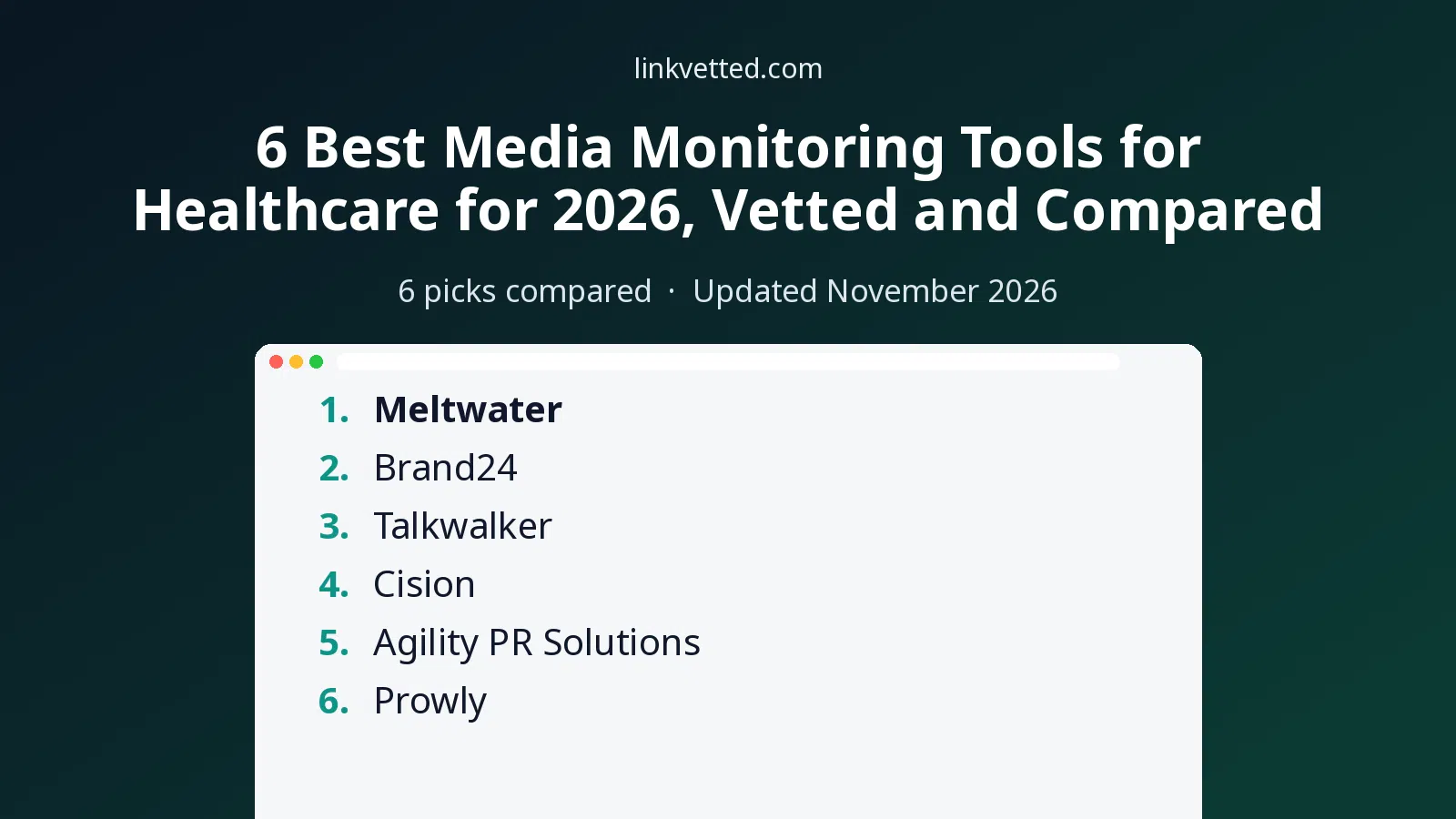
6 Best Media Monitoring Tools for Healthcare for 2026, Vetted and Compared
A practical guide to the best media monitoring tools for healthcare teams, covering coverage, compliance needs, alerting and reporting from vendor documentation.
- Editor's choice
 Meltwater
Broad news and social media coverage
Starts atSee websiteVisit meltwater.comFull review - Great alternative
 Brand24
Simple mention tracking for smaller teams
Starts atSee websiteVisit brand24.comFull review - Also consider
 Talkwalker
Social listening and visual analysis
Starts atSee websiteVisit talkwalker.comFull review
Direct answer
My top pick is Meltwater, because its media monitoring and social listening setup covers broad news and broadcast sources that healthcare comms teams usually need to watch. For teams that want a lower-cost, straightforward mention tracker, Brand24 is a sensible second option, and Talkwalker suits organisations that need deeper social listening and visual analysis. I based this on vendor documentation and public sources, not hands-on testing.
TL;DR:
- Healthcare monitoring needs to catch regulatory news, patient-safety stories and clinical trial coverage, not just brand mentions.
- Alert speed matters more than dashboard design when a story about a product or clinic starts spreading.
- Check whether the vendor indexes broadcast, podcasts and trade press, because health stories often start in specialist outlets.
- Sentiment analysis on medical topics is imperfect, so plan for human review of flagged mentions.
- Reporting exports and audit trails help when you have to brief clinicians, legal teams or leadership.
Last checked November 2026. Plan prices are not quoted in this guide because they change often; see each vendor's own pricing page for current figures before you buy.
Quick comparison
| Tool | Best for | Starts at | Free plan? | |
|---|---|---|---|---|
| Meltwater | Broad news and social media coverage | See website | No free plan | Visit |
| Brand24 | Simple mention tracking for smaller teams | See website | Free trial | Visit |
| Talkwalker | Social listening and visual analysis | See website | No free plan | Visit |
 Cision | PR teams needing media databases | See website | No free plan | Visit |
 Agility PR Solutions | Monitoring combined with media outreach | See website | No free plan | Visit |
 Prowly | Small PR teams wanting one workflow | See website | Free trial | Visit |
The best media monitoring tools for healthcare compared
I compared these tools by reading vendor documentation, help centres and public product pages, and by checking how each one handles the sources healthcare teams actually watch. I did not run hands-on tests, so treat this as a starting shortlist to evaluate against your own coverage needs and internal review process.
Meltwater is a media intelligence platform that combines monitoring, social listening, a media contact database and reporting. It fits healthcare organisations that need one place to watch traditional news, broadcast and social channels, and that have someone who can manage a fairly large workspace. Hospitals, health systems and medical device brands are the kinds of teams that tend to look at it.
For healthcare monitoring, the useful part is the breadth of sources. A story about a treatment, a recall or a clinical service can appear in trade press, local news or social posts, and Meltwater is built to pull those into saved searches and alerts. You can set up queries around brand names, drug names, executives and condition keywords, then route results to a daily digest or a live feed. Reporting exports help when you need to brief a communications lead or a clinical governance contact.
The limits are practical. There is no free plan, pricing comes through a sales conversation, and a large workspace needs someone to maintain queries and dashboards. A small clinic or a solo PR consultant may find it more than they need, and should look at lighter tools first.
- Wide source coverage across news, broadcast and social
- media database and outreach in the same platform
- alerting and reporting options
- Pricing is quote-based
- the suite can feel heavy for a small team
Brand24 is an online mention monitoring tool built around keyword projects. You add phrases, it collects public mentions from social platforms, news sites, blogs, forums and reviews, and you work from a stream of results with filters. It suits smaller healthcare teams, clinics, digital health startups and agencies that need a straightforward way to see what is being said without a long implementation.
In a healthcare context, I would use it to watch a brand name, a clinic name, a product name and a few condition or treatment terms. You can filter by sentiment and source, and set alerts for new mentions so a communications lead hears about a developing story quickly. The interface is easy enough for a marketing generalist to run, which matters when a small team has no dedicated monitoring analyst.
The drawback is coverage depth. Broadcast, some paywalled trade titles and niche clinical publications may not be fully represented, and sentiment on medical language can misread context. If your organisation needs comprehensive broadcast monitoring or heavy compliance reporting, this is a starting point rather than the whole answer.
- Quick setup for keyword and brand monitoring
- clear mention feed with sentiment filters
- accessible for non-specialists
- Weaker on broadcast and some trade press
- less depth for large enterprise reporting
Talkwalker is a consumer intelligence and social listening platform with media monitoring built in. It is aimed at brands that want to understand conversations, not just count mentions, and it includes image and logo recognition, which can help when a healthcare brand appears in visual social posts or campaign material.
For healthcare teams, the listening side is the draw. You can build queries around a condition, a treatment category or a public health topic, then look at volume, themes and sentiment over time. That is useful for communications planning and for spotting a rising concern before it reaches mainstream press. Dashboards can be shared with stakeholders who do not want to log into the raw data.
The trade-off is complexity. Building good queries and dashboards takes time and some training, and the platform is priced through sales conversations with no free plan. A small practice with basic mention-tracking needs will get more value from a simpler tool.
- Strong social listening and image recognition
- broad query and dashboard options
- useful consumer insight features
- Setup requires more skill
- no free plan and quote-based pricing
Cision is a PR and media intelligence company known for its media database, monitoring and analytics products. It fits healthcare communications and PR teams that need to find journalists and outlets, distribute news and then track coverage in one workflow. Hospitals, health systems, pharma comms teams and agencies are the typical users.
In healthcare, the media database is often the reason people choose it. You can search for health and science journalists, build lists and connect outreach to monitoring so coverage lands in the same place. Monitoring covers news and social sources, and reporting can be shaped around coverage volume, message pull-through and share of voice against other organisations.
The limits are commercial and structural. There is no free plan, contracts are usually annual and aimed at larger teams, and the platform is heavier than a simple mention tracker. A small clinic or a single-person comms function will likely find it disproportionate.
- Large media contact database alongside monitoring
- established reporting and analytics
- suits structured PR workflows
- Contracts are aimed at larger organisations
- can be costly for small teams
Agility PR Solutions offers media monitoring, a media database, press release distribution and reporting. It is aimed at PR and communications teams that want a combined toolkit rather than separate subscriptions, and it sits in the mid-market space between simple trackers and large enterprise suites.
For healthcare monitoring, the relevant features are coverage tracking across news and social sources, keyword alerts and reporting that can be shared with leadership. Because it also carries a media database, a comms team can move from spotting a journalist's story to pitching a follow-up without switching systems. That connected workflow is useful when you are managing reactive comment on a health topic.
The main drawback is that the interface and workflows can feel less modern than newer listening tools, and there is no free plan. Pricing is quote-based, so you need to talk to sales before you know whether it fits your budget.
- Monitoring, media database and reporting in one place
- analyst support options
- suits mid-sized PR teams
- Interface can feel dated
- no free plan and pricing is quote-based
Prowly is a PR software platform with a media database, pitch and release tools, a newsroom builder and media monitoring. It is aimed at small and mid-sized PR teams that want one place to run outreach and see the resulting coverage, rather than buying separate database and monitoring subscriptions.
In a healthcare setting, Prowly is most useful for a lean comms team at a clinic, digital health company or agency. You can build a journalist list, send a release, then track mentions and assemble a coverage report. The monitoring piece is enough to catch brand and campaign mentions across news and social sources, and the reporting is simple to share.
The limitation is depth. If you need extensive broadcast monitoring, advanced social listening or complex sentiment analysis, Prowly is not the strongest option. It is a workflow tool first, and monitoring is a supporting feature.
- Combines media database, outreach and monitoring
- approachable interface for small teams
- useful for owned and earned coverage
- Monitoring is not the deepest part of the product
- less suited to large-scale listening
How I chose
I built this list from vendor documentation, public product pages, help centres and published feature descriptions, and I checked each tool against the sources and workflows that healthcare communications teams commonly describe. I did not run hands-on tests, and I did not use private trials or client accounts. Where a vendor's public material was unclear on a feature, I left it out rather than guess.
The selection leans on fit rather than size. A hospital comms team has different needs from a two-person agency or a single clinic, so I included a mix of broad media intelligence platforms, social listening tools and lighter PR workflow products. I also weighed limits honestly: quote-based pricing, missing broadcast coverage and setup effort all affect whether a tool is worth it. Use this as a shortlist and confirm current features and terms directly with each vendor.
What to check before you buy
- Confirm the tool indexes the health and science trade press you actually care about, not just mainstream news.
- Ask how quickly alerts fire after a mention appears, and whether you can set different alert rules for different topics.
- Check whether sentiment analysis can be adjusted or manually overridden, since medical language often confuses automated scoring.
- Ask about data retention and export, especially if you need an audit trail for compliance or internal review.
- Confirm user roles and permissions, so clinical or legal reviewers can see coverage without editing queries.
- Ask how the vendor handles social platforms and broadcast, and whether those sources cost extra.
FAQ
What should a healthcare team monitor beyond its brand name?
Watch condition and treatment terms, clinical service names, executive names, product and device names, and public health topics relevant to your work. Many issues surface first in trade press or patient forums rather than mainstream news, so include specialist outlets and community sites in your queries. Review the keyword list quarterly as services change.
How accurate is sentiment analysis for medical topics?
It is mixed. Automated sentiment often misreads clinical language, patient stories and regulatory wording, so treat scores as a sorting aid rather than a verdict. Set up human review for anything flagged negative, and check a sample of neutral mentions each month to see whether the model is drifting. Most vendors let you adjust keywords but not the underlying model.
Do I need social listening as well as media monitoring?
Not always. If your main concern is press coverage and regulatory news, a monitoring tool with news and broadcast coverage may be enough. Social listening becomes useful when patient communities, campaign hashtags or visual posts matter to your communications plan. Start with monitoring and add listening if the conversations you care about are mostly on social platforms.
Can these tools help with crisis response?
They can shorten the time between a story appearing and your team knowing about it, which is the main value. Set alerts for high-risk keywords and route them to a named person, and agree in advance who reviews and responds. No tool replaces a crisis plan, and automated sentiment should not be the trigger for escalation on its own.
How long does setup usually take?
Simple keyword projects can be running in an afternoon. Broader platforms with dashboards, user roles and reporting take longer, often a few weeks with training. Plan for someone to own the queries after launch, because unmaintained searches fill with noise and alerts stop being useful. Ask the vendor what onboarding support is included before you commit.
Sources
- https://www.meltwater.com
- https://brand24.com
- https://www.talkwalker.com
- https://www.cision.com
- https://www.agilitypr.com
- https://prowly.com
Related guides
- Best Data Quality Monitoring Software for Healthcare (2026): 6 Picks Checked on Vendor Pages
- 6 Best Network Monitoring Software for Healthcare Practices for 2026, Vetted and Compared
- The 6 Best Network Monitoring Software for Dental Practices in 2026, Ranked
- 6 Network Monitoring Software for Medical Clinics Worth Shortlisting in 2026