Media Monitoring Tools for Agencies in 2026: The 5 Best Options Side by Side
A guide to media monitoring services for agencies, compared from vendor documentation and public sources, with what to check before you buy.
- Editor's choice
 Prowly
Media relations with built-in monitoring
Starts atSee websiteVisit prowly.comFull review - Great alternative
 Talkwalker
Social and media analytics at scale
Starts atSee websiteVisit talkwalker.comFull review - Also considerIsentia
Broadcast, print and online monitoring
Starts atSee websiteVisit isentia.comFull review
Direct answer
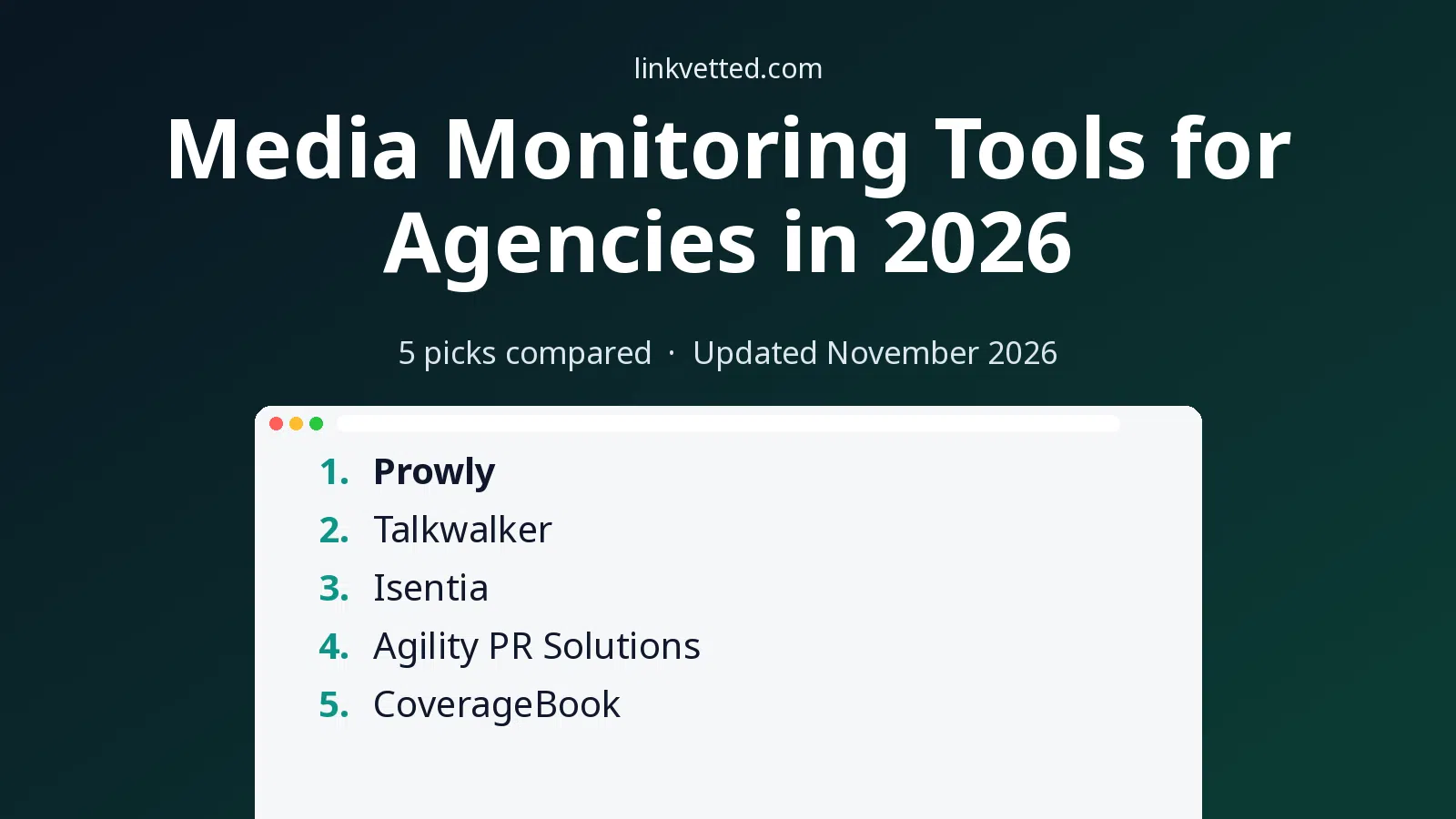
My first pick is Prowly, a media relations service that combines a media database, press release distribution and monitoring in one place, which suits agencies running outreach for several clients. For agencies that want a monitoring and analytics service layered on top of their PR work, Talkwalker is a strong second. For teams that need a broad news and broadcast monitoring service with analyst support, Isentia is worth a look.
TL;DR:
- Agencies usually need monitoring that covers many clients at once, so per-client organisation and reporting matter as much as coverage.
- A service that bundles a media database, distribution and monitoring saves the handoff work between separate vendors.
- Broadcast, print and online coverage often sit in different services, so check which channels each vendor actually covers.
- Analyst support and custom reports are common agency needs, and not every vendor offers them at the same level.
- Always confirm how a vendor handles client data, user seats and report exports before you commit.
Last checked November 2026. Plan prices are not quoted in this guide because they change often; see each vendor's own pricing page for current figures before you buy.
Quick comparison
| Tool | Best for | Starts at | Free plan? | |
|---|---|---|---|---|
| Prowly | Media relations with built-in monitoring | See website | Free trial | Visit |
| Talkwalker | Social and media analytics at scale | See website | Not stated | Visit |
| Isentia | Broadcast, print and online monitoring | See website | Not stated | Visit |
 Agility PR Solutions | Monitoring plus media database for PR teams | See website | Not stated | Visit |
 CoverageBook | Fast, clean coverage reports for clients | See website | Free trial | Visit |
The best media monitoring services for agencies compared
I put this list together from vendor documentation and public sources, looking at what each service says it covers, how it is organised for agency work and where the limits sit. I did not run hands-on tests, so treat this as a starting point for your own demo calls rather than a lab result.
Prowly is a media relations service from Semrush that brings a media database, press release distribution and media monitoring into one account. For an agency, that means you can build a list, send a release and then track what came back without moving between vendors. It fits small and mid-sized agencies that run regular outreach for a handful of clients and want one place to manage it.
On the monitoring side, Prowly tracks mentions of your clients' brands and the coverage your campaigns generate, then lets you pull that into reports. Because the monitoring sits next to the outreach tools, the workflow is straightforward: pitch, publish, then check coverage and share it. That reduces the manual copy-and-paste work that eats into an agency's billable time.
The limit is that Prowly is not a pure media listening service. If you need deep social listening or broad broadcast coverage across many markets, you will likely need a second vendor. Agencies that only need to track their own campaigns will get the most from it.
- Media database and distribution in one service
- monitoring tied to your own outreach
- reports you can share with clients
- Monitoring is built around its own workflow
- less of a standalone listening service
Talkwalker is a media monitoring and analytics service that covers news, social and other channels, with dashboards and reporting built in. It suits agencies that need to show clients not just what was said but how it moved across channels. It is a common choice for teams handling bigger accounts or several markets at once.
For agency work, Talkwalker's value is in the reporting layer. You can set up tracking for each client, then build dashboards that separate accounts and show trends over time. That helps when a client asks for a monthly summary and you need the numbers to line up across channels.
The trade-off is scale. Talkwalker is built for organisations with real monitoring programmes, so a small agency with a few light retainers may find it more than it needs. Check the onboarding and setup requirements before you commit.
- Broad media and social coverage
- analytics and dashboards
- works for multi-market accounts
- Aimed at larger programmes
- setup needs planning
Isentia
Best for: Broadcast, print and online monitoring
Isentia is a media monitoring and analysis service with a long history in broadcast, print and online coverage, plus analyst support. It fits agencies that need to prove coverage across TV, radio and newspapers, not just web mentions. That is often the case for clients in regulated or consumer sectors where broadcast still matters.
For agencies, Isentia's analyst support is the draw. Instead of building every report yourself, you can lean on their team for coverage summaries and analysis. That can free up account time on larger clients where the reporting load is heavy.
The main limit is regional variation. What Isentia covers and how it is priced depends a lot on where you and your clients are based, so confirm the specifics for your markets. Agencies that only need web and social monitoring may find it heavier than necessary.
- Strong broadcast and print coverage
- analyst support
- regional depth
- Coverage and pricing vary by region
- not a light self-serve tool
Agility PR Solutions is a media monitoring and media database service aimed at PR teams and agencies. It combines coverage tracking with a database for outreach, so an agency can monitor results and plan the next round of pitching in one place. It suits agencies that want a PR-focused service rather than a general social listening tool.
The monitoring side covers mentions and coverage, with analysis and reporting that you can shape for clients. Because it is built around PR work, the reports tend to map to what clients expect from an agency: coverage volume, outlets, messages and share of voice.
Small agencies may find the service has more parts than they need at first, and getting it set up takes some planning. If you run a lean team with a few clients, a lighter service may be a better fit.
- Monitoring and media database together
- media analysis and reporting
- built for PR workflows
- Can feel heavy for very small teams
- setup takes time
CoverageBook is a coverage reporting service that helps agencies turn a list of coverage into a polished report with metrics like reach and domain authority. It is not a monitoring service in the listening sense; it is where you assemble and present what you found. For agencies, that is often the last mile that eats time.
The workflow is simple: add the coverage you have collected, and the service fills in the metrics and lays it out for the client. That cuts the manual work of building reports in spreadsheets and makes monthly reporting less of a chore. It fits agencies that already have a monitoring source and want the reporting step to be faster.
The limit is clear: CoverageBook does not find coverage for you. If you need live monitoring across channels, you still need another service. Agencies that mainly want better client reports will get the most from it.
- Quick to build client-ready reports
- pulls in coverage metrics
- simple to share
- Reporting-focused rather than live monitoring
- you still need a source of coverage
How I chose
I built this list from vendor documentation and public sources, reading what each service says it covers, how it is organised for agency work and where the limits sit. I looked at whether a service handles multiple clients cleanly, whether it covers the channels agencies actually report on, and whether the reporting layer saves time or adds work. I did not run hands-on tests, so the notes here reflect what vendors publish and what is publicly known, not my own trial results.
I also weighed fit over feature count. A service with a long feature list is not automatically right for an agency with a handful of retainers, and a lighter service can be a better match if it covers the channels your clients care about. Where a vendor's coverage or pricing varies by region, I have said so rather than guessing. Use this as a shortlist for demo calls and check the specifics for your own clients before you commit.
What to check before you buy
- Confirm which channels the service covers: online, social, broadcast and print are often split across different vendors.
- Ask how the service organises multiple clients, including separate tracking, user seats and permissions.
- Check how reports are exported and whether they carry your agency's branding for client delivery.
- Ask about coverage in the specific markets and languages your clients operate in.
- Confirm how client data is stored and who can access it, especially if you handle sensitive accounts.
- Ask what onboarding and support look like, since setup time is a real cost for an agency.
FAQ
Do agencies need a monitoring service or a reporting service?
Many agencies need both, but they are different jobs. A monitoring service finds coverage across channels, while a reporting service like CoverageBook turns what you found into a client-ready document. Some vendors bundle both, so check which parts you actually get before you compare options.
Can one service cover all my clients?
It depends on the clients. A service that covers online and social well may be weaker on broadcast or print, and coverage varies by market. For agencies with clients in several countries, it is common to combine a broad monitoring service with a regional one for the markets that need it.
How do I compare services without hands-on testing?
Start with vendor documentation and public sources, then ask each vendor for a demo using one of your real clients as the example. Ask how they handle multiple clients, which channels they cover in your markets and what the reports look like. That gives you a practical comparison without a long trial.
Is a media database part of media monitoring?
Not always. Some services bundle a media database with monitoring and distribution, which suits agencies that pitch and report in one place. Others focus only on monitoring. Decide whether you want one vendor for the whole workflow or separate services for outreach and monitoring.
What should a small agency prioritise?
Prioritise the channels your clients actually care about, clean per-client organisation and reports you can hand over without extra work. A lighter service that covers those well is usually a better fit than a large platform with features you will not use. Confirm setup time and support before you commit.
Sources
- https://prowly.com
- https://www.talkwalker.com
- https://www.isentia.com
- https://www.agilitypr.com
- https://coveragebook.com