6 Best Media Monitoring Tools for Small Business for 2026, Vetted and Compared
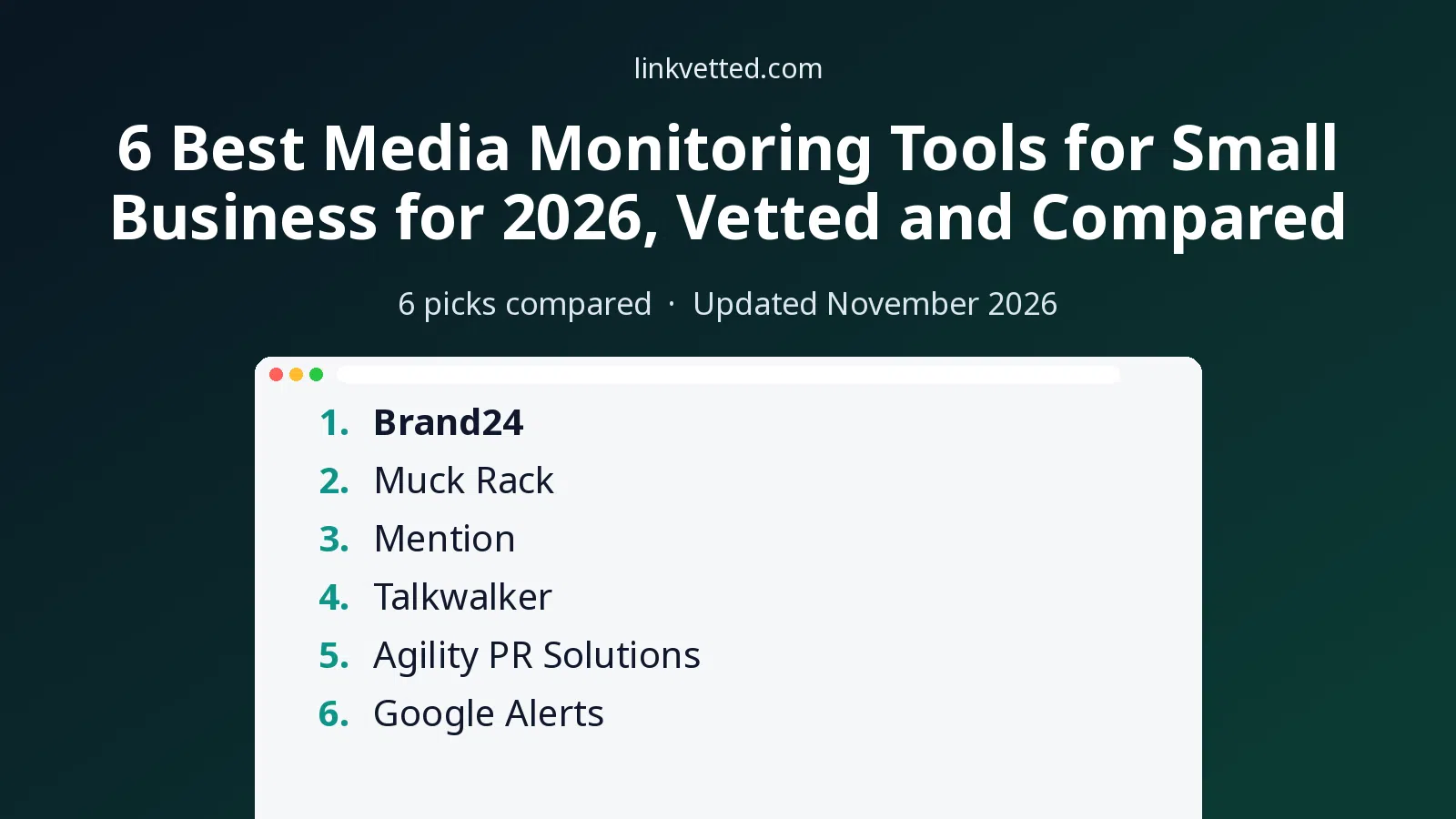
A practical guide to the best media monitoring tools for small business in 2026, compared from vendor documentation and public sources.
- Editor's choice
 Brand24
All-round mention monitoring for small teams
Starts atSee websiteVisit brand24.comFull review - Great alternative
 Muck Rack
PR coverage and journalist monitoring
Starts atSee websiteVisit muckrack.comFull review - Also consider
 Mention
Simple social listening on a budget
Starts atSee websiteVisit mention.comFull review
Direct answer
My first pick for most small businesses is Brand24, because it covers social mentions, news and review sites in one dashboard and is simple enough for a one-person marketing team. If you mainly need press coverage and journalist monitoring, Muck Rack fits better. If budget is the main constraint and you only need social listening, Mention is the lighter option. I compared these from vendor documentation and public sources, not hands-on tests.
TL;DR:
- Brand24 is a balanced starting point for a small team that needs social, news and review monitoring in one place.
- Muck Rack leans toward PR and earned media, so it suits businesses that pitch journalists and track coverage.
- Mention is a simpler listening tool that fits teams that mostly care about social conversations.
- Talkwalker is a stronger fit when you need deeper analytics and can handle a steeper setup.
- Always check alert limits, source coverage and export options before you commit to any tool.
Last checked November 2026. Plan prices are not quoted in this guide because they change often; see each vendor's own pricing page for current figures before you buy.
Quick comparison
| Tool | Best for | Starts at | Free plan? | |
|---|---|---|---|---|
| Brand24 | All-round mention monitoring for small teams | See website | Free trial | Visit |
| Muck Rack | PR coverage and journalist monitoring | See website | Not stated | Visit |
| Mention | Simple social listening on a budget | See website | Free trial | Visit |
 Talkwalker | Deeper analytics and reporting | See website | Not stated | Visit |
 Agility PR Solutions | PR monitoring with media databases | See website | Not stated | Visit |
| Google Alerts | A free baseline for web mentions | See website | Free plan | Visit |
The best media monitoring tools for small business compared
I put this list together by reading vendor documentation, pricing pages and public descriptions of each product, and by checking which ones small teams commonly mention. I did not run hands-on tests, so treat this as a starting point for your own trial. The picks below cover different needs: social listening, PR coverage, analytics depth and a free baseline.
Brand24 is a media monitoring and social listening platform that tracks mentions of your brand, competitors and keywords across social networks, news sites, blogs and review platforms. It fits a small business that wants one place to see what people say and to react to comments or coverage without stitching several tools together.
For small business use, the workflow is straightforward: you set up a project with your brand name and a few keyword variations, then review mentions as they arrive. Alerts can go to email or Slack-style channels, and you can tag mentions for follow-up. That makes it practical for tracking a product launch, a local news mention or a spike in complaints.
The limits show up when you need long historical data or heavy reporting. If your team needs deep custom dashboards or very long archives, check the plan details first. Businesses with no social presence and only occasional press mentions may find a simpler or free option enough.
- Covers social, news and review sources
- simple dashboard
- useful sentiment and share-of-voice views
- Fuller history and exports sit on higher tiers
- some sources need plan checks
Muck Rack is a PR platform that combines a media database, journalist profiles and coverage monitoring. It is built for teams that pitch stories and want to see where they land. A small business with an active PR push, or one working with an agency, can use it to track mentions and keep a record of coverage.
The monitoring side works well alongside outreach: you can follow journalists and outlets, then see coverage tied to your brand. For small businesses, that means less time searching for mentions manually and a clearer picture of which outlets pick up your news.
The trade-off is focus. If your main concern is social listening or customer reviews, Muck Rack is not the natural first pick. Small businesses without a regular PR rhythm may also find it heavier than they need.
- Strong media database and coverage tracking
- good for pitching journalists
- reporting built for PR
- Less social-first
- may be more than a small team needs
Mention is a media monitoring tool focused on tracking brand mentions across social media, blogs and news. It is aimed at teams that want a clear feed of what is being said without a long setup. For a small business, that usually means monitoring the brand name, product names and a few key phrases.
The tool sends alerts and lets you respond to mentions from a single place, which helps when a customer complaint or a positive post needs a quick reply. It is a reasonable fit if social conversations matter more to you than press coverage.
Where it falls short is depth. If you need advanced sentiment analysis, long archives or detailed competitor benchmarking, you will likely outgrow it. Businesses that mostly need press monitoring should compare it with PR-focused tools first.
- Easy setup
- covers social and web mentions
- alerts are simple to configure
- Analytics are lighter than bigger platforms
- source coverage varies by plan
Talkwalker is a media monitoring and analytics platform that covers social, news, blogs and more, with a focus on measurement and reporting. It suits a small business that has grown past simple alerts and now needs to show trends, sentiment and share of voice in reports.
For small business use, the value is in the reporting layer: you can compare your brand against competitors and track how a campaign spreads. That is useful when you need to justify marketing spend or brief a client.
The main limit is complexity. Setup takes more thought, and a solo marketer may not use most of the features. If you only need basic mention alerts, a simpler tool will save time.
- Broad source coverage
- strong analytics and visual reporting
- good for competitor tracking
- Steeper setup
- may be complex for a one-person team
Agility PR Solutions is a PR software suite that includes media monitoring, media databases and coverage reporting. It fits small businesses and agencies that run PR campaigns and want monitoring tied to outreach and reporting.
In practice, you use it to track mentions, build media lists and pull coverage into reports. For a small business working with journalists or local press, that combination can replace a few separate tools.
It is not a social listening-first product, so businesses focused on social conversations should look elsewhere. The PR focus also means smaller teams may pay for database features they rarely use.
- Combines monitoring with media databases
- built for PR workflows
- coverage reporting
- PR-centric
- less suited to pure social listening
Google Alerts
Best for: A free baseline for web mentions
Google Alerts is a free service that emails you when Google finds new web pages matching your search terms. It is the simplest way for a small business to start monitoring its brand name, product names and key people.
It works best as a baseline. You set a few alerts, choose frequency and delivery, and use it to catch news, blog posts and directory mentions. Many small teams run it alongside a paid tool rather than instead of one.
The limits are clear: no social media coverage, no sentiment analysis and no reporting dashboard. If you need to track conversations or measure coverage, you will need a dedicated tool.
- Free and quick to set up
- covers web mentions
- email delivery
- No social coverage
- limited reporting and no sentiment analysis
How I chose
I built this list from vendor documentation, public product pages and descriptions of how each tool is positioned. I looked at source coverage, alerting, reporting, ease of setup and how well each product fits a small team with limited time. I did not run hands-on tests, and I did not use client results or internal data to rank them.
The other filter was fit. A tool that suits a large PR department may be overkill for a five-person business, and a free alert service may be enough for a company that only wants to know when its name appears online. I noted the main drawback for each pick so you can judge whether it matters for your situation. Use this guide to shortlist tools, then check current plan details on each vendor site before deciding.
What to check before you buy
- Confirm which sources are covered: social networks, news, blogs, review sites, forums or broadcast.
- Check how many mentions, keywords or projects your plan allows before you hit a limit.
- Look at alert delivery options: email, app notifications or integrations with tools your team already uses.
- Ask how far back the mention history goes and whether you can export it.
- Check reporting features, especially sentiment, share of voice and competitor comparisons if you need them.
- Confirm support options and whether onboarding help is included, since setup time matters for a small team.
FAQ
What is media monitoring for a small business?
Media monitoring means tracking where your brand, products or key people are mentioned online and in the press. For a small business, it usually covers social media, news sites, blogs and review platforms. The goal is to catch coverage, respond to comments and understand what people say about you, without reading every platform manually.
Do I need a paid tool or can I start free?
You can start with Google Alerts and the built-in notifications on social platforms. That covers basic web and social mentions at no cost. A paid tool becomes worth considering when you need sentiment analysis, competitor tracking, reporting or coverage across many sources in one place. Many vendors offer a trial, so test before you commit.
How many keywords should I monitor?
Start with your brand name, common misspellings, product names and one or two competitor names. A handful of well-chosen keywords is usually more useful than a long list that produces noise. You can add campaign hashtags or spokesperson names later. Check your plan's keyword limit before you build a large list.
Can these tools track competitors as well as my own brand?
Most paid tools let you monitor competitor names and compare share of voice or sentiment. That is useful for small businesses that want to see how they stack up in their niche. Free options like Google Alerts can track competitor names too, but without the reporting and comparison features.
How do I measure whether media monitoring is working?
Look at whether you are catching mentions you would otherwise miss, how quickly you respond to them and whether coverage is growing over time. Keep a simple log of mentions and responses. Avoid tying monitoring to ranking promises; it is about awareness and response, not a direct ranking lever.
Sources
- https://brand24.com
- https://muckrack.com
- https://mention.com
- https://www.talkwalker.com
- https://www.agilitypr.com
- https://www.google.com/alerts