Best Link Building Tools for Content Marketers for 2026: Our 6 Vetted Picks
A practical guide to the best link building tools for content marketers in 2026, compared from vendor documentation and public sources.
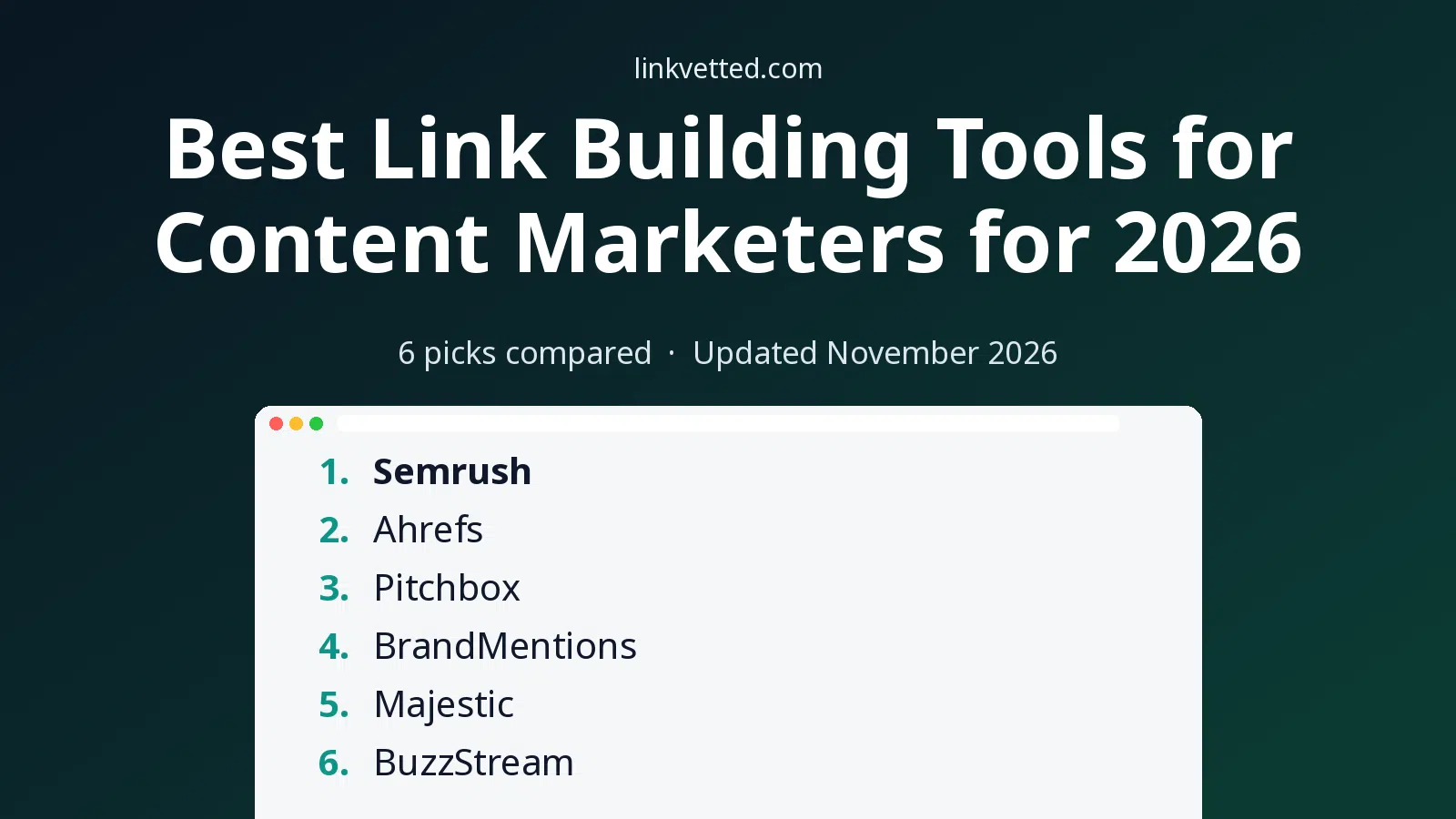
- Editor's choice
 Semrush
All-in-one backlink research and reporting
Starts atSee websiteVisit semrush.comFull review - Great alternative
 Ahrefs
Deep backlink and referring domain analysis
Starts atSee websiteVisit ahrefs.comFull review - Also consider
 Pitchbox
Running link outreach campaigns
Starts atSee websiteVisit pitchbox.comFull review
Direct answer
My first pick is Semrush, because its backlink data, competitor link views and outreach-friendly exports cover most of what a content marketer needs in one place. For prospecting and managing outreach at volume, Pitchbox is the better fit. If you mainly need to find unlinked brand mentions and turn them into link requests, BrandMentions is the one I would look at first.
TL;DR:
- Content marketers usually need three jobs covered: finding link prospects, qualifying them, and tracking what you built.
- Semrush works well as a single source for backlink data, competitor link research and reporting.
- Pitchbox is built around outreach campaigns, so it suits teams that send link requests regularly.
- BrandMentions focuses on mentions, which helps when your link building depends on unlinked brand coverage.
- None of these tools build links on their own; the content and the pitch still decide the outcome.
Last checked November 2026. Plan prices are not quoted in this guide because they change often; see each vendor's own pricing page for current figures before you buy.
Quick comparison
| Tool | Best for | Starts at | Free plan? | |
|---|---|---|---|---|
| Semrush | All-in-one backlink research and reporting | See website | Free plan | Visit |
| Ahrefs | Deep backlink and referring domain analysis | See website | No free plan | Visit |
| Pitchbox | Running link outreach campaigns | See website | Not stated | Visit |
 BrandMentions | Turning unlinked mentions into links | See website | Free trial | Visit |
 Majestic | Link profile quality and trust review | See website | No free plan | Visit |
 BuzzStream | Small teams managing blogger relationships | See website | Free trial | Visit |
The best link building tools for content marketers compared
I put this comparison together from vendor documentation, public product pages and published feature lists. I did not run hands-on tests of each tool, so treat this as a starting point for your own trial rather than a lab result. The picks below are the ones I would shortlist for content-led link building.
Semrush is a broad SEO platform, and the backlink side is what matters here. You can pull a domain's referring domains, look at which pages attract links, and compare that against competitors. For a content marketer, that means you can see which topics in your niche earn links and plan content around them instead of guessing.
The workflow I would use: start with a competitor's linked pages, filter for content types you can realistically produce, then export the referring domains as a prospect list. Semrush also keeps historical link data, so you can show movement over time in client or stakeholder reports. That reporting angle is often why content teams pick it over a single-purpose link tool.
The limit is that Semrush is priced and structured as a full suite. If your only job is sending outreach emails, you are paying for a lot you will not use. Small content teams on a tight budget should check whether a narrower tool covers their actual tasks.
- Large backlink index
- Competitor link research
- Exports for outreach lists
- Many features beyond links
- Interface can feel crowded
Ahrefs is another full SEO platform, and its backlink data is the part content marketers lean on. The referring domain views, anchor text breakdowns and link history give you a clear picture of who links to a page and how that changed. It is a common choice for agencies and in-house teams that need reliable link data across many projects.
For content planning, the linked-content views help you spot formats that attract links in your niche, such as original research, tools or detailed guides. You can then build a prospect list from the sites linking to similar pages and pitch your own version. The link history also helps when you are checking whether a page has earned links steadily or in one burst.
The main drawback is access: there is no lasting free plan, so you need a paid subscription to use it properly. People new to backlink analysis may also need time to learn the interface. If you only need occasional link checks, a lighter tool may be enough.
- Detailed referring domain data
- Strong link history
- Useful content explorer for linkable topics
- No lasting free tier
- Learning curve for new users
Pitchbox is an outreach platform rather than a link database. It is designed for teams that send link requests and blogger outreach at a steady pace and need to manage prospects, follow-ups and replies in one place. Content marketers who run regular campaigns will recognise the problem it solves: keeping track of who was contacted, when, and what happened next.
In a content-led link building process, Pitchbox sits after research. You find prospects in a tool like Semrush or Ahrefs, then load them into Pitchbox to run the sequence, personalise the pitch and track responses. That separation is useful because it keeps outreach organised without mixing it into your keyword and content work.
The limit is that Pitchbox does not tell you who to contact. You still need a prospect source and a reason for each pitch. Solo content marketers who send a handful of emails a month will likely find it more process than they need.
- Built around outreach campaigns
- Prospect and pipeline management
- Templates for repeatable pitches
- Not a content research tool
- Setup takes some planning
BrandMentions is a media and mention monitoring tool. You set up alerts for your brand, key people or target keywords, and it collects where those terms appear online. For link building, the value is in finding coverage that mentions you but does not link, which gives you a natural reason to reach out and ask for a link.
This fits content marketers who publish material that gets referenced, such as studies, guides or expert commentary. Instead of building prospect lists from scratch, you work from mentions you already earned and convert the unlinked ones. It is a quieter approach than cold outreach, and the pitch is usually easier because the site already knows your brand.
The limit is clear: it monitors mentions, it does not give you a complete backlink profile or competitor link analysis. You will still want a backlink tool alongside it. Teams that rarely get mentioned by name will get little from it.
- Monitors brand and keyword mentions
- Helps find unlinked coverage
- Alerts keep monitoring ongoing
- Not a full backlink audit tool
- Requires review of each mention
Majestic is one of the older link intelligence tools, and it is still used for judging the quality of a link profile. Its trust and citation metrics give you a way to look at whether links to a page come from sources that look credible. For content marketers, that matters when you are deciding which prospects are worth pitching and which are not.
The practical use is filtering. When you have a long list of sites that linked to a competitor's guide, Majestic helps you sort the stronger-looking domains from the weak ones before you spend time on outreach. It also helps you review your own profile after a campaign to see what kind of sites actually linked.
The trade-off is scope. Majestic is centred on link data and does not offer much for content research or outreach management. If you want one tool for everything, it will not be it. It works best as a quality check alongside a broader platform.
- Long-standing link index
- Trust and citation metrics
- Useful for profile review
- Fewer content planning features
- Dated interface in places
BuzzStream is a relationship and outreach management tool aimed at link building and digital PR work. It stores contact details, notes and conversation history so you can see how you have dealt with a site before. That is useful for content marketers who pitch the same blogs and publications more than once.
The workflow is straightforward: build a list of prospects, log contact details, send pitches and record outcomes. Over time it becomes a record of who responded, who asked for changes and who linked. For a small team, that shared history prevents duplicate outreach and awkward repeat pitches.
The limit is that BuzzStream is not a link database. You bring your own prospects, and the link data it shows is lighter than what a full SEO suite provides. Teams running very large campaigns may also find it less scalable than dedicated outreach platforms.
- Contact and relationship tracking
- Outreach workflow for small teams
- Keeps pitch history in one place
- Lighter link data than SEO suites
- Less suited to very large campaigns
How I chose
I started from the jobs a content marketer actually does when building links: finding pages and sites worth pitching, qualifying them, running outreach and reporting results. I then read vendor documentation and public product pages to see which tools cover those jobs and how they describe their own limits. I did not run hands-on tests, so I have not scored speed, accuracy or support response.
The second filter was fit. A tool that only does outreach is not a substitute for a backlink database, and a full SEO suite is more than a solo blogger needs. I noted where each tool sits in the workflow and where it stops, so you can combine two tools rather than expect one to do everything. Pricing changes often, so I have not quoted figures; check each vendor's site for current plans.
What to check before you buy
- Confirm the tool covers the specific job you are short of: prospect research, outreach management or mention monitoring.
- Check how far back the link history goes if you need to show link growth over time.
- Look at export formats, because your outreach process probably needs a CSV or a direct integration.
- Check whether the plan limits projects, users or exports, since content teams often share access.
- Review the trial or free plan terms so you can test with your own prospect list before committing.
- Ask whether the vendor offers an API or integrations with your CRM or outreach tool if you run campaigns at volume.
FAQ
Do content marketers need a paid link building tool?
Not always. If you publish occasionally and pitch a few sites a month, a free plan and a spreadsheet can work. Paid tools earn their place when you need competitor link data, regular outreach tracking or reporting across several projects. Start with the free option, then move up when the manual work becomes the bottleneck.
Can these tools build links for me automatically?
No. They help you find prospects, qualify them, manage outreach and track results. The link itself depends on your content being worth citing and your pitch being relevant to the site. Any tool that promises automatic links is worth treating with caution, because link building still involves a person on the other side deciding to link.
Which tool is best for a small content team?
It depends on the gap. A small team short of prospect data will get more from Semrush or Ahrefs. A team that already has prospects but loses track of outreach will get more from Pitchbox or BuzzStream. Mention monitoring tools like BrandMentions suit teams that already get referenced and want to convert that coverage into links.
How do I choose between Semrush and Ahrefs?
Both cover backlink research and competitor analysis. The choice often comes down to which interface your team finds easier and which other features you need, such as content or keyword research. Since I did not run hands-on tests, I would suggest trialling both with the same competitor domain and comparing the prospect lists you get.
Do I still need outreach software if I use a backlink tool?
Only if you send pitches regularly. A backlink tool gives you the list; outreach software manages the sequence, follow-ups and replies. For occasional pitching, email plus a spreadsheet is fine. Once you are contacting dozens of sites a month, a dedicated outreach tool saves time and keeps the history in one place.
Sources
- https://www.semrush.com
- https://ahrefs.com
- https://pitchbox.com
- https://brandmentions.com
- https://majestic.com
- https://www.buzzstream.com