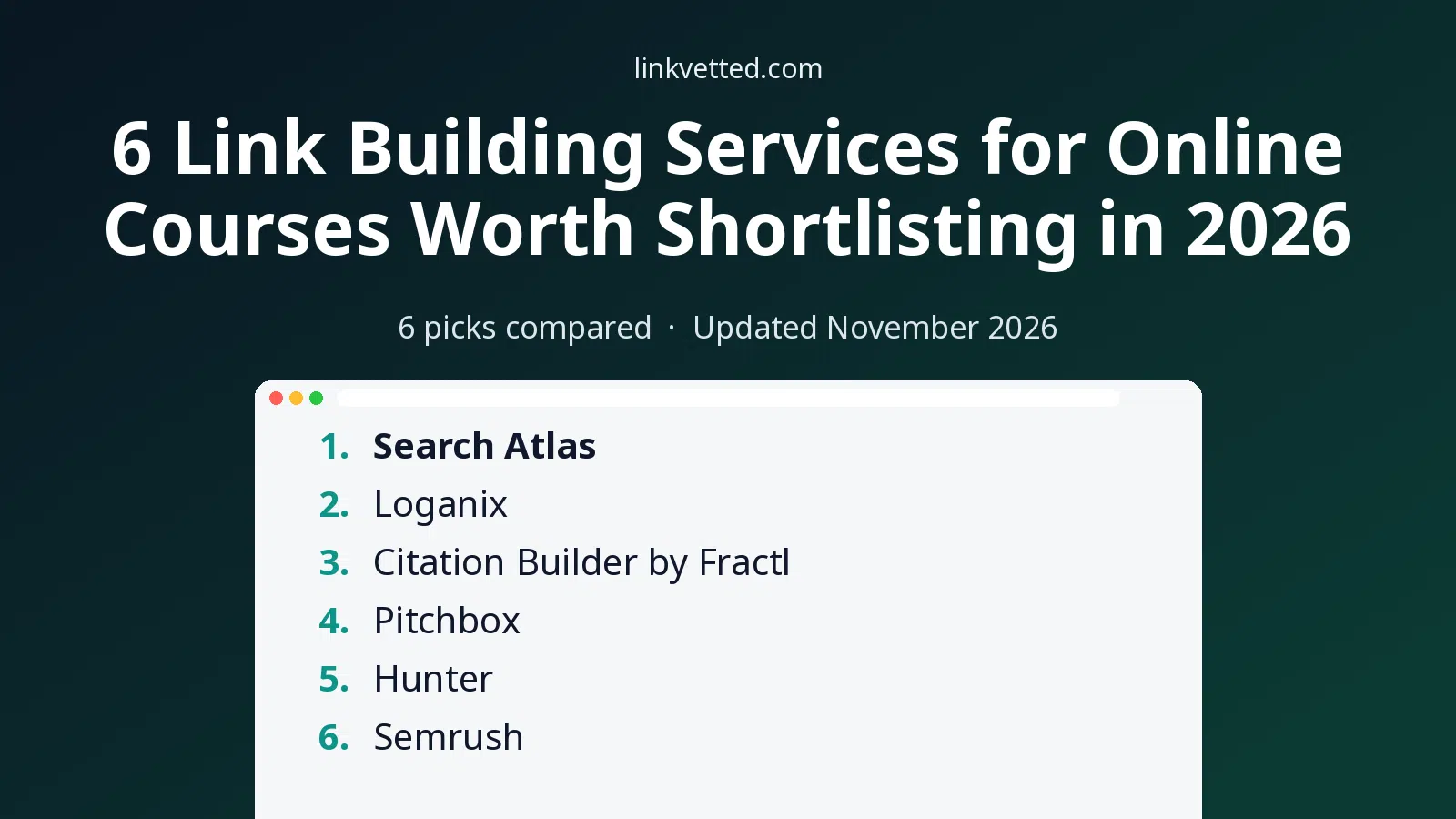
6 Link Building Services for Online Courses Worth Shortlisting in 2026
A practical guide to link building services for online course creators and edtech sites, compared from vendor documentation and public sources.
- Editor's choice
 Search Atlas
Prospecting and outreach in one platform
Starts atSee websiteVisit searchatlas.comFull review - Great alternative
 Loganix
Done-for-you link acquisition
Starts atSee websiteVisit loganix.comFull review - Also considerCitation Builder by Fractl
Digital PR with data and expert commentary
Starts atSee websiteVisit frac.tlFull review
Direct answer
My top pick for most online course businesses is Search Atlas, because it combines outreach data, prospecting and content tooling in one place, which suits teams that publish course pages and blog content regularly. For done-for-you outreach, Loganix fits teams that want to hand off link acquisition. For digital PR built around data and expert commentary, Citation Builder by Fractl is the better fit. I compared these from vendor documentation and public sources, not hands-on tests.
TL;DR:
- Course sites need links to individual course pages, category pages and instructor bios, so a service that can target specific URLs matters more than raw volume.
- Editorial links from education, career and industry publications carry more relevance for course pages than generic directory links.
- Services that combine prospecting data with outreach tracking save time for small teams that also produce course content.
- Done-for-you services reduce workload but give you less control over which pages get linked.
- Check whether a vendor supports link placement to deep pages, not just the homepage, before you commit.
Last checked November 2026. Plan prices are not quoted in this guide because they change often; see each vendor's own pricing page for current figures before you buy.
Quick comparison
| Tool | Best for | Starts at | Free plan? | |
|---|---|---|---|---|
| Search Atlas | Prospecting and outreach in one platform | See website | Free trial | Visit |
| Loganix | Done-for-you link acquisition | See website | Not stated | Visit |
| Citation Builder by Fractl | Digital PR with data and expert commentary | See website | Not stated | Visit |
 Pitchbox | Running your own outreach at scale | See website | Free trial | Visit |
 Hunter | Finding contact emails for prospects | See website | Free plan | Visit |
 Semrush | Link data alongside broader SEO work | See website | Free plan | Visit |
The best link building services for online courses compared
I put this comparison together from vendor documentation, public product pages and published material about each service. I did not run hands-on tests or buy links from these vendors, so treat this as a starting point for your own evaluation rather than a test report. The focus is on how each option fits course businesses that need links to course pages, instructor pages and educational content.
Search Atlas is an SEO platform that brings together keyword research, content tools, competitor analysis and outreach features. For an online course business, that means you can research which sites link to competing course providers, build prospect lists and manage outreach without stitching several subscriptions together. It suits small marketing teams that publish course landing pages and blog content and want one place to coordinate the work.
For link building specifically, the platform helps you find link prospects, organise outreach and track what you have sent. If your course catalogue changes often, having prospecting and content tools in the same account makes it easier to plan links for new course launches alongside the pages you already promote. The workflow is built around doing outreach yourself rather than buying placements.
The main limit is complexity. If you only want someone else to acquire links for you, a done-for-you service is simpler. Skip Search Atlas if you have no one to run campaigns and prefer a fully managed arrangement.
- Combines prospecting data with outreach tooling
- supports content planning alongside link work
- covers multiple SEO tasks in one account
- Many modules to learn
- pricing scales with usage
Loganix is a link building and SEO services company that offers managed link acquisition. You brief them on your site and the pages you want to support, and they handle prospecting and placement. For course businesses, this is useful when you have a catalogue of course pages to promote but no in-house outreach person, or when your team is busy with content and student support.
The practical benefit is time saved. You can point the service at specific course pages or category pages rather than only the homepage, which matters because course pages often need their own links to rank for specific topics. You still need to give a clear brief about the topics and page types you want links for.
The trade-off is control. You will not personally vet every site, so you rely on the vendor's process and your brief. Skip it if you want to hand-pick every placement or run outreach yourself.
- Managed link acquisition
- clear scope per order
- useful for teams without outreach capacity
- Less control over individual placements
- results depend on the brief you give
Citation Builder by Fractl
Best for: Digital PR with data and expert commentary
Fractl is a digital PR agency, and Citation Builder is its service for earning editorial mentions and links. The approach centres on original research, surveys and expert commentary that publications cite. For online course businesses, that can work well when you have data about skills, careers or learning outcomes that journalists and industry sites would reference.
This is not a quick link service. Campaigns take time to research, produce and pitch, and the output is coverage rather than a set number of links. It fits course providers with something original to say, such as survey data from students or employers, and a willingness to invest in content production alongside outreach.
The limits are pace and scope. If you need links to many course pages quickly, this is not the right tool. Skip it if you cannot commit to producing original data or commentary.
- Focus on editorial coverage
- campaigns built around original data
- suited to education and career topics
- Campaign-based rather than ongoing
- slower to produce results
Pitchbox is an outreach platform for managing prospecting, email sequences and follow-ups. It does not sell links. Instead, it gives you a system to run campaigns yourself. For an online course business, that means you can build lists of education bloggers, career sites and industry publications, then manage outreach to them from one dashboard.
The fit depends on whether you have someone to run outreach. If you do, Pitchbox helps keep campaigns organised and makes it easier to test different pitches. You still need to find prospects, write pitches and produce content worth linking to, such as course guides or original research.
Skip Pitchbox if you want a fully managed service. It is a tool for teams that will do the work themselves.
- Outreach workflow with prospect lists
- supports multiple campaigns
- helps track replies
- You supply prospects and content
- requires outreach skill
Hunter is an email finding tool. You enter a domain and it returns publicly available email addresses associated with it, which helps when you are building a prospect list for outreach. For course businesses, it is a practical companion to any outreach process: you identify sites that link to similar course providers, then use Hunter to find the right contact.
It is not a link building service on its own. It does not manage campaigns, track replies or guarantee that an email reaches the right person. Treat it as one step in a workflow that includes prospecting, pitching and content.
Skip Hunter if you expect a complete outreach system. It is best used alongside a platform like Pitchbox or as part of a manual process.
- Email discovery for outreach
- simple to use
- useful alongside any outreach process
- No outreach management
- data accuracy varies by domain
Semrush is an SEO platform with backlink analysis, keyword research, content tools and competitor tracking. For online course businesses, it helps you see which sites link to competing course providers and which pages attract links, so you can plan your own outreach targets. It also supports the content side, which matters because links usually follow useful pages.
The link building workflow in Semrush is about research and monitoring rather than outreach. You use the data to build prospect lists, then run outreach with another tool or a service. That makes it a good fit for teams that already use Semrush for other SEO work and want link data in the same place.
The limit is that it does not acquire links for you. Skip it if you want a managed service or a dedicated outreach platform.
- Backlink data for competitor research
- supports content and keyword planning
- widely used across SEO teams
- Link building is one part of a large suite
- outreach requires separate tools
How I chose
I selected these tools by looking at what each vendor documents publicly, what the product is designed to do and how that maps to the needs of online course businesses. I read product pages, help documentation and public descriptions of each service. I did not run hands-on tests, buy links or run campaigns with these vendors, so this is a comparison of stated capabilities and fit, not a test report.
The main criteria were whether a service can support links to deep pages such as course pages, whether it covers prospecting, outreach or both, and how much work it leaves with you. I also considered limits: some tools are platforms you operate yourself, while others are managed services. That distinction matters more than feature lists for small course teams, because the right choice depends on whether you have someone to run outreach or want to hand it off.
What to check before you buy
- Confirm the service can target individual course pages and category pages, not just your homepage.
- Ask how prospects are selected and whether you can review or approve sites before placement.
- Check whether the vendor covers education, career and professional training publications relevant to your courses.
- Ask what happens if a placement is removed later, and whether there is any replacement policy.
- Confirm what you need to supply, such as content, data or a brief, and whether that fits your team.
- Read the contract terms on minimum spend, campaign length and cancellation before you commit.
FAQ
What makes link building different for online course businesses?
Course businesses usually need links to several types of pages: individual course pages, category pages, instructor bios and blog content. That means a service should support deep-page targeting rather than only homepage links. Relevance also matters, so links from education, career and industry publications are usually more useful than generic directories.
Should I use a managed service or an outreach tool?
It depends on whether you have someone to run outreach. A managed service like Loganix handles prospecting and placement for you, which saves time but gives you less control. An outreach platform like Pitchbox gives you control but requires you to find prospects, write pitches and produce content. Many teams use a mix of both.
Can I build links to course pages myself?
Yes, if you have time to prospect, pitch and produce content worth linking to. Tools like Hunter and Pitchbox support that workflow, and Semrush helps with research. The main cost is your time, and results depend on the quality of your outreach and content rather than the tool alone.
How long does link building take for a course site?
Timing varies by approach. Outreach campaigns can take weeks to produce placements, and digital PR campaigns often take longer because they involve original research and pitching. Managed services may move faster depending on scope. Plan for an ongoing effort rather than a one-off project, and track progress against your own pages.
Are paid links a good idea for course businesses?
Buying links that pass ranking signals can conflict with search engine guidelines, so I would not recommend it. Editorial links earned through outreach, useful content and digital PR are the safer route. If a vendor's process is unclear, ask how placements are obtained before you buy.
Sources
- https://searchatlas.com
- https://loganix.com
- https://www.frac.tl
- https://pitchbox.com
- https://hunter.io
- https://www.semrush.com