Link Building Services for Mobile Apps in 2026: The 6 Best Options Side by Side
A practical comparison of link building services for mobile apps, covering outreach, digital PR and content-led options, with vendor facts and buying checks.
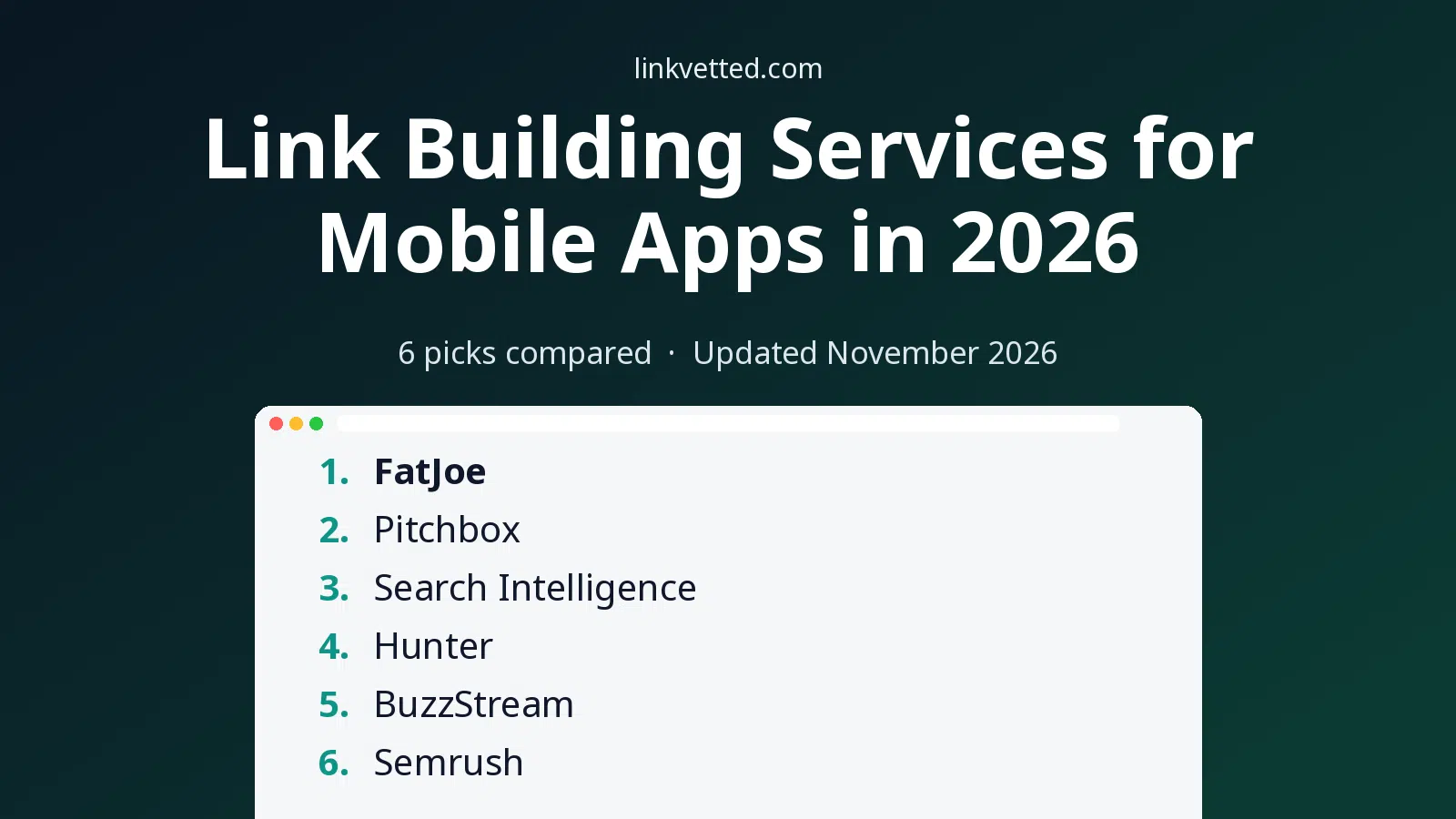
- Editor's choice
 FatJoe
Done-for-you link building
Starts atSee websiteVisit fatjoe.comFull review - Great alternative
 Pitchbox
Running your own outreach
Starts atSee websiteVisit pitchbox.comFull review - Also considerSearch Intelligence
Content-led digital PR
Starts atSee websiteVisit search-intelligence.co.ukFull review
Direct answer
My first pick is FatJoe, because it is a link building agency that publishes its service lines and order process openly, which makes it easier to judge fit for an app campaign. For teams that want to run outreach themselves, Pitchbox is the other strong option, and for content-led placements I would look at Search Intelligence. Each fits a different budget and level of involvement.
TL;DR:
- Mobile app link building usually needs different targets than a standard website campaign, because app store pages and product pages attract different publishers.
- Agency services suit teams that want outreach handled for them, while software suits teams that will run their own campaigns.
- Ask any vendor how they handle app landing pages, since some publishers will not link to store URLs.
- Digital PR and editorial placements tend to produce links that read naturally next to app coverage.
- Check the vendor's published process and sample placements before you commit to a retainer.
Last checked November 2026. Plan prices are not quoted in this guide because they change often; see each vendor's own pricing page for current figures before you buy.
Quick comparison
| Tool | Best for | Starts at | Free plan? | |
|---|---|---|---|---|
| FatJoe | Done-for-you link building | See website | Not stated | Visit |
| Pitchbox | Running your own outreach | See website | Not stated | Visit |
| Search Intelligence | Content-led digital PR | See website | Not stated | Visit |
 Hunter | Finding publisher contacts | See website | Free plan | Visit |
 BuzzStream | Managing outreach relationships | See website | Free trial | Visit |
 Semrush | Research inside an SEO suite | See website | Free plan | Visit |
The best link building services for mobile apps compared
I compared these options using vendor documentation and public sources, not hands-on tests. I looked at what each vendor says it does, how its process is described, and where the limits sit for an app-focused campaign. That means the notes below reflect published information rather than my own trial results, and you should confirm current details with each vendor.
FatJoe is a link building agency that describes its services on its own site, including blogger outreach and niche edits. For an app team without an in-house outreach person, that means the vendor handles prospecting and placement. It fits teams that want a managed service and are comfortable with a recurring spend rather than a one-off purchase.
For mobile apps, the useful part is that the agency can target publishers in categories that cover apps, such as technology and lifestyle blogs, depending on what you ask for. You would brief them on your app category and the pages you want linked, then review proposed placements. The workflow is a brief, a proposal, and a placement report.
The limit is that you are buying a service, so you need to check the publisher list against your app's niche before approving. Teams that want to control every email should skip it and use outreach software instead.
- Published service lines and order process
- Blog outreach and niche edit options
- Clear contact and support channels
- Retainer-based model
- Publisher mix varies by niche
Pitchbox is outreach software for finding prospects, managing campaigns and tracking replies. It suits an app marketing team that has someone to run outreach and wants to own the publisher relationships. It is not a service that places links for you, so the results depend on the lists and pitches your team builds.
For app campaigns, the practical use is building lists of publishers that cover your app category, then running sequenced outreach from one place. You can track which publishers replied and which placements went live. That record is useful when you report on link building alongside app install campaigns.
The limit is the operator requirement. If nobody on your team can write pitches and manage replies, the software will sit unused. Smaller app teams should look at a managed agency first.
- Built for outreach campaign management
- Supports prospecting and follow-ups
- Works with your own publisher lists
- Requires an operator to run it
- Not a placement service
Search Intelligence
Best for: Content-led digital PR
Search Intelligence is a digital PR and content-led link building service. It fits apps that have a story to tell, such as a product launch, a data angle or a category insight, because those are the hooks publishers respond to. The service is built around earning coverage rather than buying placements.
For mobile apps, this matters because app coverage often comes from technology, business and lifestyle publishers that want a reason to write. A content-led approach gives them that reason. You would work with the vendor on angles, then review the coverage that results.
The limit is that it depends on having something worth pitching. Apps with no news hook or data story may find the fit weaker. Check what the vendor needs from you before signing.
- Focus on editorial and content placements
- Digital PR angle suits product stories
- Useful for building publisher relationships
- Service-led, so scope varies
- Needs a story worth pitching
Hunter is an email finding tool. You give it a domain and it helps you find contact addresses for people at that publisher, which is the first step in any outreach campaign. It fits app teams that already have a target publisher list and need contacts to pitch.
In an app link building workflow, Hunter sits before the pitch. You build a list of publishers that cover your category, find the right editor's address, and then send your pitch from your own email or an outreach tool. It is a small but practical part of the process.
The limit is that it does not manage campaigns or place links. It is a contact-finding utility, so pair it with outreach software or an agency. Teams expecting a full service will be disappointed.
- Email finding for outreach lists
- Works alongside any outreach tool
- Simple to start
- No outreach management
- Contact data needs checking
BuzzStream is outreach and relationship management software for link building and digital PR. It fits app teams that contact the same publishers repeatedly and want a record of those conversations. The relationship angle is useful when you are building long-term coverage in your app category.
For mobile apps, you can track which publishers covered your launch, which editors replied, and which placements went live. That history helps when you pitch the next app update or feature. It keeps outreach organised rather than scattered across inboxes.
The limit is the setup and learning curve. You need to import lists and configure workflows before it pays off. Very small teams may find a spreadsheet enough at first.
- Contact and relationship tracking
- Outreach workflow support
- Useful for repeat publisher contact
- Setup takes time
- Not a placement service
Semrush is an SEO platform with backlink analysis and link building support features. It fits app teams that already use SEO tools and want research in the same place as their other work. You can study which publishers link to competing apps and use that as a starting list.
For app link building, the useful step is competitor backlink research. You look at sites linking to similar apps, then decide which are worth pitching. That list feeds into outreach software or an agency brief. It is research, not placement.
The limit is that link building is one part of a bigger subscription. If all you need is outreach, a dedicated tool is leaner. Check the current plan details on the vendor site.
- Backlink and competitor research
- Outreach support features
- Broad SEO toolkit
- Link building is one module
- Larger subscription than some need
How I chose
I built this list from vendor documentation and public sources. For each option I checked what the vendor says it does, whether it is a service or software, and how the workflow is described on its own site. I did not run hands-on tests, so I am not claiming first-hand results. The aim is to help you shortlist options that match how much of the work you want to do yourself.
The second filter was fit for app campaigns. Some link building services are built around website pages, so I noted where an app team would need to brief the vendor on app landing pages and publisher categories. I also flagged the main limit for each option, because the drawback usually decides whether a tool or service suits a small app team. Prices and plan details change, so confirm them with each vendor before you buy.
What to check before you buy
- Ask whether the vendor will link to your app store page, a product page or a landing page, and which publishers accept each.
- Request sample placements in your app category, not just a general list of sites.
- Confirm whether the service is managed or self-serve, since that decides how much work lands on your team.
- Check how the vendor reports placements, including whether you get a list of live URLs to review.
- Ask about publisher vetting, so you know what kinds of sites are excluded.
- Confirm the contract length and what happens if a placement is removed.
FAQ
What is link building for mobile apps?
It is the work of earning links from other websites to pages connected to your app, such as a product page, a landing page or an app store listing. Those links can help the pages rank and can send referral traffic. The targets are usually publishers in your app's category, such as technology, business or lifestyle sites.
Should I link to the app store or my website?
It depends on the publisher and your goal. Some publishers will link to an app store page, while others prefer a website page. Many app teams use a landing page on their own site and point links there, because it gives them more control over the content and tracking. Ask each vendor how they handle this.
Is an agency better than outreach software?
An agency suits teams with no one to run outreach, because the vendor handles prospecting and placement. Software suits teams with an operator who can build lists and send pitches. The cost model differs too, so compare the total spend against the hours your team would need.
How long does an app link building campaign take?
It depends on the vendor and the publisher response rate. Outreach campaigns usually run in cycles, with prospecting, pitching, follow-ups and placement review. Ask each vendor for its typical timeline and how it reports progress, then set your expectations from that rather than from a general figure.
Can I build app links without a service?
Yes. You can build a publisher list, find contacts with a tool like Hunter, and run pitches from your own email. It takes time and organisation, and the results depend on your pitch quality. Many small teams start this way and move to a service once outreach becomes a regular workload.
Sources
- https://fatjoe.com
- https://pitchbox.com
- https://search-intelligence.co.uk
- https://hunter.io
- https://www.buzzstream.com
- https://www.semrush.com