Link Building Services for IT Companies in 2026: The 6 Best Options Side by Side
A practical guide to the best link building services for IT companies in 2026, compared from vendor documentation and public sources.
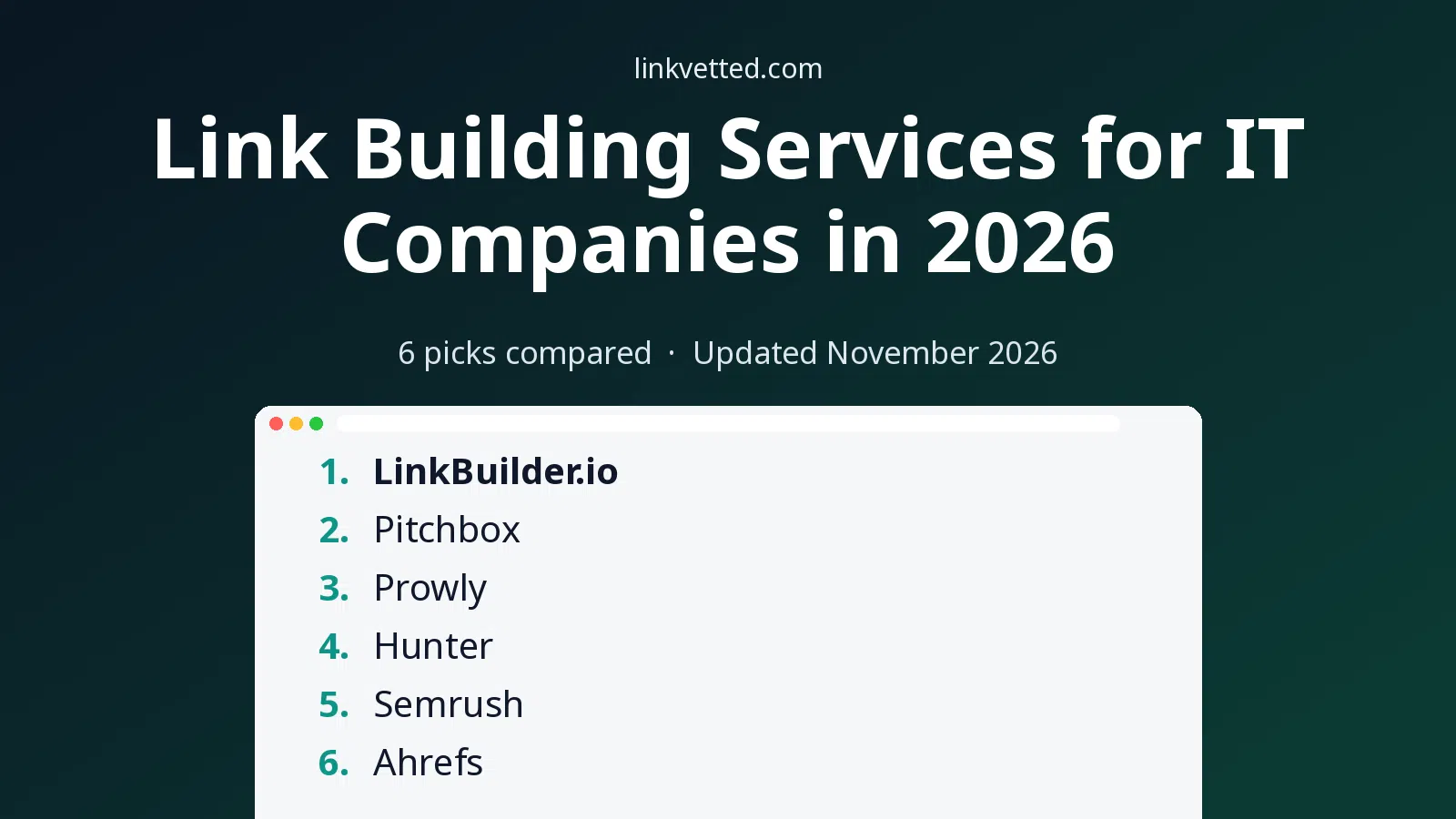
- Editor's choiceLinkBuilder.io
Managed link building for B2B tech
Starts atSee websiteVisit linkbuilder.ioFull review - Great alternative
 Pitchbox
In-house outreach at scale
Starts atSee websiteVisit pitchbox.comFull review - Also consider
 Prowly
Digital PR and media relationships
Starts atSee websiteVisit prowly.comFull review
Direct answer
My top pick is LinkBuilder.io for IT companies that want a done-for-you link building service with a clear editorial process. For teams that prefer to run outreach themselves with better data, Pitchbox is the stronger fit, and for digital PR-led placements that earn links through stories, Prowly works well. Each one suits a different stage and budget, so match the service to how much control you want over outreach.
TL;DR:
- IT companies usually need links from technology, SaaS, and business publications rather than generic guest post farms.
- Done-for-you services save time but give you less control over which sites you appear on.
- Outreach platforms cost less per link but require someone on your team to run campaigns.
- Digital PR works best when you have data, research, or product news worth writing about.
- Always ask for example placements and check that each linking site is relevant to your niche.
Last checked November 2026. Plan prices are not quoted in this guide because they change often; see each vendor's own pricing page for current figures before you buy.
Quick comparison
| Tool | Best for | Starts at | Free plan? | |
|---|---|---|---|---|
| LinkBuilder.io | Managed link building for B2B tech | See website | Not stated | Visit |
| Pitchbox | In-house outreach at scale | See website | Not stated | Visit |
| Prowly | Digital PR and media relationships | See website | Free trial | Visit |
 Hunter | Finding contact emails for outreach | See website | Free plan | Visit |
 Semrush | Link research and competitor analysis | See website | Free plan | Visit |
 Ahrefs | Backlink prospecting and analysis | See website | Not stated | Visit |
The best link building services for IT companies compared
I compared these services from vendor documentation and public sources, including each company's own product pages and published feature lists. I did not run hands-on tests or buy links through any of them, so treat this as a starting point for your own evaluation rather than a test report.
LinkBuilder.io
Best for: Managed link building for B2B tech
LinkBuilder.io is a link building agency that runs outreach campaigns on your behalf and places links on editorial sites. It fits IT companies that have no in-house outreach capacity and want a partner to handle prospecting, pitching, and placement. The service is aimed at B2B and SaaS brands, which lines up with the kinds of sites an IT company wants links from.
In practice, you brief the team on your target topics and the pages you want to promote, and they handle the rest of the workflow. That includes finding prospects, sending pitches, and reporting on placements. For an IT company with a small marketing team, this removes the daily work of managing an outreach inbox and lets you focus on content and product.
The main limit is control. You are trusting the agency's judgment on which sites are a good fit, so ask for sample placements and a list of the site types they target before you commit. Skip it if you want to approve every prospect yourself or if your budget only covers a short trial.
- Done-for-you outreach and placement
- focuses on editorial links
- suits B2B and SaaS niches
- Less control over individual sites
- requires a minimum commitment
Pitchbox is an outreach platform rather than a link building service. You use it to find prospects, manage contact lists, send personalised pitches, and track follow-ups. It suits IT companies that have someone who can run outreach consistently and want to keep full control over which sites they approach.
The workflow is built around campaigns. You import or build a prospect list, connect your email account, and send sequences with follow-ups. For link building, that means you can pitch guest posts, resource pages, or expert quotes to technology and business publications on your own terms. Because you own the list, you can keep the relationships going after the campaign ends.
The main limit is that Pitchbox gives you tools, not links. If nobody on your team has time to write pitches and manage replies, the software will not help. It is also more than a small team needs if you only want a handful of links per month.
- Built for outreach campaigns
- prospect management and follow-ups
- works with your own site list
- Needs an operator to run it
- no placements included
Prowly is a PR platform with a media database, pitch tools, and press release distribution. For IT companies, its value for link building comes through digital PR: getting your research, product launches, or expert commentary covered by journalists, which often produces editorial links as a side effect.
The workflow centres on finding relevant journalists and outlets, sending targeted pitches, and tracking coverage. If your IT company publishes original data, survey results, or strong technical commentary, this is a natural way to earn links from publications that would ignore a generic guest post pitch. The links tend to be higher quality because they come from editorial decisions rather than paid placements.
The limit is that Prowly is not a link building service and does not guarantee links. It also works best when you have something newsworthy to say. Skip it if you have no PR angle and just want placements on technology blogs.
- Media database and pitch tools
- press release publishing
- contact management
- Aimed at PR rather than SEO
- needs a story worth pitching
Hunter is an email finding tool. You enter a company domain and it returns likely email addresses for people who work there, along with verification to reduce bounces. For IT companies running their own link building, it fills a specific gap: finding the right editor or marketing contact at a target publication.
In a link building workflow, Hunter sits at the prospecting stage. You identify sites you want links from, then use Hunter to find a contact, and then pitch them through your own email tool or an outreach platform. It is cheap to start with and easy to learn, which makes it a reasonable first tool for a small IT marketing team.
It does not send emails, manage campaigns, or place links. It is also not a substitute for a proper prospect list, because finding an email does not tell you whether the site is a good fit. Treat it as one small part of the process.
- Email discovery from company domains
- verification tools
- simple to use
- No outreach or placement features
- data quality varies by domain
Semrush is an SEO platform with a backlink analytics module. For IT companies, the useful part is seeing which sites link to competitors and using that as a prospect list for your own outreach. You can also monitor new and lost links to your own site over time.
The workflow for link building starts with the backlink gap report: you enter your domain and a few competitors, and the tool shows sites that link to them but not to you. From there you can filter by relevance and authority signals, then pass the list to whoever runs outreach. It also helps you audit existing links and spot anything that looks off.
The limit is that Semrush gives you data, not links. It is also a broad platform, so you pay for many features you may not use if link building is your only goal. Skip it if you already have a backlink tool you like.
- Backlink analytics
- competitor link gap analysis
- broad SEO toolkit
- Link building is one feature among many
- no outreach service
Ahrefs is another SEO platform with a well-known backlink index. IT companies use it to find linking opportunities by studying competitor backlinks, checking which pages attract links, and filtering prospects by topic and link type. It is a research tool first and foremost.
For link building, the practical workflow is similar to Semrush: run a competitor backlink report, filter for relevant technology and business sites, and build a prospect list. Ahrefs also shows you which pages on a competitor's site earn the most links, which can inform your own content plan. That makes it useful for planning linkable assets, not just for outreach lists.
The limits are the same as any research tool: no outreach, no placements, and a cost that only makes sense if you use the wider platform. Beginners may also find the interface dense at first.
- Large backlink index
- strong filtering options
- useful competitor reports
- No outreach or placement service
- learning curve for beginners
How I chose
I built this list from vendor documentation and public sources. That means I read each company's own product pages, feature descriptions, and published help content to understand what the service actually does, then matched those capabilities to the needs of IT companies. I did not run hands-on tests, buy links, or track results for any client through these services.
The main criteria were relevance to B2B and technology niches, whether the tool or service covers prospecting, outreach, or placement, and how much control it gives the buyer. I also looked at limits: whether a service requires a minimum commitment, whether a tool needs an in-house operator, and whether the product is a full platform or a single feature. Where I was unsure about a detail such as free plan availability, I left it as not stated rather than guess.
What to check before you buy
- Ask for example placements and confirm the linking sites are relevant to technology, SaaS, or business audiences.
- Check whether the service handles prospecting, outreach, and placement, or only one part of the process.
- Confirm who approves the final list of sites and whether you can reject placements you do not want.
- Ask how they handle link removals and whether there is any guarantee or replacement policy.
- Check the reporting: you want to see live links, anchor text, and the page each link points to.
- Make sure the contract length and cancellation terms fit your budget and testing plans.
FAQ
Are paid link building services safe for IT companies?
Paid services are common, but the risk depends on how links are acquired. Editorial placements on relevant sites are lower risk than bulk links from unrelated directories. Ask any vendor how they source placements, and avoid anyone who cannot name the sites they target or who promises a set number of links from vague sources.
Should an IT company use an agency or run outreach in-house?
It depends on capacity. An agency suits teams with no one to run outreach, while an in-house setup with a tool like Pitchbox gives more control and usually costs less per link. Many IT companies start in-house to learn what works, then move to a managed service once volume grows.
How many links does an IT company need each month?
There is no fixed number. A small number of relevant, editorial links per month is often more useful than a large volume of low-quality ones. The right pace depends on your content output and how competitive your niche is, so set a target based on competitor link growth rather than a generic figure.
Can digital PR replace traditional link building?
It can cover much of it. Digital PR earns links through stories, data, and expert commentary, which often produces more relevant coverage than guest posting. It works best alongside other methods, because not every IT company has news to pitch every month.
What should I avoid when buying link building services?
Avoid anyone who sells links by volume without naming sites, guarantees rankings, or uses private blog networks. Also be wary of services that will not share sample placements or that push unrelated niches. Check that the sites they target are indexed and have real editorial content.
Sources
- https://linkbuilder.io
- https://pitchbox.com
- https://prowly.com
- https://hunter.io
- https://semrush.com
- https://ahrefs.com