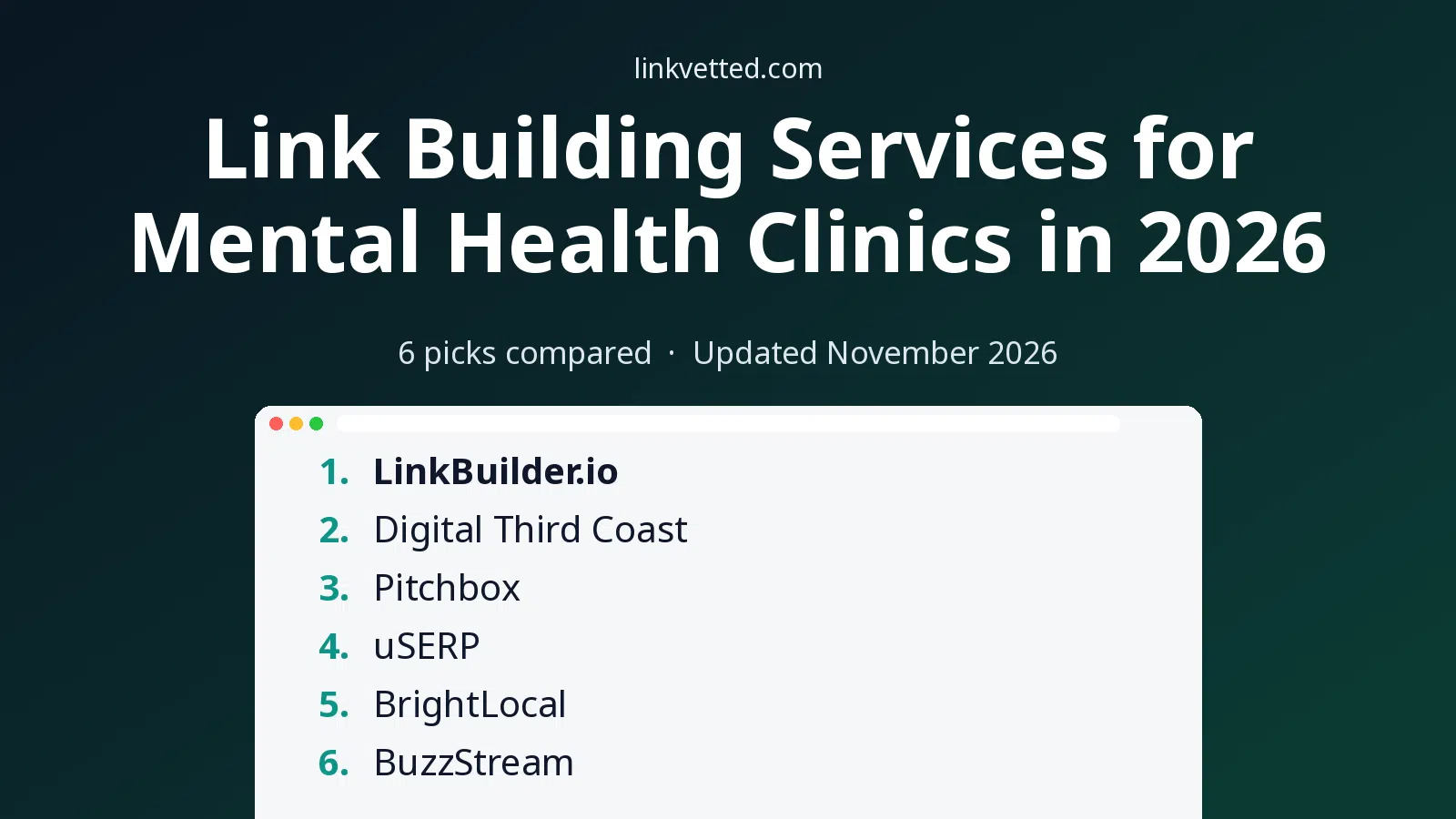
Link Building Services for Mental Health Clinics in 2026: The 6 Best Options Side by Side
A practical guide to the best link building services for mental health clinics in 2026, compared from vendor documentation and public sources.
- Editor's choiceLinkBuilder.io
Clinics that want to approve placements
Starts atSee websiteVisit linkbuilder.ioFull review - Great alternativeDigital Third Coast
Clinics wanting digital PR campaigns
Starts atSee websiteVisit digitalthirdcoast.comFull review - Also consider
 Pitchbox
In-house teams running their own outreach
Starts atSee websiteVisit pitchbox.comFull review
Direct answer
My top pick is LinkBuilder.io, a link building agency that works from curated publisher lists and lets you approve each placement, which suits clinics that need careful control over where their name appears. For clinics that want digital PR and editorial mentions, I suggest Digital Third Coast. For clinics that prefer a self-serve outreach platform they run themselves, Pitchbox is the option I point to. Each fits a different budget and level of involvement.
TL;DR:
- Mental health clinics need links from health, wellness and local publishers, so placement quality matters more than volume.
- Editorial and digital PR services usually fit clinics better than bulk link packages because you can review each site.
- Self-serve outreach software only works if someone on your team can run campaigns and write pitches.
- Local citations and directory listings support clinic visibility but are not a substitute for editorial links.
- Ask every vendor how they handle sensitive health topics and whether you approve placements before they go live.
Last checked November 2026. Plan prices are not quoted in this guide because they change often; see each vendor's own pricing page for current figures before you buy.
Quick comparison
| Tool | Best for | Starts at | Free plan? | |
|---|---|---|---|---|
| LinkBuilder.io | Clinics that want to approve placements | See website | Not stated | Visit |
| Digital Third Coast | Clinics wanting digital PR campaigns | See website | Not stated | Visit |
| Pitchbox | In-house teams running their own outreach | See website | Not stated | Visit |
 uSERP | Clinics outsourcing outreach entirely | See website | Not stated | Visit |
 BrightLocal | Local citations and clinic listings | See website | Free trial | Visit |
 BuzzStream | Small teams doing their own outreach | See website | Free trial | Visit |
The best link building services for mental health clinics compared
I put this comparison together from vendor documentation and public sources, and I did not run hands-on tests of these services. I looked at what each vendor says it does, how placements are handled, and where each one fits a clinic that needs careful, health-appropriate links.
LinkBuilder.io
Best for: Clinics that want to approve placements
LinkBuilder.io is a link building agency that runs outreach on your behalf and gives you a list of publishers to review before anything goes live. That model fits a mental health clinic because you can decline a site that feels off-topic or low quality. It is aimed at businesses that want editorial links but do not have an in-house outreach team.
For a clinic, the useful part is the review step. You can check that a publisher covers health, wellness or local community topics before you accept a link. The vendor handles prospecting and pitching, so your team is not writing cold emails. You still need to read each placement and confirm the page makes sense for your practice.
The limit is that approval takes your time, and the service is not built for local directory listings. Clinics that want citations handled in the same place should look at a local SEO tool instead.
- Curated publisher lists
- placement approval before publishing
- outreach handled by the vendor
- You still spend time reviewing placements
- not a local citation tool
Digital Third Coast
Best for: Clinics wanting digital PR campaigns
Digital Third Coast is a digital marketing agency that runs content and digital PR campaigns. Its work is built around earning editorial mentions rather than buying links in bulk. That approach suits a clinic that wants coverage in health, lifestyle or local news outlets, where a mention carries more weight than a directory listing.
The workflow is campaign-based: the agency develops content or a story angle, then pitches it to publishers. For a clinic, this can mean coverage around topics like access to care or community mental health. You get editorial links as a byproduct of the coverage, and the agency manages the pitching.
The limit is that this is an agency relationship, not a tool you log into and run yourself. Clinics with a very small budget may find a campaign model hard to justify, and results depend on the story angles the agency can develop.
- Digital PR and content focus
- editorial-style outreach
- works on campaigns rather than bulk links
- Agency engagement rather than self-serve
- timelines depend on campaign work
Pitchbox is outreach software for teams that want to find prospects, manage contacts and send pitches from one place. It is not an agency, so it does not place links for you. It fits a clinic with a marketer or agency partner who can run outreach campaigns and keep them organized.
For link building, the tool helps you build prospect lists, track who you contacted and follow up. A clinic could use it to reach local health blogs, community organizations and journalists. The software handles the logistics, but the pitch quality and the choice of publishers are still on you.
The limit is that it requires real outreach work. If nobody on your team can write pitches and manage replies, the software will not produce links on its own. Small clinics without marketing staff should skip it.
- Outreach workflow in one place
- prospect management
- campaign tracking
- You write and send the pitches
- needs someone to run it
uSERP is a link building service that runs outreach for clients and places links on publishers it selects. It is aimed at companies that want to outsource the work rather than run campaigns in-house. For a clinic, that means handing over prospecting and pitching to a vendor.
The service describes a vetting process for publishers, which matters when your site covers mental health. You want links from sites that are relevant and credible, not random general blogs. The vendor manages the outreach and reports on placements, so your team is not sending emails.
The limit is that you have less say over each individual publisher than with an approval-based service. Clinics that want to review every site before a link goes live should ask about that step before signing up.
- Managed outreach service
- publisher vetting described in its process
- handles prospecting and placement
- Less control over individual publishers
- agency-style engagement
BrightLocal is a local SEO platform built around citations, listings and local rank tracking. It is not an editorial link building service, but it belongs in this list because local citations are part of how clinics show up in local search. A clinic with several locations can use it to keep name, address and phone details consistent.
The workflow is straightforward: you audit existing listings, build new citations and track how your local profiles perform. For a mental health clinic, consistent listings help people find the right location and contact details. The links from citations are not the same as editorial coverage, but they support local visibility.
The limit is that BrightLocal will not earn you mentions in health publications or news outlets. Clinics that only use citation tools and skip editorial outreach will have a thin link profile.
- Citation building and audit
- local listing management
- review and local rank tracking
- Not an editorial link service
- citation links carry less weight
BuzzStream is outreach and relationship management software for small teams. It helps you keep track of prospects, contacts and conversations so outreach does not fall through the cracks. It fits a clinic with one marketer who can run a modest outreach program.
For link building, you would use it to build a list of local health writers, community sites and journalists, then track your pitches and follow-ups. The tool keeps the history in one place, which matters when outreach is a side task rather than a full-time job.
The limit is the setup and the writing. BuzzStream organizes outreach but does not find publishers for you or write pitches. Clinics without anyone to run campaigns should look at a managed service instead.
- Contact and prospect management
- outreach tracking
- works for small teams
- Setup takes time
- you still write every pitch
How I chose
I compared these services from vendor documentation and public sources, not from hands-on tests. I read what each vendor says about its process, how placements are handled, whether clients approve publishers, and what kind of team the service is built for. I also weighed how each model fits a mental health clinic, where the topic is sensitive and placement quality matters more than the number of links.
I left out bulk link packages and anything that promises rankings, because those models are a poor fit for a clinic's reputation. I also did not include tools I could not verify as currently operating. The list mixes managed services, digital PR, outreach software and local citation tools so you can match the option to how much work your team can take on. Where a vendor's public documentation was thin, I said so rather than filling the gap.
What to check before you buy
- Ask whether you approve each publisher before a link goes live, and get that in writing.
- Confirm the vendor understands health content and will not place your clinic on unrelated general blogs.
- Check whether the service covers local citations as well as editorial links, or whether you need a second tool.
- Ask how they handle sensitive topics like therapy, addiction or crisis care in pitches and placements.
- Request sample placements from similar clients, and check the publishers yourself.
- Clarify who writes the pitches and who owns the outreach records if you leave.
FAQ
Do mental health clinics need link building?
Links help a clinic's pages rank and help people find the practice through search. Editorial mentions in health and local publications also build trust with prospective clients. It is not the only factor, but a clinic with no links beyond directories will struggle to compete for search terms that matter.
Are paid links a good idea for a clinic?
Buying links that pass ranking signals violates search engine guidelines and puts your site at risk. Services that place links through outreach and editorial mentions are a different model. Ask any vendor to explain how placements are earned and whether publishers disclose sponsored content.
How long does link building take for a clinic?
Outreach and editorial placements usually take months to show up, and there is no fixed timeline. Campaign-based digital PR can take longer because it depends on story angles and publisher interest. Anyone promising fast results should be treated with caution.
Can I do link building myself?
Yes, if someone on your team can write pitches and follow up. Outreach software like Pitchbox or BuzzStream helps you stay organized. The trade-off is time: prospecting, writing and follow-up take hours each week, which is why many clinics use a managed service.
What should a clinic avoid in link building?
Avoid bulk link packages, private blog networks and any vendor that promises rankings or a set number of links without showing you the publishers. For a clinic, a link from an unrelated or low-quality site can do more harm to your reputation than having fewer links.
Sources
- https://linkbuilder.io
- https://www.digitalthirdcoast.com
- https://pitchbox.com
- https://userp.io
- https://www.brightlocal.com
- https://www.buzzstream.com