6 Best Link Building Services for Fitness Brands for 2026, Vetted and Compared
A practical guide to the best link building services for fitness brands in 2026, compared from vendor documentation and public sources.
- Editor's choice
 FATJOE
Fitness blogger and editorial outreach
Starts atSee websiteVisit fatjoe.comFull review - Great alternative
 Siege Media
Content-led digital PR campaigns
Starts atSee websiteVisit siegemedia.comFull review - Also consider
 Loganix
Managed link building and citations
Starts atSee websiteVisit loganix.comFull review
Direct answer
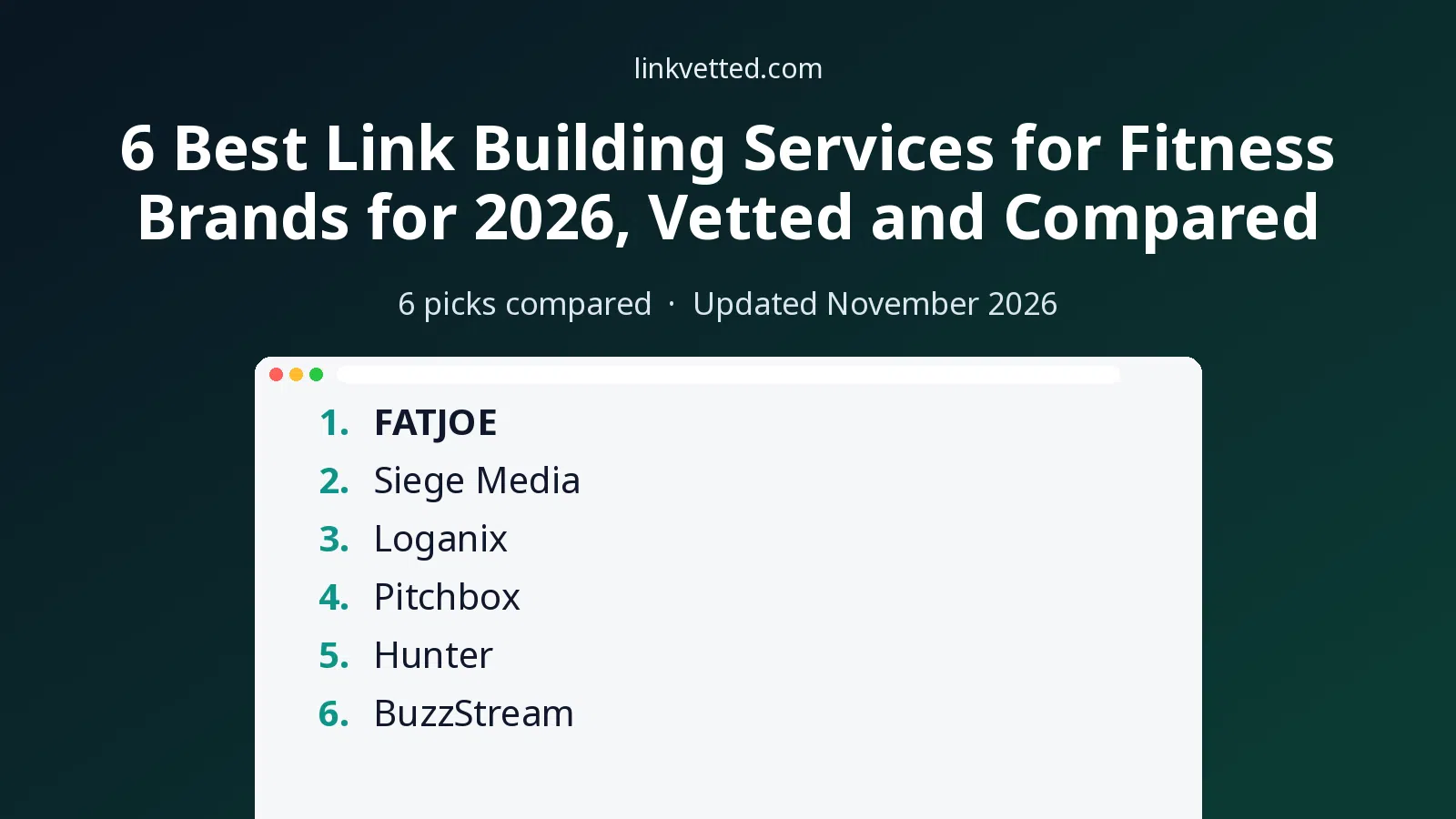
My top pick for most fitness brands is FATJOE, because it is built around blogger outreach and editorial placements that suit gyms, coaches and supplement shops. For teams that want a managed service with a clear scope, I point to Siege Media or Loganix. For brands that prefer to run outreach from their own inbox, Pitchbox and Hunter are the tools I recommend. I compared these from vendor documentation and public sources, not hands-on tests.
TL;DR:
- Fitness is a niche where editorial links from health, training and lifestyle sites carry more weight than generic directory links.
- A managed service suits brands without an in-house outreach team, while software suits brands that want control over every email.
- Check whether the vendor publishes sample placements and accepts fitness or supplement clients before you commit.
- Ask how links are sourced, whether placements are permanent, and what happens if a link is removed.
- Budget for content as well as links, because most fitness placements need a guide, review or expert quote to earn the link.
Last checked November 2026. Plan prices are not quoted in this guide because they change often; see each vendor's own pricing page for current figures before you buy.
Quick comparison
| Tool | Best for | Starts at | Free plan? | |
|---|---|---|---|---|
| FATJOE | Fitness blogger and editorial outreach | See website | Not stated | Visit |
| Siege Media | Content-led digital PR campaigns | See website | No free plan | Visit |
| Loganix | Managed link building and citations | See website | Not stated | Visit |
 Pitchbox | Running your own outreach campaigns | See website | Not stated | Visit |
 Hunter | Finding contact emails for outreach | See website | Free plan | Visit |
 BuzzStream | Managing blogger and publisher relationships | See website | Free trial | Visit |
The best link building services for fitness brands compared
I put this list together from vendor documentation, public pages and what each service says about its own process. I did not run hands-on tests, and I have not measured results for any client. The aim is to help you shortlist services that fit a fitness brand, whether you run a gym, a coaching business or a supplement store.
FATJOE is a link building and blogger outreach service that places links through its network of publishers. For a fitness brand, the appeal is that it works with lifestyle, health and general interest blogs rather than only business directories. It fits gyms, personal trainers and small ecommerce brands that want editorial placements without building an outreach team.
In practice, you pick a category and describe your site, then the service handles prospecting and placement. For fitness topics, that means you can ask for health, training or wellness blogs where a product review or a training guide would make sense. The workflow is closer to ordering than to a custom campaign, which keeps it simple for small teams.
The limit is control. You see less of the individual site list up front than you would with a custom agency, and the service is not a substitute for a content strategy. Skip it if you need named placements approved one by one or a full editorial program.
- Outreach-focused placement model
- Categories that cover health and lifestyle
- Simple ordering process
- Limited detail on individual sites before ordering
- Not a full content agency
Siege Media is a content marketing and digital PR agency that builds links through original content and outreach. Fitness brands with a story to tell, such as a training method, a nutrition angle or a product category, can use that content as the hook for placements. It fits established brands that can commit to a content program rather than one-off links.
The agency approach means you get strategy, content production and outreach in one engagement. For fitness, that could be a data-led piece on training habits or a practical guide that health and lifestyle publications can reference. The link building is tied to the content, so the value depends on how well the content fits your niche.
The drawback is scale. This is not a quick, low-cost link order, and smaller brands may find the scope larger than they need. Skip it if you want a small batch of links with no content work attached.
- Content and link building under one roof
- Digital PR focus
- Clear process documentation
- Minimum engagement likely suits larger budgets
- Less suited to very small brands
Loganix offers managed link building, local citations and related SEO services through productised packages. For a fitness business with a physical location, such as a gym or studio, the citation work can sit alongside link building. It suits owners who want to hand off the task and get a defined deliverable.
For fitness brands, the useful part is the ability to order specific link types without a long agency onboarding. You can combine local listings with editorial links, which helps a studio rank for local searches while also building authority. The process is documented on the site, so you know what you are ordering.
The trade-off is customisation. Packages are standardised, so you have less say over the exact sites than with a bespoke campaign. Skip it if you need a highly tailored digital PR plan or named placements for a premium brand.
- Productised link packages
- Also handles local citations
- Clear order flow
- Less bespoke strategy
- Placement quality varies by package
Pitchbox is outreach software for finding prospects, managing campaigns and sending sequences. It is not a link building service in itself, but it gives a fitness brand the workflow to run its own campaigns. It fits teams that already know which sites they want and want to manage the process in one place.
For fitness, you might build lists of training blogs, nutrition sites and local publications, then run a sequence around a guide or a product. The software handles the pipeline, follow-ups and reporting, so you can see which pitches convert. That control is the reason many in-house teams choose software over a managed service.
The limit is that you do the work. You need prospect lists, content and someone to write pitches. Skip it if you have no outreach capacity and want links delivered for you.
- Prospect management and sequences
- Works with your own lists
- Reporting built in
- You supply prospects and content
- Requires outreach skill
Hunter is an email finding and verification tool. It helps you find contact addresses for editors and writers at fitness publications, then verify them before you send. It fits small brands and freelancers who run manual outreach and need reliable contacts without a big stack.
In a fitness link building workflow, Hunter sits at the prospecting stage. You identify a site, search the domain, and get likely contacts for the editorial team. That saves time compared with hunting through contact pages, and verification reduces bounced emails that hurt your sender reputation.
It does not send emails, track replies or manage placements. Treat it as one step in the process. Skip it if you need a full outreach platform or a managed link service.
- Email finding and verification
- Domain search
- Simple interface
- No outreach or link management
- Data coverage varies by site
BuzzStream is outreach and relationship management software for link building and digital PR. It fits fitness brands that build long-term relationships with bloggers, coaches and publishers rather than one-off placements. You can track contacts, conversations and campaign history in one place.
For fitness, that matters because the same training blogs and health sites come up repeatedly. BuzzStream lets you record who you spoke to, what they covered and when to follow up. Over time, that turns outreach into a relationship pipeline instead of a series of cold emails.
The limit is that it is software, not a service. You still need prospects, content and pitches. Skip it if you want someone else to run the campaign end to end.
- Contact and relationship tracking
- Outreach sequences
- Team collaboration
- Setup takes time
- Not a link vendor
How I chose
I selected these services by reading their public documentation, pricing pages and process descriptions, and by checking whether each one openly serves fitness, health or lifestyle clients. I looked at the type of work each does, the level of control a buyer gets, and the limits stated on the vendor's own site. I did not run hands-on tests, and I have not measured results for any brand.
I also weighed fit. A gym with one location has different needs from a supplement brand selling nationwide, so I included a mix of managed services, productised link packages and outreach software. Where a vendor's documentation was thin, I noted the limit rather than filling the gap with assumptions. Use this list as a shortlist, then ask each vendor for sample placements and client references in your niche before you buy.
What to check before you buy
- Ask for sample placements in fitness, health or lifestyle, and check whether the sites are relevant to your audience.
- Confirm whether links are editorial or paid placements, and whether they are marked as sponsored where required.
- Ask what happens if a link is removed, and whether there is any replacement policy.
- Check whether the vendor accepts supplement, fitness equipment or coaching clients, since some publishers avoid certain categories.
- Confirm who writes the content and whether you approve it before outreach starts.
- Get the reporting format in writing, including which metrics are shown and how often.
FAQ
Do fitness brands need link building?
Yes, if you want to rank for competitive terms. Links from relevant health, training and lifestyle sites help search engines see your brand as a source worth citing. A gym competing locally may need fewer links than a supplement brand, but both benefit from editorial mentions on sites their customers read.
Are paid link placements safe?
Paid placements carry risk if they violate search engine guidelines. Editorial links earned through outreach are the safer route. If you buy placements, ask how they are disclosed and avoid networks that exist only to sell links. The vendor should be able to explain its sourcing clearly.
How long does link building take?
Most campaigns take months before you see movement, because outreach, content and indexing all take time. A small batch of placements may land within weeks, but the effect on rankings is slower. Plan for a steady program rather than a one-off order.
Can I do link building myself?
Yes, especially if you have time for prospecting and writing. Tools like Hunter and Pitchbox support a DIY workflow. The trade-off is your time. Many fitness owners start DIY, then move to a managed service once outreach becomes a weekly job.
What should a fitness brand avoid in link building?
Avoid link networks, automated link schemes and irrelevant directories. Also avoid vendors that will not name sample sites or explain their process. For fitness, steer clear of placements on sites with no connection to health, training or lifestyle, since relevance matters.
Sources
- https://fatjoe.com
- https://www.siegemedia.com
- https://loganix.com
- https://pitchbox.com
- https://hunter.io
- https://www.buzzstream.com