Best Link Building Services for B2B for 2026: Our 6 Vetted Picks
A practical guide to the best link building services for B2B in 2026, compared from vendor documentation and public sources, with fit, limits and checks.
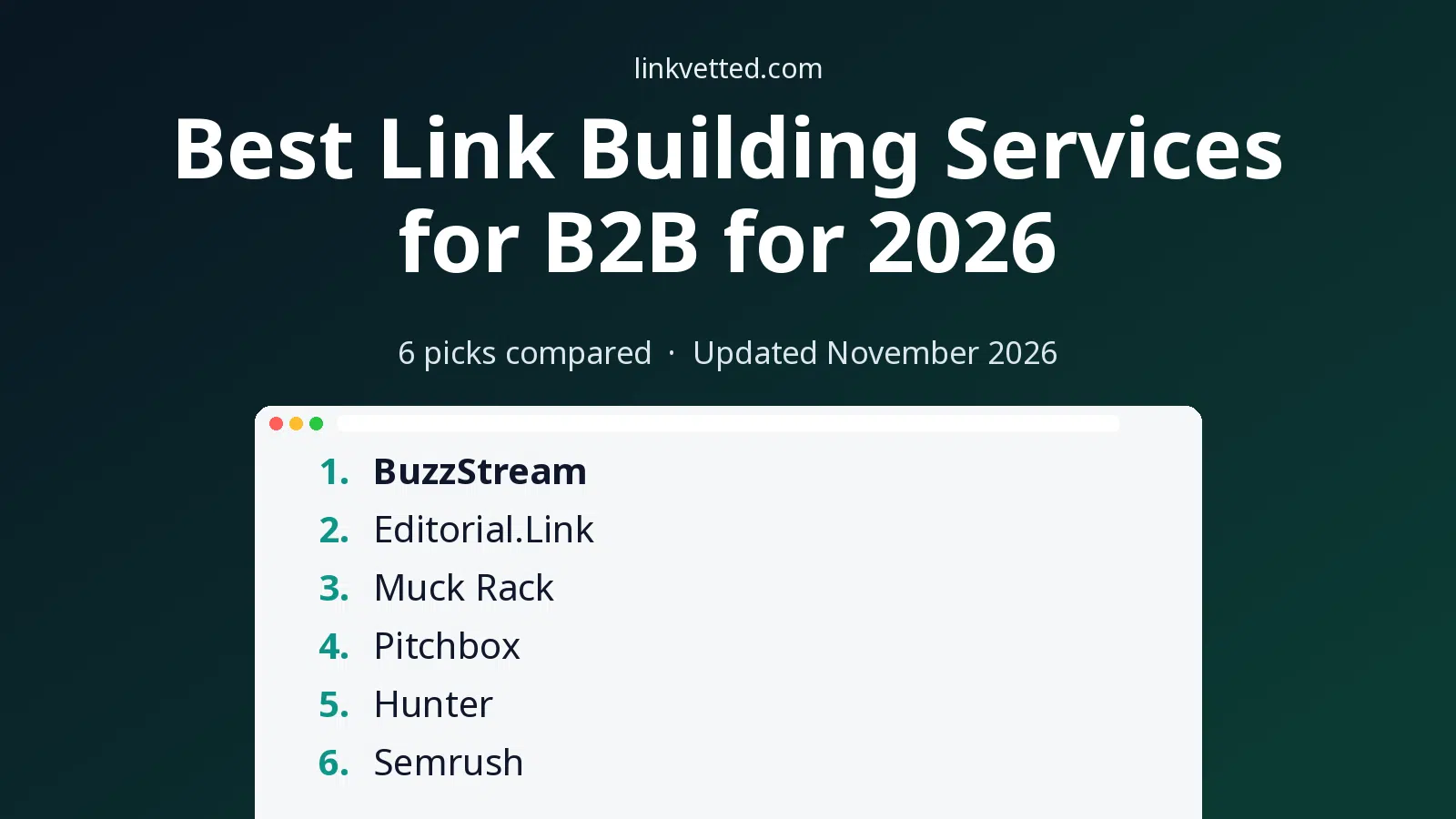
- Editor's choice
 BuzzStream
Managing B2B outreach campaigns
Starts atSee websiteVisit buzzstream.comFull review - Great alternative
 Editorial.Link
Done-for-you editorial link placements
Starts atSee websiteVisit editorial.linkFull review - Also consider
 Muck Rack
Digital PR and journalist outreach
Starts atSee websiteVisit muckrack.comFull review
Direct answer
My first pick is BuzzStream for managing B2B outreach at scale, because it keeps prospect research, contact records and follow-ups in one place. For done-for-you placements, I point people to Editorial.Link, and for digital PR with journalist relationships, Muck Rack is the stronger fit. Each covers a different part of the job: outreach workflow, paid placements and media relations. The right choice depends on whether you want software, a service or a newsroom-style approach.
TL;DR:
- B2B link building usually needs fewer, more relevant links than consumer SEO, so relevance and editorial context matter more than volume.
- Outreach software such as BuzzStream fits teams that want to run their own campaigns and keep control of messaging.
- Done-for-you services such as Editorial.Link suit teams without outreach capacity but still need to check each placement.
- Digital PR tools such as Muck Rack help when your B2B links come from journalists and industry publications.
- Always ask vendors how they source sites, whether links are editorially placed and what happens if a link is removed.
Last checked November 2026. Plan prices are not quoted in this guide because they change often; see each vendor's own pricing page for current figures before you buy.
Quick comparison
| Tool | Best for | Starts at | Free plan? | |
|---|---|---|---|---|
| BuzzStream | Managing B2B outreach campaigns | See website | Free trial | Visit |
| Editorial.Link | Done-for-you editorial link placements | See website | Not stated | Visit |
| Muck Rack | Digital PR and journalist outreach | See website | No free plan | Visit |
 Pitchbox | Agencies running many outreach campaigns | See website | Not stated | Visit |
 Hunter | Finding B2B contact emails | See website | Free plan | Visit |
 Semrush | Link research and competitor analysis | See website | Free plan | Visit |
The best link building services for B2B compared
I compared these tools from vendor documentation and public sources, not from hands-on testing. I looked at what each product says it does, who it is built for and where the limits sit. My aim is to help you shortlist options for B2B link building, then check the details yourself before you commit.
BuzzStream is outreach software for link building and digital PR teams. You build lists of prospects, store contact details and run email sequences from the same tool. For B2B, that matters because your target list is usually small and specific: industry blogs, trade publications and partner sites. The tool fits in-house marketers and agencies that want to run outreach themselves rather than buy placements.
In a B2B link building workflow, BuzzStream helps you keep research, contact history and follow-ups together. You can segment prospects by topic or site type, which makes it easier to send relevant pitches to trade press instead of generic requests. The tool records replies and lets teammates see who contacted whom, which reduces duplicate outreach when several people work on the same campaign.
The limit is that BuzzStream is software, not a service. You still need to find prospects, write pitches and earn the link. Teams without outreach time or writing capacity should skip it and look at a done-for-you option instead.
- Contact and prospect database in one place
- outreach sequences and follow-ups
- Team collaboration on campaigns
- Needs setup before campaigns run smoothly
- Not a link marketplace
Editorial.Link is a link building service that places content on publisher sites. Instead of running outreach, you brief the vendor and they handle the placement process. For B2B teams that need links from industry and business publications but do not have an outreach team, this removes the manual work. It suits marketing managers who can review placements but cannot run a full campaign in-house.
For B2B, the useful part is the editorial angle: you are buying a placement in a publication rather than a directory listing. You still control the topic and the page the link points to, so you can aim at commercial pages or comparison content. The workflow is closer to buying media than running a campaign, which is why it fits teams with a budget but limited time.
The limit is that you are trusting the vendor's site selection. Ask for example placements and check each site for real editorial standards, audience fit and traffic signals before you approve. If you want full control over every pitch, stick with outreach software.
- Placement service rather than software
- Publisher network aimed at editorial links
- Fits teams without outreach capacity
- You rely on the vendor's site vetting
- Placements need your own quality review
Muck Rack is a media relations platform used by PR teams to find journalists, pitch stories and monitor coverage. It is not a link building tool in the classic sense, but for B2B it often produces the best links: coverage in trade press, business media and industry newsletters. If your link strategy depends on expert commentary and data stories, this is the kind of tool that supports it.
In practice, you use Muck Rack to build journalist lists, send pitches and track who covered your story. Each mention can become a link if the publication links to your source page. For B2B, that means pitching original data, survey results or expert comment to reporters who cover your sector. The coverage then supports both brand visibility and link acquisition.
The limit is that Muck Rack is a PR tool, so you will not see link metrics or domain authority inside it. Small teams without a PR function may find it too broad. Skip it if you want a simple placement service and do not plan to run media outreach.
- Journalist and media database
- Monitoring for brand mentions
- Media relations workflow
- Built for PR, not link metrics
- Priced for PR teams
Pitchbox is outreach and campaign management software aimed at agencies and larger marketing teams. It combines prospect search, email automation and campaign reporting. For B2B agencies that run link building for several clients, it helps keep campaigns separate and track activity across accounts. It fits teams with a repeatable outreach process already in place.
For B2B link building, Pitchbox supports the parts that take time: finding prospects, sending sequences and following up. You can build campaigns around specific topics, such as industry publications or partner sites, and track replies in one place. The reporting side helps account managers show clients what outreach was done, which is useful when link building is one line in a retainer.
The limit is that Pitchbox is built for volume and process. A small B2B team sending a handful of pitches a week may find it heavier than needed. Check the setup effort and whether your team will actually use the campaign features before you buy.
- Campaign management for multiple clients
- Prospect search and email automation
- Reporting on outreach activity
- Setup takes planning
- More than a small team needs
Hunter is an email finding tool. You enter a company domain and it returns public email addresses associated with that domain. For B2B link building, that is a practical first step: you identify the publications and companies you want links from, then find the right editor or marketing contact. It fits teams that already know which sites they want and need contact details.
In a link building workflow, Hunter sits before outreach. You build a list of target sites, find contacts and then move them into your outreach tool or CRM. For B2B, this is useful because trade publications and industry sites often list generic addresses, and a named contact improves reply rates. The tool is simple enough for a solo marketer to use without training.
The limit is clear: Hunter does not send emails, manage campaigns or place links. It is one step in the process. If you want an all-in-one outreach platform, pair it with BuzzStream or Pitchbox, or choose a placement service instead.
- Email finding for company domains
- Simple search workflow
- Useful for building prospect lists
- Email finding only
- Not an outreach or placement service
Semrush is an SEO platform with backlink analysis, keyword research, site audits and competitor tracking. For B2B link building, the backlink tools help you see which sites link to competitors and which pages attract links. That research feeds your target list before outreach starts. It fits teams that want data to guide decisions rather than guessing which sites matter.
In practice, you use Semrush to find referring domains for competitor pages, spot industry sites that link to similar content and check your own link profile. For B2B, that means you can build a shortlist of trade publications and industry blogs that already link to your peers. The data is a starting point; you still need to check each site for relevance and editorial quality.
The limit is that Semrush is a broad suite, and link building is only one part of it. If you only need outreach software, a dedicated tool is more focused. Skip it if you already have backlink data from another source and just need help with pitching.
- Backlink data for competitor research
- Site audit and keyword tools in one suite
- Useful for planning target lists
- Link building is one part of a large suite
- Data needs your own interpretation
How I chose
I built this list from vendor documentation and public sources. I read what each product says it does, who it is designed for and what it does not cover. I did not run hands-on tests, and I did not use client results or private data to rank them. The goal was to cover the different ways B2B teams get links: outreach software, placement services, PR platforms and research tools.
My filter was fit for B2B work. That means tools that help with small, targeted prospect lists, trade publications and editorial context, rather than mass link acquisition. I also looked at the limits: whether a tool is software or a service, whether it handles outreach end to end, and what you still have to do yourself. Where a product is part of a larger suite, I noted that so you can judge whether it is worth it for link building alone.
What to check before you buy
- Ask how the vendor or tool sources target sites, and whether placements are editorial or paid.
- Check whether links are permanent and what happens if a link is removed later.
- Confirm the tool or service covers your sector, since B2B niches vary a lot.
- Ask for example placements or campaigns in your industry before you commit.
- Check whether outreach, writing and reporting are included or left to your team.
- Review the contract terms for renewals, cancellations and replacement links.
FAQ
What is the best link building service for B2B?
There is no single best option. BuzzStream suits teams that want to run outreach themselves, Editorial.Link suits teams that want placements handled, and Muck Rack suits digital PR. Match the choice to whether you want software, a service or media relations, then check the vendor's documentation and example work.
Are paid link placements safe for B2B sites?
Paid placements carry risk if the site is low quality or the link is not clearly editorial. Check each site for real content, a relevant audience and consistent publishing. Ask the vendor how sites are vetted and whether links are marked as sponsored where required. Your own review matters more than the vendor's claims.
How many links does a B2B site need?
There is no fixed number. B2B link building usually focuses on relevance and a small number of strong placements rather than volume. A handful of links from trade publications and industry sites can matter more than many low-quality links. Set targets based on your competitors' link profiles and your content plan, not a generic quota.
Can I do B2B link building without a service?
Yes. You can research target sites, find contacts with a tool like Hunter, and run outreach with BuzzStream or a simple email setup. This takes time and consistent follow-up. A service makes sense when your team lacks outreach capacity or when you need placements in specific publications quickly.
How do I judge a link building vendor?
Ask for example placements, how sites are selected and what happens if a link is removed. Check whether the vendor explains its process in writing and whether it will share the target site list before you pay. Avoid vendors that promise specific rankings or refuse to show where links will appear.
Sources
- https://www.buzzstream.com
- https://editorial.link
- https://muckrack.com
- https://pitchbox.com
- https://hunter.io
- https://www.semrush.com