Choosing Expert Sourcing Platforms in 2026: 6 Options Compared
A practical guide to the best expert sourcing platforms for link building and digital PR, compared from vendor documentation and public sources.
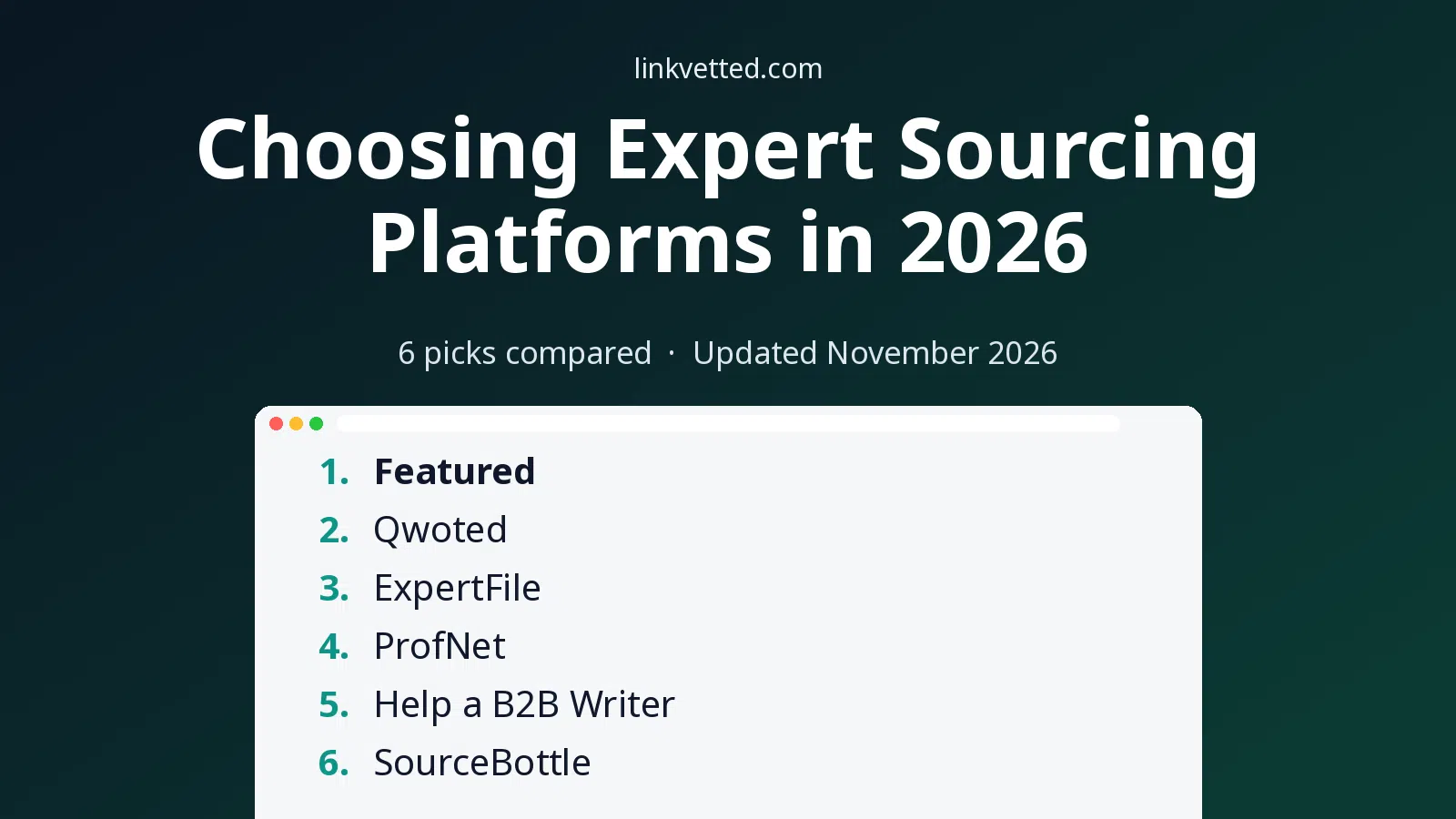
- Editor's choiceFeatured
Getting experts quoted in articles
Starts atSee websiteVisit featured.comFull review - Great alternativeQwoted
Answering journalist requests
Starts atSee websiteVisit qwoted.comFull review - Also considerExpertFile
Finding academics and researchers
Starts atSee websiteVisit expertfile.comFull review
Direct answer
My top pick is Featured, because it is built around getting named experts quoted in published articles, which is exactly what a link building and digital PR workflow needs. For teams that want a journalist-style request feed, Qwoted is the other obvious choice. If you want a large database of academics and researchers you can search directly, ExpertFile is worth a look. Each one fits a slightly different part of the expert sourcing job.
TL;DR:
- Expert sourcing platforms connect you with named, quotable people, not just email addresses, so the quote itself becomes the asset you pitch.
- The best platform for you depends on whether you want to answer journalist requests, search a database, or manage your own roster of contributors.
- Most platforms are two-sided: you can respond to requests as a source, or you can search for experts to quote in your own content.
- Free tiers are common but usually limited, so check message limits and response visibility before committing.
- Always verify an expert's credentials yourself; a platform profile is a starting point, not a guarantee.
Last checked November 2026. Plan prices are not quoted in this guide because they change often; see each vendor's own pricing page for current figures before you buy.
Quick comparison
| Tool | Best for | Starts at | Free plan? | |
|---|---|---|---|---|
| Featured | Getting experts quoted in articles | See website | Not stated | Visit |
| Qwoted | Answering journalist requests | See website | Free plan | Visit |
| ExpertFile | Finding academics and researchers | See website | Not stated | Visit |
| ProfNet | Broad media request coverage | See website | Not stated | Visit |
| Help a B2B Writer | B2B source requests | See website | Free plan | Visit |
| SourceBottle | Australian media requests | See website | Free plan | Visit |
The best expert sourcing platforms compared
I put this list together from vendor documentation and public sources, not from hands-on testing. I looked at what each platform says it does, who it is aimed at, how the workflow runs, and where the limits are. Where a vendor does not publish pricing, I say so rather than guess. Treat this as a starting map, then check each platform yourself before you sign up.
Featured
Best for: Getting experts quoted in articles
Featured is a platform where experts answer questions and publishers turn those answers into articles. For an agency doing digital PR, the appeal is that you can position a client as the expert and get a quote published with a credit and link. It suits consultants, founders and in-house specialists who have something specific to say and want a bylined presence rather than a one-off mention.
In a link building workflow, Featured works best when you already have a client with clear expertise. You write the answer, the platform matches it to a publication, and the resulting article gives you a natural citation. It is less about blasting requests and more about producing useful answers that editors want to run. That fits outreach teams who prefer quality over volume.
The main limit is transparency. Because pricing is not published, you need to talk to the vendor to know whether it fits your budget. Skip it if you need a large, searchable database of experts rather than a quote-driven publishing flow.
- Built around expert quotes and Q&A articles
- lets experts and publishers find each other
- useful for building author profiles
- Pricing is not public
- value depends on how many relevant publications use it
Qwoted
Best for: Answering journalist requests
Qwoted is a request platform where journalists and writers post what they need and sources reply. It is close to the old journalist-request model but built as a proper product. For agencies, it is a way to get clients quoted in news and feature articles, which often produces a mention or link. It suits PR people and SEOs who can respond quickly and write a clear, usable quote.
The workflow is simple: you browse open requests, pick the ones that match your client's expertise, and send a short pitch with a quote and credentials. Speed and relevance matter, because journalists pick from many replies. I treat it as a daily habit rather than a one-off task, since the good requests close fast.
The drawback is that not every beat gets steady requests, and popular topics attract a lot of replies. If you cannot monitor it regularly, you will miss most of the useful ones. It is also not a database you can search for experts, so it does not replace a roster tool.
- Journalists post requests you can respond to
- free tier to start
- covers many beats
- Response volume varies by topic
- competition for each request can be high
ExpertFile
Best for: Finding academics and researchers
ExpertFile is a directory of experts, many of them academics and researchers at universities and institutions. If you are writing a piece that needs a credible, citable voice on a technical or scientific topic, it is a sensible place to search. It fits content teams producing research-led articles and digital PR campaigns that lean on authority.
The way I would use it is to search by topic, shortlist a few names, then contact them directly through their listed channels. The profiles give you enough context to write a specific, relevant request rather than a generic one. That improves reply rates and the quality of the quote you get back.
The limit is scope. It is not built for fast, high-volume outreach, and many experts are busy academics who may not reply. Skip it if you need consumer or B2B practitioner quotes at short notice.
- Large directory of academic and institutional experts
- profiles list credentials
- useful for research-led content
- Skews academic
- not aimed at quick link building
ProfNet
Best for: Broad media request coverage
ProfNet is one of the older media request services, connecting journalists with experts and PR contacts. It has been around a long time, which means it covers a wide range of beats and has a large pool of journalists using it. For agencies that want another request stream alongside newer platforms, it can be worth adding.
In practice you watch incoming queries, match them to your clients, and send a response with a quote and background. Because it is broad, you need a clear filter for what is relevant, otherwise it becomes noise. I would pair it with a tighter platform rather than rely on it alone.
The main drawback is the experience. The interface is not as modern as newer tools, and the quality of requests varies. If you want a polished, fast workflow, this may frustrate you.
- Long-running request service
- wide range of topics
- connects with journalists
- Interface feels dated
- response quality varies
Help a B2B Writer
Best for: B2B source requests
Help a B2B Writer is a request board aimed squarely at B2B content. Writers post what they need, and sources reply with quotes and credentials. For agencies working with SaaS, finance, legal or other B2B clients, the fit is tighter than a general request platform, because the requests already match the audience.
The workflow is straightforward: scan the board, find requests that match a client's expertise, and reply with a short, specific answer. Because the audience is B2B, the quotes tend to be more technical and easier to place. I would check it a few times a week rather than constantly.
The limit is volume. It is a niche board, so there are fewer requests than on larger platforms. It works as one channel in a mix, not as your only source.
- Focused on B2B writers and sources
- free to use
- simple request format
- Narrow B2B focus
- smaller request volume
SourceBottle
Best for: Australian media requests
SourceBottle is an Australian service that sends journalists' requests to sources by email. If you work with Australian clients or want coverage in that market, it is a practical, low-cost way to get quotes placed. It fits PR and SEO teams with an AU audience.
You subscribe to categories, receive requests by email, and reply directly to the journalist. The format is simple and does not need a dashboard. For agencies targeting Australian media, that directness is the appeal.
The clear limit is geography. Outside Australia the requests are less relevant, so it is not a general-purpose tool. Skip it if your clients have no Australian audience.
- Free to join
- strong Australian media focus
- simple request alerts
- Australia-centric
- limited reach outside that market
How I chose
I built this list from vendor documentation and public sources. I read what each platform says about its audience, its workflow and its features, and I checked that the product is currently operating. I did not run hands-on tests, so I am not claiming first-hand experience with any of them. Where a vendor does not publish pricing or free-plan details, I marked it as not stated rather than filling in a number.
My filter was fit for link building and digital PR work. That means I favoured platforms where a quote can turn into a published mention or citation, and where the workflow is clear enough to run regularly. I also weighed limits: whether a platform is too narrow, too broad, or too opaque on pricing. The result is a shortlist for different needs, not a single winner for everyone. Check each one against your own clients and budget before you commit.
What to check before you buy
- Whether the platform is request-based or database-based, and which one your workflow actually needs.
- How often requests appear in your client's topic areas, not just overall volume.
- Whether pricing is published or quote-only, and what the contract length looks like.
- What the free tier includes, especially message limits and whether responses are visible.
- Whether you can manage multiple client profiles or need separate accounts.
- How the platform handles links and credits in published articles, since that affects the SEO value.
FAQ
What is an expert sourcing platform?
It is a service that connects journalists, writers and marketers with named experts who can provide quotes or commentary. Some are request boards where journalists post needs, and some are searchable databases of experts. For link building, the value is a published quote that credits your client, which can include a link.
Are these platforms useful for link building?
Yes, when used carefully. A quoted expert often gets a credit and sometimes a link, and the mention sits in a real article rather than a directory. The key is relevance: a quote on a topic your client genuinely knows beats a generic comment. Treat it as digital PR, not as a link scheme.
Do I need a paid plan?
Not always. Several platforms have free tiers that let you respond to requests, which is enough to test whether the volume suits you. Paid plans usually add features like more messages or profile visibility. Start free, see if you get replies, then decide whether to upgrade.
Can I use more than one platform?
Yes, and I would. Each platform has a different pool of journalists and a different beat mix, so a small stack covers more ground. Pick one request board, one database if you need experts to quote yourself, and one niche board for your client's market.
How do I verify an expert's credentials?
Ask for a short bio, a link to their work, and their role and organisation. Cross-check the organisation's website and any public profiles. A platform profile is a starting point, not proof. For regulated topics like health or finance, confirm qualifications before you put a quote forward.
Sources
- https://featured.com
- https://www.qwoted.com
- https://expertfile.com
- https://www.profnet.com
- https://helpab2bwriter.com
- https://www.sourcebottle.com