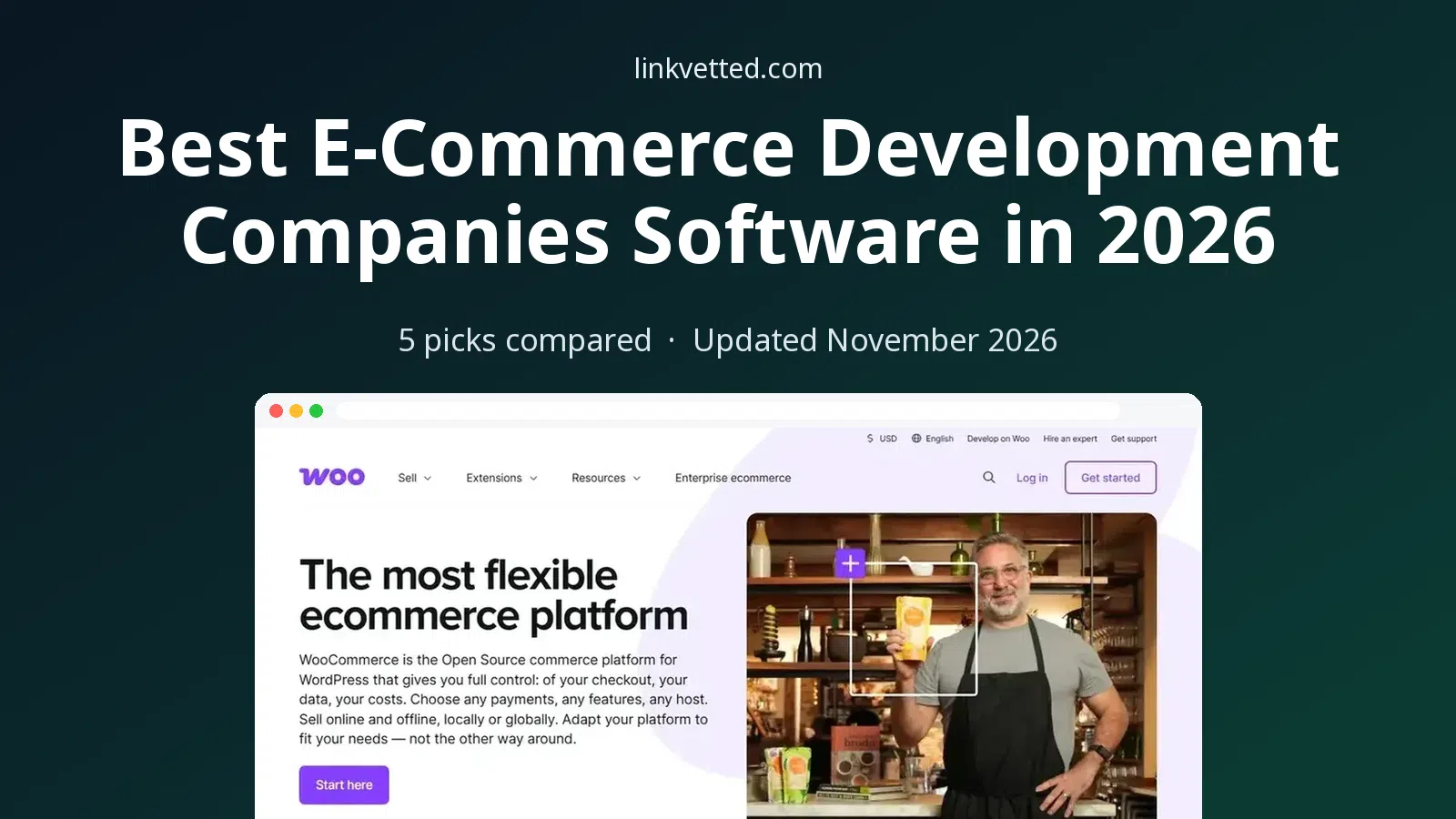
Best E-Commerce Development Companies Software in 2026: 5 Tools Compared
Compare 5 picks for the best e-commerce development companies software, with prices, free plans and who each fits. Real limits included. Details below.
- Editor's choice
 Adobe Commerce
Enterprise B2B and B2C personalization at scale
Starts atSee websiteVisit business.adobe.comFull review - Great alternative
 WooCommerce
Open-source adaptability for developers and merchants
Starts at$29 a monthVisit woocommerce.comFull review - Also consider
 Salesforce Commerce Cloud
Commerce connected to the Salesforce ecosystem
Starts atSee websiteVisit salesforce.comFull review
Direct answer
Adobe Commerce comes first here, mainly for enterprise B2B and B2C personalization at scale. Listed starting prices: WooCommerce from $29 a month, Squarespace from $12 per month and Shopify from $19 a month. WooCommerce fits open-source adaptability for developers and merchants; Salesforce Commerce Cloud fits Commerce connected to the Salesforce ecosystem. The remaining 2 options are covered below with prices and limits.
TL;DR:
- Number one here is Adobe Commerce, a fit for enterprise B2B and B2C personalization at scale.
- Neither Adobe Commerce nor Shopify, nor any of the other 3 tools, has a permanent free plan; trials and quotes are the norm.
- The lowest published monthly entry price here is $12 per month, from Squarespace.
- Squarespace comes with a trade-off: Commerce features less deep than dedicated systems.
Last checked November 2026. Prices and plan details were read from the vendors' own pages in November 2026; vendors change plans often, so confirm the current price on the vendor site before you buy.
Quick comparison
| Tool | Best for | Starts at | Free plan? | |
|---|---|---|---|---|
| Adobe Commerce | Enterprise B2B and B2C personalization at scale | See website | Not stated | Visit |
| WooCommerce | Open-source adaptability for developers and merchants | $29 a month | Not stated | Visit |
| Salesforce Commerce Cloud | Commerce connected to the Salesforce ecosystem | See website | Not stated | Visit |
 Squarespace | Design-led websites with built-in selling tools | $12 per month | Free trial | Visit |
 Shopify | All-in-one hosted commerce for most sellers | $19 a month | Free trial | Visit |
The full e-commerce development companies software list
Short on time? The summary and table above give the quick view of 5 tools for e-commerce development companies software, and the profiles that follow give the detail behind each entry.
Pick Adobe Commerce if this describes you: enterprise B2B and B2C personalization at scale. Enterprises that require deep personalization and integration with broader digital experience systems frequently evaluate Adobe Commerce for that reason. More specifically, Adobe Commerce, formerly known as Magento, is positioned as an AI-powered composable ecommerce system for B2B and B2C that provides personalized experiences at global scale.
Limits to weigh: Complicated for smaller merchants.
On top of that, Adobe Commerce makes most sense when scale, personalization, and composability are firm requirements. The system's enterprise orientation means implementation and continuing operation generally need specialist developers and partners, which can be out of reach for smaller merchants. Check the vendor site for Adobe Commerce pricing; none is listed in this comparison. Trial and free access: Not stated.
- Designed for B2B and B2C enterprise needs
- Personalized experiences at global scale
- Implementation demands specialist resources
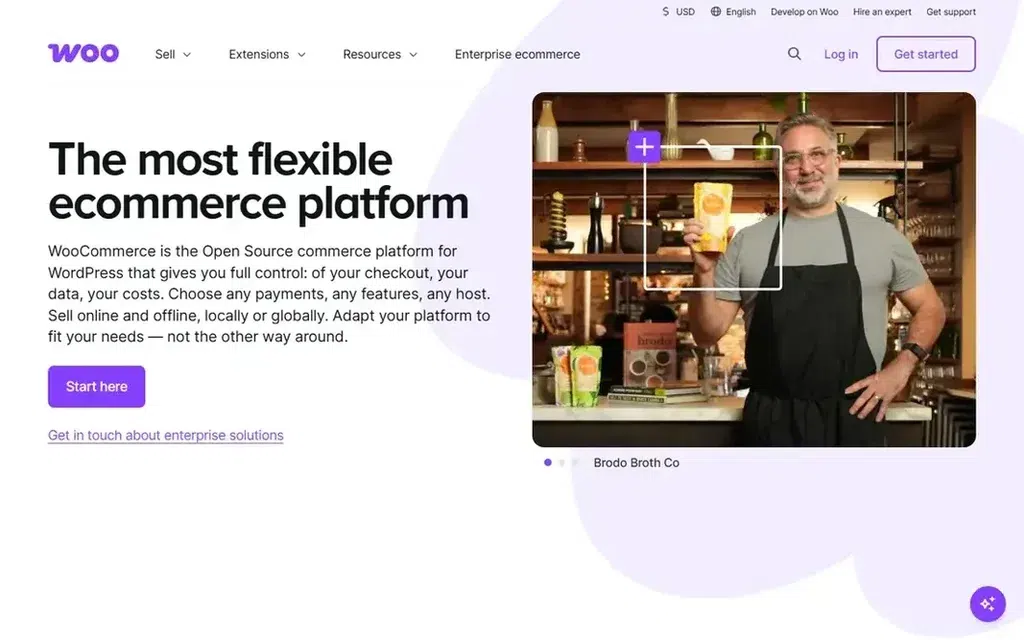
Where WooCommerce fits: open-source adaptability for developers and merchants. Companies without developer support may prefer a completely hosted system for example Shopify.
It suits teams that want ownership of their storefront code and are comfortable working within the WordPress ecosystem. WooCommerce pricing: $29 per month. As for free access: Not stated.
What to check first: Needs more technical maintenance.
- Targeted at both merchants and developers
- Open-source system with long-term focus
- Performance relies on hosting choices
Salesforce Commerce Cloud
Best for: Commerce connected to the Salesforce ecosystem
Salesforce Commerce Cloud was built for Commerce connected to the Salesforce ecosystem. It suits enterprises already invested in Salesforce that value a unified view of customers across sales, service, and commerce.
The product's value is most solid inside the Salesforce ecosystem, so businesses not using those tools may face additional integration and implementation effort. Salesforce Commerce Cloud does not show a starting price in this comparison, so check the vendor site for current pricing. Free access: Not stated.
Limits to weigh: Tied closely to Salesforce ecosystem.
- Supports unified customer data strategies
- Suits organizations already using Salesforce
- Can require significant implementation effort
Squarespace was built for design-led websites with built-in selling tools. Squarespace is a solid fit when a beautiful site and straightforward selling are the central goals.
Also, the product appeals to users who value aesthetics and simplicity over deep commerce configuration. Price to start with Squarespace: $12 per month. On free options: Free trial.
Where it is weaker: Commerce features less deep than dedicated products.
- Configurable templates and AI website builder
- Domain and hosting included
- Restricted developer-level customization

Shopify works best for all-in-one hosted commerce for most sellers. For most standard retail and direct-to-consumer firms, though, Shopify spans the essentials without heavy engineering effort. In daily use, Shopify is a hosted all-in-one commerce system that bundles store building, AI-assisted tools, and business management in one place.
Merchants with unusual technical requirements or existing developer workflows should compare WooCommerce or enterprise choices before committing. More specifically, the product is built to handle everything from product pages to marketing and operations, which makes it a practical default for small and mid-size teams that value speed and simplicity over deep code-level control. Shopify cost at the entry level: $19 per month. On free options: Free trial.
Limits to weigh: Less control over core code than open-source choices.
- Hosted system with wide app ecosystem
- Merges storefront and business management tools
- Advanced customization can need app extras
How we chose
The comparison looks at four things: starting price, free access, how well the feature set matches e-commerce development companies software, and the main limit of each tool. Where a vendor does not publish a price, the entry says quote. Where a price depends on seats or billing term, the entry says so. The sequence is a judgement call: typical use case first, then pricing transparency, then free access. Use the profiles to check fit.
What to confirm before you sign up
- Ask Adobe Commerce and Salesforce Commerce Cloud for a written quote, since no starting price is shown.
- Run a trial of Squarespace and Shopify with real work before paying for a year; your own workflow is the best test.
- Before choosing Adobe Commerce, weigh its main limit: implementation demands specialist resources.
- Confirm that Salesforce Commerce Cloud connects to the apps your team already uses, on the plan you would actually buy.
- Check how data leaves Squarespace: formats, limits and whether exports are available on every plan.
FAQ
Is Adobe Commerce the right pick for everyone comparing e-commerce development companies software?
No single tool suits every team. Adobe Commerce comes first because it fits enterprise B2B and B2C personalization at scale, while WooCommerce suits open-source flexibility for developers and merchants and Salesforce Commerce Cloud suits Commerce connected to the Salesforce ecosystem. Match the tool to your own size, budget and workflow before deciding.
Can I try these options before paying?
Often, yes. Squarespace and Shopify offer a free trial. Use your own data and a real task during the test, and check what the free tier or trial limits before you rely on it. All 5 picks in this E-Commerce development companies software comparison list a starting price, free plan details and the main limits on their cards above.
Do these tools publish their prices?
Not all of them. Adobe Commerce and Salesforce Commerce Cloud publish no starting price, so expect a quote request for those. The rest, WooCommerce included, show a starting price, though seats and billing terms still change the final cost.
When should I choose WooCommerce over a hosted platform?
WooCommerce makes sense when you want open-source ownership of your storefront code and have developer resources to maintain it. Also, hosted products such as Shopify cut maintenance but offer less code-level control.
Does any tool for e-commerce development companies software here have a free plan?
No tool in this list, Adobe Commerce and Shopify included, has a permanent free plan. Squarespace, Shopify offer a trial. Trials and quotes are the usual route, so plan a short evaluation period.
Sources
- https://business.adobe.com/products/magento/magento-commerce.html
- https://woocommerce.com
- https://www.salesforce.com/commerce
- https://www.squarespace.com
- https://www.shopify.com