6 E-Commerce Development Companies Software for Remote Teams Worth Shortlisting in 2026
6 best e-commerce development companies software for remote teams, compared on pricing, free plans and best-fit use. Honest caveats for every entry. No hype.

- Editor's choice
 BigCommerce
Scalable multi-channel commerce operations
Starts atSee websiteVisit bigcommerce.comFull review - Great alternative
 Adobe Commerce
Enterprise B2B and B2C composable commerce
Starts atSee websiteVisit business.adobe.comFull review - Also consider
 Shopify
All-in-one hosted commerce for remote teams
Starts at$19 a monthVisit shopify.comFull review
Direct answer
BigCommerce is the first pick on this list for scalable multi-channel commerce operations. Listed starting prices: Shopify from $19 a month, Squarespace from $12 a month and WooCommerce from $29 per month. Adobe Commerce is the stronger choice for enterprise B2B and B2C composable commerce, while Shopify suits all-in-one hosted commerce for remote teams. The remaining 3 options are covered below with prices and limits.
TL;DR:
- The list opens with BigCommerce, aimed at scalable multi-channel commerce operations.
- The main caution on Salesforce Commerce Cloud: best value inside the Salesforce ecosystem.
- None of the 6 tools, from BigCommerce to WooCommerce, has a free plan, so budget for a subscription or use a trial.
- For open-source adaptability for developer-led teams, WooCommerce is worth a look.
- The cheapest monthly starting price in the list is $12 per month, offered by Squarespace.
Last checked November 2026. Prices and plan details were read from the vendors' own pages in November 2026; vendors change plans often, so confirm the current price on the vendor site before you buy.
Quick comparison
| Tool | Best for | Starts at | Free plan? | |
|---|---|---|---|---|
| BigCommerce | Scalable multi-channel commerce operations | See website | Not stated | Visit |
| Adobe Commerce | Enterprise B2B and B2C composable commerce | See website | Not stated | Visit |
| Shopify | All-in-one hosted commerce for remote teams | $19 a month | Free trial | Visit |
 Salesforce Commerce Cloud | Commerce within the Salesforce ecosystem | See website | Not stated | Visit |
 Squarespace | Design-led websites with commerce features | $12 a month | Free trial | Visit |
 WooCommerce | Open-source adaptability for developer-led teams | $29 per month | Not stated | Visit |
E-Commerce Development Companies Software for Remote Teams, one by one
Short on time? The summary and table above give the quick view of 6 e-commerce development companies software for remote teams, and the profiles that follow give the detail behind each entry.

BigCommerce makes the most sense for scalable multi-channel commerce operations. BigCommerce describes itself as commerce built for momentum, powering modern buying experiences across brands, regions, and channels from a single, scalable foundation.
The main drawbacks: Setup may need more planning than simple builders.
The platform's scalability focus can mean more configuration work at the start, which may not suit very small teams wanting a fast launch. Pricing for BigCommerce is not stated here, so ask the vendor for current figures. Free options: Not stated.
- Made for momentum across brands and regions
- Supports several channels from one system
- Enterprise focus can feel heavy for small teams
Adobe Commerce is a good fit for enterprise B2B and B2C composable commerce. Adobe Commerce, also known as Magento, is described as an AI-powered composable e-commerce product for B2B and B2C that gives personalized experiences at global scale.
More specifically, remote teams in enterprise settings with dedicated development and operations staff may find the composable approach handy for integrating commerce with broader digital experience systems. The system's enterprise orientation means implementation and continuing management demand specialized resources, which can be excessive for small or mid-size remote teams. No starting price is listed for Adobe Commerce here; confirm pricing on the vendor site. Free options: Not stated.
What to check first: Complicated implementation for smaller teams.
- Personalized experiences at global scale
- Serves both B2B and B2C models
- Needs specialized development resources

For all-in-one hosted commerce for remote teams, Shopify is a natural candidate. Shopify presents itself as an all-in-one commerce system for companies. Its homepage flags AI-assisted building and growth, plus tools to handle every part of a business beyond e-commerce software.
Limits to weigh: Customization relies on the product ecosystem.
On top of that, consider WooCommerce or Adobe Commerce instead when open customization or enterprise composability is the priority. Since Shopify is a hosted product, teams that require deep server-level control or highly custom architectures may find it limiting. Shopify pricing: $19 per month. As for free access: Free trial.
- Manages plenty of parts of a business in one place
- AI-assisted store building and growth features
- Less control over backend hosting
Salesforce Commerce Cloud makes the most sense for Commerce within the Salesforce ecosystem. Salesforce Commerce Cloud is the commerce offering within Salesforce's system. BigCommerce or Shopify can be more direct when commerce is the primary need and CRM alignment is secondary.
Where it falls short: Best value inside the Salesforce ecosystem.
Also, teams already using Salesforce for sales or service operations may value keeping commerce data and workflows connected. As for the details, for remote organizations standardized on Salesforce, it can cut the number of separate systems the team has to learn and maintain. From a buyer's view, the system's strength is tied to the Salesforce ecosystem. So teams outside it may find integration and configuration more effort than a standalone commerce tool. Salesforce Commerce Cloud shows no starting price here, so confirm the cost on the vendor site. On free options: Not stated.
- Supports unified commerce experiences
- Part of the broader Salesforce system
- Configuration can need specialist help
Squarespace serves design-led websites with commerce features. Remote teams that prioritize visual presentation and a refined brand site alongside entry-level selling may find it a solid fit for launching a presence without a developer.
Drawbacks to consider: Advanced store workflows may need workarounds.
WooCommerce or Adobe Commerce are better matches when commerce functionality must scale beyond a design-first site. The starting price for Squarespace: $12 per month. Free options: Free trial.
- AI website builder tools
- Configurable website templates
- Commerce depth is secondary to design
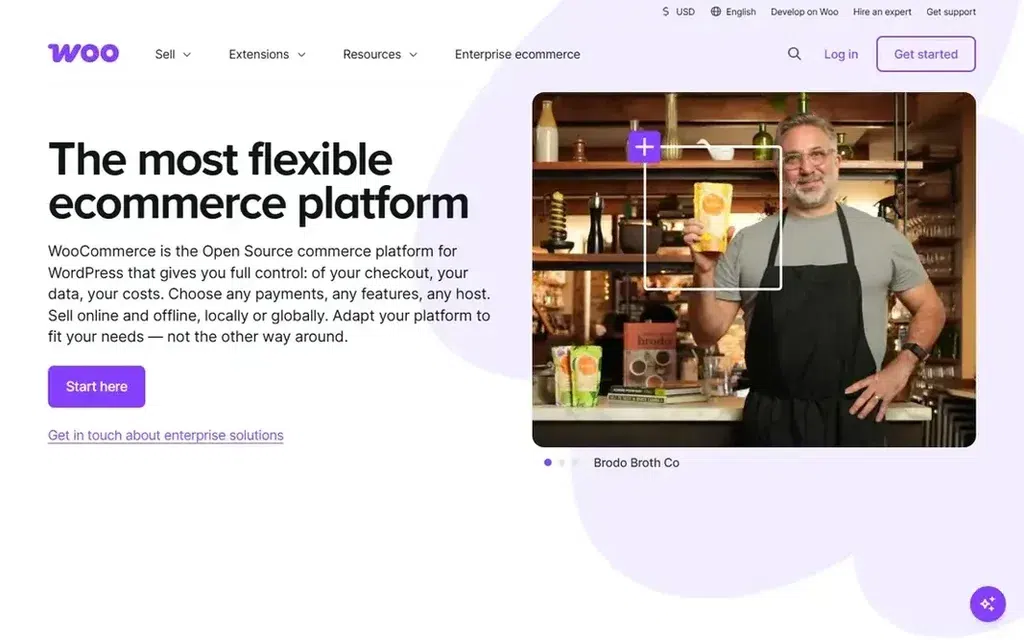
WooCommerce targets open-source adaptability for developer-led teams. Open source also means the team takes care of hosting, updates, and security, which can be a burden without dedicated technical staff.
What you pay to start with WooCommerce: $29 per month. Free access: Not stated.
Points against: Hosting and security are team responsibilities.
- Designed for long-term business growth
- Open-source e-commerce system
- Needs more technical maintenance
How the list was put together
A buyer's checklist
- Ask BigCommerce, Adobe Commerce and Salesforce Commerce Cloud for a written quote, since no starting price is shown.
- Use real work to test the free trial from Shopify and Squarespace, rather than a demo project.
- Before choosing BigCommerce, weigh its main limit: enterprise focus can feel heavy for small teams.
- Make sure Squarespace lets you export your data in a format another tool can read.
- Test how quickly Adobe Commerce answers a pre-sales question; it hints at how support will feel later.
FAQ
Can enterprise platforms work for smaller remote teams?
Adobe Commerce and Salesforce Commerce Cloud are aimed at enterprise-scale operations and may need specialized resources. Smaller remote teams commonly find more straightforward systems more proportionate except when complicated integrations or global scale are immediate requirements.
How are the e-commerce development companies software for remote teams ordered?
The order follows typical fit for e-commerce development companies software for remote teams, with BigCommerce first and WooCommerce last, then price clarity and free access. It is editorial judgement, not a score, so another team could rank the tools differently.
Is BigCommerce the right pick for everyone comparing e-commerce development companies software for remote teams?
No single tool suits every team. BigCommerce comes first because it fits scalable multi-channel commerce operations, while Adobe Commerce suits enterprise B2B and B2C composable commerce and Shopify suits all-in-one hosted commerce for remote teams. Match the tool to your own size, budget and workflow before deciding.
How should a remote team choose between hosted and open-source commerce?
Hosted systems ease operations and let the team focus on selling, whereas open-source choices like WooCommerce offer more control at the cost of maintenance. Match the choice to your team's technical capacity and long-term customization needs.
Which e-commerce product is a good match for a fully remote team?
This list starts with BigCommerce, which fits scalable multi-channel commerce operations. For other needs, Adobe Commerce is aimed at enterprise B2B and B2C composable commerce, and Shopify at all-in-one hosted commerce for remote teams. Check each tool's price and main limit first.
Can I try these tools before paying?
Often, yes. Shopify and Squarespace offer a free trial. Use your own data and a real task during the test, and check what the free tier or trial limits before you rely on it. For the full picture, the cards above cover all 6 entries of this E-Commerce development companies software for remote teams list, including price, free plan and limits.
Sources
- https://www.bigcommerce.com
- https://business.adobe.com/products/magento/magento-commerce.html
- https://www.shopify.com
- https://www.salesforce.com/commerce
- https://www.squarespace.com
- https://woocommerce.com