Document Repository Software in 2026: A Guide to 6 Tools
Best document repository software: 6 contenders ranked by fit, with entry costs and free tiers. The weak spots sit next to the strengths. Refreshed for 2026.
- Editor's choice
 Box
Secure cloud content management
Starts at$7 per user/month (Business Starter)Visit box.comFull review - Great alternative
 Egnyte
Hybrid cloud and on-premises storage
Starts at$10 per user/month (Team)Visit egnyte.comFull review - Also consider
 Microsoft SharePoint
Teams already on Microsoft 365
Starts atIncluded with Microsoft 365 (from $6/user/month)Visit microsoft.comFull review
Direct answer
If you need secure cloud content management, Box is the first tool to look at here. Egnyte is better for hybrid cloud and on-premises storage, and Microsoft SharePoint is better for teams already on Microsoft 365. Details, prices and limits for the rest of the 6 tools are below.
TL;DR:
- Box sits first on this list: secure cloud content management.
- A fair warning about Microsoft SharePoint: can sprawl without governance.
- DocuWare suits digitizing paper-heavy workflows.
- Only Box offers a free plan among these 6 tools.
- The lowest published monthly entry price here is Included with Microsoft 365, from Microsoft SharePoint.
Quick comparison
| Tool | Best for | Starts at | Free plan? | |
|---|---|---|---|---|
| Box | Secure cloud content management | $7 per user/month (Business Starter) | Yes | Visit |
| Egnyte | Hybrid cloud and on-premises storage | $10 per user/month (Team) | No | Visit |
| Microsoft SharePoint | Teams already on Microsoft 365 | Included with Microsoft 365 (from $6/user/month) | Free trial | Visit |
 Alfresco | Configurable open-source content product | See website | Free trial | Visit |
 Laserfiche | Records management and compliance | See website | Free trial | Visit |
 DocuWare | Digitizing paper-heavy workflows | See website | Free trial | Visit |
Tool-by-tool breakdown
If you are comparing document repository software, this page covers 6 tools in one place: what each is best for, what it costs to start, whether it has a free plan, and the main limit to know about.

Box works best for secure cloud content management. The free level hands individuals 10GB, which is genuinely handy for evaluation. In daily use, premium business plans start at $7 per user a month for small teams, scaling to unlimited storage on higher tiers.
Watch-outs: Business levels need annual commitment for best pricing.
the main limit is that the granular admin controls and advanced security features that regulated businesses need sit on the pricier plans. For everyday use, HIPAA, GDPR, and FedRAMP certifications make it a natural fit for healthcare, finance, and legal teams that require a document repository auditors will accept. Price to start with Box: $7 per user/month. Box offers a free plan.
- Clean interface users actually adopt
- Solid security and compliance certifications
- Advanced governance lives on higher plans

For hybrid cloud and on-premises storage, Egnyte is a natural candidate. Edge caching keeps large files quick locally, and ransomware detection watches file behavior to freeze suspicious encryption before it spreads.
Teams without dedicated IT will find Box or SharePoint simpler to live with. Starting cost for Egnyte: $10 per user/month. Egnyte does not include a free plan.
Trade-offs to know: Interface is admin-oriented instead of approachable.
- Unique hybrid architecture links local NAS with cloud
- Ransomware detection
- Setup needs IT involvement
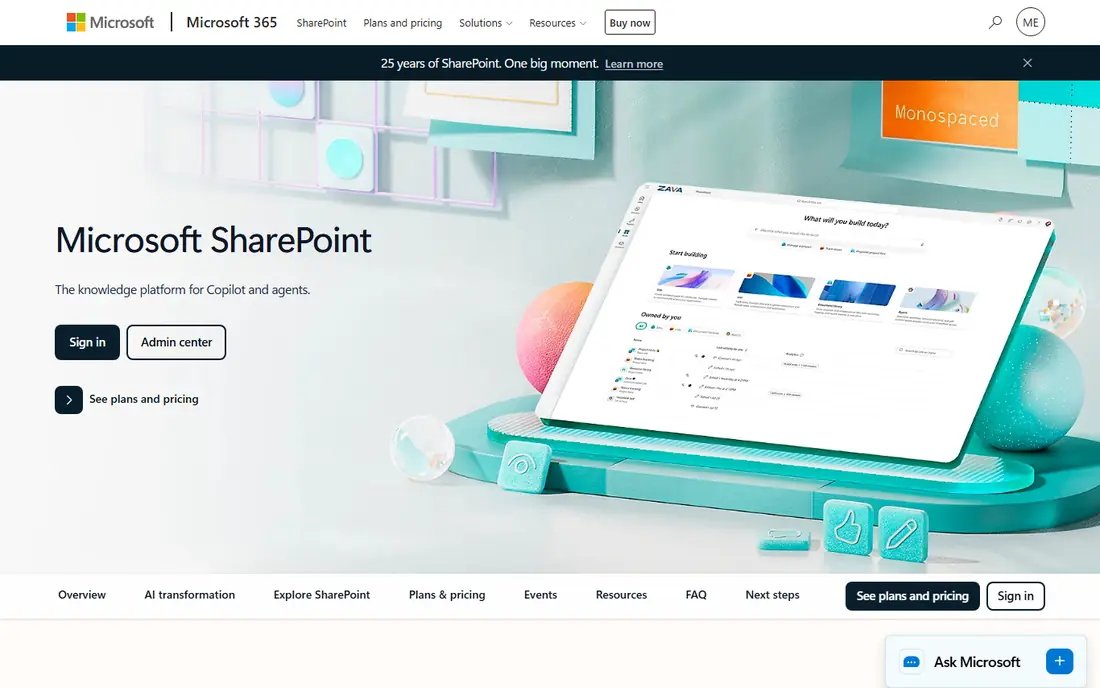
Choose Microsoft SharePoint for teams already on Microsoft 365. The honest catch is governance. As for the details, files shared in Teams channels live in SharePoint automatically, so adoption frequently happens on its own.
Trade-offs to know: Can sprawl without governance.
In daily use, if you already pay for Microsoft 365, you already own a capable document repository: document libraries with version history, check-in and check-out, metadata columns, and permissions down to the individual file. Also, without someone owning site structure and naming conventions, SharePoint libraries sprawl into the same chaos they replaced. Price to start with Microsoft SharePoint: Included with Microsoft 365. Free options: Free trial.
- Bundled with Microsoft 365 subscriptions
- Granular permissions and versioning
- Administration is a real skill
Alfresco is a good fit for configurable open-source content product. Alfresco began as the open-source alternative to pricey enterprise content management, and that DNA remains.
More specifically, the community edition is free but self-supported, and the enterprise system needs implementation expertise. For everyday use, the trade-off is that Alfresco rewards technical teams and punishes casual ones. Alfresco does not show a starting price in this comparison, so check the vendor site for current pricing. Free options: Free trial.
Drawbacks to consider: Community edition is self-supported.
- Open-source roots with deep customization
- Now backed by Hyland
- Enterprise pricing is quote-based
Laserfiche makes the most sense for records management and compliance. Government agencies, banks, and healthcare organizations use it to enforce retention schedules, run audits, and automate document-heavy processes with AI-assisted capture that reads invoice fields like PO numbers and totals.
Downsides: Can feel heavy for straightforward storage needs.
This comparison lists no price for Laserfiche; ask the vendor. On free options: Free trial.
- Serious records retention and compliance tooling
- Wide integrations including DocuSign and Salesforce
- Pricing starts around $45-55 per user per month and climbs
DocuWare serves digitizing paper-heavy workflows. DocuWare has spent decades on one problem: turning paper and scattered files into an organized, searchable repository.
Its capture tools scan, index, and file documents automatically. The workflow engine routes invoices, contracts, and HR documents for approval without email chains. Check the vendor site for DocuWare pricing; none is listed in this comparison. Free plan details: Free trial.
Where it falls short: Quote-based pricing slows evaluation.
- Solid workflow automation
- Purpose-built for document capture and indexing
- Implementation normally needs a partner
What went into this list
Each tool was reviewed on what its vendor publishes: price, plan limits, core features and stated drawbacks. We did not run hands-on tests. Plan names, prices and limits change often. Treat the figures here as a starting point and verify them with the vendor. The sequence is a judgement call: typical use case first, then pricing transparency, then free access. Use the profiles to check fit.
Before you commit
- Get a written quote from Alfresco, Laserfiche and DocuWare; the list shows no starting price for them.
- Look at the free plan from Box closely: its caps decide whether it is usable for real work.
- Run a trial of Microsoft SharePoint, Alfresco, Laserfiche and DocuWare with real work before paying for a year; your own workflow is the best test.
- Read the limits listed for Box first: individual plans are expensive for the storage offered.
- Work out what Laserfiche costs with your real seat count, add-ons and usage, not just the entry price.
- Confirm that Microsoft SharePoint connects to the apps your team already uses, on the plan you would actually buy.
FAQ
Is Box the right pick for everyone comparing document repository software?
No single tool suits every team. Box comes first because it fits secure cloud content management, while Egnyte suits hybrid cloud and on-premises storage and Microsoft SharePoint suits teams already on Microsoft 365. Match the tool to your own size, budget and workflow before deciding.
Can I try these options before paying?
Often, yes. Box has a free plan and Microsoft SharePoint, Alfresco, Laserfiche and DocuWare offer a free trial. Use your own data and a real task during the test, and check what the free tier or trial limits before you rely on it.
What is the difference between SharePoint and a shared drive?
A shared drive is just networked folders. SharePoint layers on version history, check-in and check-out, metadata, granular permissions, retention policies, and search across all content.
How are the tools for document repository software ordered?
Box sits first and DocuWare last because the order follows typical fit for document repository software, then price clarity and free access. It is a judgement call, so read each profile for fit and limits.
Do these tools publish their prices?
Not all of them. Alfresco, Laserfiche and DocuWare publish no starting price, so expect a quote request for those. The rest, Box included, show a starting price, though seats and billing terms still change the final cost.
Do I need on-premises document management?
Most small and mid-sized firms do not. More specifically, cloud repositories are simpler to maintain and access remotely. More specifically, on-premises or hybrid choices like Egnyte or DocuWare's on-premise edition make sense when regulations, client contracts, or data-residency rules need data to stay on your own infrastructure.