Best Digital Out of Home Advertising Platforms in 2026: 9 Platforms Compared
We compared the best digital out-of-home advertising platforms for billboards, transit, retail, and place-based screens, with pricing and measurement in 2026.
- Editor's choice
 AdQuick
Planning and buying across many owners
Starts atSee websiteVisit adquick.comFull review - Great alternative
 Vistar Media
Programmatic DOOH at scale
Starts atSee websiteVisit vistarmedia.comFull review - Also consider
 Place Exchange
Programmatic marketplace access
Starts atSee websiteVisit placeexchange.comFull review
TL;DR:
- Self serve platforms such as Blip and Blindspot suit small budgets, while programmatic platforms such as Vistar and Place Exchange suit agencies buying at scale.
- AdQuick and Adomni cover both planning and buying, which helps teams that want one dashboard for many screen owners.
- Media owners such as Lamar and Clear Channel still matter for flagship billboards, airports, and transit, where programmatic supply is thinner.
- Measurement differs by platform, from footfall and mobile retargeting to sales lift, so agree on the success metric before you book screens.
- Creative built for a few seconds of attention, with large text and one message, outperforms a shrunken social or TV advert on outdoor screens.
Quick comparison
| Tool | Best for | Starts at | Free plan? | |
|---|---|---|---|---|
| AdQuick | Planning and buying across many owners | See website | No | Visit |
| Vistar Media | Programmatic DOOH at scale | See website | No | Visit |
| Place Exchange | Programmatic marketplace access | See website | No | Visit |
 Adomni | Self serve DOOH with AI planning | See website | No | Visit |
 Blip Billboards | Small local digital billboard budgets | See website | No | Visit |
 Blindspot | Per-play pricing with no minimums | See website | No | Visit |
 Broadsign | Operating and monetising screen networks | See website | No | Visit |
 Lamar Advertising | Owned billboard and transit inventory | See website | No | Visit |
 Clear Channel Outdoor | Airport and large-market outdoor reach | See website | No | Visit |
The best digital out of home advertising platforms
We compared vendor product pages and public 2026 DOOH guides. Digital out of home, or DOOH, covers digital billboards, transit screens, airport displays, retail media, and place-based screens in gyms, offices, and restaurants. The nine below cover self serve buying, programmatic buying, marketplace access, and direct media-owner inventory, so small businesses and agencies can each find a fitting route.
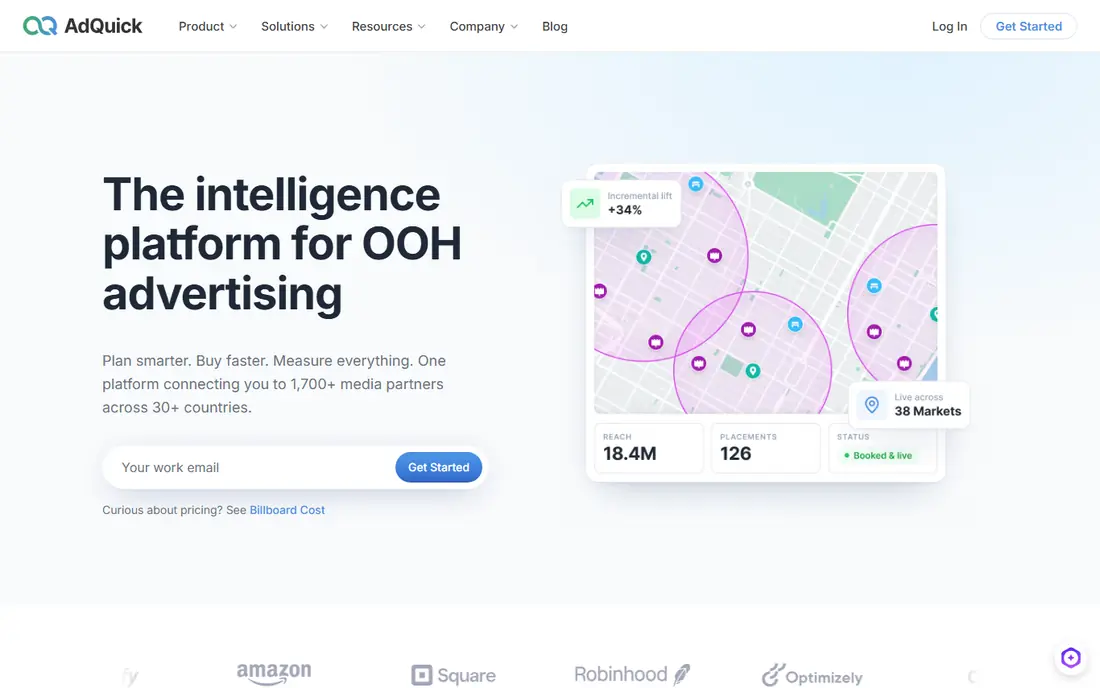
AdQuick lets advertisers plan, price, buy, and measure out-of-home campaigns across many owners, formats, and markets from one platform. It covers digital billboards, transit, place-based screens, and programmatic DOOH, with audience targeting, proposals, and unified reporting. For a brand running campaigns in several cities, that single view beats contacting each media owner separately.
AdQuick pricing is quoted by market and format, and public guides put small single-market tests in the low thousands of dollars for a month. That is realistic for a regional campaign, but it is not a 50 dollar self serve test. Use AdQuick when you need multi-owner scale and unified measurement, and use a self serve billboard tool for a first local test.
- Marketplace across many media owners
- Planning, buying, and measurement in one platform
- Programmatic and direct options
- Pricing is quoted and varies by market
- Small test campaigns still need a real budget
- Platform breadth takes time to learn
Vistar Media provides programmatic DOOH buying and monetisation, with a demand-side platform for advertisers and a supply-side platform for media owners. Its inventory covers roadside, transit, retail, and place-based screens, with audience targeting, delivery controls, and measurement that links exposure to outcomes. Agencies use Vistar to buy DOOH alongside other programmatic channels, with pooled supply and frequency controls.
Vistar is built for agencies and larger advertisers, not for a single local billboard test. Pricing is custom, and the platform rewards buyers who understand programmatic bidding, audience segments, and supply paths. For scale and programmatic control, it is one of the strongest options on this list.
- Demand and supply side programmatic tools
- Large device and venue inventory
- Audience targeting and measurement
- Enterprise and agency focus
- Pricing is custom
- Setup needs programmatic knowledge
Place Exchange runs a programmatic marketplace for out-of-home, giving DSPs and advertisers access to curated screen supply with supply-path controls and measurement. Its integrations with omnichannel DSPs let a team add DOOH to an existing digital plan, rather than running outdoor as a separate silo. That matters for brands that want consistent audience targeting across mobile, video, and outdoor.
Place Exchange is usually reached through a DSP, so a small advertiser without a DSP seat will need a partner or a self serve platform instead. For agencies already buying programmatically, Place Exchange offers a transparent route into DOOH supply without building direct owner relationships for every market.
- Curated programmatic marketplace
- Omnichannel DSP integrations
- Supply-path controls and measurement
- Access is often through a DSP seat
- Pricing depends on DSP and inventory
- Direct small-budget buying is limited
Adomni lets brands, agencies, and small businesses plan and launch DOOH campaigns from a self serve platform, with access to a large number of digital screens. Its AI assistant, called Jeen, helps with audience targeting, inventory recommendations, budget planning, and campaign setup, which lowers the barrier for teams new to outdoor. Adomni also supports CTV and mobile retargeting, so an outdoor campaign can be followed up on phones and TVs.
Adomni pricing is quoted, and screen depth varies by city and format, so a campaign in a major metro will look different from one in a smaller market. Review AI recommendations against your own audience and geography knowledge before launch, since an automated plan can still miss local context such as events, roadworks, or venue fit.
- Self serve planning and buying
- AI assistant for targeting and budgeting
- DOOH plus CTV and mobile retargeting
- Pricing is quoted
- Inventory depth varies by market
- AI recommendations need human review
Blip Billboards lets small advertisers buy digital billboard time in short bursts, with flexible budgets and daypart scheduling, without an agency or a large contract. A local restaurant, gym, or service business can upload creative, pick boards by location, set a daily budget, and see when ads played. That low-friction model makes outdoor accessible to businesses that once assumed billboards were only for national brands.
Blip coverage is limited to its participating billboard networks, so it will not cover every market or format. National campaigns, airport takeovers, and place-based networks need a broader platform. For a first local billboard test, Blip is one of the easiest places to start.
- Self serve local billboard buying
- Flexible budgets and scheduling
- Simple creative upload and reporting
- Limited to participating digital billboard networks
- National scale needs another platform
- Creative must suit billboard viewing
Blindspot sells DOOH by the play, with per-play pricing, no minimums, and no agency retainers in public guides, which suits startups and small businesses testing outdoor for the first time. Advertisers pick exact screens and hours, pay per play, and can launch quickly with a small budget. Its global coverage also helps brands testing outdoor in several countries without signing separate owner deals.
Per-play buying needs budget discipline, since a popular screen at peak hours can consume a small budget fast. Check screen locations, play frequency, and proof-of-play reporting before scaling, and compare cost per play with cost per thousand impressions on other platforms to judge value fairly.
- Per-play pricing from low levels in public guides
- No minimums or retainers
- Global screen coverage
- Per-play model needs careful budget control
- Screen quality varies by network
- Measurement depends on campaign setup
Broadsign is best understood as the operating system for digital signage networks, used by media owners, venues, and operators to manage screens, schedule content, sell inventory, and serve ads. Advertisers encounter Broadsign indirectly, through networks that use it, or through its programmatic supply connections. Its strength is reliable, large-scale screen management, with workflows for content approval, scheduling, and reporting.
Broadsign is not a self serve advertiser tool in the same way as Blip or Adomni, so a small advertiser should not start here. Media owners, retail networks, and place-based operators, on the other hand, will find Broadsign essential for running a professional, measurable screen business.
- Content management and scheduling for screen networks
- Inventory and ad serving tools
- Programmatic supply options
- Built for media owners and operators, not direct advertisers
- Pricing is quoted
- Setup is enterprise-grade
Lamar Advertising owns one of the largest billboard and transit networks in the United States, covering digital and static bulletins, transit displays, and airport media in many markets. Buying direct from Lamar suits brands that want flagship locations, long-term presence on a key route, or a coordinated multi-market buy from one owner. Local sales teams and creative services help with design and placement for those campaigns.
Lamar is a media owner, not a self serve dashboard, so buying involves a sales conversation, market pricing, and campaign planning. Small, short-burst tests are better suited to Blip or Blindspot, while Lamar suits brands that want scale, premium locations, and a sustained outdoor presence.
- Large owned billboard and transit network
- Local sales teams
- Creative services and national reach
- Direct owner buying, not a self serve platform
- Pricing varies by market and format
- Minimums suit larger campaigns
Clear Channel Outdoor
Best for: Airport and large-market outdoor reach
Clear Channel Outdoor operates billboards, airport media, digital displays, and street furniture in large US and international markets, with audience planning, creative services, and programmatic access for larger buyers. Its airport and downtown inventory suits brands that want high-impact, high-dwell placements for travellers, commuters, and city audiences. National advertisers use it for flagship campaigns that need scale and visibility.
Clear Channel pricing is quoted by market and format, and premium airport and downtown locations cost more than standard roadside boards. Small advertisers should test DOOH on a self serve platform first, then approach Clear Channel when a flagship or airport campaign justifies the budget.
- Large-market billboards and airport media
- Digital displays and street furniture
- Audience planning and programmatic access
- Direct owner buying with quoted pricing
- Premium locations cost more
- Small local tests need another route
How we picked these
We compared vendor product pages and public 2026 DOOH guides, and we kept only platforms and owners that are live and offer a real route to buying digital outdoor inventory. We judged buying model, pricing transparency, screen coverage, targeting and daypart controls, and measurement options, and we included self serve, programmatic, marketplace, and direct-owner routes so different budgets fit.
We did not run live DOOH campaigns on each platform for this guide. Our findings rest on official product pages and public guides, and screen availability, pricing, and measurement options vary by market and format. Confirm current inventory, minimums, and proof-of-play reporting for your markets before booking.
How to buy DOOH without wasting budget
Start with the screen, not the platform. Decide whether you need roadside billboards for drivers, transit screens for commuters, airport displays for travellers, or place-based screens for shoppers, gym members, or office workers. Each screen type has a different dwell time, viewing distance, and creative need, and a platform that is strong on billboards may be weak on place-based inventory.
Check measurement before you book. Ask whether the platform reports plays, impressions, footfall, mobile retargeting reach, or sales lift, and how it proves an ad actually played. Proof-of-play logs, photos, and third-party verification matter, since an outdoor impression is only valuable if the screen was on, visible, and showing your creative at the promised time.
Build creative for seconds, not minutes. Outdoor viewers give a billboard a few seconds, so use large text, one message, strong contrast, and a brand mark that reads from distance. A shrunken social advert with small text and five messages will fail outdoors, no matter how good the targeting is. Test creative at real size and distance before launch, and keep a simple call to action such as a short URL, QR code, or memorable search phrase.
A simple first DOOH test
Pick one market, one screen type, and one message for two to four weeks, with dayparting that matches your audience, such as morning commute for coffee or evening for dining. Measure footfall, site visits, or store visits where possible, and compare results with a control period. Scale only the screens and times that show real response.
FAQ
What is a digital out of home advertising platform?
A digital out of home platform helps advertisers plan, buy, and measure ads on digital screens outside the home, including digital billboards, transit screens, airport displays, retail media, and place-based screens. Some platforms are self serve, some are programmatic, and some are direct media owners. The right type depends on budget, market, screen type, and measurement needs.
How much does DOOH advertising cost?
Costs vary by market, format, and buying model, from per-play pricing on Blindspot and flexible budgets on Blip to quoted programmatic CPMs and premium airport rates. Public guides put small single-market tests in the low thousands of dollars, while premium and national campaigns cost far more. Always compare cost per play, per thousand impressions, and per outcome, not only the headline budget.
Can small businesses afford digital billboards?
Yes, through self serve platforms such as Blip Billboards and Blindspot, which allow small budgets, short bursts, and local targeting without an agency contract. A local business should start with one market, a few boards, and a simple creative, then scale based on footfall or site visits. National and premium inventory still needs a larger budget.
How is DOOH measured?
DOOH measurement ranges from proof-of-play logs and estimated impressions to footfall tracking, mobile retargeting, and sales lift studies. Programmatic platforms such as Vistar and Place Exchange offer audience and outcome measurement, while self serve tools focus on plays and reporting. Agree on the success metric before booking, and ask how the platform proves delivery.
What creative works best on outdoor screens?
Creative with large text, one clear message, strong contrast, and a brand mark that reads from distance works best outdoors. Viewers have only a few seconds, so avoid small text, dense copy, and multiple calls to action. A short URL, QR code, or memorable search phrase helps viewers act after seeing the screen.
Should I buy DOOH programmatically or direct from an owner?
Programmatic buying suits agencies and brands that need scale, audience targeting, and unified reporting across many screens and owners. Direct owner buying suits flagship locations, airports, and long-term presence on a key route, where a single owner controls the best inventory. Many campaigns use both, with programmatic for breadth and direct buys for premium placements.
Sources
- https://www.adquick.com
- https://www.vistarmedia.com
- https://www.placeexchange.com
- https://www.adomni.com
- https://www.blipbillboards.com
- https://seeblindspot.com
- https://broadsign.com
- https://www.lamar.com
- https://www.clearchanneloutdoor.com
- https://www.unite.ai/best-digital-billboard-advertising-companies/